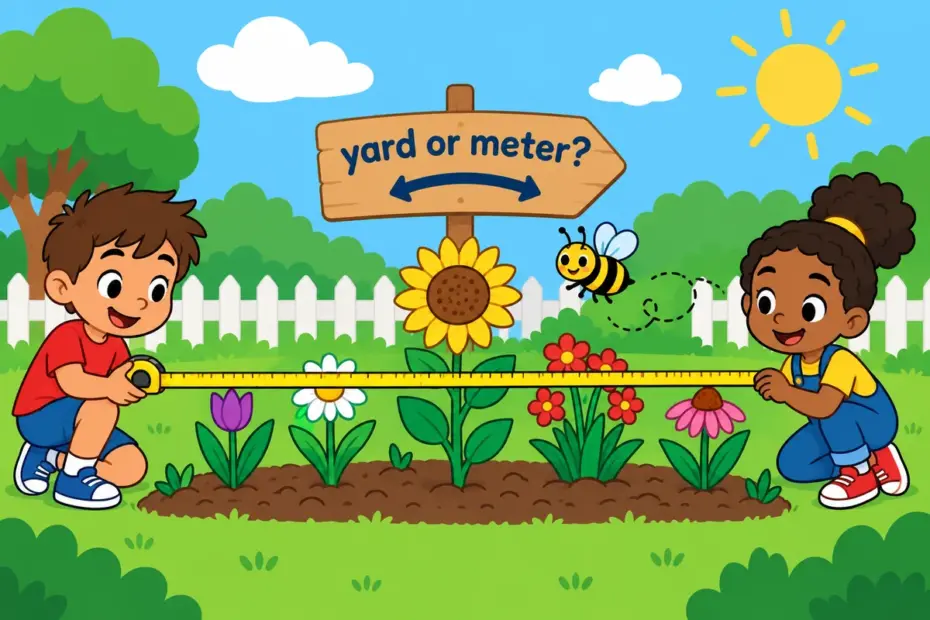
In the yard vs meter choice, use meter for science, most countries and everyday metric measures, and yard for US customary and imperial contexts such as cloth, sports fields and short distances. A yard is three feet, while a meter is the metric base unit. Compare ten yards of cloth with one hundred meters of track.
Yard vs meter at a glance
- A yard is an imperial and US customary unit equal to three feet, or 0.9144 of a meter.
- A meter is the base unit of length in the metric system, equal to 100 centimetres.
- The United States still uses the yard in everyday life; most other countries measure in meters.
- One meter is about 1.094 yards, so a meter is slightly the longer of the two.
- The commonest error is mixing the two units inside one calculation without converting.
What do yard and meter mean?
A yard is a unit of length in the imperial and US customary systems, defined as three feet or thirty-six inches. A meter is the base unit of length in the metric system and equals one hundred centimetres. The Cambridge entry for yard and the entry for meter both record the measurement senses, and the dedicated yard page collects further examples.
| Unit | Plain meaning | Example sentence |
|---|---|---|
| yard | Imperial unit of three feet | The fence stood one hundred yards from the road. |
| yard | A grassy enclosure beside a building | The children played in the back yard. |
| meter | Metric base unit of length | The pool is fifty meters long. |
| meter | A measuring instrument | The parking meter had run out. |
One limitation matters: yard is overloaded. It names both a unit and an enclosed outdoor area, so a sentence such as the yard is long is ambiguous without context. The comparison on this page concerns the unit, which is the sense that overlaps with meter.
Yard vs meter compared
The table below lines up the two units against the criteria that decide which to reach for in a sentence.
| Criterion | yard | meter |
|---|---|---|
| System | Imperial and US customary | Metric and SI |
| Length in feet | 3 feet | About 3.28 feet |
| Length in centimetres | 91.44 centimetres | 100 centimetres |
| Main users | United States, some UK trades | Almost every other country |
| Typical uses | Cloth, golf, American football, gardens | Science, athletics, road signs, medicine |
| Register | Everyday imperial usage | Technical and international |
| Plural form | yards | meters, or metres in British English |
The decisive criterion is the measurement system in use. Once a document has committed to metric, every length should be in meters; switching to yards mid-page is the error that makes a specification look careless.
How do you use yard and meter in a sentence?
Both units follow a number and precede the noun being measured, and both take a hyphen when they modify a noun directly. The orthography of the metric unit changes with the variety of English.
| Pattern | Example | What it signals |
|---|---|---|
| number + yards | She bought three yards of ribbon. | Imperial quantity, common in fabric shops. |
| number + meters | The flagpole stands twelve meters tall. | Metric quantity, standard internationally. |
| hyphenated modifier | A fifty-meter pool is standard for the Olympics. | The unit modifies the noun and takes a hyphen. |
| conversion sentence | One meter equals about 1.094 yards. | States the ratio between the two systems. |
| British spelling | The track is four hundred metres long. | British English writes the unit as metre. |
Use the abbreviation only after a number and never in running prose: 100 m is fine in a data table, but a news story writes one hundred metres. Writers who must move between systems often keep a conversion line beside the figures.
Yard and meter in a sentence: examples across contexts
The two units rarely share a sentence, so the examples below show each one doing its natural work, beside the smaller foot and inch and the larger kilometer.
| Context | Example sentence | Why this works |
|---|---|---|
| Fabric shop | The tailor asked for two yards of blue linen. | Cloth is still sold by the yard in the United States. |
| Athletics | The runner completed the four hundred meters in record time. | Track events are measured in meters worldwide. |
| Science report | The sample was lowered to a depth of thirty meters. | Metric is the default in scientific writing. |
| American football | The team needed ten yards for a first down. | The sport counts distance in yards by rule. |
| Golf | The flag was one hundred and fifty yards away. | Golf distances are given in yards in the United States. |
| Home improvement | The garden path is about six meters long. | Metric countries measure building work in meters. |
| Medical note | The wound was three centimetres wide. | The metric unit sits inside a familiar clinical unit. |
| Road sign | The next junction is five hundred meters ahead. | International road signs use meters and kilometres. |
| School maths | Convert twelve yards to meters before you add them. | Names the conversion the comparison demands. |
| Conversation | That fence must be twenty yards if it is a foot. | Casual imperial guessing suits a spoken register. |
Notice that only the school sentence contains both units, and it does so to convert one into the other. Putting the two side by side in any other sentence usually signals a mistake in unit discipline.
Which should you use?
Choose the unit that matches the reader and the setting, then stay with it for the whole document.
| Situation | Use | Why |
|---|---|---|
| Scientific or medical writing | meter | Metric units are the international standard for research. |
| Most countries outside the United States | meter | Everyday lengths and road signs are metric. |
| Fabric, golf or American football | yard | These activities are conventionally measured in yards. |
| US home and garden projects | yard | Imperial tape measures are the domestic default. |
| A page that must serve both systems | meter, with yards in brackets | Lead with the metric figure and convert once, clearly. |
When a page truly needs both, name the conversion once rather than repeating it, and keep the measure and its unit together. Mixing the two systems inside one sentence is the fastest way to look unreliable.
Word forms and grammar of yard and meter
The two units inflect and spell differently, and the metric unit has a British variant. The table also records the ambiguous second sense of yard.
| Form | Part of speech | Example |
|---|---|---|
| yard | noun, unit | A yard is three feet. |
| yards | noun, plural | Twenty yards is a short throw. |
| yard | noun, enclosure | The yard needs mowing. |
| meter | noun, US spelling | The room is four meters wide. |
| metre | noun, British spelling | The room is four metres wide. |
| meters | noun, plural | Two hundred meters of cable arrived. |
In British English metre is the unit and meter is the instrument, so a metre is a length while a meter measures something. American English uses meter for both.
Common mistakes with yard and meter
- Incorrect:
The room is five yards and two meters wide.Correct: The room is five yards wide, or about 4.6 meters. Rule: Pick one system per measurement and convert rather than adding. - Incorrect:
A meter is shorter than a yard.Correct: A meter is longer than a yard. Rule: One meter is about 1.094 yards, so a meter is slightly longer. - Incorrect:
The track is four hundred meters long in London.Correct: The track is four hundred metres long in London. Rule: British English spells the unit metre. - Incorrect:
He ran the 100m dash in prose.Correct: He ran the one hundred metre dash. Rule: Abbreviations belong in tables, not running text. - Incorrect:
We measured the meter of cloth.Correct: We measured the yard of cloth. Rule: Cloth is sold by the yard, and meter names the instrument.
Practice using yard and meter
Convert, choose and correct, then read the reason for each answer.
- Fill the gap: The swimming pool is twenty-five ______ long.
- Choose the better word: For a physics paper, record the length in (yards / meters).
- Correct the error: The fabric is three yards, which is about 3.3 meters too long.
- Build a sentence: use one meter equals about 1.094 yards to state the ratio.
- Spot the register: which belongs on a British road sign — 200 metres, or 200 yards?
- Rewrite in metric: The garden is ten yards wide.
Answers
- meters — pools are measured in meters almost everywhere.
- meters — scientific writing uses metric units.
- The fabric is three yards, which is about 2.74 meters — the conversion of three yards is not 3.3 meters.
- Model answer: One meter equals about 1.094 yards, which is why a meter is slightly longer.
- 200 metres — British road signs use the metric unit, spelled metre.
- The garden is about nine meters wide — ten yards converts to roughly nine meters.
The bottom line
Use yard vs meter to match the measurement system, not the length itself: a yard is three feet and suits US customary contexts such as cloth, golf and football, while a meter is the metric base unit and suits science, athletics and most countries. Two details settle most writing: a meter is slightly longer than a yard, at about 1.094 yards, and metre is the British spelling of the unit. Keep every measurement in one system, and consult a conversion line when both are needed.
Frequently asked questions about yard and meter
Is a yard longer than a meter?
No. A yard is shorter, because one yard equals 0.9144 of a meter and one meter equals about 1.094 yards. The gap is small enough to be invisible in casual talk but large enough to matter in engineering, so a measurement written in the wrong unit can change a result by almost ten percent.
How do you convert yards to meters?
Multiply the number of yards by 0.9144 to get meters, or divide meters by 0.9144 to get yards. A quick estimate is to take nine tenths of the yard figure. For example, ten yards is about 9.14 meters, which is why a fifty-yard pool is under fifty meters.
Why does the United States still use yards?
The United States retains customary units such as the yard for everyday life, trade and sport even though science and industry use metric measures. This dual system means American readers meet yards at the fabric shop and meters in a laboratory report, and writers should match the unit to the setting.
Is it meter or metre?
Meter is the American spelling and also the British word for a measuring instrument, while metre is the British spelling of the unit of length. So a British text writes a fifty-metre pool but a parking meter. Choose the spelling that matches the variety of English the page targets.