Ecumenical describes efforts to unite different Christian churches, or more broadly anything that is inclusive and worldwide in scope. To use ecumenical in a sentence, place it before the noun it describes: “The two congregations began an ecumenical food drive.” It is an adjective, so it never takes a plural or an object.
Ecumenical at a glance
- Ecumenical is an adjective; the related nouns are ecumenism and ecumenicism.
- Its first sense concerns unity between different Christian churches.
- Its second, broader sense means inclusive or worldwide in outlook.
- The usual nouns are council, service, dialogue, movement and spirit.
- The commonest error is using it for non-religious inclusion where inclusive or universal is plainer.
What does ecumenical mean?
Ecumenical is an adjective meaning concerned with unity between different Christian churches, or, more broadly, inclusive and worldwide in scope. The Cambridge entry for ecumenical records both uses, and the table below keeps them apart: one names a church movement, the other a general breadth of outlook.
| Sense | Plain meaning | Example sentence |
|---|---|---|
| Church unity | Bringing different churches together | The council issued an ecumenical statement on peace. |
| Church unity | A shared service across denominations | An ecumenical service filled the town hall. |
| Broad inclusion | Wide, universal in outlook | Her ecumenical tastes ranged across many traditions. |
| Broad inclusion | Reaching beyond one narrow group | The festival took an ecumenical approach to music. |
The word traces to a Greek term for the inhabited world, which is why the broad sense means worldwide rather than merely friendly. One honest limitation: outside religious writing, ecumenical can sound inflated, so inclusive or broad is often the plainer choice for a general audience, and global is the everyday word when the reach is simply the whole world.
How do you use ecumenical in a sentence?
Ecumenical is an attributive adjective, so it sits before the noun it describes, and it can follow a linking verb in the predicate. It never takes a preposition, because the breadth is built into the word.
| Pattern | Example | What it signals |
|---|---|---|
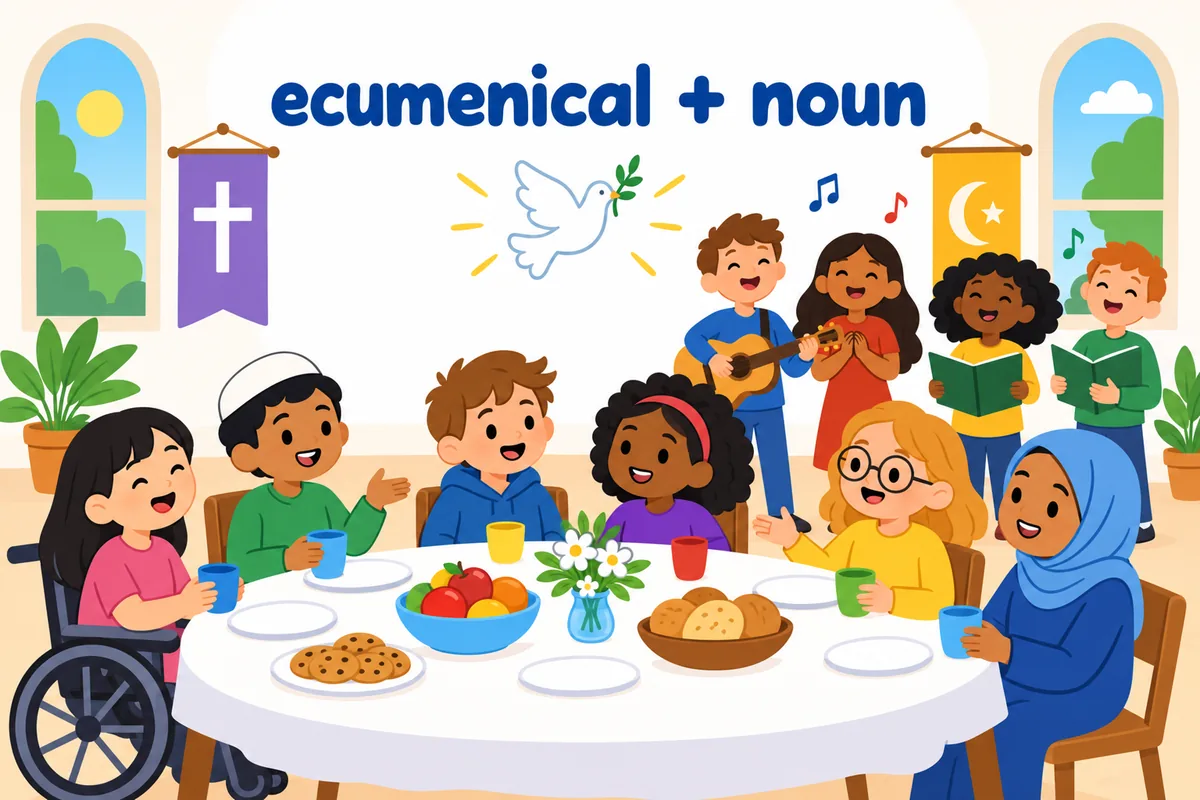
| ecumenical + noun | The bishops called for an ecumenical council. | The judgement attaches to a church body or event. |
| noun + is + ecumenical | The charity’s work is genuinely ecumenical. | A predicate use, common in profiles. |
| more / most + ecumenical | This year’s service was the most ecumenical yet. | Degree, because the adjective is gradable. |
| ecumenical + movement noun | The ecumenical movement grew after the war. | The default collocation for church unity. |
| ecumenical + spirit | They met in an ecumenical spirit. | A broader, warmer use of the same adjective. |
The collocation decides the sense: an ecumenical council or service is about churches, while an ecumenical spirit or taste is about breadth of outlook. Feed the adjective a sports or shopping noun and it will sound forced.
Ecumenical in a sentence: examples across contexts
Ecumenical changes little in meaning but moves between a church notice and a general essay. The ten sentences below keep one adjective while shifting the register, beside its opposite parochial and the plainer broad.
| Context | Example sentence | Why this works |
|---|---|---|
| Church notice | All are welcome at the ecumenical service on Sunday. | The church-unity sense fits a shared act of worship. |
| Religious news | Leaders signed an ecumenical agreement on aid. | Names a formal document between traditions. |
| Theology essay | The ecumenical movement reshaped twentieth-century worship. | The settled collocation for the broad church cause. |
| Charity report | The shelter runs an ecumenical kitchen open to all faiths. | Shows cooperation across congregations. |
| School assembly | The choir learned an ecumenical hymn for the concert. | A shared song suits a gathering of many traditions. |
| General essay | His ecumenical reading list crossed many disciplines. | The broad sense, applied to culture rather than church. |
| Museum label | The exhibition takes an ecumenical view of world art. | Broad inclusion in a curatorial voice. |
| Town council | An ecumenical group cleaned the war memorial. | Names people drawn from several congregations. |
| Personal letter | Her approach to neighbours was warmly ecumenical. | A predicate use softens the formal adjective. |
| Academic prose | Historians debate how ecumenical the early councils truly were. | The church sense, kept precise by the context. |
The broad sense is always carried by an abstract noun such as reading, taste or view. Give ecumenical a concrete object without a religious frame and the sentence tilts back toward the church meaning.
Register also rises with the word. A church notice uses ecumenical comfortably, a charity leaflet can use it to signal cooperation, and a museum label stretches it to art. A casual text message, though, would say that everyone is welcome or that the whole neighbourhood joined in, because ecumenical would sound out of place beside a smiley face.
Ecumenical vs universal
Ecumenical and universal both suggest reach, but ecumenical keeps a religious centre while universal is a claim about everyone or everything. The table separates them.
| Attribute | ecumenical | universal |
|---|---|---|
| Home | Church unity, then general breadth | Logic, science and general description |
| Typical nouns | council, service, movement, spirit | truth, rule, right, language |
| Claim | Reaches across separate groups | Applies to all cases |
| Religious tone | Strong in the first sense | None |
| Register | Formal, often religious | Formal and technical |
Verdict: choose ecumenical when the reach is across churches or traditions, and universal when the claim is that something holds for everyone without exception.
Word forms and grammar of ecumenical
Ecumenical builds a small family, and the nouns matter because writers often reach for the wrong one. The table gives the derivations and one confusable that is unrelated in meaning.
| Form | Part of speech | Example |
|---|---|---|
| ecumenical | adjective | The ecumenical council met in autumn. |
| ecumenically | adverb | The parishes worked ecumenically on the shelter. |
| ecumenism | noun | Ecumenism grew slowly in the last century. |
| ecumenicist | noun, a person | An ecumenicist led the dialogue. |
| ecumenicity | noun, rare | Rare; use the breadth of the movement instead. |
| economical | adjective, unrelated | An economical car saves fuel, not souls. |
The near-twin economical belongs to money and efficiency, and confusing the two is a common slip, because the two words differ by a single syllable.
Common mistakes with ecumenical
- Incorrect:
The new supermarket was very ecumenical.Correct: The new supermarket was very well stocked. Rule: Ecumenical needs churches or a breadth of outlook, not ordinary convenience. - Incorrect:
The council was ecumenical for peace.Correct: The council issued an ecumenical statement on peace. Rule: The adjective modifies a noun; it does not take for. - Incorrect:
The ecumenical of the group impressed us.Correct: The ecumenism of the group impressed us. Rule: The noun is ecumenism, not a clipped adjective. - Incorrect:
He bought an ecumenical car.Correct: He bought an economical car. Rule: Ecumenical concerns unity; economical concerns thrift. - Incorrect:
The plan was ecumenical, covering only our street.Correct: The plan was parochial, covering only our street. Rule: Ecumenical means broad; a narrow local scope is parochial. - Incorrect:
The team’s ecumenical plan covered the whole sports league.Correct: The team’s ambitious plan covered the whole sports league. Rule: Outside religion, ecumenical keeps a church flavour, so ambitious or wide is clearer.
Ecumenical, interdenominational and nondenominational
Three church words overlap, and readers often mix them. Ecumenical stresses unity between separate churches, interdenominational describes something shared by several denominations, and nondenominational describes a body that belongs to none of them.
| Word | Focus | Example |
|---|---|---|
| ecumenical | Unity between separate churches | An ecumenical council gathered the bishops. |
| interdenominational | Shared across denominations | An interdenominational choir sang at the service. |
| nondenominational | Belonging to no denomination | A nondenominational charity ran the shelter. |
| parochial | Confined to one local church or group | A parochial school serves one parish. |
The difference is direction: ecumenical moves toward unity, interdenominational describes cooperation already happening, nondenominational avoids the question of belonging altogether, and parochial narrows the scope to one place. A single sentence rarely needs two of them, so the writer should reach for the word whose direction matches the fact.
Practice using ecumenical
Choose, correct and build, then read why each answer fits the sense.
- Fill the gap: The town held an ______ service for the flood victims.
- Choose the better word: For a general audience, use (ecumenical / inclusive) for a broad reading list.
- Correct the error: The club took an ecumenical view of its own basement only.
- Build a sentence: use ecumenical council about church leaders meeting.
- Spot the register: which belongs in a church notice — an ecumenical service, or a multi-team event?
- Rewrite with a plainer word: Her ecumenical tastes embraced many cuisines. Use broad.
- Identify the sense: does the ecumenical movement belong to the church sense or the broad sense?
Answers
- ecumenical — the church-unity sense fits a shared act of worship.
- inclusive — outside religious writing the plain word is clearer.
- The club took a parochial view of its own basement — a narrow local scope is parochial, not ecumenical.
- Model answer: The ecumenical council brought bishops from several traditions together.
- An ecumenical service — the church notice uses the religious collocation.
- Her broad tastes embraced many cuisines — broad drops the church overtone the sentence does not need.
- The church sense — movement here means churches working together, not a general breadth of outlook, which the fixed phrase ecumenical movement marks.
The bottom line
Use ecumenical in a sentence when different Christian churches unite, or, more loosely, when something is inclusive and worldwide in outlook. Two nuances decide most uses: the church sense lives in collocations such as ecumenical council and ecumenical service, while the broad sense needs an abstract noun such as tastes or spirit. Outside religious writing, inclusive is usually the plainer and safer adjective.
Frequently asked questions about ecumenical
Is ecumenical only a religious word?
Its first sense is religious, referring to unity between different Christian churches, and that is the meaning most readers know. A second, broader sense means inclusive or worldwide in outlook, and it appears in cultural writing. Outside religion, though, a plainer word such as inclusive usually serves the sentence better.
What is the noun form of ecumenical?
The usual noun is ecumenism, meaning the movement or principle of church unity. Ecumenicism is a less common variant, and ecumenicity is rare enough to avoid. So a sentence can praise an ecumenical council or discuss ecumenism as a movement, but the clipped form the ecumenical is a mistake.
What is the opposite of ecumenical?
The opposite is parochial, which means narrowly local or confined to one group or church. Where ecumenical reaches across traditions, parochial stays inside one. Narrow and insular are close synonyms for the contrast, while a broader opposite rarely appears because ecumenical is itself the word for breadth.
How do you pronounce ecumenical?
Ecumenical is usually pronounced with the stress on the third syllable, as in ek-yoo-MEN-i-kul. Some speakers place the stress on the first syllable instead, and both are heard, so neither should count as an error. The related noun ecumenism keeps the same long vowel in the middle.