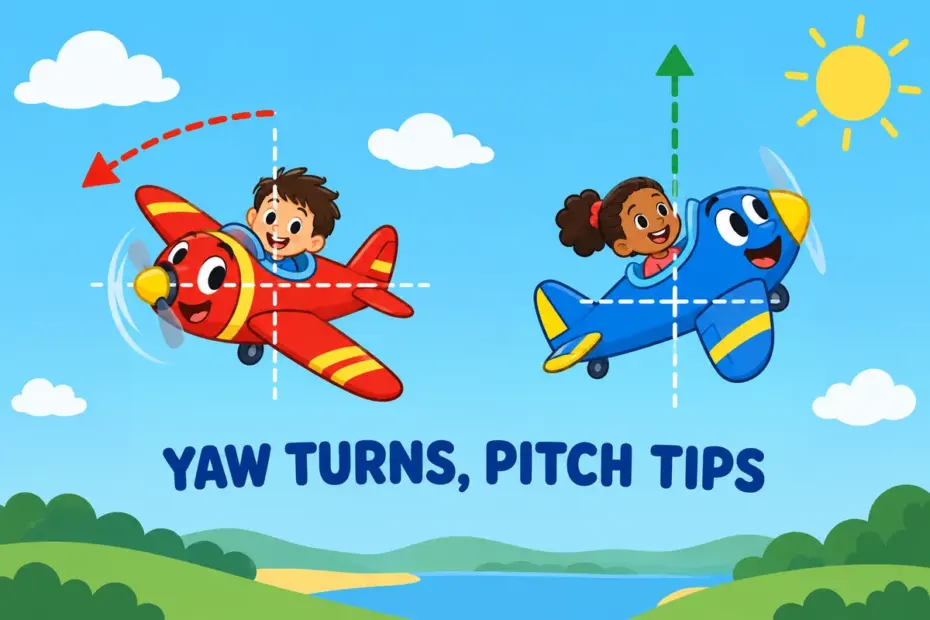
Yaw vs pitch describes two rotations: yaw swings an object left or right about the vertical axis, while pitch tips its nose up or down about the side-to-side axis. To use them correctly in a sentence, name the axis first: a drone that spins on the spot is yawing, while one that climbs is pitching.
Yaw and pitch at a glance
- Yaw is rotation about the vertical axis, so the nose swings left or right like a shake of the head.
- Pitch is rotation about the side-to-side axis, so the nose points up or down like a nod.
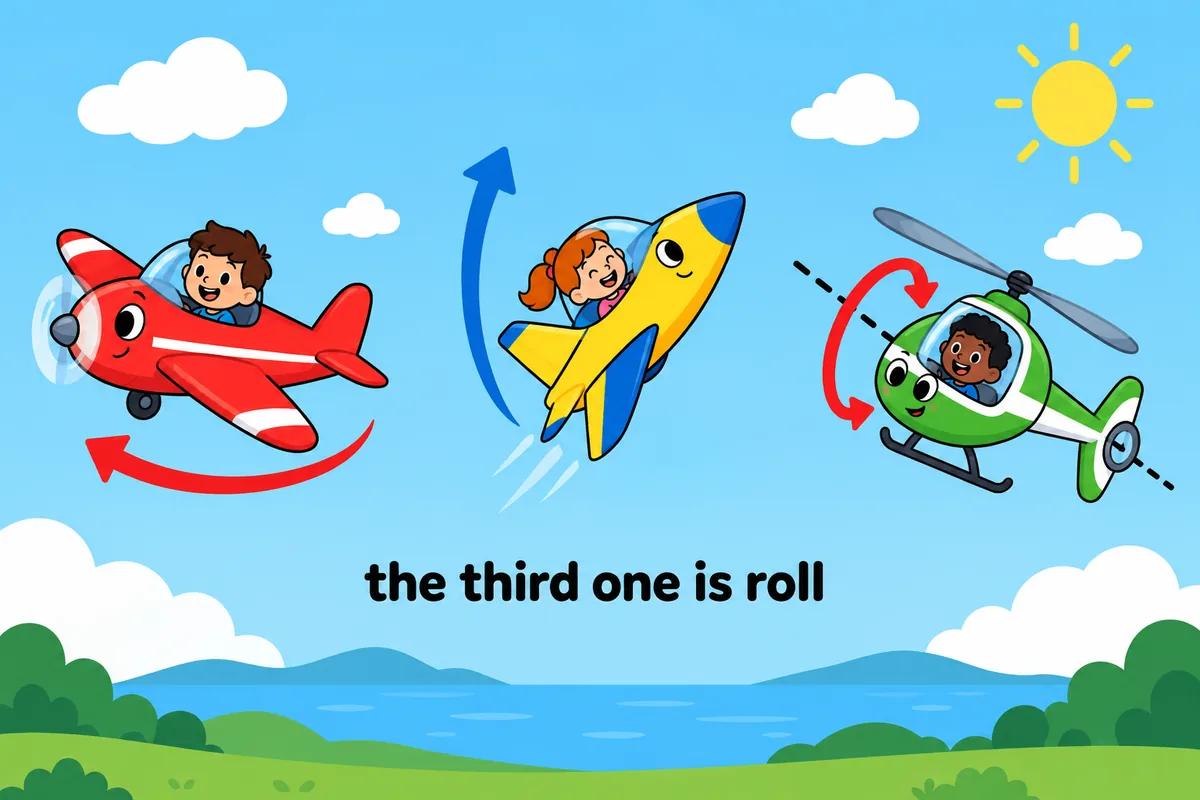
- Roll, the third rotation, turns an object about its front-to-back axis and should not be confused with either.
- The everyday equivalents are turning for yaw and tilting for pitch.
- The commonest error is using pitch for a left-right turn, which is always yaw.
What do yaw and pitch mean?
Yaw is the rotation of an object about its vertical axis, and pitch is its rotation about the side-to-side axis. In plain terms, yaw is turning left or right and pitch is tipping up or down. The Cambridge entry for yaw treats the word as a motion of a ship or aircraft, and the Cambridge entry for pitch lists the same technical sense among many others. Both words describe a change of orientation in space, which is why engineers measure them together.
| Term | Axis of rotation | Everyday motion | Example sentence |
|---|---|---|---|
| yaw | Vertical axis | Shaking the head no | The aircraft yawed to the left as the rudder moved. |
| pitch | Side-to-side axis | Nodding the head yes | The glider pitched upward in the rising air. |
| roll | Front-to-back axis | Tilting the head to one shoulder | The boat rolled in the swell. |
One limitation is worth stating. Outside flying, sailing, robotics and game design, both words are jargon. In ordinary speech most people say turn left and tilt up, and the technical terms would sound out of place in a recipe or a text message. Pitch is especially overloaded: the same spelling covers a throw, a musical note, a sports field and a tar-like substance, so only context makes the aviation sense clear. In other settings pitch means to throw, as in pitch the ball, which is one more reason to anchor the technical sense early.
Yaw vs pitch: the master comparison
Yaw and pitch answer different questions, so choosing between them is never a matter of taste. The table weighs the criteria that decide the word in a real sentence.
| Criterion | yaw | pitch |
|---|---|---|
| Axis of rotation | Vertical axis | Side-to-side axis |
| Plain-English motion | Turning left or right | Tipping up or down |
| What the nose does | Swings toward one side | Points above or below level |
| Head gesture that models it | Shaking no | Nodding yes |
| Control surface on an aircraft | The rudder | The elevators |
| Effect on the view | The horizon slides sideways | The horizon rises or falls |
| Setting word that fits | Heading or direction | Angle or climb |
| Example sentence | The drone yawed to face the gate. | The drone pitched down to land. |
Two consequences follow from the axes. A change of heading is always yaw, even when the object is a car or a satellite rather than a plane, and a change of climb or dive is always pitch. The words are also fixed in the plural of nothing: each names a single rotation, so yaws and pitches as nouns appear only when a writer counts several of them.
Which should you use?
The choice comes down to the motion you can see, and the five situations below each point to one word without hesitation.
| Situation | Use | Why |
|---|---|---|
| A drone spins on the spot | yaw | The rotation is about the vertical axis, so the heading changes. |
| An aircraft climbs | pitch | The nose rises about the side-to-side axis. |
| A car slides sideways in a bend | yaw | The body turns about its vertical axis, which is what a spin is. |
| A camera pans across a room | yaw | Panning changes the horizontal direction the lens faces. |
| A camera points at the ceiling | pitch | The lens tips upward about the horizontal side-to-side axis. |
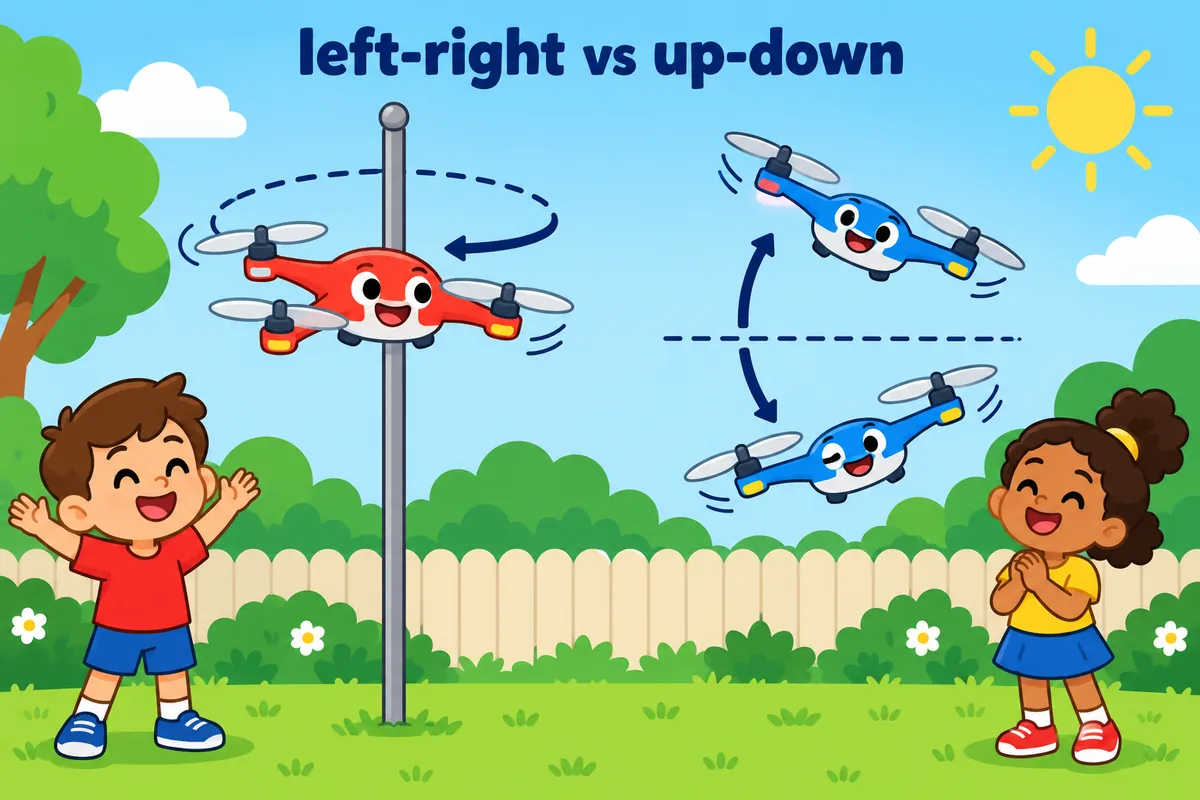
If you can remember only one rule, remember this: left or right is yaw, and up or down is pitch. Applying it, a boat that turns left or right is yawing, while a kite that tilts its nose up is pitching, and the two can happen in the same second without either word becoming wrong.
Yaw and pitch in a sentence: examples across contexts
Yaw and pitch keep their technical meaning and change only their setting. The ten sentences below move from an airfield to a classroom display, and each one names the axis that moves.
| Context | Example sentence | Why this works |
|---|---|---|
| Aviation | The pilot yawed the aircraft onto the runway heading. | Names the left-right rotation before lining up. |
| Drone flying | The drone pitched forward to pick up speed. | The up-down rotation controls climb and dive. |
| Sailing | The yacht yawed in the gust before the helmsman corrected. | Turning about the vertical axis at sea. |
| Robotics | The robot arm yawed to reach the far shelf. | Describes a horizontal sweep around a joint. |
| Video games | Players adjust yaw with the left stick and pitch with the right. | The classic two-axis control split. |
| Film making | A pan is yaw and a tilt is pitch, though crews rarely use the engineering words. | Everyday craft keeps plainer names for the same motions. |
| Automotive testing | Engineers log the yaw rate to judge how a car corners. | Yaw rate is a standard stability reading. |
| Spacecraft | The capsule pitched to point its heat shield forward. | Orientation about the side-to-side axis. |
| Weather | The kite pitched and yawed in the shifting breeze. | Pairs both words in one natural sentence. |
| Academic writing | The model treats yaw and pitch separately to simplify the maths. | Keeps the two axes distinct and easy to analyse. |
The third rotation, roll, is left out on purpose, because mixing three terms too early confuses readers. When the object rolls to one side about its front-to-back axis, that is neither yaw nor pitch, and the distinction is worth one clear sentence rather than a whole paragraph.
How do you use yaw and pitch in a sentence?
Both words behave the same way in grammar, which makes the pair easy to learn once the meaning is settled. They are regular verbs and countable nouns, and the verb patterns below cover most real writing.
| Pattern | Example | What it signals |
|---|---|---|
| subject + yaw + adverb | The ship yawed sharply. | Turning about the vertical axis. |
| subject + pitch + adverb | The boat pitched violently. | Tipping about the side-to-side axis. |
| yaw or pitch + object | The pilot pitched the nose down. | A controlled rotation, common in flight writing. |
| yaw + to + direction | The drone yawed to face the gate. | Turning to a new heading. |
| pitch + up, down or forward | The glider pitched up. | The direction of the tip. |
| yaw rate, pitch angle | A sensor records the yaw rate. | Noun phrases common in engineering. |
The shared frame is a change of rotation about an axis, so the axis word does the teaching. Yaw always names motion about the vertical axis, while pitch turns about a horizontal one. When the audience is general, the plainer verbs turn and tilt often carry the meaning with no loss.
Word forms and grammar of yaw and pitch
Yaw inflects like a simple regular verb, and pitch does the same, though pitch carries many extra senses as a noun. The table keeps the technical forms together.
| Form | Part of speech | Meaning and example |
|---|---|---|
| yaw | verb, base form | The plane yawed to the left. |
| yaw | noun | The rudder controls yaw. |
| yaws, yawing, yawed | verb inflections | The craft is yawing slowly. |
| pitch | verb, base form | The plane pitched up. |
| pitch | noun | A steep pitch alarms passengers. |
| pitches, pitching, pitched | verb inflections | The helicopter pitched forward. |
| yaw rate | noun phrase | Engineers record the yaw rate on every lap. |
| pitch angle | noun phrase | A steep pitch angle reduces lift. |
The noun pitch is a false friend in other contexts: it also means a throw, a sales talk, a musical note and a playing field, so an engineering text should fix the sense early. Yaw has no such rivals, which is why it causes fewer reading problems. The related noun the angle changes is a reminder that pitch is measured, while yaw is described by heading.
Common mistakes with yaw and pitch
- Incorrect:
The plane pitched to the left.Correct: The plane yawed to the left. Rule: Left and right motion is yaw; pitch is up and down. - Incorrect:
The drone yawed upward.Correct: The drone pitched upward. Rule: Upward motion is pitch, whatever the craft. - Incorrect:
The ship rolled left and right about its vertical axis.Correct: The ship yawed about its vertical axis. Rule: Roll belongs to the front-to-back axis, not the vertical one. - Incorrect:
The missile changed its pitch to fly east.Correct: The missile changed its yaw to fly east. Rule: A change of heading is horizontal, so it is yaw. - Incorrect:
Point the camera yaw up at the ceiling.Correct: Pitch the camera up at the ceiling. Rule: A tilt toward the ceiling is pitch, the up-down rotation.
Practice using yaw and pitch
Seven short tasks follow; the answers give the reason, not only the key.
- Fill the gap: The helicopter ______ slowly to the right before hovering.
- Choose the better word: Climbers feel the plane (yaw / pitch) as it lifts off.
- Correct the error: The boat yawed up and down on the waves.
- Build a sentence: use yaw about a drone turning to follow a path.
- Spot the term: a camera swings across a room, then points at the ceiling. Which motion is which?
- Rewrite in plain English: replace yawed in The glider yawed to the left of the ridge.
- Add the third term: say what roll adds beyond yaw and pitch.
Answers
- yawed — a slow turn to the right is rotation about the vertical axis.
- pitch — the nose lifts about the side-to-side axis during take-off.
- The boat pitched up and down on the waves — up-and-down motion is pitch, not yaw.
- Model answer: The drone yawed to follow the winding path.
- Across the room is yaw; toward the ceiling is pitch.
- Model answer: The glider turned to the left of the ridge.
- Roll adds rotation about the front-to-back axis, tilting the object side to side.
The bottom line
Yaw vs pitch comes down to the axis: yaw turns an object left or right about the vertical axis, and pitch tips it up or down about the side-to-side axis. The two details that decide most sentences are these: name the axis rather than the feeling of the motion, and keep the third rotation, roll, out of both. When the reader is a general one, the plain verbs turn and tilt often do the work.
Frequently asked questions about yaw and pitch
Is yaw the same as turning?
In everyday language, yes. Yaw is the technical name for a turn about the vertical axis, so a drone that faces a new direction has yawed. The word matters when a sentence must separate that turn from a climb, because turn alone cannot tell a reader whether the object also tipped upward.
What causes yaw in an aircraft?
On a plane the rudder, a moving panel on the tail, produces yaw by pushing the tail sideways so the nose swings the other way. Pilots use it to keep the nose aligned during a turn or a crosswind landing. Uneven thrust from two engines can also cause unwanted yaw.
What is roll, and how is it different?
Roll is rotation about the front-to-back axis, so the wings of a plane tilt one way and the other, like tipping the head toward a shoulder. Yaw turns left or right about the vertical axis, and pitch tips the nose up or down about the side-to-side axis. The three axes together describe an object fully.
Do video games use yaw and pitch the same way?
Yes, most games map yaw to the left-right look and pitch to the up-down look, which is exactly the engineering meaning. A separate button usually handles roll. Knowing the technical terms helps players understand control settings, camera rigs and simulator manuals without guesswork.