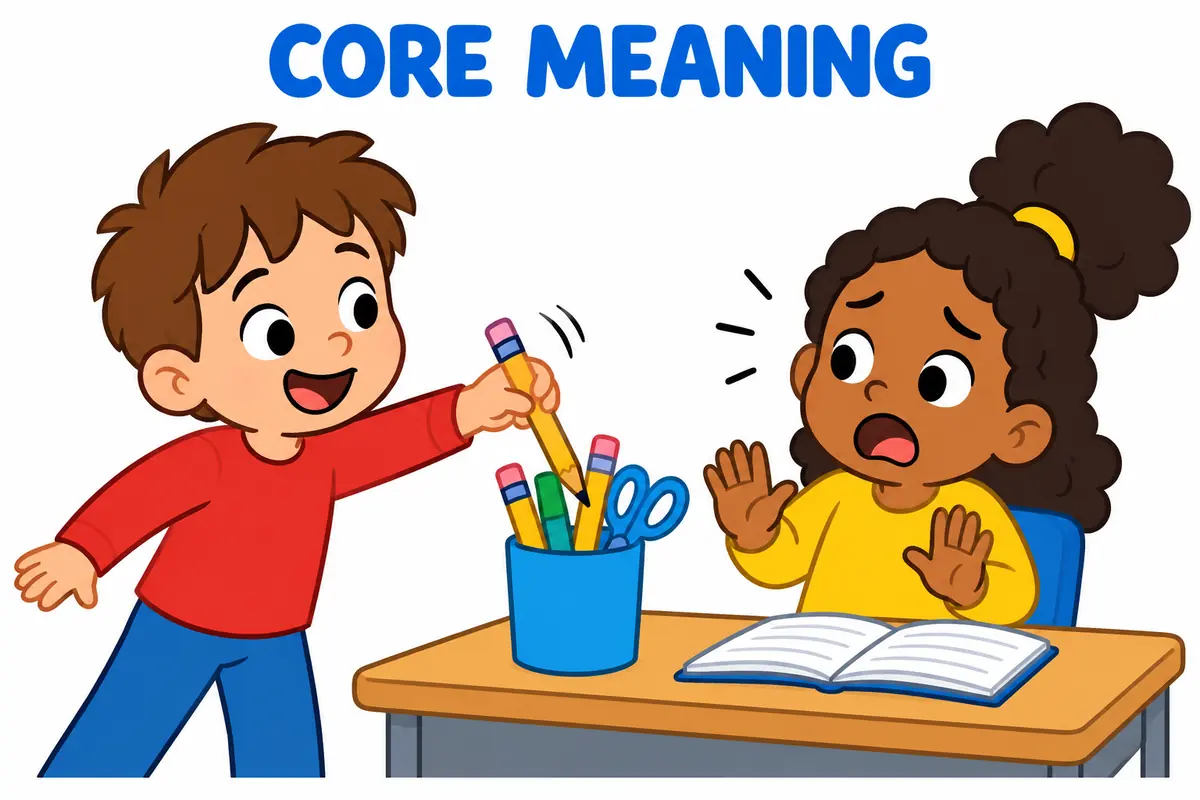
Lead on in a sentence means to encourage someone to believe or hope for something, often when that expectation is false or will not be fulfilled. It commonly takes a person as its object. “The seller led us on about the delivery date” signals misleading reassurance.
Lead On at a glance
- Lead On functions as verb and follows regular inflection patterns.
- A common pattern is lead + person + on / be led on by + promise.
- The phrase is clearest when its object or surrounding context is stated.
- A frequent learner error is treating lead on as interchangeable with mislead.
- Use a plainer alternative when the idiom’s register or extra implication is unwanted.
What does lead on mean?
Lead on is a phrasal verb meaning to encourage someone to believe something that is not true or to hope for something unlikely. The Cambridge Dictionary: lead on entry describes the core usage; the exact sense depends on the grammatical frame. For a simpler synonym, consider beguile. Lead On is not a universal substitute for that plainer word: choose it only when its specific implication is intended. You can also compare delude when selecting a more precise expression.
| Sense | Plain meaning | Example sentence |
|---|---|---|
| Primary | Lead on is a phrasal verb meaning to encourage someone to believe something that is not true or to hope for something unlikely. | The recruiter led the applicant on about the promised role. |
| Contextual | A related use shaped by its object or setting | Do not lead customers on with a delivery date you cannot meet. |
How do you use lead on in a sentence?
The useful pattern is lead + person + on / be led on by + promise. Keep the object close enough to make the intended meaning clear; a particle may move around a short object, but a pronoun normally sits between the verb and particle.
| Pattern | Example | What it signals |
|---|---|---|
| lead + person + on / be led on by + promise | The recruiter led the applicant on about the promised role. | The core meaning in a natural frame. |
| past form + object | Do not lead customers on with a delivery date you cannot meet. | A completed action or state. |
| pronoun + particle | They lead it on before lunch. | Typical placement of a short pronoun object. |
Compare the everyday alternative deceive: the phrasal verb is more idiomatic, while a single-word verb may sound more neutral in formal writing.

Lead On in a sentence: examples across contexts
The following examples keep the phrase in distinct settings so its grammar and tone are easy to compare.
| Context | Example sentence | Why this works |
|---|---|---|
| Classroom | The recruiter led the applicant on about the promised role. | A concrete task shows the core pattern. |
| Workplace | Do not lead customers on with a delivery date you cannot meet. | The object makes the intended sense explicit. |
| Conversation | I would lead on that before tomorrow. | The base form follows would. |
| News report | The report said the manager lead on after the dispute. | A past-tense form anchors the event. |
| Academic writing | The study discusses how people lead on in this setting. | The bare form follows how people. |
| Please lead on the relevant item before sending the reply. | An imperative gives a direct instruction. | |
| Travel | We watched the guide lead on before the group arrived. | The bare infinitive follows watched. |
| Family conversation | She has lead on every detail for the trip. | The participle follows has. |
Lead On vs mislead
These expressions overlap in some situations, but they do different work: lead on carries the particular sense above, while mislead states the simpler related action or idea. A useful distinction is whether you need the idiom’s extra shade of meaning.
| Attribute | lead on | mislead |
|---|---|---|
| Core meaning | Lead on is a phrasal verb meaning to encourage someone to believe something that is not true or to hope for something unlikely. | A related, more general meaning |
| Typical context | Informal or idiomatic phrasing | Broad neutral usage |
| Grammatical form | verb | Usually a verb |
| Implication | Specific nuance from the particle | Less idiomatic, direct meaning |
Verdict: choose lead on for its specific idiomatic implication and mislead when the plain meaning is enough.
Word forms and grammar of lead on
The verb inflects regularly. Keep the particle with the verb phrase, and use the conventional object position shown in the table.
| Form | Part of speech | Example |
|---|---|---|
| lead on | verb, base | I lead on the material today. |
| leads on | verb, third person | She leads on each topic. |
| leaded on | verb, past | They leaded on yesterday. |
| leading on | verb, participle | He is leading on now. |
| leading-on | related noun | The dictionary lists leading-on as a related form. |
Common mistakes with lead on
- Incorrect: I leaded yesterday. Correct: I leaded it yesterday. Rule: Include the object when the verb requires one.
- Incorrect: She lead it on. Correct: She leads it on. Rule: Add the third-person singular ending to the verb.
- Incorrect: They have leaded it. Correct: They have leaded it. Rule: The participle follows have; do not add a second past marker.
- Incorrect: The phrase always means mislead. Correct: Use lead on only when its idiomatic nuance fits. Rule: Similar meanings do not make two expressions interchangeable.
Lead on describes misleading encouragement. The person who leads someone on gives them reason to expect something, often while knowing that the expectation is false or will not be met. “The seller led us on about the delivery date” suggests more than a neutral mistake: it implies that reassurance kept the customers waiting. The phrase can describe deliberate deception, but the surrounding context determines how strongly blame is implied.
The common pattern is lead + person + on: “She led him on.” Because the object is a pronoun, it belongs between the verb and particle. A noun object can also appear there, as in “They led the visitors on,” or after the particle in some contexts, as in “They led on the visitors,” although the latter can sound less natural or create ambiguity with the directional meaning “continue leading.” In most learner writing, keeping the person between the words is clearest.
The passive phrase be led on focuses on the person who was misled: “Several applicants felt they had been led on.” It is not the same as lead someone to, which can describe causing a result without deception: “The evidence led the team to a new explanation.” The preposition or particle changes the relationship, so do not substitute on for to casually.
In relationships, lead someone on often means encouraging romantic hopes without intending to pursue a relationship. The expression can also concern a job offer, sale, invitation, or promise. It is less specific than lie to: a person can create a misleading impression through selective promises or repeated delays without stating one direct falsehood. For a careful report, describe the actual conduct instead of assuming intent from the idiom alone.
Use mislead when you want a neutral, broad verb, and lead on when you want to emphasize the false hope or expectation created for a person. Do not use it for ordinary persuasion when the offer is genuine. Someone who encourages a team to try a difficult plan has not necessarily led them on; the phrase carries an implication of deceptive or unfulfilled expectation that can unfairly accuse someone if the facts do not support it.
| Pattern | Meaning | Example |
|---|---|---|
| lead + person + on | Create a false expectation | The agency led the applicants on about the opening. |
| be led on by + promise | Describe the deceived person’s experience | We were led on by repeated assurances. |
| lead someone to + result | Cause a result, not necessarily deceive | The clue led her to the right address. |
| lead someone on romantically | Encourage romantic hope without commitment | He said he did not mean to lead her on. |
When the facts are disputed, report the observable behavior separately from the accusation. “The company led customers on” is a strong characterization; “the company repeatedly promised a date it did not meet” describes events without deciding why they happened. A careful writer can then explain why customers felt misled. This distinction matters in workplace, news, or legal contexts, where the idiom may imply intent that the evidence has not established.
The phrase is most natural when a person is the one whose expectations are shaped. It can be awkward if the object is an abstract idea: rather than “the delay led on hope,” write “the delay kept hopes alive” or name the people who were given hope. A person can also lead themselves on in a reflexive construction, but it is less common and usually means that they continued to believe what they wanted to believe.
Use tense to locate the promise and the result: “He leads her on” describes a current or habitual pattern; “he led her on” places it in the past; “she was led on” uses the passive to focus on her experience. In questions and negatives, the auxiliary carries tense, so write “Did they lead you on?” and “They did not lead us on,” not “did led.”
Practice using lead on
- Fill the blank: She ___ the list as each task was completed.
- Choose: The phrase meant “Lead on is a phrasal verb meaning to encourage someone to believe something that is not true or to hope for something unlikely.”: lead on or mislead?
- Correct the form: He lead the details yesterday.
- Write a sentence using the pattern lead + person + on / be led on by + promise.
- Choose the more neutral alternative for a formal report: lead on or mislead?
- Fill the blank: They have ___ the plan before the meeting.
Answers
- leaded; the sentence describes a completed action.
- lead on; it is the expression with the stated specific sense.
- He leaded it yesterday; a transitive use needs an object.
- Answers vary; the sentence should include the requested grammatical frame.
- mislead; a plain verb is usually more neutral in formal prose.
- leaded; have takes the past participle.

The bottom line
Lead on in a sentence is easiest to use when the sentence gives enough context to identify its intended meaning. Match the phrase to its normal grammatical pattern, and keep its tone in mind. Choose a simpler alternative when the idiomatic implication is unnecessary.
Frequently asked questions about lead on
Is lead on formal or informal?
Lead On is an idiomatic expression whose tone depends on context and region. It can sound natural in conversation, while a plainer alternative may suit a formal report better. Readers should check whether the phrase’s particular nuance is intended before choosing it in professional writing.
Can the object come between the words?
With many phrasal verbs, a short noun object can appear before or after the particle, while a pronoun normally comes between the verb and particle. For this expression, follow familiar examples and avoid placing a long object where it makes the sentence difficult to parse.
What is a simple synonym for lead on?
Mislead may work as a broad alternative in some sentences, but it does not reproduce every implication of lead on. Choose the synonym only after checking the full context. If the phrase expresses a more specific attitude or result, replacing it may change the meaning.
How can I remember the meaning?
Learn lead on as part of a short phrase with its usual object or complement, then write an original sentence in a familiar setting. Comparing that sentence with a plain alternative such as mislead helps reveal the extra nuance and makes the grammar easier to remember.