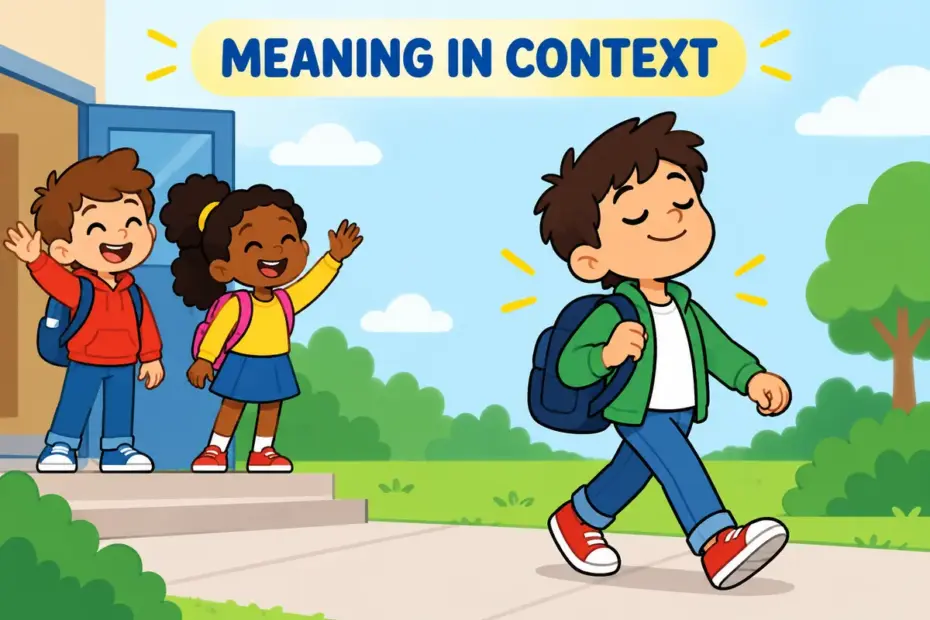
Swan off in a sentence means to leave a place in a relaxed, confident, or sometimes dismissive way. The phrase often carries a judgment about the person’s manner, so it sounds more vivid and informal than simply leave. “He swanned off without helping” implies careless self-assurance.
Swan Off at a glance
- Swan Off functions as verb and follows regular inflection patterns.
- A common pattern is swan off + place / swan off without + gerund.
- The phrase is clearest when its object or surrounding context is stated.
- A frequent learner error is treating swan off as interchangeable with leave.
- Use a plainer alternative when the idiom’s register or extra implication is unwanted.
What does swan off mean?
Swan off is an informal phrasal verb meaning to leave in a casual, self-assured, or dismissive manner. The Cambridge Dictionary: swan off entry describes the core usage; the exact sense depends on the grammatical frame. For a simpler synonym, consider abandon. Swan Off is not a universal substitute for that plainer word: choose it only when its specific implication is intended. You can also compare desert when selecting a more precise expression.
| Sense | Plain meaning | Example sentence |
|---|---|---|
| Primary | Swan off is an informal phrasal verb meaning to leave in a casual, self-assured, or dismissive manner. | She swanned off down the corridor after the meeting. |
| Contextual | A related use shaped by its object or setting | He swanned off without putting away the equipment. |
How do you use swan off in a sentence?
The useful pattern is swan off + place / swan off without + gerund. Keep the object close enough to make the intended meaning clear; a particle may move around a short object, but a pronoun normally sits between the verb and particle.
| Pattern | Example | What it signals |
|---|---|---|
| swan off + place / swan off without + gerund | She swanned off down the corridor after the meeting. | The core meaning in a natural frame. |
| past form + object | He swanned off without putting away the equipment. | A completed action or state. |
| pronoun + particle | They swan it off before lunch. | Typical placement of a short pronoun object. |
Compare the everyday alternative depart: the phrasal verb is more idiomatic, while a single-word verb may sound more neutral in formal writing.
Swan Off in a sentence: examples across contexts
The following examples keep the phrase in distinct settings so its grammar and tone are easy to compare.
| Context | Example sentence | Why this works |
|---|---|---|
| Classroom | She swanned off down the corridor after the meeting. | A concrete task shows the core pattern. |
| Workplace | He swanned off without putting away the equipment. | The object makes the intended sense explicit. |
| Conversation | I would swan off that before tomorrow. | The base form follows would. |
| News report | The report said the manager swan off after the dispute. | A past-tense form anchors the event. |
| Academic writing | The study discusses how people swan off in this setting. | The bare form follows how people. |
| Please swan off the relevant item before sending the reply. | An imperative gives a direct instruction. | |
| Travel | We watched the guide swan off before the group arrived. | The bare infinitive follows watched. |
| Family conversation | She has swan off every detail for the trip. | The participle follows has. |
Swan Off vs leave
These expressions overlap in some situations, but they do different work: swan off carries the particular sense above, while leave states the simpler related action or idea. A useful distinction is whether you need the idiom’s extra shade of meaning.
| Attribute | swan off | leave |
|---|---|---|
| Core meaning | Swan off is an informal phrasal verb meaning to leave in a casual, self-assured, or dismissive manner. | A related, more general meaning |
| Typical context | Informal or idiomatic phrasing | Broad neutral usage |
| Grammatical form | verb | Usually a verb |
| Implication | Specific nuance from the particle | Less idiomatic, direct meaning |
Verdict: choose swan off for its specific idiomatic implication and leave when the plain meaning is enough.
Word forms and grammar of swan off
The verb inflects regularly. Keep the particle with the verb phrase, and use the conventional object position shown in the table.
| Form | Part of speech | Example |
|---|---|---|
| swan off | verb, base | I swan off the material today. |
| swans off | verb, third person | She swans off each topic. |
| swaned off | verb, past | They swaned off yesterday. |
| swaning off | verb, participle | He is swaning off now. |
| swanning-off | related noun | The dictionary lists swanning-off as a related form. |
Common mistakes with swan off
- Incorrect: I swaned yesterday. Correct: I swaned it yesterday. Rule: Include the object when the verb requires one.
- Incorrect: She swan it off. Correct: She swans it off. Rule: Add the third-person singular ending to the verb.
- Incorrect: They have swaned it. Correct: They have swaned it. Rule: The participle follows have; do not add a second past marker.
- Incorrect: The phrase always means leave. Correct: Use swan off only when its idiomatic nuance fits. Rule: Similar meanings do not make two expressions interchangeable.
Swan off adds an attitude to leaving. It usually suggests that a person departs in a relaxed, self-assured, or showy way, and it may imply that the departure is dismissive. “She swanned off before the cleanup began” does more than report that she left; it hints that she left without helping. The phrase is vivid because the speaker is evaluating the manner of departure.
The expression is informal and often carries criticism or humor. It is not a neutral replacement for leave in every sentence. “The last train swanned off at six” sounds odd if the writer simply means the train departed; trains do not normally display the personal attitude that the idiom suggests. Use depart for a formal timetable, walk off for movement away, or leave abruptly when the manner matters but the idiom is too casual.
The verb is separable only in limited constructions; the usual frame is a person followed by swan off, often with a place phrase or a phrase beginning with without: “He swanned off without saying goodbye.” The past form is conventionally spelled swanned, with a doubled n; the present participle is swanning. Do not form the past as “swaned.”
A place phrase can show the direction of the departure: “The guests swanned off down the road.” The phrase can also highlight what the person failed to do: “They swanned off without clearing the table.” In both cases, the writer’s viewpoint matters. If the sentence is meant to be objective, say plainly that the guests left; if the dismissive or self-satisfied quality is part of the point, swan off can capture it efficiently.
Do not confuse swan off with swanning around. The former focuses on leaving; the latter usually describes moving about in an unhurried or self-important way. Both are figurative and informal, but the particles change the event. Similarly, walk off may simply describe how someone leaves, whereas swan off adds the speaker’s judgment about the person’s manner.
| Sentence detail | Effect | Example |
|---|---|---|
| Leaving without helping | Suggests a dismissive departure | He swanned off without stacking the chairs. |
| Direction after departure | Shows the path away | They swanned off down the lane. |
| Formal schedule | Use a neutral verb instead | The coach departed at noon. |
| Past spelling | Double the final consonant | She swanned off after the argument. |
Because the phrase contains a judgment, it can reveal the narrator’s attitude as much as the person’s movement. A character may “swan off” in one narrator’s account and simply “leave” in another’s. In a short story or review, that judgment can make a sentence lively; in minutes, incident reports, and neutral news writing, it may sound biased. Decide whether the reader should hear the speaker’s criticism before choosing the idiom.
The phrase does not necessarily mean that the person is happy. Someone may swan off after an argument, which can suggest indifference, self-importance, or a refusal to engage. Nor does it always mean that the person walks; the emphasis is the manner of leaving, while a separate phrase can supply the route or means. If the mode matters, say “drove away” or “walked out” directly.
Keep the spelling distinction visible during editing: the base verb is swan, but the past tense and participle double the final consonant before the ending: swanned off, swanning off. This follows the familiar consonant-doubling pattern in short stressed verbs. The form “swaned” suggests a different spelling pattern and is not the standard past form of this expression.
Practice using swan off
- Fill the blank: She ___ the list as each task was completed.
- Choose: The phrase meant “Swan off is an informal phrasal verb meaning to leave in a casual, self-assured, or dismissive manner.”: swan off or leave?
- Correct the form: He swan the details yesterday.
- Write a sentence using the pattern swan off + place / swan off without + gerund.
- Choose the more neutral alternative for a formal report: swan off or leave?
- Fill the blank: They have ___ the plan before the meeting.
Answers
- swaned; the sentence describes a completed action.
- swan off; it is the expression with the stated specific sense.
- He swaned it yesterday; a transitive use needs an object.
- Answers vary; the sentence should include the requested grammatical frame.
- leave; a plain verb is usually more neutral in formal prose.
- swaned; have takes the past participle.

The bottom line
Swan off in a sentence is easiest to use when the sentence gives enough context to identify its intended meaning. Match the phrase to its normal grammatical pattern, and keep its tone in mind. Choose a simpler alternative when the idiomatic implication is unnecessary.
Frequently asked questions about swan off
Is swan off formal or informal?
Swan Off is an idiomatic expression whose tone depends on context and region. It can sound natural in conversation, while a plainer alternative may suit a formal report better. Readers should check whether the phrase’s particular nuance is intended before choosing it in professional writing.
Can the object come between the words?
With many phrasal verbs, a short noun object can appear before or after the particle, while a pronoun normally comes between the verb and particle. For this expression, follow familiar examples and avoid placing a long object where it makes the sentence difficult to parse.
What is a simple synonym for swan off?
Leave may work as a broad alternative in some sentences, but it does not reproduce every implication of swan off. Choose the synonym only after checking the full context. If the phrase expresses a more specific attitude or result, replacing it may change the meaning.
How can I remember the meaning?
Learn swan off as part of a short phrase with its usual object or complement, then write an original sentence in a familiar setting. Comparing that sentence with a plain alternative such as leave helps reveal the extra nuance and makes the grammar easier to remember.