The phrase ring up in a sentence means telephone someone, or record the price of a purchase at a checkout. Its grammar depends on the intended sense: ring + person + up. For example, “I rang up my sister after the train arrived.” shows ring up in a natural, complete sentence with enough context to understand the expression.
Ring Up at a glance
- Part of speech: phrasal verb phrase with the base form ring up.
- Core meaning: Telephone someone, or record the price of a purchase at a checkout.
- Grammar: ring + person + up is a common construction.
- Useful contrast: call overlaps in meaning but does not fit every sentence.
- Common learner issue: selecting the right preposition or object for the intended sense.
What does ring up mean?
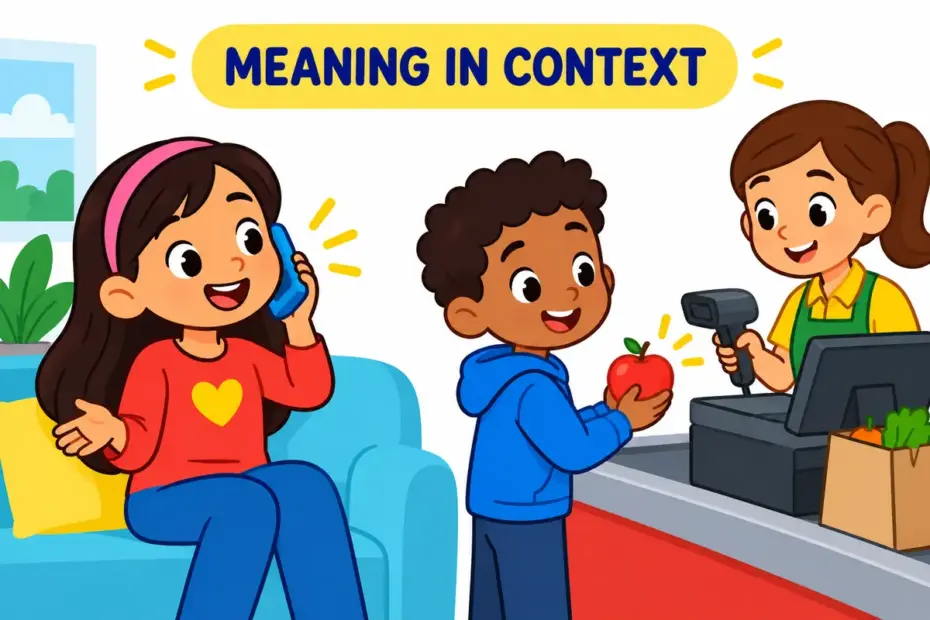
Ring Up is a phrasal verb meaning telephone someone, or record the price of a purchase at a checkout. Telephone use can refer to a completed call or the act of calling; it does not itself tell whether the conversation connected. In checkout use, “ring up” describes entering or totaling the sale, not necessarily accepting payment. Use “charge” when emphasizing the amount billed, and “pay” when emphasizing money changing hands.
| Sense | Plain meaning | Example |
|---|---|---|
| Telephone | Call someone by telephone. | I rang up my sister after the train arrived. |
| Checkout | Enter a purchase in a till or point-of-sale system. | The cashier rang up the groceries. |
The Cambridge Dictionary: ring up supports these core meanings and patterns. Nearby vocabulary includes bill, call, and charge; each can express a related idea, but none automatically substitutes for every sense of ring up.
How do you use ring up in a sentence?
Ring Up takes different complements according to its meaning. These patterns show the particle or preposition’s job and whether a direct object is required. Telephone use can refer to a completed call or the act of calling; it does not itself tell whether the conversation connected. In checkout use, “ring up” describes entering or totaling the sale, not necessarily accepting payment. Use “charge” when emphasizing the amount billed, and “pay” when emphasizing money changing hands.
| Pattern | Example | What it signals |
|---|---|---|
| ring + person + up | I rang Sam up after work. | The object may sit between verb and particle. |
| ring up + person | I rang up Sam after work. | A personal object can also follow the particle. |
| ring up + purchase/total | The clerk rang up the two notebooks. | A thing or bill is the checkout object. |
| ring up + person + on + number | She rang me up on the office line. | The telephone sense may include a number or location. |
It is separable. A noun object may appear before or after up, while a pronoun normally goes between: “ring the shop up,” but “ring it up.”

Ring Up in a sentence: examples across contexts
Each example gives enough surrounding detail to identify the sense. The subject, complement and preposition are part of the meaning, rather than decoration.
| Context | Example sentence | Why this works |
|---|---|---|
| Family call | Nadia rang up her aunt to ask about the appointment. | A person as object indicates the telephone sense. |
| Checkout | The cashier rang up the bread and oranges separately. | Products as object indicate the till sense. |
| Shop instruction | Could you ring these items up before the queue grows? | The object can come between ring and up. |
| Travel | I rang up the hotel to confirm our late arrival. | A destination can follow the telephone use. |
| Workplace | The assistant rang up the supplier after the delivery was delayed. | The call is made to a person or organization. |
| Receipt | The clerk rang up the total and gave me a receipt. | Total is the recorded amount at checkout. |
| Conversation | Ring me up when you get home, and I will share the address. | The pronoun object sits between verb and particle. |
| Correction | She rang up the customer, then rang up the purchase. | The two objects resolve the distinct meanings. |
Ring Up vs call
Call is a useful comparison because it overlaps with one sense of ring up, but its grammar or emphasis differs. Choose by asking what the sentence needs to communicate.
| Feature | ring up | call |
|---|---|---|
| Core meaning | telephone someone, or record the price of a purchase at a checkout | broader or adjacent meaning |
| Typical subject/object | ring + person + up | depends on the verb’s own pattern |
| Emphasis | the specific action or sense shown above | the related idea without the same nuance |
| Useful context | Family call | general situations where the simpler word is enough |
| When to choose it | when the particle/preposition and context fit | when its plain meaning is the intended one |
Verdict: choose ring up when the sentence needs its specific pattern; choose call when its broader or simpler meaning is intended.
Word forms and grammar of ring up
Use the form that matches the subject and time reference. Do not transfer the pattern of a related word automatically: the example in each row shows the form in a complete clause.
| Form | Use | Example |
|---|---|---|
| ring up | base form | I ring up the store on Fridays. |
| rings up | third-person present | The cashier rings up each item. |
| rang up | simple past | I rang up my cousin last night. |
| rung up | past participle | The purchase was rung up twice. |
| ringing up | present participle | She is ringing up the order. |
Common mistakes with ring up
These errors arise when a learner treats the particle as a separate preposition or gives the verb an object pattern it does not take.
- Incorrect:
I rang up to my mother.Correct: I rang my mother up. Rule: The telephone verb takes its person as a direct object, without to. - Incorrect:
The clerk rang up me.Correct: The clerk rang me up. Rule: A personal pronoun normally goes between ring and up. - Incorrect:
The cashier rang the groceries up.Correct: The cashier rang the groceries up. Rule: This is correct: a noun object can go on either side of up. - Incorrect:
He rang me yesterday.Correct: He rang me up yesterday. Rule: In this phrasal-verb use, include up; ring alone can also mean telephone in some varieties, but the target phrase includes the particle.
Practice using ring up
Complete each task by checking both meaning and grammar. The final two items ask for interpretation and revision, so more than one well-formed answer may be possible.
- Fill the gap: Nadia rang up her aunt to ask about the appointment.
- Choose the better word, ring up or call: “The cashier rang up the bread and oranges separately.”
- Correct the error: “I rang up to my mother.”
- Build a sentence that uses ring up + person.
- Explain the meaning in this example: “Could you ring these items up before the queue grows?”
- Rewrite this sentence more precisely: “It happened.”
Answers
- Nadia rang up her aunt to ask about the appointment. — the context supplies the intended sense.
- ring up — the sentence follows the target phrase’s pattern.
- I rang my mother up. — The telephone verb takes its person as a direct object, without to.
- Model: I rang up Sam after work. — this uses the specified construction.
- The object can come between ring and up. — the subject and complement signal the sense.
- Model: I rang up my sister after the train arrived. — the revised sentence names the subject and action.
How context changes ring up
Ring Up is easiest to interpret when the sentence gives a concrete subject and complement. Compare these cases: the same phrase can look different when the actor changes, when a preposition is added, or when the sentence shifts from literal to figurative use.
- Family call: Nadia rang up her aunt to ask about the appointment. A person as object indicates the telephone sense.
- Checkout: The cashier rang up the bread and oranges separately. Products as object indicate the till sense.
- Shop instruction: Could you ring these items up before the queue grows? The object can come between ring and up.
- Travel: I rang up the hotel to confirm our late arrival. A destination can follow the telephone use.
- Workplace: The assistant rang up the supplier after the delivery was delayed. The call is made to a person or organization.
- Receipt: The clerk rang up the total and gave me a receipt. Total is the recorded amount at checkout.
- Conversation: Ring me up when you get home, and I will share the address. The pronoun object sits between verb and particle.
- Correction: She rang up the customer, then rang up the purchase. The two objects resolve the distinct meanings.
A reader should not have to guess which sense is intended. Add the object, place, time, or result that distinguishes it. For example, “Nadia rang up her aunt to ask about the appointment.” names the situation; “The cashier rang up the bread and oranges separately.” adds a different clue. The two sentences share vocabulary but communicate distinct details.
For a related vocabulary step, compare bill, call, or charge only after deciding which sense of ring up is active. A synonym may fit one context and fail in another because prepositions and objects belong to particular constructions. Replacing a phrase without checking the whole clause can create a grammatical error even when the dictionary meanings overlap.
The bottom line
Use ring up in a sentence when the subject and surrounding words support the intended meaning. The most useful distinction is telephone use can refer to a completed call or the act of calling; it does not itself tell whether the conversation connected. If a simpler word communicates the point more clearly, prefer it.

Frequently asked questions about ring up
Can “ring up” mean call someone?
Yes. In this sense, ring up means telephone someone: “I rang up my cousin.” It is separable, so a noun can appear before or after up, but a pronoun normally goes between the parts: “I rang her up.” The sentence normally makes the caller clear from its subject.
Can “ring up” mean add a price?
Yes. At a checkout, a cashier rings up an item or total by entering it into the till. The purchase is the object: “The cashier rang up the basket of groceries.” This use is distinct from telephoning, and context makes the sense clear.
Is “ring up” separable?
Yes. With a noun object, both “ring up the customer” and “ring the customer up” are possible. With a pronoun, place it between the verb and particle: “ring her up,” not “ring up her.” This placement rule is a reliable test for separable phrasal verbs.
What is the past tense of “ring up”?
The past tense is rang up, and the past participle is rung up. Write “I rang up the shop” for a completed call and “the items were rung up” for a passive checkout action. The form changes with tense; the particle up stays the same.