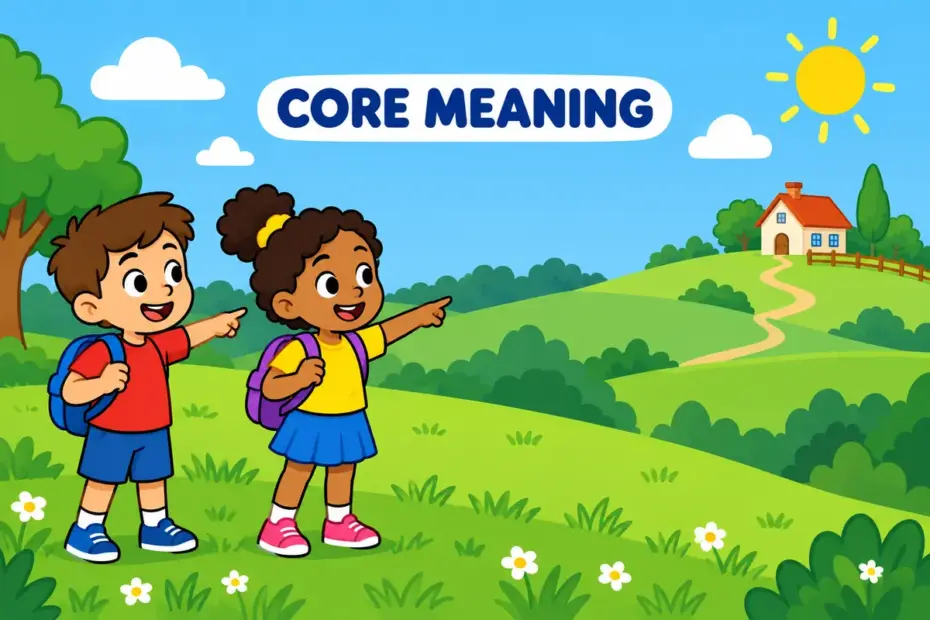
Yond vs yonder compares two words for something at a distance: yonder is the recognizable demonstrative adverb or adjective, while yond is a much rarer literary form. Choose yonder in ordinary modern writing, as in “the cabin over yonder”; reserve yond for deliberate archaic or poetic effect.
Yond Vs Yonder at a glance
- Yonder points to a place or thing at some distance, often in the speaker’s view.
- Yond is a rare, chiefly literary form meaning at a distance or over there.
- Yonder can modify a noun (“that yonder hill”) or stand alone (“look yonder”).
- Neither word is a neutral replacement for away in most everyday sentences.
- The common error is treating yond and yonder as equally current alternatives.
What does yond vs yonder mean?
Yonder is an adverb or adjective that points to a place or thing at some distance; yond has a similar meaning but sounds archaic or poetic to most present-day readers. The dictionary entries Cambridge Dictionary: yond and Merriam-Webster Dictionary: yond document the standard senses and forms. When this expression is not the right choice, a plain term such as there or a direct description may be clearer; it does not automatically carry every implication of its near-synonym.
| Sense | Plain meaning | Example |
|---|---|---|
| Yonder is an adverb or adjective that points to a place or thing at some distance; yond has a similar meaning but sounds archaic or poetic to most present-day readers | Yonder is an adverb or adjective that points to a place or thing at some distance; yond has a similar meaning but sounds archaic or poetic to most present-day readers. | Yond Vs Yonder appears in a sentence that supplies its context. |
| Contextual or extended use | Meaning shaped by the surrounding subject and register | The writer chose a precise alternative when there was clearer. |
The related page on yonder gives readers another useful point of comparison.The related page on away gives readers another useful point of comparison.The related page on beyond gives readers another useful point of comparison.
How do you use yond vs yonder in a sentence?
Yonder is an adverb or adjective that points to a place or thing at some distance; yond has a similar meaning but sounds archaic or poetic to most present-day readers. The grammatical frame helps a reader recognize the intended meaning; the particle or nearby noun can be decisive.
| Pattern | Example | What it signals |
|---|---|---|
| yonder + noun | We could see yonder island. | Adjective use, usually literary or regional in flavour. |
| verb + yonder | The path bends yonder. | Adverb locating an action or place. |
| over yonder | Their cottage stands over yonder. | Fixed conversational phrase meaning over there. |
| yond + noun | They watched from yond hill. | Compressed literary adjective; unusual in contemporary prose. |
Yond Vs Yonder in a sentence: examples across contexts
These examples vary the setting so the same expression is not mistaken for a universal fit. Register and grammatical role both affect whether a sentence sounds natural.
| Context | Example sentence | Why this works |
|---|---|---|
| Everyday conversation | Yonder is the old stone bridge we crossed yesterday. | The demonstrative points to a visible landmark, though over there sounds more conversational. |
| Narrative | The shepherd led the flock toward yonder ridge. | Yonder adds a storybook or pastoral tone. |
| Poetry | A single lamp glimmered on yond shore. | Yond can work when the writer intentionally wants compressed, archaic diction. |
| Classroom | Point to the yonder star on the map. | The adjective modifies a noun, but a teacher would usually say distant star. |
| Travel writing | A trail climbs toward the village yonder. | The adverb locates the village beyond the immediate foreground. |
| Dialogue | “The picnic tables are over yonder,” said Mira. | The familiar phrase over yonder feels more idiomatic than yond. |
| Historical fiction | The messenger rode toward yond fortress. | The old-fashioned form suits a deliberately historical voice. |
| Technical directions | The exit is 300 metres farther down the corridor. | A measured instruction needs precision rather than either literary demonstrative. |
Yond Vs Yonder vs there
Yonder is an adverb or adjective that points to a place or thing at some distance; yond has a similar meaning but sounds archaic or poetic to most present-day readers. Use the comparison table to check meaning, grammar and register before substituting one word for another.
| Criterion | yond vs yonder | there |
|---|---|---|
| Part of speech | Adverb or adjective, sometimes demonstrative | Adjective or adverb, literary |
| Core meaning | At some distance; over there | At a distance; over there |
| Modern familiarity | Recognizable, marked or folksy | Rare; many readers find it archaic |
| Typical setting | Dialogue, storytelling, descriptive prose | Poetry or stylized historical writing |
| Best plain substitute | there, over there, distant | there, distant |
| Reader effect | Points while adding an old-fashioned tone | Strongly signals deliberate archaic diction |
Verdict: choose the target when its specific meaning and grammar fit, and choose there only when that word expresses the intended idea more precisely.
Which should you use?
Choose yonder when you want a reader to locate something at a distance and the slightly folksy or literary tone suits the sentence. Choose yond only when the sentence deliberately adopts an older poetic voice; for neutral directions, replace both with there, over there, farther on or a measurable distance.
| Situation | Recommended wording | Reason |
|---|---|---|
| Giving a child a direction across a field | “The gate is over there.” | Simple directional language is easier to process than a marked demonstrative. |
| Writing a warm, story-like description | “A cottage stood yonder.” | Yonder supplies distance and a traditional narrative flavour. |
| Writing a poem with an old-fashioned voice | “The ship sailed from yond shore.” | Yond can compress the phrase and reinforce an intentionally archaic register. |
| Giving a precise route | “Turn left after the second bridge.” | Neither word gives a distance or landmark sequence precisely enough for navigation. |
The word can also point from a speaker’s imagined viewpoint, not only from a visible spot. A narrator may write “in yonder years” to mean a distant future or past, but that phrasing is stylized and should be supported by the rest of the voice. The same sentence in a modern report would sound needlessly ornate.
Placement changes the feel as well. “Yonder mountain” is grammatically possible, but many current readers find “that mountain over there” more natural in speech. The standalone adverb in “the mountain yonder” can sound more literary still. Writers often keep yonder in the familiar phrase “over yonder,” where the repeated sense of distance is conventional rather than confusing.
Do not use yond as a clipped form of beyond. “The trail goes yond the fence” is not standard contemporary phrasing; write “beyond the fence.” That distinction matters because yond points to a distant location, while beyond expresses crossing or being on the far side of a boundary. One word points; the other relates two places.
For most practical prose, the deciding question is whether the tone is doing useful work. If the reader needs only location, use there or a specific landmark. If an old-fashioned narrative voice is intentional, yonder is the more recognizable choice and yond is the stronger stylistic signal. The choice also signals voice.
Word forms and grammar of yond vs yonder
| Form | Part of speech | Example |
|---|---|---|
| yonder | adverb/adjective | The children waved from yonder field. |
| yond | adverb/adjective | The poem names a ship on yond sea. |
| over yonder | adverbial phrase | The orchard lies over yonder. |
| beyond | preposition/adverb | The path continues beyond the gate. |
Common mistakes with yond vs yonder
- Incorrect:
The station is yond the river.Correct: The station is beyond the river. Rule: Yond does not normally function as the modern preposition beyond. - Incorrect:
We parked over yond.Correct: We parked over yonder. Rule: The established phrase is over yonder; yond is not its usual adverb form. - Incorrect:
Yonder is always the more formal word.Correct: Yonder is more recognizable; yond is rarer and more archaic. Rule: Rarity does not make a word a neutral formal choice. - Incorrect:
The yonder is beautiful.Correct: The view over there is beautiful. Rule: Yonder normally modifies a noun or functions as an adverb, not as a standalone count noun.
Practice using yond vs yonder
Try each task before checking the answer; the explanation identifies the grammatical or meaning clue.
- Fill in the blank: Choose yond vs yonder or there for a sentence about the intended meaning.
- Choose the better word: Complete a sentence where only yond vs yonder fits the context.
- Correct the error: Rewrite one of the incorrect patterns above.
- Build a sentence: Use yond vs yonder in a short workplace message.
- Spot the register: Identify which example above fits a formal report, and explain why.
- Rewrite: Replace yond vs yonder with a clear plain-language alternative without changing the main idea.
Answers
- Use yond vs yonder where the definition and syntax fit; the context determines the intended reading.
- Choose yond vs yonder only if its exact meaning fits; there expresses a different idea.
- Use the corrected construction shown in the common-mistakes section; its rule explains the repair.
- Model: The editor checked whether yond vs yonder conveyed the intended meaning; the subject and setting make the phrase interpretable.
- The technical or academic example is most suitable because it states the point precisely and avoids casual tone.
- Choose a direct synonym that preserves the sentence’s intended action or state; do not swap words mechanically.
The bottom line
Use yond vs yonder when its meaning and grammatical pattern fit the sentence. The strongest clue is the surrounding context, while register determines whether the expression sounds natural to the intended reader. A direct alternative is clearer when the phrase could be misunderstood.
Frequently asked questions about yond vs yonder
Is yond still used today?
Yond appears chiefly when a writer wants an old-fashioned, poetic or deliberately stylized voice. Most contemporary readers understand the intended distance, but they may notice the word as unusual. For neutral directions, there, over there, farther on or beyond is clearer.
Does yonder mean far away?
Yonder means at some distance or over there, but it does not specify a measurement. The place may be across a room, across a field or farther away when context makes that clear. Use a distance such as two miles when exact location matters.
Can yonder come before a noun?
Yes. Yonder can act as an adjective in phrases such as yonder hill or yonder village. This use is marked and often literary or folksy; in ordinary instructions, that hill across the field or the distant village will sound more natural.
Is yonder the same as beyond?
No. Yonder points to a place at some distance, while beyond means farther than or on the far side of a limit. Yonder hill identifies a hill over there; beyond the hill locates something on its other side. The sentence context supplies that distinction.