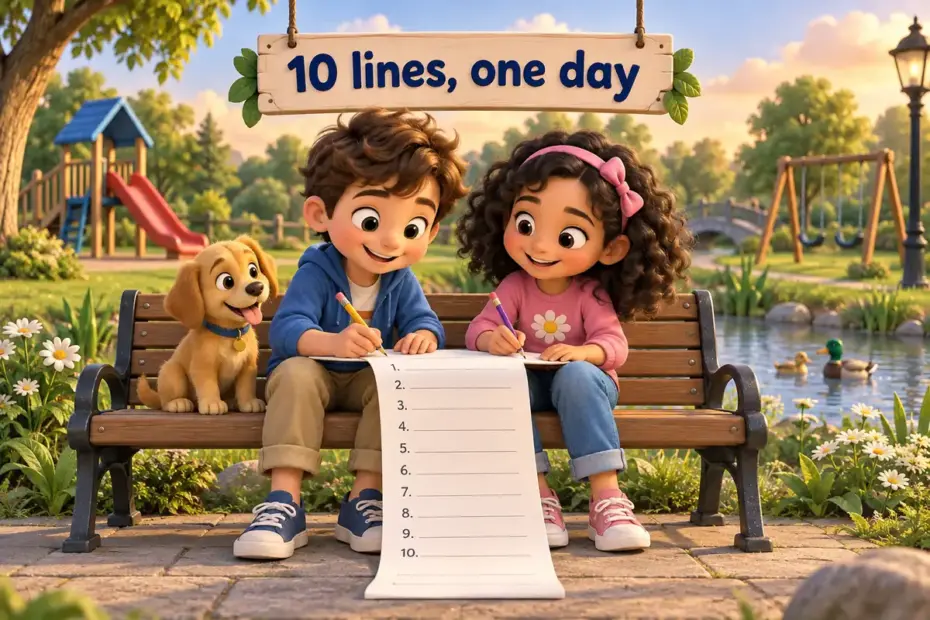
10 lines about a day at the park is a short writing task that asks for ten clear sentences about one visit. The lines usually follow the day from arrival to going home, and each one adds a single detail. A simple example is the sentence the swings were busy all morning.
10 lines about a day at the park at a glance
- The task needs ten sentences that tell the story of one visit in order.
- Each line should add one new detail rather than repeat an idea.
- A clear opening names the time, and a clear ending names the journey home.
- Simple past tense keeps the whole recount consistent.
- The commonest slips are mixed tenses and opening every line the same way.
What are 10 lines about a day at the park?
Ten lines about a day at the park are ten short sentences that describe a single trip in sequence. Read as a set, they move from arrival to play, then to food and rest, and finish with the walk home, so the reader sees one whole day rather than ten unrelated facts.
| Line | Example line | What it describes |
|---|---|---|
| Line 1 | The park gate opened at nine in the morning. | arrival and time |
| Line 2 | Bright kites filled the sky above the green field. | the scene and the weather |
| Line 3 | My little cousin ran straight to the tall slide. | a person and an action |
| Line 4 | The swings creaked as we pushed higher and higher. | play and sound |
| Line 5 | We spread a mat under the old oak tree. | a place and a detail |
| Line 6 | Sandwiches and cold juice tasted best in the shade. | food and feeling |
| Line 7 | A duck family waddled past the quiet pond. | wildlife and movement |
| Line 8 | We played hide and seek behind the thick bushes. | a game and a place |
| Line 9 | A soft breeze cooled us as the sun began to dip. | weather and time |
| Line 10 | We walked home tired but happy at the end of the day. | ending and mood |
Each line above is a complete sentence, which is the rule that keeps the set tidy; more guidance on writing tidy single lines sits in adjectives for lines.
How do you write 10 lines about a day at the park?
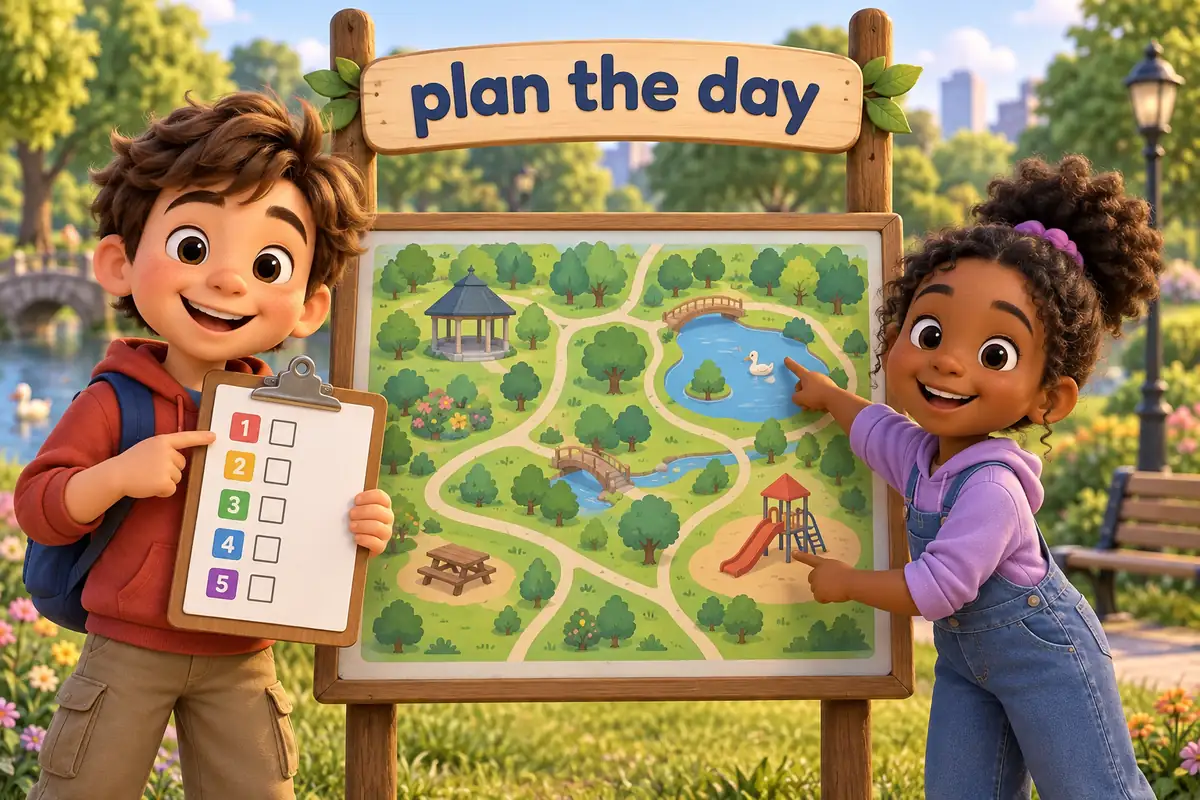
The plan below breaks the day into five steps, and each step supplies two lines. Keeping the steps in order is what turns a list of sentences into a clear recount of one visit.
| Step | What to do | Example |
|---|---|---|
| 1. Set the time | Open with when the visit began | The park gate opened at nine. |
| 2. Describe the place | Add one clear scene detail | Bright kites filled the sky. |
| 3. Name the people | Show who came and what they did | My cousin ran to the slide. |
| 4. Add play and food | Include one activity and one snack | We shared sandwiches in the shade. |
| 5. Close the day | End with the journey home | We walked home tired but happy. |
Writing the five steps first, then filling two lines under each, stops the middle of the recount from sagging and keeps the ten lines balanced.
Which words make the lines stronger?
Strong lines lean on a few precise nouns and adjectives rather than long, vague descriptions. The table shows the words that do the most work in a park recount.
| Word | Type | Example line |
|---|---|---|
| busy | adjective | The swings were busy all morning. |
| shady | adjective | We sat in a shady corner. |
| warm | adjective | A warm breeze crossed the field. |
| swing | noun | The swing moved high. |
| bench | noun | An old bench stood by the path. |
| pond | noun | Ducks swam in the pond. |
Choosing the right describing word matters as much as choosing the noun, and a wider set sits in adjectives for park and in adjectives for day.
A day at the park: 10 lines across contexts
The same ten-line shape changes with the reader. The table shows how the lines adapt for a classroom recount, a letter home, a poem and a short speech, with a reason for each choice.
Switching context changes the vocabulary but not the order, so a learner can reuse the same ten-line plan in almost any writing task.
Common mistakes when writing 10 lines about a day at the park
These are the errors that appear most often in school writing. Each one shows the wrong version, the corrected version and the rule behind the fix.
Mistake 1: mixed tenses. Incorrect: We play hide and seek and then went home. Correct: We played hide and seek and then went home. Rule: keep the whole recount in one past tense.
Mistake 2: the wrong preposition. Incorrect: We arrived in the park at nine. Correct: We arrived at the park at nine. Rule: use at for the park as a point of arrival.
Mistake 3: the wrong past form. Incorrect: I seen a duck on the pond. Correct: I saw a duck on the pond. Rule: the simple past of see is saw, not seen.
Mistake 4: repeating the same opener. Incorrect: It was fun. Then it was fun. Then it was fun. Correct: The swings were fun, the pond was calm and the walk home was happy. Rule: vary the subject so each line adds a new detail.
Mistake 5: losing the order of events. Incorrect: We walked home, then we arrived at the gate. Correct: We arrived at the gate, then we walked home. Rule: keep the lines in time order, with later events described later.
The last error is the easiest to miss, and a firm grasp of time markers such as all at once and later helps keep the sequence clear.
Sentence patterns for a day at the park
Ten strong lines draw on a small number of patterns. The table shows the five patterns that carry a recount, each with an example and what it signals.
| Pattern | Example | What it signals |
|---|---|---|
| past simple recount | The gate opened at nine. | a completed action in order |
| past continuous | The swings creaked as we pushed. | an action in progress |
| adjective before noun | a shady spot | a quality placed on a noun |
| time-marker opener | In the morning, the park was quiet. | sets the order of events |
| closing feeling | We walked home tired but happy. | ends the recount with mood |
A learner who can swap freely between these five patterns can fill ten lines without repeating the same sentence shape twice.
Practice writing 10 lines about a day at the park
- Fill in the blank with a time marker: ___ the gate opened at nine.
- Choose the better verb form: We (played / play) on the swings all morning.
- Write one line that names a person and an action.
- Correct the error: I seen a duck on the pond.
- Build a line: use pond and ducks.
- Spot the register: which line suits a poem, (a) We arrived at the gate at nine o’clock sharp, or (b) Soft breeze, tall slide, happy day?
Answers
- In the morning, because it sets the time at the start of the recount.
- Played, because a completed morning activity takes the simple past.
- My cousin ran to the tall slide; it names a person and one action.
- I saw a duck on the pond; the simple past of see is saw.
- Ducks swam across the quiet pond; pond names the place and ducks names the birds.
- (b), because it compresses the day into images rather than reporting exact times.
The bottom line
Writing 10 lines about a day at the park works best when the ten sentences follow one visit in order, from the open gate to the walk home. Keep the past tense steady, give each line a fresh detail and end with a feeling. Set out the day with at the end of the day in mind, and the recount almost writes itself.
Frequently asked questions about 10 lines about a day at the park
How long should each line be?
One clear sentence of about eight to fifteen words suits the task best. Long enough to name a subject and an action, short enough to stay easy to read, and each line should carry just one idea so the set of ten stays balanced.
Must the ten lines be in time order?
Yes. A recount is understood through order, so the lines should move from arrival to play, then to food and rest, and finish with the walk home. Jumbling the order makes the day harder to follow, even when every single sentence is correct.
Which tense should the lines use?
The simple past tense suits almost every line, as in the gate opened and the kites filled the sky. A learner may switch briefly to the past continuous, as in the swings creaked as we pushed, but the recount should not slide into the present tense.
Can the same opening word start every line?
It can, but it should not. Starting all ten lines with the same word or phrase makes the recount flat. Vary the subject instead, moving between the park, the people, the weather and the feeling, so each line adds something the reader did not already know.