100 reading sentences for kids are short, friendly lines a young reader can sound out with growing confidence. Each sentence uses familiar sight words and one clear idea, so children practise decoding without losing the meaning. The list moves from two or three words up to full simple sentences.
100 Reading Sentences for Kids at a Glance
- A reading sentence for kids stays short enough to finish in one breath.
- It repeats high-frequency sight words until they are automatic.
- Lines grow in length only as the reader gains control.
- Familiar topics keep attention on the words, not the subject.
- The commonest mistake is choosing lines that are too long for the reader.
What Are Reading Sentences for Kids?
A reading sentence for kids is a short line written with words a young reader already knows by sight, so the child can practise decoding without meeting an unfamiliar idea at the same moment. The aim is fluency: reading smoothly and with understanding. Because the words repeat across lines, the child meets each one many times and stops sounding it out letter by letter.
The table below maps sentence length to the reading stage a child has reached, so an adult can pick lines that match.
| Reading stage | Typical length | Sample line |
|---|---|---|
| First words | two to three words | I see a cat. |
| Early sentences | three to five words | The dog can run. |
| Growing reader | five to seven words | My red ball is in the box. |
| Confident reader | seven to nine words | We went to the park after school. |
| Fluent reader | nine to twelve words | The little bird sang on the fence all morning. |
How Do You Use Reading Sentences for Kids?
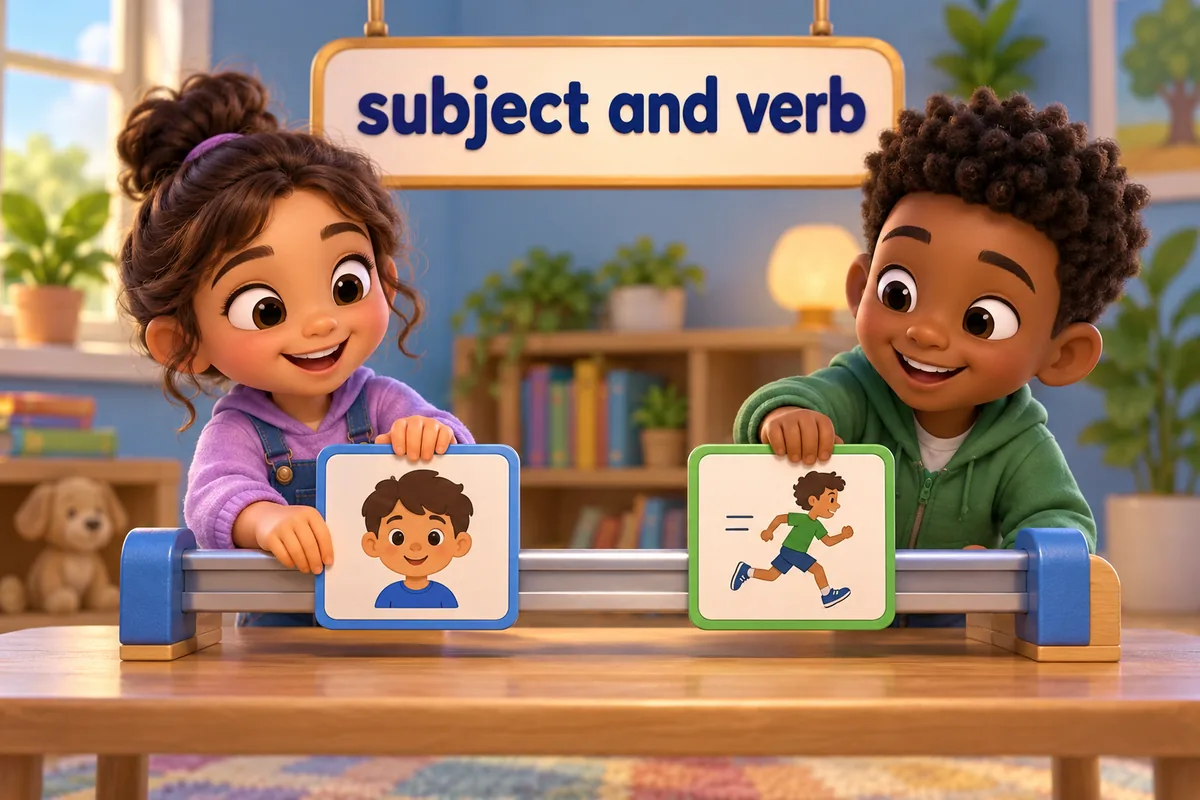
Read one line at a time, pointing under each word, and let the child say the words aloud. The pattern below keeps the grammar simple: a doer first, then the action, with one extra detail at most. Once the frame is comfortable, add a describing word to stretch the line.
| Pattern | Example | What it builds |
|---|---|---|
| subject + verb | Birds fly. | the basic reading frame |
| subject + verb + object | I have a hat. | a word after the action |
| subject + verb + place | Dad sits here. | a simple position word |
| adjective + subject + verb | The big dog runs. | attention to describing words |
| subject + verb + and + verb | We sing and clap. | two actions in one line |
Reading Sentences for Kids: Examples Across Contexts
The lines below stay in the words a young reader meets every day. Each one is short, and the reason beside it shows what the child is practising.
| Context | Sentence | What it practises |
|---|---|---|
| Pets | My cat sits on the mat. | short vowels in cat, sits, mat. |
| Home | Dad has a big red cup. | sight words has and a. |
| Playground | We run and jump all day. | two joined actions. |
| Food | I like jam on my bread. | the sight word like. |
| Bedtime | The moon is up in the sky. | position word up and in. |
| School | My bag is on the chair. | everyday classroom nouns. |
| Weather | The sun is warm today. | one describing word, warm. |
| Toys | Look at my new blue car. | colour word and sight words. |
| Nature | A bee can fly to the flower. | long vowel in bee and fly. |
| Family | We help Mom set the table. | the sight word help. |
| Animals | The duck swims in the pond. | verb swims with a place. |
| Snack | She can get a cup of milk. | the sight word get. |
Which Reading Sentences Should You Start With?
Begin with the lines a child can read in one breath and finish with a smile. Success builds the confidence that carries into the next stage, so short and easy beats long and impressive every time.
| Reader | Best starting line | Why |
|---|---|---|
| Just starting | I see a cat. | two sight words and one noun |
| Knows sight words | The dog can run. | adds a helper verb |
| Uses adjectives | The big dog runs fast. | one describing word |
| Joins actions | We sing and clap. | a simple joining word |
| Reads smoothly | We went to the park after school. | a longer place phrase |
These practice lines fit neatly into guided reading for kids, where a teacher hears each child read aloud. Add colour to the lines with the simple describing words collected in adjectives for kids. Words such as apple and ant from the list of a words for kids appear in the easiest sentences below. The next set of sight words grows from the b words for kids, such as ball and bird.
Word Forms and Grammar of Reading Sentences
Early reading lines lean on a small set of very common words. The table groups them so an adult can pre-teach the trickiest ones before the child reads the line.
| Word | Type | Example in a line |
|---|---|---|
| the | sight word | The dog runs. |
| see | verb | I see a bird. |
| is | linking verb | The sun is warm. |
| and | joining word | We sing and clap. |
| on | position word | The cup is on the mat. |
| can | helper verb | A bee can fly. |
More Reading Sentences to Try
These extra lines stay in the same small sight-word set, so a child can read them without help.
| Sentence | Words to practise |
|---|---|
| I can see a red hen. | can, see, red |
| The pig is in the mud. | is, in |
| We like to play outside. | like, to |
| My cup is on the mat. | on, my |
| A big bug sits on the log. | big, sits |
| She can hop and run. | can, and |
| The cat has a soft bed. | has, soft |
| I like my little hat. | like, little |
| Dad can fix the old car. | can, old |
| We go to the shop by bus. | go, to |
| The fish swim in the pond. | swim, in |
| A red bird sits in the tree. | sits, tree |
Common Mistakes With Reading Sentences for Kids
My dog went running quickly through the large green park yesterday morning. For an early reader, write My dog ran in the park. Rule: keep lines as short as the reader can manage.
The cat the dog the bird. Write The cat sat. Rule: every sentence needs a verb, not just a string of nouns.
I seed a bug. Write I see a bug. Rule: use the known sight word see rather than an invented past form.
Run dog fast. Write The dog runs fast. Rule: put the doer first and match the verb to it.
My ball are red. Write My ball is red. Rule: a singular subject takes a singular verb.
Practice Reading Sentences for Kids
- Fill in the blank: My cat ______ on the mat.
- Choose the better word: (The dog runs fast. / The dog is a fast-running animal.)
- Correct the error: I seed a bird.
- Build a sentence: use the words the, sun, and warm.
- Fill in the blank: We sing ______ clap.
- Spot the register: which line suits a first reader, I see a cat or I observed a cat?
Answers
- sits — a singular subject takes the singular verb sits.
- The dog runs fast. — the short line matches an early reader.
- I see a bird. — use the sight word see.
- Sample: The sun is warm. — a linking verb joins the two words.
- and — and joins the two actions.
- I see a cat — the shorter, simpler line suits a first reader.
The Bottom Line
100 reading sentences for kids works best when each line is short, uses words the child already knows, and repeats them in new settings. Fluency comes from meeting the same sight words again and again inside complete ideas, not from long sentences. Move up a level only when the current lines are read smoothly, and add one describing word at a time.
Frequently asked questions about Reading Sentences for Kids
How long should a reading sentence be for a beginner?
A beginner reads best with two to five words, such as I see a cat or The dog can run. The line should fit comfortably in one breath and finish before the child tires. As fluency grows, add words gradually rather than jumping to long sentences the reader cannot yet hold together.
What are sight words and why do they matter?
Sight words are very common words, such as the, and, is and you, that early readers learn to recognise instantly rather than sound out. They appear in almost every sentence, so recognising them on sight frees the child to spend decoding effort on the longer, less familiar words that carry the meaning.
Should a child point at each word while reading?
Yes, for beginners. Pointing with a finger helps a young reader track from left to right and match each spoken word to the printed one, which prevents guessing at words from pictures. The habit fades on its own as fluent reading takes over, usually within a year of steady practice.
How often should we practise reading sentences?
Short daily practice beats long weekly sessions. Ten to fifteen minutes a day, reading a handful of lines and rereading favourites, builds fluency faster than one long sitting, because a little repeated practice keeps the words fresh without tiring the child or turning reading into a chore.