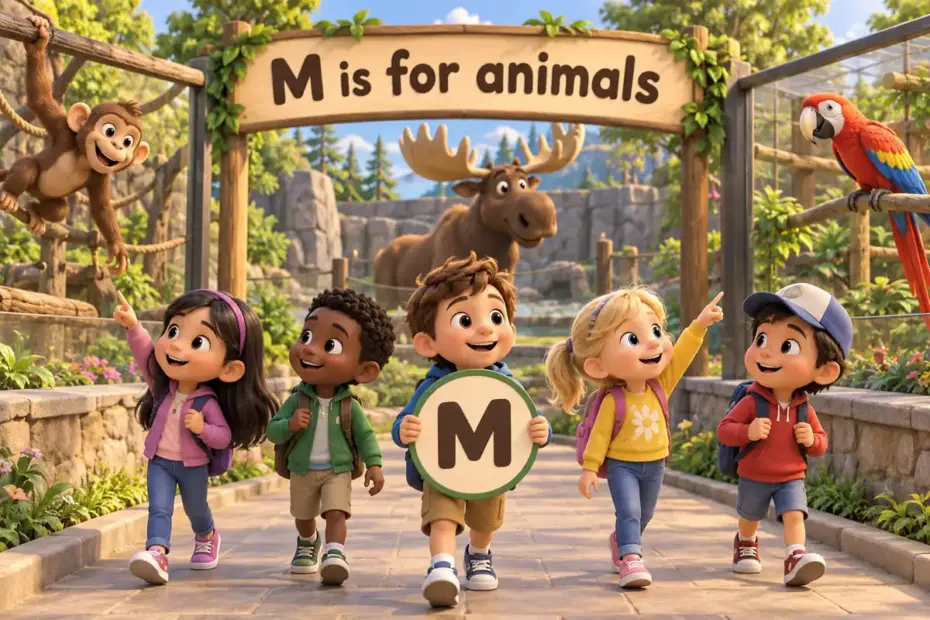
Animals that start with m run from the monkey to the manta ray, and this list groups them by type so each name is easy to place. Learn the primate first, then add a bird, a reptile and an insect. A simple example is the phrase the monkey swings from branch to branch with a firm grip.
Animals that start with m at a glance
- Animals that start with m include the monkey, the moose and the macaw.
- The names cover several animal groups, from primate to fish.
- Every animal name here is a common noun, so it stays lowercase inside a sentence.
- Regular plurals add -s, while a few animal names keep one form for any number.
- The commonest slip is a capital letter on a common noun, as in a Bear.
What kinds of animals start with the letter M?
Animals that start with m divide into clear groups, and each group shares body features and habits. Sorting the names this way makes a long list easier to remember, so the table below pairs every group with example animals.
| Group | Example animals | What the group means |
|---|---|---|
| primate | monkey | Mammals with forward-facing eyes and grasping hands. |
| deer family | moose | Hoofed mammals with slender legs; most males grow antlers. |
| bird | macaw | Feathered animals with wings and a beak. |
| insect | moth | Small animals with six legs and three body parts. |
| fish | manta ray | Animals that breathe through gills and live in water. |
| small mammal | mongoose | Small warm-blooded animals that feed their young on milk. |
Most of these m names are short and phonetic, which makes them useful for early reading and spelling drills. A word’s group also predicts the kind of fact you can give it, such as fur for a mammal or feathers for a bird.
How do you use animals that start with m in a sentence?
Animal names behave like any other common noun. The pattern you choose depends on how many animals you mean and whether the reader already knows which one. Teachers describing an animal often reach for adjectives for animals.
| Pattern | Example | What it signals |
|---|---|---|
| a + name | A monkey the monkey swings from branch to branch with a firm grip. | one animal, unspecified |
| the + name | The moose wades into a shallow lake to feed on water plants. | a known or already named animal |
| plural name | Two monkeys rested by the water. | more than one animal |
| name as subject | The macaw cracks a nut with its strong curved beak. | the animal performs the action |
| possessive name | The monkey’s sure steps gripped the rock. | ownership of a feature or action |
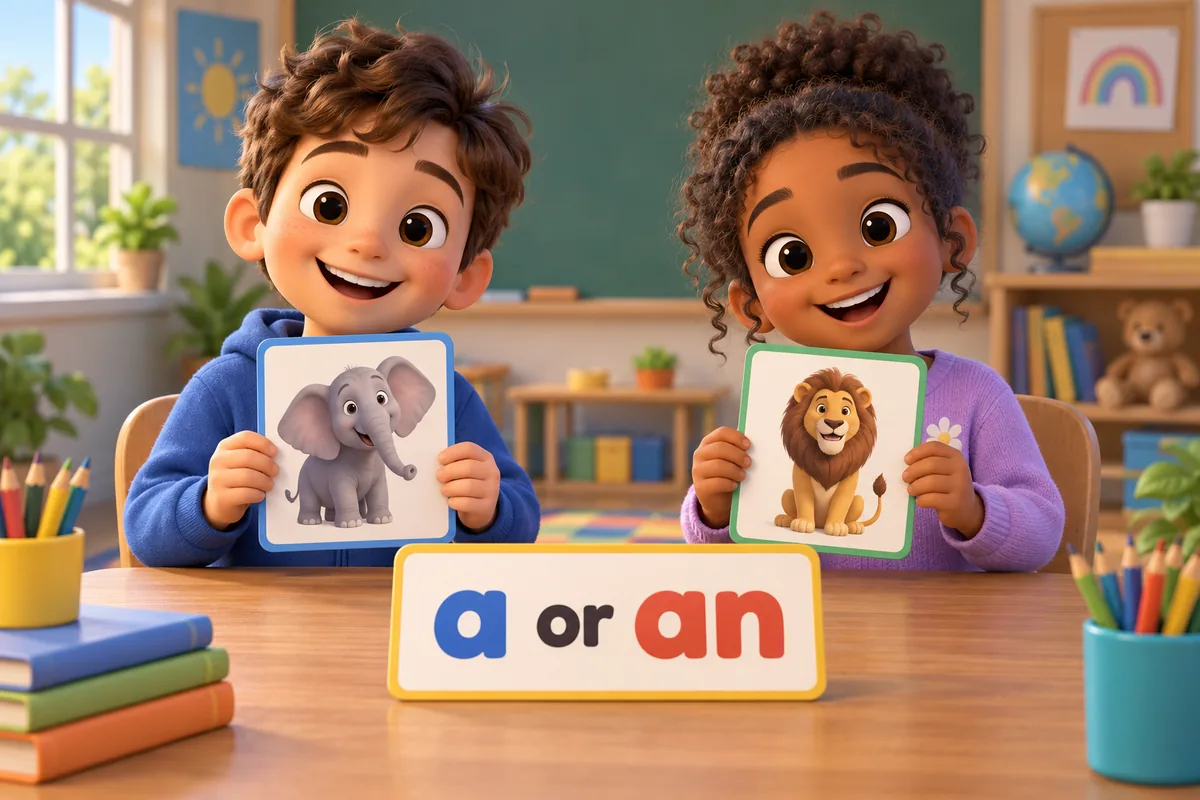
The article is chosen by sound, not spelling, so a vowel sound takes an and a consonant sound takes a. That single rule removes most article errors with animal names.
Animals that start with M: examples across contexts
The sentences below place one m animal in a different register each time, from a classroom note to a field report. Each row names the context, gives the sentence, and explains what the sentence does.
| Context | Example sentence | Why this works |
|---|---|---|
| Classroom | The class sorted the monkey, the moose and the mongoose into the right groups. | lists three names from the list in a school task |
| Zoo information board | The mongoose darts under a bush and watches for danger. | gives one present-tense fact for visitors |
| Science report | The moose wades into a shallow lake to feed on water plants. | states a neutral fact in the present tense |
| Nature diary | The monkey swings from branch to branch with a firm grip. | records an observation in simple present |
| Picture caption | The macaw cracks a nut with its strong curved beak. | labels a photo with one clear fact |
| Quiz card | The macaw is a bird, while the mongoose is a small mammal. | contrasts two groups in the list |
| Conservation poster | Protect the moth and the habitat it needs. | uses an imperative about wildlife |
| Story time | The children watched as the moth circles a lamp and settles on the wall. | uses a simple narrative frame |
| Field guide | The manta ray glides through warm water on wide wings. | reads like a reference entry |
| Museum label | The macaw is one of the animals that start with the letter M. | describes a display in one line |
| Spelling list | M words such as monkey, moose and mongoose all begin with the letter m. | groups words by their first letter |
| Phonics drill | The monkey swings from branch to branch with a firm grip. Saying the name aloud shows children the opening m sound. | links the animal to its first sound |
Readers who want the whole alphabet in one place can browse animals from a to z. Seeing the same pattern across many letters makes the noun grammar feel ordinary.
Which animals that start with m should you learn first?
The best first animal depends on what the learner needs. A short, familiar name suits a young reader, a mammal suits a science lesson, and a longer name suits spelling practice.
| Situation | Best choice | Why |
|---|---|---|
| A first word to read | the moth | short and phonetic, so it is easy to sound out |
| A science lesson on mammals | the monkey | a clear example of a warm-blooded animal |
| A lesson on birds | the macaw | shows feathers, wings and a beak |
| A spelling challenge | the mongoose | more letters to split into syllables |
| A zoo visit | the moose | large enough to spot quickly in an enclosure |
Pair each animal with a picture and one fact, and the word sticks faster. The same method works for adjectives that start with m when learners move on to description.
Word forms and grammar of m animal names
Animal names follow ordinary noun grammar. The table shows the forms a learner needs most, including the article rule and the capital-letter rule.
| Form | Part of speech | Example |
|---|---|---|
| singular | common noun | The monkey swings from branch to branch with a firm grip. |
| plural | common noun | We counted two monkeys near the path. |
| article a / an | article before a name | a monkey |
| possessive | common noun | The monkey’s trail was easy to follow. |
| group noun | common noun | The monkey is a primate. |
| capital letter | sentence start only | A monkey runs at the head of this list. |
Adverbs carry the way an animal moves, as in the fox moved quietly. For more of them see adverbs that start with m.
Common mistakes with m animal names
These are the errors that appear most often in school writing. Each one shows the wrong version, the corrected version, and the rule behind the fix.
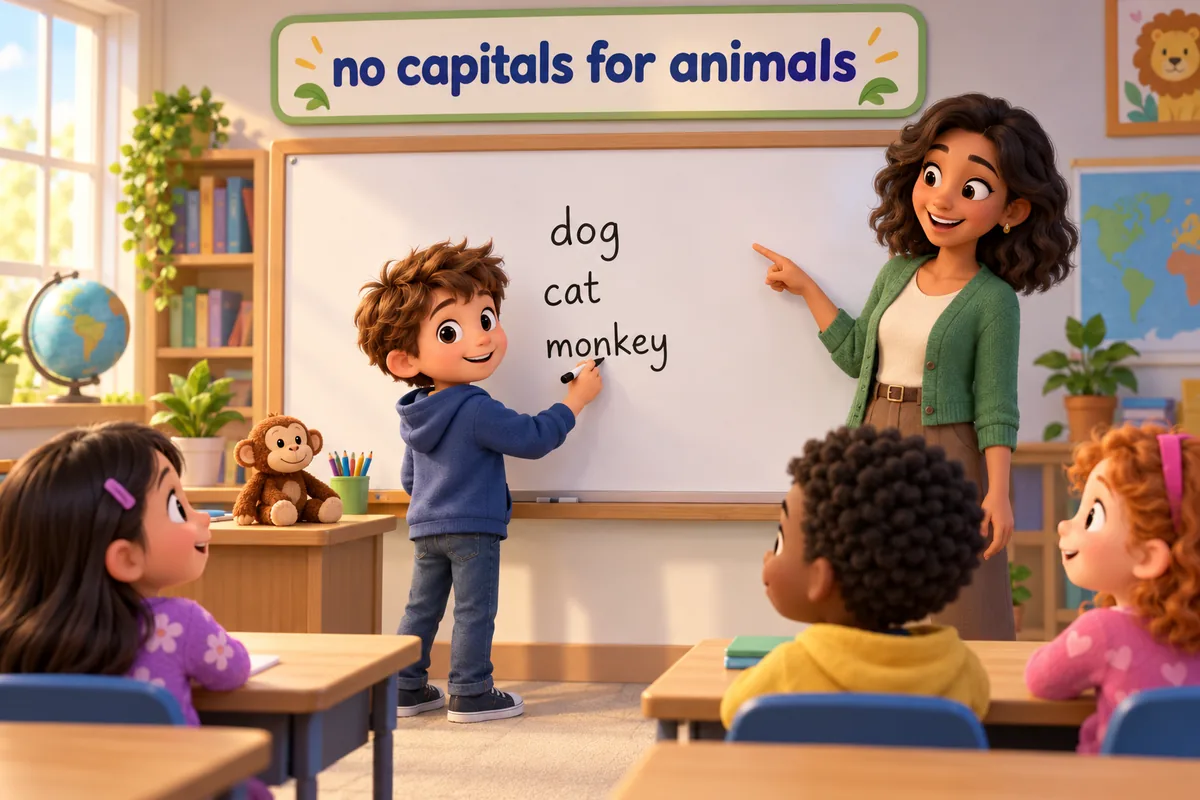
Mistake 1: a capital letter on a common noun. Incorrect: I saw a Bear by the river. Correct: I saw a bear by the river. Rule: an animal name is a common noun and takes a capital only at the start of a sentence or in a title.
Mistake 2: an apostrophe on a plural. Incorrect: We saw two monkeys’s at the park. Correct: We saw two monkeys at the park. Rule: a plural noun never takes an apostrophe; the apostrophe marks possession, as in a monkey’s tail.
Mistake 3: the wrong article. Incorrect: We saw an monkey. Correct: We saw a monkey. Rule: use an before a vowel sound and a before a consonant sound.
Mistake 4: a missing plural ending. Incorrect: Two monkey were on the log. Correct: Two monkeys were on the log. Rule: a regular noun adds -s to show more than one.
Mistake 5: forcing a plural on an irregular name. Incorrect: Three deers grazed nearby. Correct: Three deer grazed nearby. Rule: deer and fish keep the same form for one or many.
A quick check at the end of a sentence catches most of them: look for a stray capital, an apostrophe on a plural, and the article before a vowel sound.
Practice using animals that start with m
- Fill in the blank: add the article. ___ monkey is a primate.
- Choose the correct article: (a / an) monkey.
- Write the plural of monkey.
- Correct the error: We saw two monkeys’s at the wildlife park.
- Build a sentence: use monkey and the word zoo.
- Spot the register: which sentence suits a science report, (a) I saw a big monkey at the zoo, or (b) The monkey swings from branch to branch with a firm grip.?
Answers
- A, because monkey starts with a consonant sound.
- a monkey, because monkey begins with a consonant sound.
- monkeys, formed by adding -s to the singular.
- We saw two monkeys at the wildlife park; a plural takes no apostrophe.
- The monkey swings from branch to branch with a firm grip. at the zoo; the animal is the subject.
- (b), because it states a fact in a neutral present tense rather than a personal remark.
The bottom line
The animals that start with m are a compact set of common nouns that reward careful grouping. Sort them by type, and the facts become easier to recall. Use the article and capital-letter rules, and the writing stays clean. Start with the monkey, the moose and the manta ray, then add the rest.
Frequently asked questions about animals that start with the letter m
How many animals start with the letter M?
There is no fixed number, because the total shifts when scientists reclassify species and when old names fall out of use. This list collects the m animals learners meet most often, from familiar names such as the monkey to rarer ones such as the manta ray.
Should the names of animals begin with a capital letter?
Animal names are common nouns, so they take a capital only at the start of a sentence or in a title. A proper name, such as a breed or a pet name, is different, which is why we write a dog but call one Rover when it has a name.
How can a child remember m animal names?
Group the names by type and match each one to a picture and a single fact. Repeating the group name, such as primate, keeps the set organised, and saying the first sound aloud anchors the spelling. Keep the list short at first, then add new animals once the earlier names are secure.
Do any m animals have an unusual plural?
The plural is regular for almost every name here, formed by adding -s to the singular. A few animal words, such as deer, fish and sheep, keep the same form for one or many, so they never take an s. Check the plural in a dictionary only when the form looks unusual, then copy it exactly.