Braces punctuation in English covers the curved pair of marks written { and }, which hold material together inside a larger item. Braces appear less often than brackets or parentheses in ordinary prose, and most writers meet them in maths or computer code. In writing, they group a set within a set.
Braces punctuation in English at a glance
- Braces are the curly marks { and }, also called curly brackets.
- They group a small set of items inside a larger list or sentence.
- Braces rarely appear in formal prose, where round parentheses do the job.
- In maths and code, braces mark sets and blocks of instructions.
- Every opening brace needs its matching closing brace in the same sentence.
What are braces in English punctuation?
Braces are the punctuation pair { and } that enclose material inside another pair of marks. They belong to a family of enclosing marks, and each member has a settled job; a set of ready lines sits in braces sentence examples.
| Mark | Shape | Usual job |
|---|---|---|
| Braces | { } | group a set inside another set |
| Brackets | [ ] | add a clarification inside a quotation |
| Parentheses | ( ) | add an aside or extra detail |
| Angle brackets | < > | mark a tag, a code token or a placeholder |
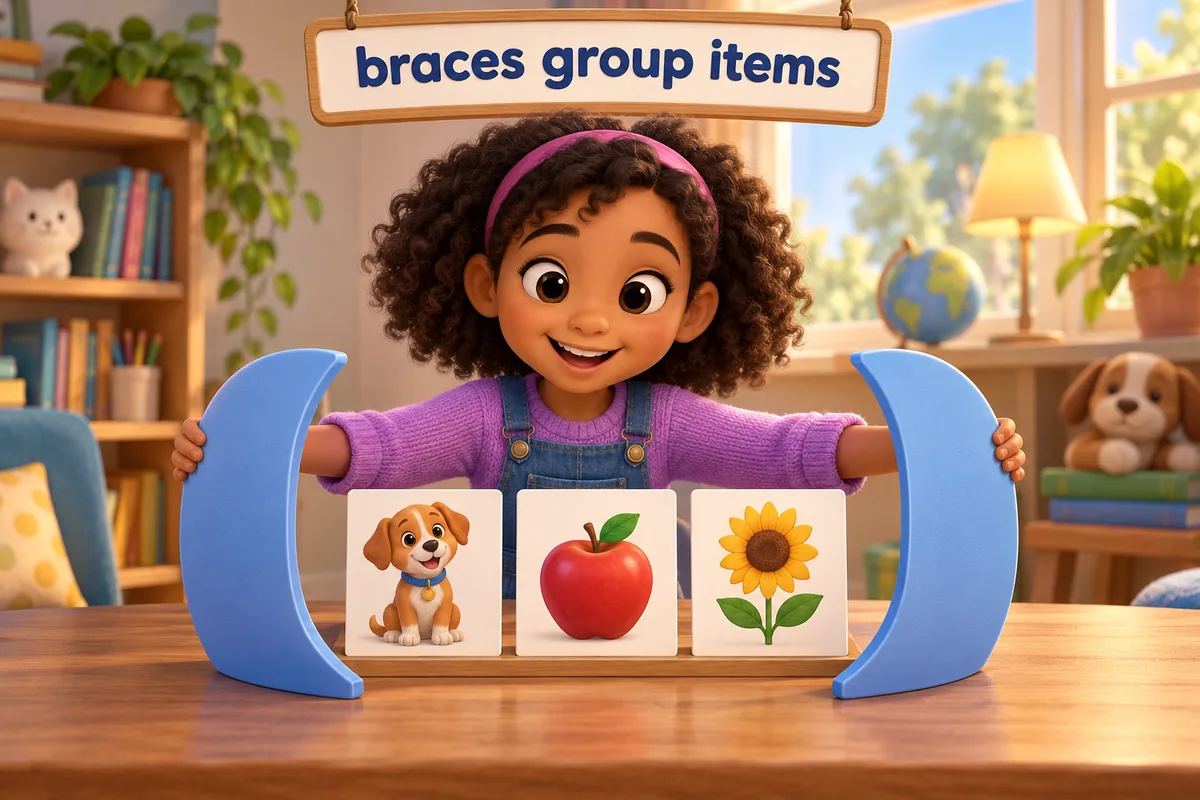
Because the pair looks like a softer version of brackets, beginners assume the two are interchangeable. They are not: the square pair edits someone else’s words, while the curly pair groups items, and a text that swaps them can read as a mistake. The shape itself is the giveaway: the middle of a brace pinches inward to point at the group it holds.
How do you use braces in a sentence?
Each use below keeps the braces around a small group, and the pattern decides where the pair sits. The same shapes appear in short examples of braces in sentences. Because braces nest, they are the one enclosing mark where the level of a group must be checked before the sentence is finished.
| Pattern | Example | What it signals |
|---|---|---|
| braces inside parentheses | The panel (chaired by Dr Rao {term: two years}) decides. | a set within a set |
| braces for grouped options | Choose a size {small, medium, large}. | a short list treated as one unit |
| braces in maths | {1, 3, 5} | a set of numbers |
| braces in code | if (ready) { start(); } | a block of instructions |
| braces for optional text | bring {up to} two guests | material that may be left out |
Two rules keep the pairs readable: keep each group short, and keep the levels in order. A reader who meets braces inside parentheses reads the round pair first and the curly pair second, so the outer mark should always be the round one. A brace is never a standalone mark of emphasis, so if you want a word to stand out, dashes or parentheses do the job better.
Braces punctuation examples across contexts
Each setting below shows the same pair of marks doing a slightly different job, from a maths class to a technical file. The list also shows that braces travel well between subjects, since the same shape marks a set in maths and a block in code.
| Context | Example | Why this works |
|---|---|---|
| Mathematics | The set {2, 4, 6} lists even numbers. | braces mark a set of values |
| Programming | while (count < 5) { print(count); } | braces hold a block of code |
| Editing | The author (writing in 1912 {see note}) revised the line. | braces nest inside parentheses |
| Forms | Title {Mr, Ms, Dr} | braces group the allowed choices |
| Music notes | Repeat bars {1-4} twice. | braces group a range of bars |
| Technical writing | Replace {name} with the account holder. | braces mark a placeholder |
| Linguistics | The gloss {pl} marks a plural. | braces tag a category |
| Proofreading | Keep the clause {if short} on one line. | braces mark optional text |
| Teaching | Draw the shape {triangle, square} beside the number. | braces group two options |
| Archives | Box 12 (folder {3}) was missing. | braces sit inside a larger reference |
| Astronomy | The catalogue entry {NGC 224} names the galaxy. | braces hold a code inside a record |
| Apps | Enter the value {0 to 9}. | braces give the allowed range |
Braces, brackets or parentheses: which mark do you need?
The three marks look related but never swap, because each answers a different question about the material it holds.
| Question | Braces | Brackets | Parentheses |
|---|---|---|---|
| What does it hold? | a set or a group | an editorial insert | an aside or detail |
| How common in prose? | rare | occasional | common |
| Typical setting | maths, code, forms | quotations, citations | everyday writing |
| Can it nest? | yes, inside parentheses | rarely | yes, as the outer pair |
| Example | {a, b} | [see note] | (as agreed) |
Use braces only when you need to group a set inside another wrapping, use brackets to add your own words to a quotation, and use parentheses for an ordinary aside; choosing the wrong pair looks like a typo even when the meaning survives. In practice you rarely need braces at all, because most asides and inserts have a round or square home. Reserve the curly pair for a genuine set, a block of code or a placeholder, and the text stays clean. If a draft shows braces where parentheses would do, simplify the mark rather than the meaning.
Word forms and related punctuation of braces
Each term below names one part of the pair, and more ways to write braces in a sentence sit on the same reference page.
| Term | What it names | Example |
|---|---|---|
| braces | the pair { } | {a, b} |
| opening brace | the left mark | { |
| closing brace | the right mark | } |
| curly brackets | another name for braces | { } |
| bracketed | enclosed in brackets | [see note] |
| parenthetical | enclosed in parentheses | (as agreed) |
Names matter when you proofread, because a note about a curly bracket may mean braces while a note about a bracket means the square pair alone. Treating the two as identical hides the real question, which is how many levels of wrapping the text needs.
Common mistakes with braces
Most brace errors come from mixing it with a nearby mark or from losing one half of the pair.
- Incorrect: The chair (nods) {and smiles). Correct: The chair (nods and smiles). Rule: never mix a brace with a parenthesis in one pair.
- Incorrect: Choose {red, blue. Correct: Choose {red, blue}. Rule: an opening brace needs its closing partner.
- Incorrect: The panel {chaired by Dr Rao (term two years)} decides. Correct: The panel (chaired by Dr Rao {term: two years}) decides. Rule: the round pair wraps the square job.
- Incorrect: She said the plan was {late}. Correct: She said the plan was [late]. Rule: an editorial insert in a quotation takes brackets.
- Incorrect: We met {yesterday}. Correct: We met (yesterday). Rule: an ordinary aside takes parentheses, not braces.
Read the pair aloud as a single unit, and any mismatch becomes easy to spot: an unclosed brace leaves the rest of the sentence sounding unfinished.
Practice using braces
- Fill in the blank: The set ___ lists the odd numbers.
- Choose the better mark: the aside (as agreed / {as agreed}) belongs here.
- Correct the error: Choose {tea, coffee.
- Build a line: show a set of three colours inside braces.
- Spot the setting: which place uses braces as a block, (a) a maths set, or (b) a block of code?
- Fill in the blank: The caption (figure ___3) sits under the map.
Answers
- {1, 3, 5}, because braces mark the set.
- (as agreed), because an aside takes parentheses.
- Choose {tea, coffee}; the closing brace was missing.
- {red, blue, green}, grouping three colours as one set.
- (b), because a block of code is held in braces.
- (figure {3}), because a set sits inside the round aside.
The bottom line
Braces punctuation in English marks a small group inside a larger unit, and the pair almost always appears in maths, code or a form rather than in ordinary sentences. Wrap a set in { and }, keep every opening brace matched with a closing one, and reach for parentheses or brackets when the job is an aside or an editorial insert. Match the mark to the job, and the reader reads the group as one unit. Used this way the pair never draws attention to itself, which is exactly what a quiet grouping mark should do in finished prose.
Frequently asked questions about braces
Are braces the same as curly brackets?
Yes, the two names point to the same pair of marks, { and }. Curly brackets is the older printing name, while braces is the usual term in maths and computing. Both describe the curved shape, and both wrap a small group together. Whichever name you use, the job is the same.
Do braces ever appear in normal English writing?
They are rare in ordinary prose, where parentheses handle asides and brackets handle inserts. Braces turn up mainly in technical material such as maths sets, computer code, forms and glosses. In an essay or a letter you can usually replace a brace with a plain pair of parentheses without losing meaning.
Can I nest braces inside parentheses?
You can, and that is the standard order, so a set inside an aside reads (details {term}). Nesting the other way, with parentheses inside braces, looks confusing and is best avoided. Keep each opening mark paired with its own closing mark so the levels stay clear to the reader.
How do I type braces on a keyboard?
On most keyboards the braces share keys with the square brackets, reached with the shift key, so shift plus the bracket key gives an opening or closing brace. If your layout hides them, a symbol menu on the device will insert the pair. Check that both halves appear in the finished text.