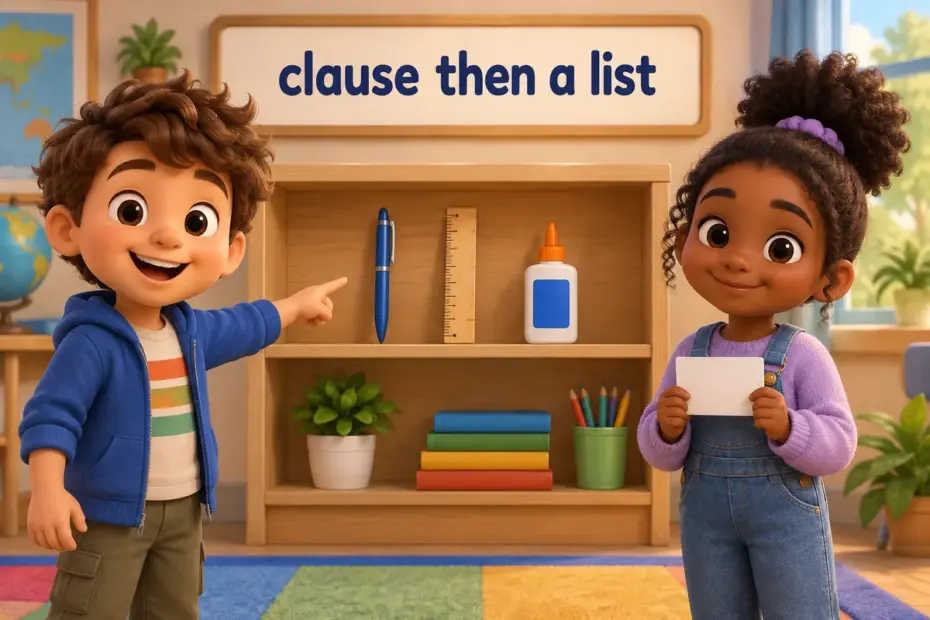
Colon in English rules uses and examples all point to one habit: a colon introduces only what the sentence has already set up. The mark appears before a list, an explanation or a quotation, never between a verb and its object. “We need three things: a pen, a ruler and glue” shows the pattern in action.
Colon in English rules uses and examples at a glance
- A colon introduces a list, an explanation or a quotation.
- It comes after a complete clause, never after a bare verb.
- A colon is not the same as a semicolon, which joins two full clauses.
- In titles and labels, a colon often separates a main part from a subtitle.
- It also appears in fixed shapes such as times and ratios.
What are the colon rules in English?
The colon has a settled set of jobs, and each one begins with a clause that could stand alone; other small marks carry fixed rules too, as with adjectives and articles a an the.
| Rule | Example | What it shows |
|---|---|---|
| Introduce a list | Bring three things: a pen, a ruler and glue. | sets up the items |
| Introduce an explanation | One thing was clear: the plan had failed. | adds the reason |
| Introduce a quotation | She said one word: no. | presents direct speech |
| After a formal salutation | Dear Dr Rao: | opens a formal letter |
| Times and ratios | 10:30, a ratio of 3:1 | a fixed technical use |
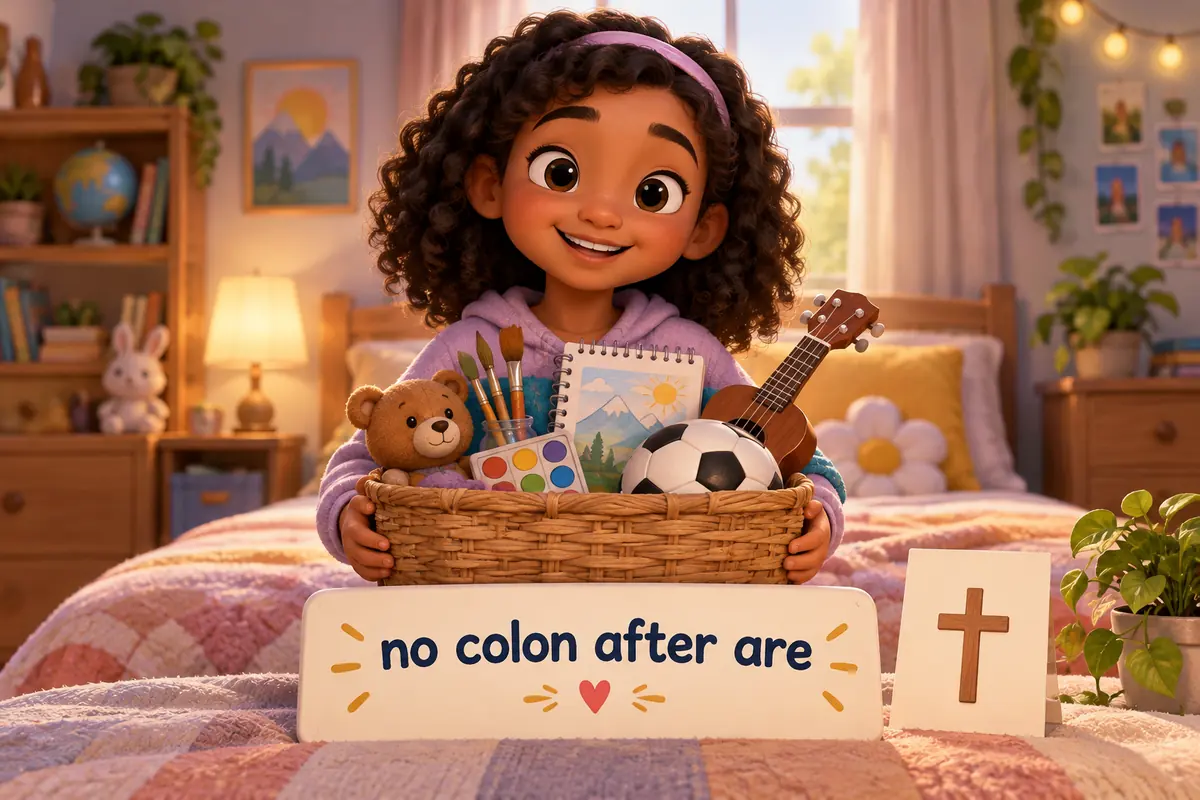
| Not after a verb | Her hobbies are reading and cycling. | no colon before an object |
The single test that covers nearly every case is to read the words before the mark on their own; if they form a complete sentence, a colon may follow, and if they do not, it may not. That is why a list always sits after a full clause rather than after a verb.
How do you use a colon in a sentence?
Every pattern below builds on the same rule, so the mark itself is easy once the clause is complete; ready-made lines sit in colon sentence examples.
| Pattern | Example | What it signals |
|---|---|---|
| clause + colon + list | We need two things: paper and tape. | a complete clause then a list |
| clause + colon + explanation | He won nothing: the race was cancelled. | a cause after the mark |
| clause + colon + quotation | She whispered: I am ready. | direct words |
| colon + capital letter | One rule stands: Always check your work. | a full sentence after the mark |
| no colon after a verb | The items are paper and tape. | an object, not a list set-up |
| colon in a title | Maths: A Short History | a subtitle style |
Notice that the mark itself never chooses the job; the clause in front of it does. Build a complete clause, then add the colon and whatever it introduces, and the sentence stays correct without a second check.
Colon in English rules uses and examples across contexts
Each setting below shows the mark doing real work, from a shopping list to a formal letter.
| Context | Example sentence | Why this works |
|---|---|---|
| Shopping list | Buy these: milk, bread and tea. | a complete clause then items |
| Workplace email | There is one problem: the file is missing. | an explanation after the mark |
| News report | The result was decisive: the team won by four. | a detail that expands the claim |
| Academic writing | Three factors matter: cost, speed and safety. | a formal list set-up |
| Story | He answered with one word: no. | a single word after the mark |
| Formal letter | Dear Sir: | the salutation in some styles |
| Recipe | Add the dry mix: flour, sugar and salt. | an instruction then a list |
| Schedule | The talk starts at 14:30. | a fixed time use |
| Sports result | They won by a margin of 3:1. | a fixed ratio use |
| Book title | Rivers: A Natural History | a main title and subtitle |
| Meeting notes | Two points to note: the date and the room. | a formal set-up for items |
| Notice board | Opening hours: 9 to 5. | a label before a short list |
The same mark serves a shopping note and a printed book, because its job never changes; only the words around it shift with the setting. A learner who can spot one correct use can recognise them all.
What is the difference between a colon and a semicolon?
The two marks look alike but do opposite things, and mixing them is the commonest punctuation slip; the choice is set out in colon vs semicolon.
| Test | Colon | Semicolon |
|---|---|---|
| What it does | introduces what follows | joins two full clauses |
| Usual shape | clause then a list or reason | clause then clause |
| Example | One thing was clear: the plan failed. | The plan failed; we tried again. |
| Can a list follow? | yes | no |
| Shows a link or a lead-in | a lead-in | a link |
Use a colon to point forward to something the sentence promised, and a semicolon to balance two complete sentences as equals; swapping them changes the logic of the line. Reading the words before and after the mark as separate units shows at once which of the two fits.
Word forms and related punctuation of colons
| Term | Note | Example |
|---|---|---|
| colon | a single mark | two things: this and that |
| semicolon | a mark plus a period above | we tried; it worked |
| capital after colon | allowed before a full sentence | One rule: Always check. |
| lower-case after colon | usual before a list | these: milk, bread and tea |
| ratio colon | no spaces | 3:1 |
| time colon | no spaces | 10:30 |
The capital-after-colon question causes more uncertainty than any other, and the practical answer is that a full sentence may start with a capital while a list stays lower-case. Consistency within one document matters more than which style you pick.
Common mistakes with colons
Each wrong line below breaks one rule, and the fix is a small edit to the sentence or the mark.
- Incorrect: Her hobbies are
:reading and cycling. Correct: Her hobbies are reading and cycling. Rule: no colon after a verb and its object. - Incorrect: We bought
:milk, bread. Correct: We bought milk and bread. Rule: a colon needs a complete clause before it. - Incorrect: He was tired
;so he slept. Correct: He was tired, so he slept. Rule: keep a comma before so, not a mark that joins clauses. - Incorrect: One point
:the bus was late. Correct: One point: the bus was late. Rule: add a space after the colon. - Incorrect: The plan failed
;we tried again: it worked. Correct: The plan failed, we tried again, and it worked. Rule: do not stack marks of the same job in one sentence.
A comma marks a pause, so even careful comma rules will not cover a colon’s job; the two marks answer different questions. Each slip above is fixed by completing the clause before the mark or by choosing the semicolon for two joined sentences.
Practice using colons
- Fill in the blank: We need three things ___ paper, tape and glue.
- Choose the better mark: The race was cancelled (: / 😉 so we went home.
- Correct the error: Her hobbies are: reading and cycling.
- Build a sentence: introduce an explanation after a complete clause.
- Spot the mark: which one joins two full clauses, a colon or a semicolon?
- Fill in the blank: One rule stands ___ Always check your work.
Answers
- colon, because a complete clause introduces the list.
- (:) fits only if written as a colon plus a clause; here so he went home needs a comma, so no colon.
- Her hobbies are reading and cycling; no colon after a verb.
- One thing was clear: the plan had failed.
- A semicolon joins two full clauses.
- colon, because a full sentence follows the mark.
The bottom line
Colon in English rules uses and examples share one idea: the mark introduces what a complete clause has already promised, whether that is a list, an explanation or a quotation. Keep a full clause before the colon, never put one between a verb and its object, and use a semicolon when the job is to join two sentences. Match the mark to the job, and the sentence reads as cleanly as it sounds. Because the rule is one test rather than a long list, it holds for every kind of writing a learner is likely to meet.
Frequently asked questions about colons
Does a capital letter follow a colon?
Either is allowed, but the choice depends on what follows. If a full sentence comes after the colon, a capital letter is common, as in One rule stands: Always check your work. If a list or a short phrase follows, keep the first word lower-case, as in these: milk, bread and tea.
Can a colon follow any part of a sentence?
No, a colon should follow a clause that could stand as a sentence on its own. That means it cannot sit between a verb and its object, so Her hobbies are reading and cycling takes no colon. The test is to read the words before the mark as a complete sentence.
What is the difference between a colon and a dash?
A colon introduces a list or an explanation in a fairly formal way, while a dash can do similar work with a more casual tone. A colon is the safer choice in reports and essays, and a dash belongs in informal writing. Both point forward, but the register differs.
Should a colon have a space after it?
In ordinary prose, put one space after the colon, as in One point: the bus was late. The main exceptions are fixed technical forms such as a time of 10:30 or a ratio of 3:1, where no space appears. Getting the space right avoids a common typo.