An essay about persuasive writing shows how a writer tries to change a reader’s mind by stating a claim and supporting it with reasons. Persuasion uses evidence, clear order and a closing line that tells the reader what to do next, so every part pushes toward one aim.
Essay about persuasive writing at a glance
- Persuasive writing tries to convince a reader to agree or to act.
- It states a claim, then gives reasons and evidence.
- Strong persuasion answers the most likely opposing point.
- Emotive words and repetition can help when they stay honest.
- It ends with a call to action that names the next step.
What is persuasive writing?
Persuasive writing is any text whose main job is to convince the reader to think or act in a certain way, from a school poster to a campaign speech. It leans on reasons and evidence rather than on facts alone, because the goal is a change of mind. The table below separates the main tools writers use.
| Tool | What it does | Example |
|---|---|---|
| Claim | States the main point | School should start an hour later. |
| Reason | Gives a supporting idea | Sleep helps pupils learn. |
| Evidence | Backs the reason with facts | Doctors link enough sleep to better memory. |
| Emotive words | Makes the reader care | A tired start costs children their best hours. |
| Call to action | Tells the reader what to do | Ask the school council for a later start. |
How do you build a persuasive paragraph?
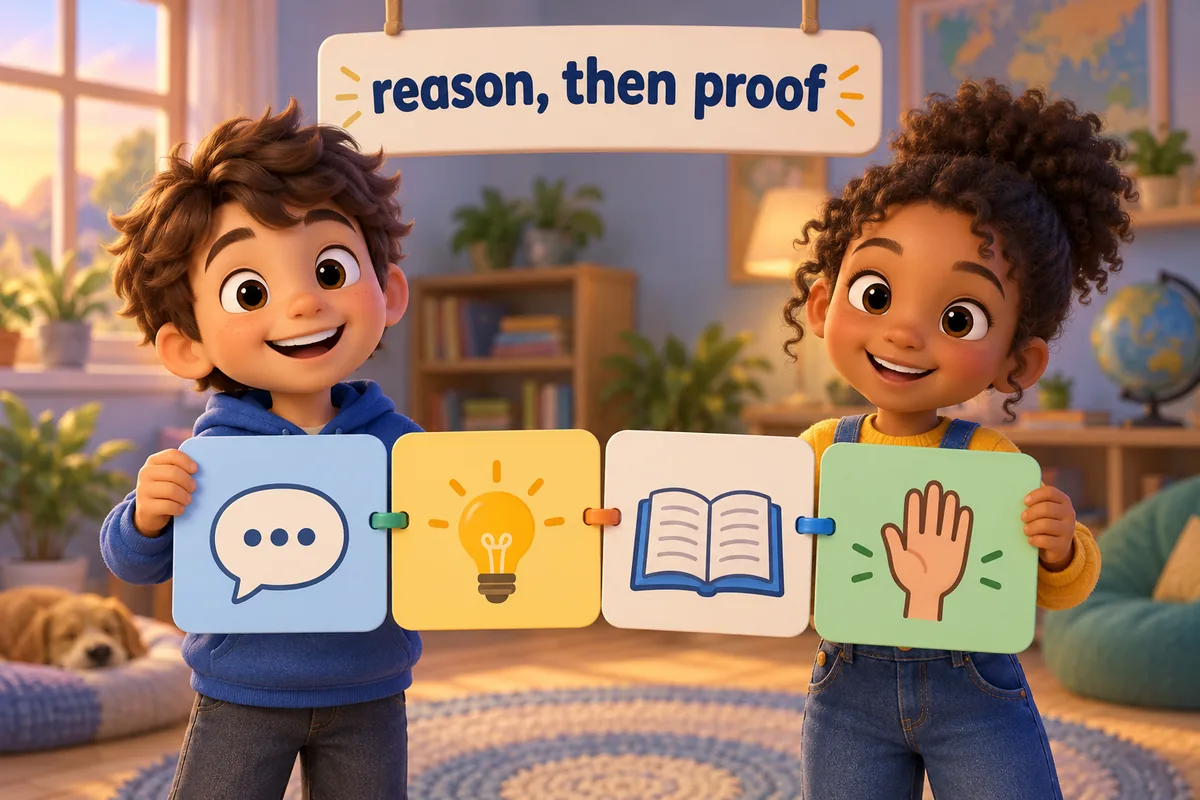
A persuasive paragraph follows a simple chain: claim first, reason second, evidence third, and a link to the next point. Building the chain in order stops the writing from rambling. Reading a set of persuasive sentences first gives writers ready made models to imitate.
| Step | What the writer does | Example sentence |
|---|---|---|
| State | Give the claim plainly | Recess should be longer. |
| Support | Add the strongest reason | Children focus better after moving. |
| Prove | Add evidence or an example | Teachers report calmer afternoon lessons. |
| Answer | Address the other side | Some worry about lost lesson time. |
| Close | End with a request | Ask the council for ten more minutes. |
Essay about persuasive writing: examples across contexts
Persuasion appears in many places, and the same structure adapts to each. The examples below show a setting, a claim and the tool doing the work. A page of essay sentences supplies more openers for each setting.
| Context | Example | Why it works |
|---|---|---|
| School poster | Our playground needs a shade tree. | A clear claim with an easy action. |
| Letter to a council | Please add a crossing near the school. | A request backed by a safety reason. |
| Class debate | Homework should be shorter on Fridays. | Stated view with reasons to defend. |
| Newspaper column | The town should fund the library. | A claim supported by public benefit. |
| Online review | This book is worth reading. | A judgement with examples as proof. |
| Speech | We can plant a garden this spring. | A call to action that names the step. |
| Advertisement | Choose the reusable bottle. | A claim plus a concrete benefit. |
| Science pitch | Our class should recycle paper. | A claim joined to a measurable result. |
Persuasive writing or informative writing
| Point | Persuasive writing | Informative writing |
|---|---|---|
| Main aim | Change a mind or prompt action | Help the reader understand |
| Structure | Claim, reasons, evidence, close | Introduction, facts, summary |
| Language | Emotive and direct | Neutral and factual |
| Reader role | Decide or act | Learn |
| Typical ending | A call to action | A closing fact |
Persuasive writing pushes for agreement and action, while informative writing only wants the reader to understand, so a writer should decide the aim before choosing the shape. A clear aim keeps the words honest.
Terms used in persuasive writing
Writers meet these terms in almost every persuasive task, so they are worth learning early. A list of adjectives for writing helps add the descriptive force persuasion needs.
| Term | Meaning | Example |
|---|---|---|
| claim | The main point the writer argues | Recess should be longer. |
| reason | A supporting idea | Children focus better after moving. |
| evidence | A fact that backs a reason | Teachers report calmer lessons. |
| counterargument | The opposing point | Some worry about lost lesson time. |
| call to action | A request for the reader to act | Ask the council for more minutes. |
| repetition | Repeating a key phrase | More play, more focus. |
More persuasive writing phrases to use
Ready phrases help a writer begin and connect ideas without a long pause. Use them as tools, not as a script, so each line still carries a real reason. The phrases below fit a claim, a reason or a closing request.
| Purpose | Phrase | What it does |
|---|---|---|
| For a claim | I believe that… | Names the writer view at once. |
| For a reason | This matters because… | Introduces the support. |
| For evidence | For example… | Adds a concrete detail. |
| For the other side | Some people argue that… | Shows a fair, balanced view. |
| For a closing | That is why you should… | Ends with a clear request. |
| For emphasis | Above all… | Marks the strongest point. |
| For a concession | Admittedly, some may object… | Shows the writer can be fair. |
| For a summary | In short… | Restates the main point near the end. |
| For a warning | If we do nothing… | Shows a consequence of inaction. |
These openers work in a letter, a poster or a speech, so a writer can reuse them across many persuasive tasks.
Mistakes with persuasive writing
Recess should be longer because it should.Correct: Recess should be longer because moving helps children focus. Rule: Every claim needs a reason that adds real information.Everyone knows my idea is best.Correct: Teachers report calmer lessons after longer breaks. Rule: Evidence persuades more than a bare opinion.I am right, so there is no other view.Correct: Some worry about lost lesson time, yet shorter breaks still work. Rule: Answering the other side makes a case stronger.Please, please, please agree.Correct: Ask the council for ten more minutes. Rule: A clear request works better than begging.We should be nicer and also recycle and also read more.Correct: Our class should recycle paper. Rule: One claim per piece keeps the argument focused.
Practice using persuasive writing
Try each item before reading the answers below. The tasks mix fill in the blank, choosing the stronger line and building a claim.
- Fill in the blank: A persuasive paragraph states a claim, then gives a reason and ________.
- Choose the stronger line: (Everyone should agree with me / Walking to school keeps us fit and saves fuel).
- Correct the error: “Our library needs books because it needs books.”
- Build a claim about a longer lunch break using one reason.
- Name the tool used in this line: A tired start costs children their best hours.
- Spot the register: Which ending fits a letter to a head teacher? A) So yeah, whatever. B) Please consider a ten minute change.
Answers
- Evidence, because a reason becomes convincing when a fact or example backs it.
- The second line, because it gives a concrete benefit instead of a bare demand.
- Our library needs books because pupils have none to borrow, because this adds a real reason.
- Lunch should be longer because children need time to eat and play, which states a claim plus a reason.
- Emotive words, because the line makes the reader feel the cost rather than stating a fact.
- Ending B, because it makes a polite, specific request suited to a formal letter.

The bottom line
An essay about persuasive writing succeeds when the claim is clear, the reasons are supported and the reader is answered fairly. Persuasion ends with a call to action, so a strong piece tells the reader exactly what to do next.
Frequently asked questions about persuasive writing
What are the main parts of persuasive writing?
The main parts are a claim, reasons, evidence, an answer to the other side and a call to action. The claim states the point, the reasons explain why, and the evidence proves it. The closing request tells the reader exactly what to do next.
How is persuasive writing different from telling a story?
A story tells what happened in time order, while persuasive writing argues for one point of view. A story tries to entertain, and persuasion tries to convince. The two use different shapes, different tenses and different endings, so a writer should pick the right one.
Can children use persuasive writing at school?
Yes. Children use it in letters, posters, debates and reviews. A simple structure of claim, reason and request is easy to learn. Teachers often start with a topic the class cares about, such as a longer break or a garden.
What makes a persuasive piece weak?
A piece is weak when it gives a claim with no reasons, ignores the other side or begs instead of asking. Weak persuasion also repeats the same point. Adding one fact and one answered objection makes the same claim much stronger.