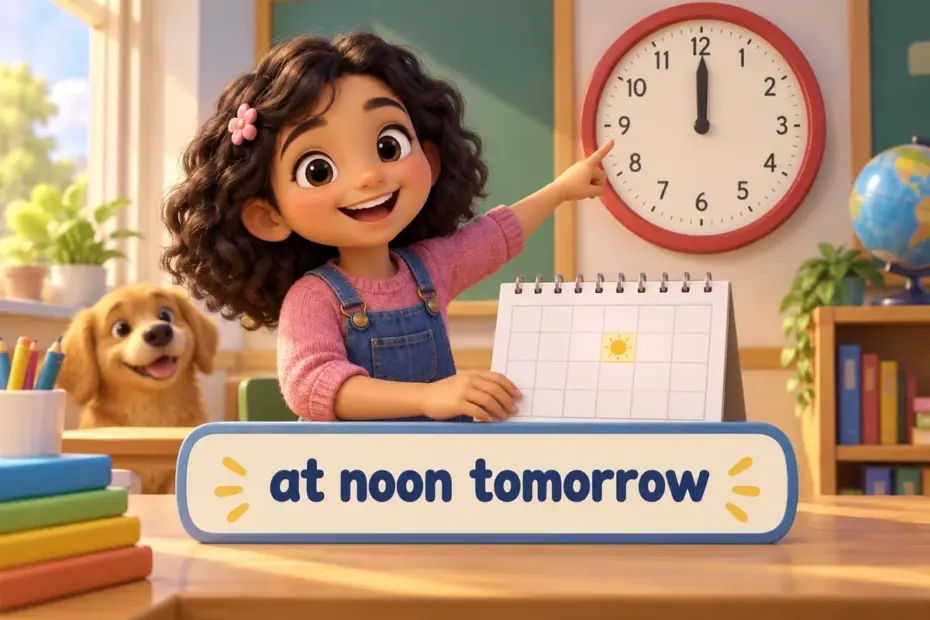
Future continuous structure and examples come down to one pattern: will be plus an -ing verb. The tense describes an action that will be in progress at a chosen future moment, as in “At six I will be driving home.” It answers what will be happening, not merely what will happen.
Future continuous structure and examples at a glance
- The positive form is will be + verb-ing: she will be working.
- The negative inserts not: she will not be working.
- Questions move will before the subject: will she be working?
- The tense shows an action in progress at a future time.
- Time markers such as at eight or this time tomorrow anchor the moment.
What is the future continuous structure?
The future continuous is a verb phrase built from will, be and an -ing verb, and it names an action that will be happening round a future point. The auxiliary will never changes with the subject, so every person takes the same shape. Because those helping verbs never change, the only real choices a writer makes are the time marker and the main verb. The related page on continuous in a sentence shows how the -ing form behaves in other tenses too.
| Form | Structure | Example |
|---|---|---|
| Positive | subject + will be + verb-ing | They will be travelling at midnight. |
| Negative | subject + will not be + verb-ing | They will not be travelling after dark. |
| Yes / no question | will + subject + be + verb-ing | Will they be travelling tonight? |
| Wh- question | wh-word + will + subject + be + verb-ing | When will they be travelling? |
| Short answer | Yes, subject + will. | Yes, they will. |
When do you use the future continuous?
The tense earns its place in a few clear jobs, and each job answers a slightly different question. A reader meets it most often in plans, predictions and polite enquiries, so the function is worth naming directly. The time marker, often a short phrase, pins the exact moment and usually sits at the start of the clause, as the page on in future shows.
| Use | Structure in context | Example |
|---|---|---|
| Action in progress later | at + future time | At nine I will be studying. |
| A fixed future plan | already arranged | We will be meeting the client on Monday. |
| Prediction about activity | a future scene | This time next year she will be running her own shop. |
| Polite enquiry | question form | Will you be needing anything else? |
| Overlapping events | two clauses | While you are cooking, I will be setting the table. |

Future continuous structure and examples across contexts
The same pattern appears in classrooms, offices and travel plans, and the setting changes only the time marker and the verb. Eight sentences show the range, and a look at future in a sentence adds more frames.
| Context | Example sentence | Why this works |
|---|---|---|
| Classroom | At ten tomorrow the class will be taking the spelling test. | at plus a clock time fixes the moment |
| Workplace email | I will be working from home on Thursday, so call my mobile. | the tense explains the day’s arrangement |
| Travel plan | We will be landing in Lisbon just after sunrise. | the action is in progress around an arrival point |
| Prediction | By 2050 many drivers will be using electric cars. | the tense paints an ongoing future scene |
| Polite enquiry | Will you be joining us for dinner? | a question softens the request |
| Home chat | Do not ring at seven; I will be bathing the baby. | the overlap explains why the call is awkward |
| News report | The bridge will be closing for repairs next month. | a firm arrangement stated as an ongoing change |
| Academic writing | Researchers will be measuring rainfall across the region. | the ongoing method suits a study description |
Future continuous vs future simple
Writers often swap the future continuous for the future simple, because both look forward. The difference is whether the action is a point or a stretch, and the choice changes what the listener pictures. A promise lands as a single point in time, while a description of activity spreads across the moment, and that spread is exactly what the continuous form adds.
| Attribute | Future simple | Future continuous |
|---|---|---|
| Structure | will + base verb | will be + verb-ing |
| Focus | A completed fact or decision | An action in progress |
| Example | I will call you at six. | I will call while you are travelling. |
| Feel | Short and decisive | Ongoing and descriptive |
| Common use | Promises and offers | Arrangements and background scenes |
Verdict: use the future simple for a single promised action, and the future continuous when you want to show that something will be underway.
Word forms and grammar of the future continuous
The tense has no irregular parts beyond the fixed helping verbs, so accuracy depends on word order and on remembering both auxiliaries. Keep will and be side by side and the whole form holds.
| Form | Part of speech | Example |
|---|---|---|
| will be travelling | verb phrase | We will be travelling by night. |
| will not be travelling | negative verb phrase | We will not be travelling by night. |
| Will it be raining? | question verb phrase | Will it be raining at the match? |
| won’t be | contraction | She won’t be waiting long. |
| be being | unusual continuous of be | He will be being careful is non-standard; say he will be careful. |
| will | modal auxiliary | The modal stays the same for every subject. |
Common mistakes with the future continuous
Incorrect: She will be travel tomorrow. Correct: She will be travelling tomorrow. The frame needs the -ing form after be, not the base verb.
Incorrect: They will travelling at noon. Correct: They will be travelling at noon. Both auxiliaries are required: will plus be plus the -ing verb.
Incorrect: Will she will be working? Correct: Will she be working? The subject moves between will and be, and a second will is never added.
Incorrect: I be working at nine. Correct: I will be working at nine. A bare be cannot carry the future, so the modal will must be present.
Incorrect: He will be come at five. Correct: He will be coming at five. Only -ing verbs follow be in this tense, because the action must be shown as ongoing.
Practice using the future continuous
Five tasks mix fill-in-the-blank, error correction and sentence building. Watch the word order as you write, then check the reasoning.
- Fill the gap: At eight tomorrow I ______ (write) my report.
- Fill the gap: ______ you ______ (wait) at the station at six?
- Correct the error: They will be study all evening.
- Make it negative: She will be driving to work.
- Build a sentence about next Monday using the future continuous.
Answers
- will be writing. The frame is will be plus the -ing verb, and the time marker fixes the moment.
- Will you be waiting. The question form moves will in front of the subject, then be plus wait-ing.
- They will be studying all evening. After be the verb must take -ing, not the base form.
- She will not be driving to work. The negative places not between will and be.
- Next Monday I will be presenting the budget to the team. The pattern is will be plus presenting.
The bottom line
Future continuous structure and examples rest on one frame: will be plus the -ing verb. The tense shows an activity in progress at a future moment rather than a single finished act, which is why it suits plans, arrangements and background scenes. Move will to the front for a question and place not after will for a negative. Keep both auxiliaries, and this tense will never slip.
Frequently asked questions about the future continuous
What is the difference between will be doing and will do?
Will be doing shows an action in progress around a future time, while will do states a single completed decision or promise. So I will call you at six presents one event, and I will be working at six describes what is underway. Choose the continuous form for a stretch of time.
Can the future continuous describe the present?
Not normally, because will looks forward. The present continuous covers an action happening now, as in I am writing a letter, and the future continuous covers an action around a later moment, as in I will be writing at noon. The tense, not the -ing ending, sets the time.
Is the future continuous formal or informal?
It sits comfortably in both registers. A workplace email uses it for a plan, as in I will be working from home, and a conversation uses it for an arrangement, as in we will be meeting at eight. The formality comes from the surrounding words, not from the tense itself.
How do I make a future continuous question?
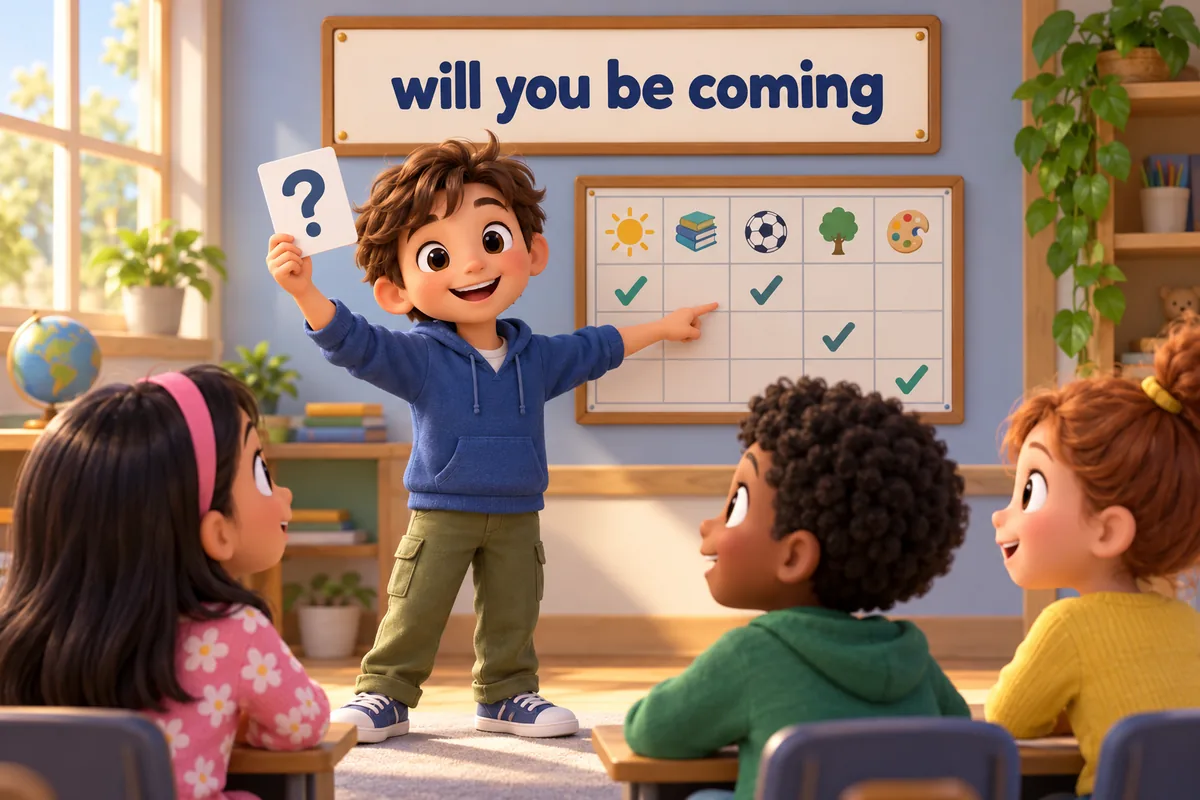
Move will in front of the subject and keep be before the -ing verb: will you be joining us? For a wh-question, put the question word first: when will you be arriving? Add the base verb as -ing, and never repeat will after the subject.