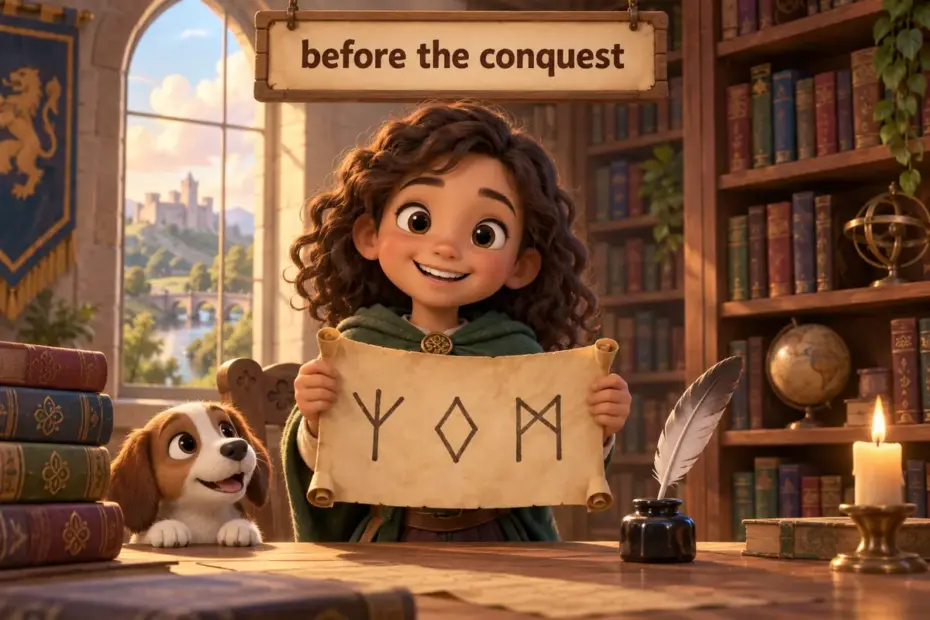
How to speak Old English begins with the letters and sounds the earliest writers used, not with the words of Shakespeare. The language spoken before the Norman Conquest had its own pronouns, its own verb endings and a mostly Germanic vocabulary.
How to speak Old English at a glance
- Old English is the earliest recorded stage of the English language.
- It was spoken before the Norman Conquest, earlier than Middle English.
- It used letters such as thorn, eth and ash that modern English dropped.
- Its pronouns, verb endings and word stock differ from modern English.
- Old English is not the English of Shakespeare, which is much later.
What is Old English?
Old English is the earliest recorded stage of the English language, spoken before the Norman Conquest and earlier than Middle English. It is not the English of Shakespeare, which came centuries later, because an Old English sentence needs a glossary even for a fluent modern reader. The page on adjectives for old shows how the word old pairs with stage names across the language. A phrase such as good old days in a sentence shows how older wording lives on in modern speech.
| Feature | Old English | Modern English |
|---|---|---|
| Alphabet | thorn (þ), eth (ð) and ash (æ) | modern th and a only |
| Pronouns | hē, hēo, hit | he, she, it |
| Verb endings | verbs change strongly with the subject | far fewer endings today |
| Word stock | largely Germanic words | many French and Latin borrowings |
| Spelling | spelling varied between scribes | one fixed spelling today |
| Reading | needs a glossary | read directly |
How do you pronounce Old English words?
Old English spelling stays close to the sound the scribes heard, so most letters are pronounced and few are silent. A handful, such as c and g, shift with their neighbours, so the table gives cautious approximations rather than a full guide. Read each word slowly and let the vowel length carry the rhythm, because Old English marks long sounds with a small stroke.
| Old English word | Approximate sound | Meaning |
|---|---|---|
| hwæt | hwat | what |
| cyning | koo-ning | king |
| þēoden | thay-oh-den | lord or prince |
| ɫīf | weef | woman or wife |
| gōd | gode | good |
| scēawian | shay-ah-wee-an | to look |
Old English in practice: examples across contexts
A beginner meets Old English through a few features at a time rather than whole sentences. Each row pairs a setting with one feature and the modern sentence it explains, and the page on old fashioned in a sentence shows how older words survive in modern speech. Read each row aloud and the older form soon becomes easier to recognise.
| Context | Old English feature | Modern English sentence |
|---|---|---|
| Chat | the pronoun hēo for she | she walks home at dusk. |
| Story | the letter thorn þ for th | the path runs north. |
| Song | the word cyning for king | the king returns at dawn. |
| Letter | the word hlāford for lord | the lord greets the hall. |
| Report | the plural ending -as | the warriors march inland. |
| Lesson | the letter ash æ | the apple is red. |
| Sign | the letter wynn ɫ for w | the wolf waits by the wall. |
| Prayer | the greeting wēs hāl | be well, friend. |
Old English vs Modern English
The two stages look related on the page but behave quite differently in use. One needs study and a word list, while the other is the everyday language of today. The gap between them is wider than most beginners expect, which is why a patient start repays the effort.
| Attribute | Old English | Modern English |
|---|---|---|
| When it was spoken | Before the Norman Conquest | Today |
| Grammar | Strong case and verb endings | Word order carries the meaning |
| Vocabulary source | Mostly Germanic | Germanic, French and Latin |
| Letters | thorn, eth, ash and wynn | the modern twenty-six letters |
| Reading today | Slow, with a glossary | Direct, at normal speed |
Verdict: treat Old English as a separate stage that must be studied, not as modern English in old clothes.
Word forms and related names
The names of the language stages are proper nouns, and a few related terms help a learner place Old English on the timeline. Using the right stage name keeps a discussion clear, because Old English, Middle English and modern English are three different things.
| Form | Part of speech | Example |
|---|---|---|
| Old English | proper noun | Old English is the earliest recorded stage. |
| Middle English | proper noun | Middle English followed after the Conquest. |
| Englisc | the speakers’ own name | the speakers called their language Englisc. |
| modern English | proper noun | modern English reads directly. |
| Old English word | noun phrase | an Old English word often looks unfamiliar. |
| glossary | noun | a glossary helps a reader of Old English. |
Common mistakes about Old English
Most confusion comes from placing Old English in the wrong century or treating it as modern spelling. The five pairs below show the fault beside its repair. Fixing the timeline first clears up most of the others.
Incorrect: Shakespeare wrote in Old English. Correct: Shakespeare wrote in Early Modern English, which is centuries later than Old English. Mixing the two stages is the commonest error.
Incorrect: Old English is just modern English with strange spelling. Correct: Old English has different pronouns, verb endings and word stock, so it is a separate stage rather than odd spelling.
Incorrect: I can read Old English with the modern alphabet. Correct: Old English uses letters such as thorn and ash that modern English dropped, so a reader learns their values first.
Incorrect: Old English sounds like modern English spoken slowly. Correct: its sounds and stress differ enough that a modern speaker catches only a few words without study.
Incorrect: Every Old English word survives today. Correct: many Old English words were lost and replaced by French or Latin borrowings, so the modern word list is only partly the same.
Practice speaking Old English
Six tasks mix fill-in-the-blank, error correction and sentence building. Keep the timeline and the letters in mind, then check the reasoning. Each answer names the fact it rests on, so a wrong reply still teaches a useful detail.
- Fill the gap: The modern word king comes from the Old English ______.
- Fill the gap: Old English used the letter thorn for the ______ sound.
- Correct the error: Shakespeare wrote his plays in Old English.
- Correct the error: Old English is only modern English with odd spelling.
- Build a sentence using the word glossary about reading Old English.
- Name two letters that Old English used but modern English does not.
Answers
- cyning. The Old English noun cyning became the modern word king.
- th. Thorn stood for the th sound that modern English now writes with two letters.
- Shakespeare wrote his plays in Early Modern English. Old English is far earlier than his work.
- Old English is a separate stage with its own grammar and words. It is not modern English with odd spelling.
- A glossary beside an Old English text lists each unfamiliar word. The noun glossary names the word list a reader needs.
- Thorn and ash are two of them. Modern English dropped both letters from its alphabet.
The bottom line
How to speak Old English starts with respect for its distance: it is the earliest recorded stage of the language, earlier than Middle English and far earlier than Shakespeare. Learn the extra letters first, then the pronouns and word stock, and read short texts with a glossary beside you. Treat it as a separate language to study rather than a strange version of modern English, and the patterns will begin to look familiar.
Frequently asked questions about Old English
Is Old English the same as Shakespeare’s English?
No. Shakespeare wrote in Early Modern English, which came centuries after Old English and is close to the language we read today. Old English has different pronouns, verb endings and vocabulary, and it needs a glossary. The two are separate stages on the timeline of English.
How do I start learning Old English?
Begin with the alphabet, especially thorn, eth and ash, then learn the pronouns and a short list of common words. Read simple texts with a glossary beside you and say each line aloud. Grammar comes next, because Old English relies on endings more than modern English does.
How is Old English different from modern English?
Old English marks meaning with case endings and verb endings, while modern English relies mostly on word order. Its vocabulary is largely Germanic, with fewer French and Latin words than today. It also uses letters such as thorn and ash that modern spelling has dropped.
Can I speak Old English like a modern language?
You can learn to read it and to pronounce reconstructed texts, and some enthusiasts hold spoken conversations. Reconstructed pronunciation is a careful approximation rather than a recording, because no speakers survive, so treat any spoken form as a well-reasoned guess.