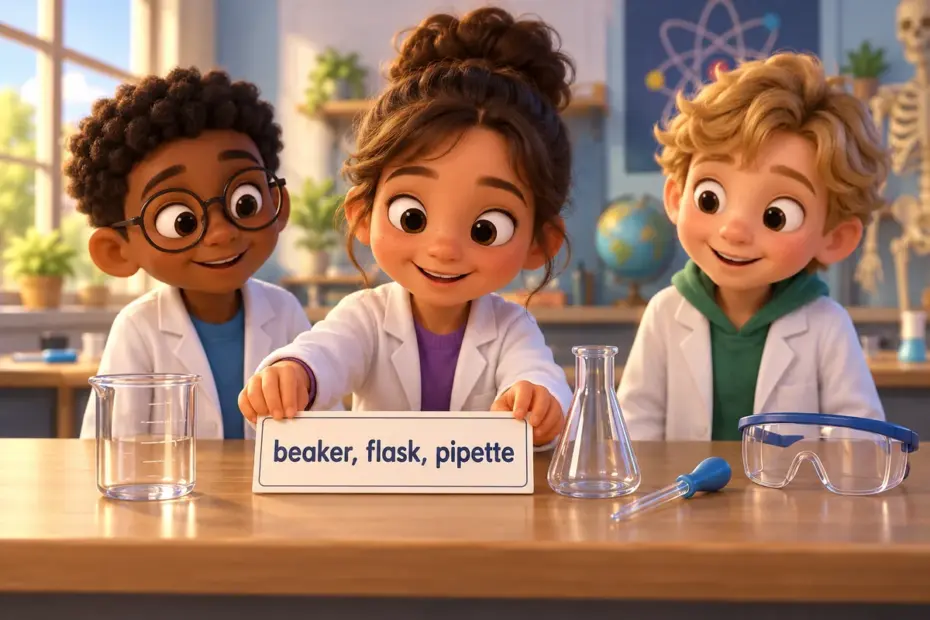
Laboratory equipment names are the words for the tools scientists use every day, from the beaker that holds a liquid to the glove that protects a hand. Each name belongs to a group such as glassware, measuring tools, safety gear or heating equipment, and one example shows the pattern: a pipette measures tiny volumes.
Laboratory equipment names at a glance
- Laboratory equipment names fall into four main groups: glassware, measuring tools, safety gear and heating equipment.
- Most of the names are count nouns, so one beaker becomes two beakers.
- A single item can carry a formal name and a short one, such as volumetric flask and flask.
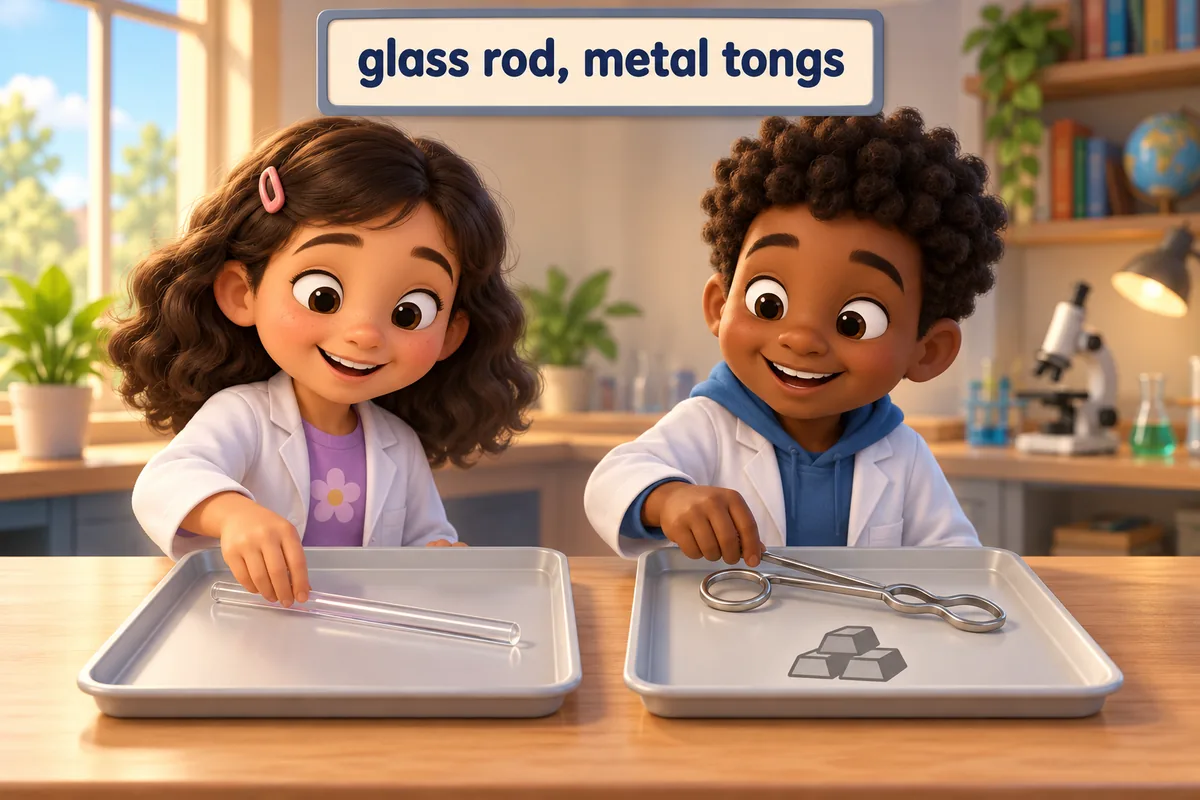
- The material often appears inside the name, as in glass rod or metal tongs.
- The commonest error is calling every glass container a beaker.
What does laboratory equipment include?
Laboratory equipment covers the vessels, tools and protective items used to run an experiment, and the names sort themselves into groups by what the item does. The word laboratory behaves like an ordinary count noun, which you can see in laboratory in a sentence. Not every object in a lab counts as equipment: a chair, a sink or a shelf is furniture, and a chemical such as salt is a reagent, so the name equipment points to the reusable tools that do the work.
| Group | Plain purpose | Common names |
|---|---|---|
| Glassware | hold, mix and heat liquids | beaker, flask, test tube, graduated cylinder |
| Measuring tools | take an exact reading | pipette, burette, thermometer, balance |
| Safety gear | protect the person | goggles, gloves, lab coat, fume hood |
| Heating equipment | apply controlled heat | Bunsen burner, hot plate, tripod, crucible |
| Support and handling | hold or move an item | clamp, retort stand, tongs, spatula |
How are laboratory equipment names built?
Most of these names are either a single word or a compound that joins a describing word to a base noun, and the base noun reveals the group. The pattern becomes obvious once a few names are read together.
| Pattern | Example | What it signals |
|---|---|---|
| material + object | glass rod | the substance the item is made of |
| shape + object | round-bottom flask | the form of the vessel |
| job + object | measuring cylinder | the task the item performs |
| name + base noun | Bunsen burner | an item named after a person |
| base noun alone | pipette | the whole item in one word |
Laboratory equipment names in sentences across contexts
The names appear in science lessons, safety briefings and technical reports, and the register decides how much detail you add. The same naming habit shows in equipment in everyday sentences, where the shared gear of a whole team is named.
| Context | Example sentence | Why this works |
|---|---|---|
| Classroom | Place the beaker on the bench before you pour. | names one vessel by its job |
| Lab report | We filled the graduated cylinder to twenty millilitres. | a precise measuring tool |
| Safety briefing | Wear goggles and gloves at every bench. | protective gear named together |
| Exam question | Name the equipment used to measure a small volume. | asks for a single tool |
| Shopping list | Order six test tubes and one test-tube rack. | count nouns with quantities |
| Teacher instruction | Heat the flask gently on the hot plate. | device plus its setting |
| News report | The lab replaced its old fume hoods last year. | a large fixed item |
| Technician note | The balance needs calibrating before the next run. | a measuring instrument |
| Textbook | A crucible withstands very high temperatures. | defines an item by a trait |
| Poster | Return every pipette to its rack after use. | a rule stated plainly |
Which word should you use?
Two items can look alike while doing different jobs, so match the name to the task rather than the shape. The naming of shared team gear appears again in sports equipment vocabulary, where the same principle applies.
| Situation | Use | Example |
|---|---|---|
| Measure a small exact volume | pipette | Draw ten millilitres with the pipette. |
| Hold and heat a liquid | beaker | Warm the beaker on the tripod. |
| Measure a larger volume | graduated cylinder | Read the cylinder at eye level. |
| Grind a solid | mortar and pestle | Crush the crystals in the mortar. |
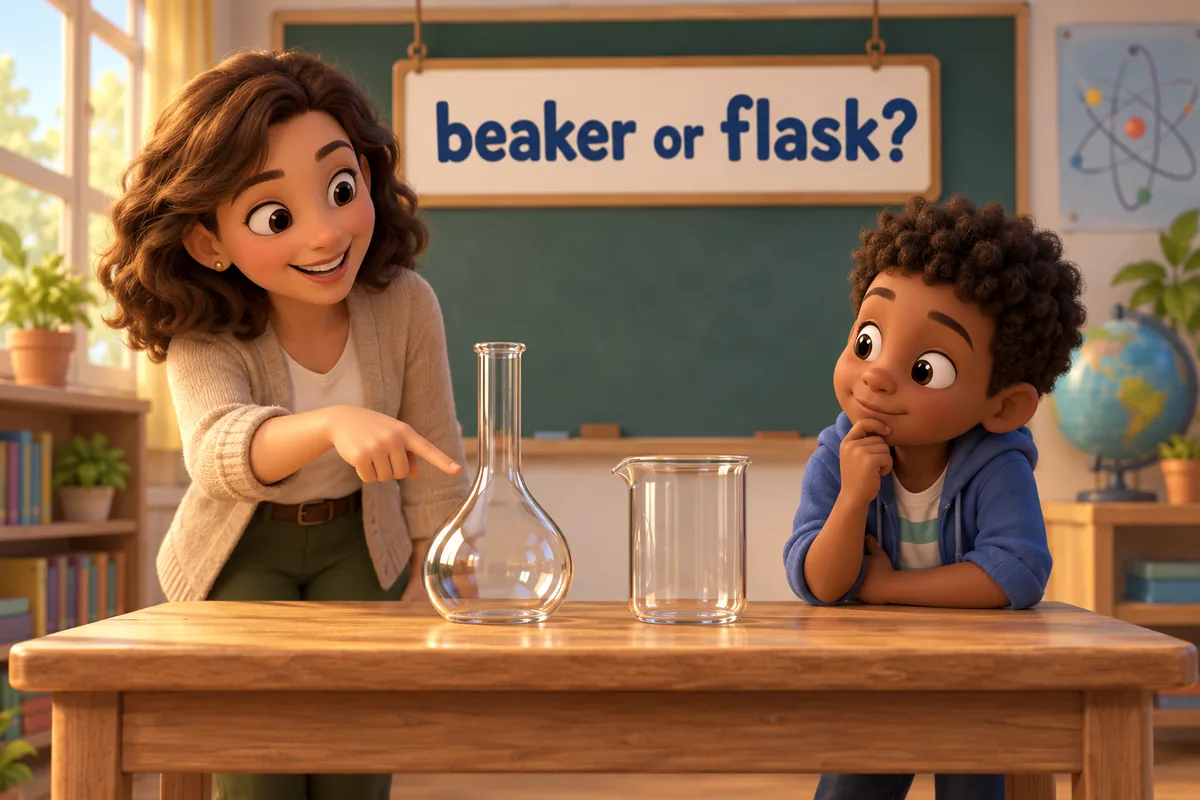
The word beaker is the one learners stretch too far. A beaker has a flat bottom, a small spout and rough graduation marks, so it measures only approximately. For an exact reading, name the pipette, the burette or the graduated cylinder instead.
Word forms and grammar of laboratory equipment
Most names are regular count nouns, but two of the group words are uncountable, and that difference controls the verb. The forms below show the pattern.
| Form | Part of speech | Example |
|---|---|---|
| beaker | count noun | One beaker is enough. |
| beakers | count noun, plural | Two beakers sit on the shelf. |
| pipette | count noun | Pass me the pipette. |
| glassware | uncountable noun | The glassware was washed and dried. |
| equipment | uncountable noun | All equipment must be signed out. |
| apparatus | uncountable noun | The apparatus stood ready on the bench. |
| calibrate | verb | Calibrate the balance each week. |
Equipment, glassware and apparatus take a singular verb and never a plural s: write the equipment is clean, not the equipments are clean. When you need to count, add a partitive such as a piece of equipment or a set of glassware.
Common mistakes with laboratory equipment names
Mistake 1: plural on an uncountable name. Incorrect: The equipments are stored in the cupboard. Correct: The equipment is stored in the cupboard. Rule: equipment has no plural form, so it takes a singular verb.
Mistake 2: beaker for any glass container. Incorrect: Measure exactly five millilitres in the beaker. Correct: Measure exactly five millilitres in the graduated cylinder. Rule: a beaker only gives an approximate reading.
Mistake 3: flask and beaker treated as one word. Incorrect: Heat the mixture in a flat flask. Correct: Heat the mixture in a flat beaker. Rule: a flask has a narrow neck, a beaker has a spout and a flat base.
Mistake 4: missing plural after a number. Incorrect: Collect three test tube from the drawer. Correct: Collect three test tubes from the drawer. Rule: a number greater than one takes the plural count noun.
Mistake 5: safety gear named as a single object. Incorrect: Put on your goggle before you begin. Correct: Put on your goggles before you begin. Rule: the protective items are used in pairs and carry the plural.
Practice using laboratory equipment names
- Fill in the blank: Transfer the liquid with a ___ to get an exact volume.
- Choose the better word: Read the level in the (beaker / graduated cylinder) to the nearest millilitre.
- Correct the error: The glassware is dried, and the equipments are stacked.
- Build a sentence: use test tube to describe storing a small sample.
- Spot the register: which line suits a lab report, (a) Grab that clear thingy, or (b) Place the sample in a clean test tube?
- Fill in the blank: Heat the water in a ___ over the burner.
Answers
- pipette, because a pipette delivers a measured volume with precision.
- graduated cylinder, because it carries fine graduation marks for an exact reading.
- The glassware is dried, and the equipment is stacked; equipment has no plural form.
- The technician sealed the sample in a clean test tube and labelled the lid.
- (b), because a lab report uses precise, standard names.
- beaker, because a beaker holds liquid safely over a flame.
The bottom line
Laboratory equipment names sort into four groups, and the group word is the safest choice when you are unsure of an exact item. Glassware holds liquids, measuring tools read them, safety gear protects the user, and heating equipment supplies controlled warmth. Learn the group first, then the precise name, and the beaker-for-everything error disappears.
Frequently asked questions about laboratory equipment
Is equipment a countable or uncountable noun?
Equipment is uncountable, so it has no plural form and takes a singular verb, as in the equipment is checked each morning. If you need to count individual items, add a partitive such as a piece of equipment or two items of equipment rather than writing equipments.
What is the difference between a beaker and a flask?
A beaker has a flat base, a straight side and a small spout, and it measures only roughly. A flask has a narrow neck, often a rounded body, and can be closed with a stopper. The neck and the base shape, not the size, tell you which name to use.
Why is goggles always plural?
Goggles protect both eyes at once, so the item is treated as a pair and named in the plural, like scissors or trousers. The singular goggle survives only as an adjective, as in a goggle strap, or when one lens is meant on its own.
Can I call all lab tools apparatus?
Apparatus is a broad uncountable term for the set of equipment arranged for a task, so it fits a whole setup rather than one named item. Use the exact name such as pipette or crucible when a specific tool matters, and reserve apparatus for the assembled whole.