Nouns with and without articles follow patterns that depend on how specific the noun is, so a book names any book while the book names one known book. English uses a, an and the, and it also drops the article in many regular cases. This guide maps the choices with clear examples.
Nouns with and without articles at a glance
- Use a or an before a singular countable noun that is not yet specific.
- Use the when the noun is already known, unique, or fixed by the situation.
- Use no article before plural or uncountable nouns in a general statement.
- Many fixed phrases drop the article, as in go to bed and by train.
- The commonest error is using the with a general plural or uncountable noun.
What does it mean to use a noun with or without an article?
A noun with an article carries an a, an or the before it, and a noun without an article stands bare. The little word signals how specific the noun is, so a boy names any boy while the boy names one that the listener already knows about.
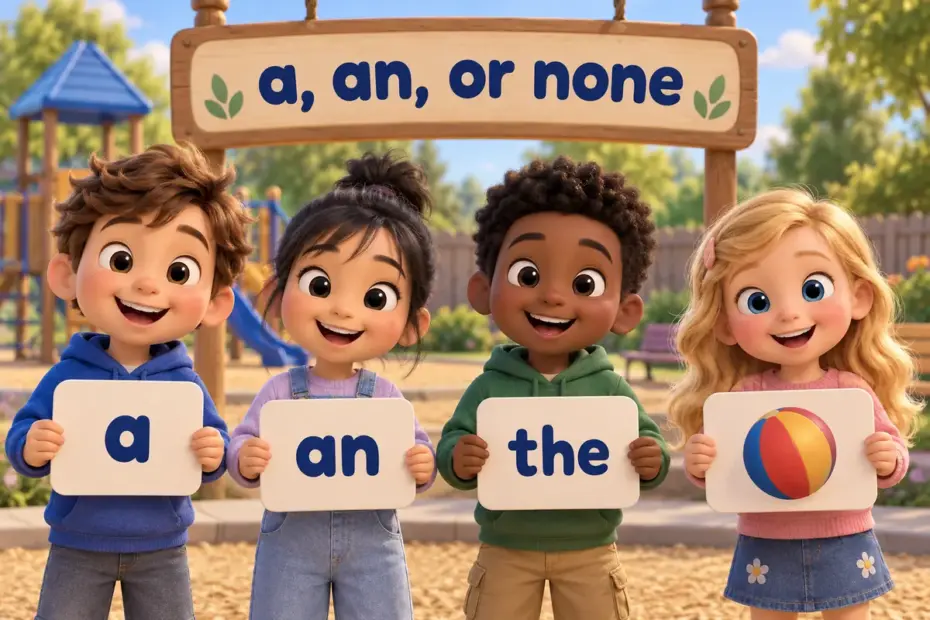
English has three choices rather than two: the indefinite articles a and an, the definite article the, and the zero article, which means no article at all. The choice turns on whether the noun is countable, whether it is singular, and whether the listener can identify it.
| Choice | Used with | Example |
|---|---|---|
| a or an | a singular countable noun, not yet known | I bought a lamp. |
| the | a noun already known or unique | Please switch off the lamp. |
| no article | a plural or uncountable noun in general | Lamps are useful. |
These patterns sit beside related pages such as adjectives and articles a an the usage rules, which show how a describing word sits between the article and its noun. The article agrees with the noun, while the adjective only adds information.
How do you decide whether to use an article?
Two questions settle most cases: is the noun countable, and can the listener identify it?
| Pattern | Example | What it signals |
|---|---|---|
| a or an + singular count noun | She adopted a cat. | One of many, not yet known. |
| the + any noun | The cat slept on the mat. | A particular one both know. |
| no article + plural | Cats sleep through the day. | The whole class in general. |
| no article + uncountable | Water boils at a fixed heat. | The substance as a whole. |
| no article + proper noun | Marta lives in Lisbon. | Names need no article. |
The choice of a or an depends on sound rather than spelling, so an hour takes an because the h is silent, while a university takes a because the word begins with a y sound.
A first mention usually takes a, and every later mention of the same thing takes the. A reader who meets a dog in the first line expects the dog in the second, because the word is now known. That shift from a to the is the clearest single signal of definiteness in English.
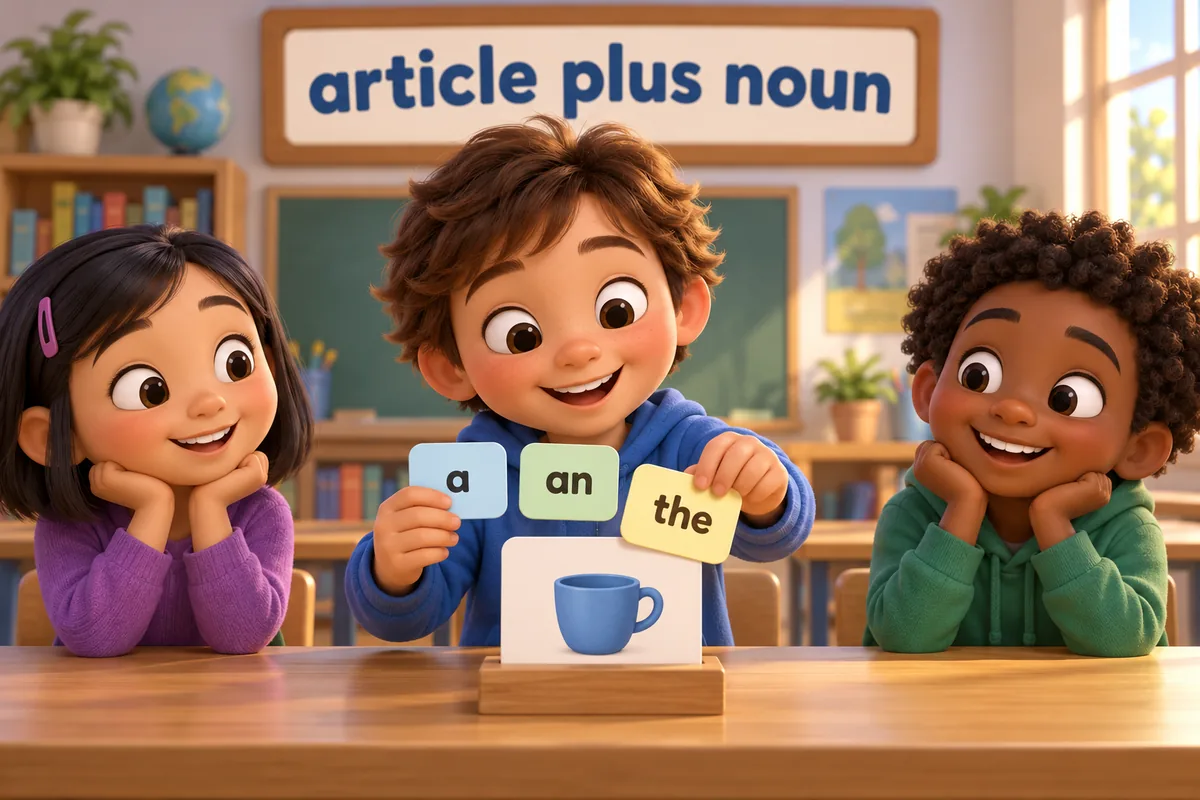
Nouns with and without articles across contexts
The choice appears in every kind of writing, and the context shows why one form suits the sentence.
| Context | Example sentence | Why this works |
|---|---|---|
| Classroom | Water changes to steam when heated. | An uncountable noun in general drops the article. |
| Workplace email | Please send the report by Monday. | A known report takes the. |
| News report | A witness called the police. | First mention takes a. |
| Recipe | Add an egg and stir. | A singular count noun takes an before a vowel sound. |
| Travel note | We travelled by train to Rome. | A fixed transport phrase drops the article. |
| Bedtime | She went to bed at nine. | A fixed phrase drops the article. |
| History book | The moon was hidden by cloud. | A unique thing takes the. |
| Job advert | We need a designer with vision. | An unspecified person takes a. |
| Morning talk | Honesty saves time in the end. | An abstract noun drops the article. |
Notice how the same noun can take different articles as the meaning shifts. A general statement about school as an idea drops the article, while a sentence about one particular building keeps the, so the choice tracks the writer’s meaning rather than the word itself.
Which article should you use?
Match the article to the status of the noun in the sentence, using the table below as a decision check.
| Situation | Choice | Example |
|---|---|---|
| First mention of one thing | a or an | I saw a fox. |
| Second mention of the same thing | the | The fox ran off. |
| A plural in general | no article | Foxes are wary. |
| A single unique thing | the | The sun rose early. |
| An uncountable in general | no article | Bread is cheap here. |
A related pattern shows how some adjectives resist comparison, and absolute adjectives describing without comparison explains the group that behaves like a fixed quality.
Register matters as well. Fixed phrases such as at home, in bed and by car are learned whole, and adding an article breaks the phrase rather than making it more precise. In formal writing the same care applies, because a stray the before a general plural reads as an error even when the rest of the sentence is sound.
Word forms and grammar of articles
The article itself does not change for number or case, but a and an change with the sound that follows.
| Form | Part of speech | Example |
|---|---|---|
| a | indefinite article | a car, a hotel |
| an | indefinite article | an apple, an hour |
| the | definite article | the car, the sky |
| no article | zero article | cars, water, honesty |
| a university | a before a y sound | a university, a European trip |
The article belongs to the noun phrase, so it stays even when an adjective is added, as in a long journey or the old bridge. A wider list of bare nouns appears in nouns that start with c, where many general plurals run without an article.
Bare nouns are also common in headlines and lists, where a writer wants the whole class rather than one member. The same sentence in a report often restores the article, so the form follows the purpose of the text as much as the grammar.
Common mistakes with articles
The errors fall into a few familiar groups, and each has a single test that fixes it.
Mistake 1: the with a general plural. Incorrect: I like the cats. Correct: I like cats. Rule: a whole class in general drops the article.
Mistake 2: a before a vowel sound. Incorrect: She is a honest person. Correct: She is an honest person. Rule: an replaces a before a vowel sound.
Mistake 3: an before a consonant sound. Incorrect: He owns an house. Correct: He owns a house. Rule: a replaces an before a consonant sound.
Mistake 4: an article before an abstract noun. Incorrect: Please show the patience. Correct: Please show patience. Rule: an abstract noun in general takes no article.
Mistake 5: adding an article to a fixed phrase. Incorrect: She went to the bed early. Correct: She went to bed early. Rule: fixed phrases such as go to bed and by train keep the zero article.
Practice using nouns with and without articles
Complete each item, then read the reason to confirm the choice.
- Fill in the blank: I need ________ umbrella before we leave. (a / an)
- Fill in the blank: ________ honesty matters in a friendship. (the / no article)
- Choose the better word: She studies at (a / an) university.
- Correct the error: The lions are dangerous animals.
- Build a sentence: mention a plural noun in general with no article.
- Spot the register: which fits a formal notice, the report is ready, or report is ready?
Answers
- an. Umbrella begins with a vowel sound, so an is used.
- no article. Honesty is abstract and general, so it takes no article.
- a. University begins with a y sound, so the article is a.
- Lions are dangerous animals. A whole class in general drops the article.
- Sample: Books open doors. A bare plural names the whole class.
- The report is ready. A known, specific report takes the.

The bottom line
Nouns with and without articles turn on how specific the noun is, and three choices cover almost every case. Use a or an for one unspecified countable noun, the for a known or unique one, and no article for plurals, uncountables and fixed phrases. The noun’s sound and its place in the conversation decide the rest.
Frequently asked questions about articles with nouns
Why do we say an hour but a hotel?
The choice follows the sound, not the letter. Hour begins with a vowel sound because the h is silent, so it takes an. Hotel begins with a sounded h, which is a consonant sound, so it takes a. Listening to the first sound gives the right answer.
Can I use the with an uncountable noun?
Yes, when the noun is specific or already known, so pass the water refers to particular water on the table. The bare form water names the substance in general. The presence of the tells the listener which water is meant.
Do all proper nouns take no article?
Most do, so cities, people and countries take no article, as in Lisbon and Marta. Some names keep the, including rivers, oceans and plural names such as the Alps and the Netherlands. Those fixed cases follow convention and are best learned as whole phrases.
What is the zero article?
The zero article is the name for using no article at all before a noun. It appears with general plurals, uncountable nouns and abstract nouns, as in cats, water and honesty. It is a real choice in English, not a missing word, and it changes the meaning just as a, an and the do.