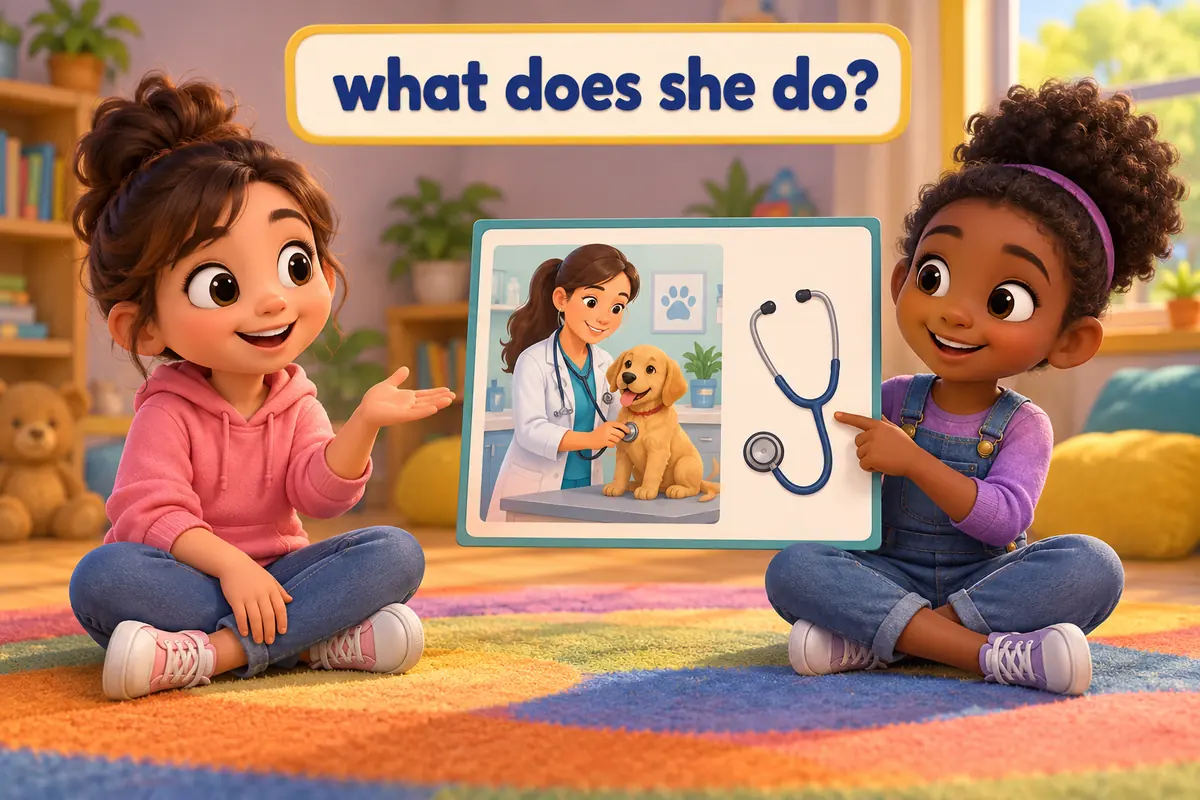
Occupation topics for kids are the job themes that help children talk about work, such as what a doctor, teacher or chef does each day. The topic works best when it links a job name to a place, a tool and a simple question. “What does a firefighter do?” starts a whole conversation.
Occupation topics for kids at a glance
- An occupation topic is a job such as doctor, teacher or chef used as a subject to talk about.
- The usual pattern links a job to a workplace and a tool.
- Question prompts such as what does a plus job plus do open a discussion.
- Naming the tools a worker uses is the fastest way to add detail.
- The commonest mistake is naming a job with no place or action attached.
What are occupation topics for kids?
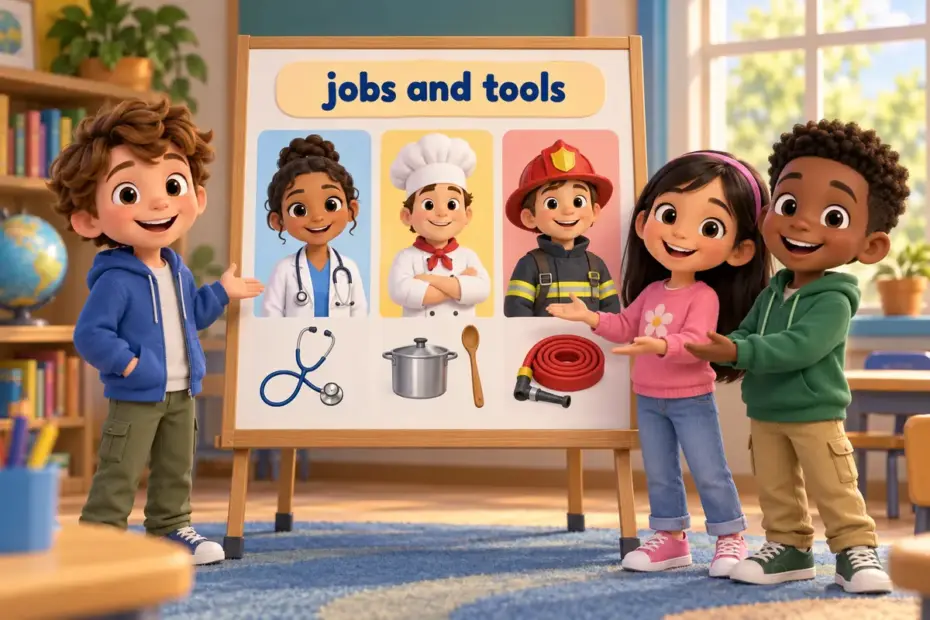
An occupation topic for kids is a job used as the subject of a lesson, a chat or a project, and the strongest topics pair the job with a place and a task. The pairs below give a child three facts at once, which is enough for a short talk. Each row also suggests the tool or action that makes the job easy to picture.
| Job | Workplace | What the person does |
|---|---|---|
| doctor | clinic or hospital | checks patients and helps them feel better |
| teacher | school | plans lessons and explains new ideas |
| chef | kitchen or restaurant | cooks meals and designs menus |
| firefighter | fire station | puts out fires and rescues people |
| farmer | farm or field | grows crops and looks after animals |
| dentist | dental surgery | keeps teeth healthy and clean |
One honest caution is worth stating: a job title alone is thin, and a child who answers only with a name has nothing to say next. The topic grows the moment it gains a place, a tool or an action, so a doctor becomes a doctor who works in a clinic and uses a stethoscope. A small amount of detail is worth more than a long list of job names.
How do you use occupation topics?
An occupation topic runs on a few short question patterns that pull out a place, a tool and an action. These frames work in a lesson, at home or during a project.
| Pattern | Example | What it signals |
|---|---|---|
| What does a + job + do? | What does a chef do? | asks for the main task |
| Where does a + job + work? | Where does a farmer work? | asks for the workplace |
| A + job + uses a + tool | A dentist uses a small mirror. | names the tools |
| Why is a + job + important? | Why is a teacher important? | asks for a reason |
| Would you like to be a + job? | Would you like to be a pilot? | invites a personal answer |
Occupation topics across contexts
Occupation talk fits show and tell, a classroom project and a family dinner alike, and each setting asks for a slightly different phrase. Children pick up job words faster when they attach them to places, and pages such as a words for kids and b words for kids widen the vocabulary a child can bring to the subject.
| Context | Example sentence | Why this works |
|---|---|---|
| Show and tell | My aunt is a nurse at the clinic. | names a job and a place |
| Career day | A baker showed us how bread rises. | links a job to a demonstration |
| Classroom project | We drew a fire station and a truck. | pairs a job with a place |
| Library visit | The librarian helped us find a book. | names a task as well as a job |
| Family talk | Dad works in an office downtown. | reports a real workplace |
| Writing task | When I grow up, I want to be a vet. | states a wish with a reason to come |
| Interview game | What does a pilot wear at work? | tests a job detail |
| Dressing up | I am the doctor today. | turns a job into play |
| News discussion | The firefighters helped after the storm. | links a job to a real event |
| Poster task | Our poster shows five jobs. | groups several topics together |
| Visit from a worker | She asked the chef about his favourite dish. | adds a personal question |
Which occupation topic should you choose?
The best topic is one a child can picture and ask about, not the most exciting job in the world. A short comparison helps a teacher or parent pick well.
| Situation | Better topic | Weaker topic | Reason |
|---|---|---|---|
| Very young children | doctor or teacher | architect | everyday jobs are easy to picture |
| A child who loves animals | vet or farmer | banker | interest drives the questions |
| A short talk | chef | prime minister | a concrete job fills a talk fast |
| A creative class | artist or baker | inspector | these jobs invite drawing and making |
| A safety lesson | firefighter | actor | the topic links to safe behaviour |
A strong topic answers three questions before the child stops: what the worker does, where the work happens and what tool is used. A child who can answer all three has enough for a short talk, and the rest grows from the discussion. Adding one personal reason, such as why the job matters to the family, turns a list of facts into something a child owns.
Words and phrases linked to jobs
Job words sit inside a working family that helps a child describe effort and skill. Young readers can pair workplace and hardworking with compound words for kids, then describe the workers with adjectives for kids such as patient, careful and brave.
| Word | Type | Example |
|---|---|---|
| job | noun | She has an interesting job. |
| work | verb and noun | He works in a bakery. |
| worker | noun | The workers fixed the road. |
| career | noun | She chose a career in science. |
| uniform | noun | The nurse wears a blue uniform. |
Common mistakes with occupation topics
Mistake 1: naming a job with no detail. Incorrect: A doctor is a job. Correct: A doctor helps people who feel ill. Rule: a topic needs a task, not just a label.
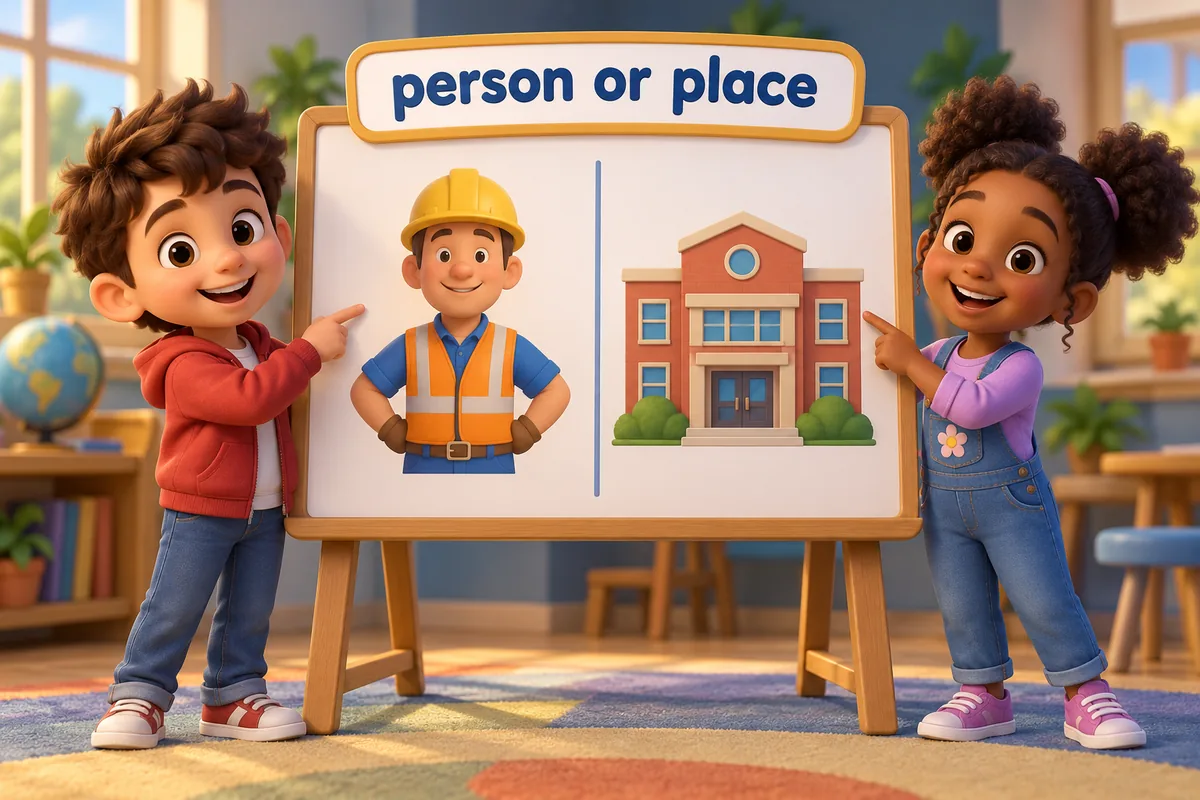
Mistake 2: confusing the person and the place. Incorrect: A hospital works in a doctor. Correct: A doctor works in a hospital. Rule: the person is the worker and the place is the workplace.
Mistake 3: using the wrong verb form. Incorrect: She work in a school. Correct: She works in a school. Rule: a singular subject takes a verb ending in s.
Mistake 4: leaving out the article. Incorrect: I want to be firefighter. Correct: I want to be a firefighter. Rule: a singular job name takes a or an.
Mistake 5: writing job titles without a capital. Incorrect: A doctor and teacher visited. Correct: A doctor and a teacher visited. Rule: job titles take a capital only before a name, as in Doctor Lee.
Mistake 6: mixing where and what. Incorrect: What does a farmer work? Correct: Where does a farmer work? Rule: where asks for a place and what asks for a thing or task.
Practice using occupation topics
- Fill in the blank: What does a ___ do? She helps sick people.
- Choose the better question: (Where / What) does a chef work? In a kitchen.
- Correct the error: The dentist work in a clinic.
- Build a sentence: name a job, its workplace and one tool.
- Spot the register: which sentence suits show and tell, (a) My mother is a nurse, or (b) Nurse mother?
- Fill in the blank: I would like to be ___ pilot.
Answers
- doctor, because the clue is helping sick people.
- Where, because the answer is a kitchen, which is a place.
- The dentist works in a clinic; a singular subject takes works.
- A chef works in a kitchen and uses a sharp knife.
- (a), because show and tell uses a full, clear sentence.
- a, because a singular job name takes an article.
The bottom line
Occupation topics for kids work best when a job is joined to a workplace, a tool and an action, because those three facts give a child enough to talk about. Simple prompts such as what does a plus job plus do pull out the details, and one personal reason makes the topic feel like the child’s own. Choose a job a child can picture, and the conversation fills itself.
Frequently asked questions about occupation topics for kids
What are good occupation topics for young children?
Everyday jobs such as doctor, teacher, chef and farmer work best, because a young child can picture the place and the tools. Each topic needs only three facts: what the worker does, where the work happens and what is used. Children add more detail as their vocabulary grows.
How do I start a job discussion with kids?
Open with one simple question, such as what does a chef do, and let the child answer before you add anything. Follow with where the chef works and what tools are used. A picture or a real object such as a wooden spoon turns the talk concrete and keeps attention longer.
Should children learn job titles or job descriptions first?
Learn the title together with a short description, because a bare comic without an action is hard to use. A child who knows that a firefighter puts out fires can answer follow-up questions. The description is also what makes the topic interesting rather than a memory test.
What words help a child talk about jobs?
Useful words include job, work, worker, career and uniform, plus action verbs such as help, build, cook and teach. Pairing a noun with a verb gives a child a whole sentence. Concrete tools such as a stethoscope or a whisk add the detail that makes a talk vivid.