
How to Choose Adjectives for Academics
The best adjective depends on what you are describing: a person’s area of expertise, a research method, a teaching practice, or a finished piece of work. Choose a word that fits observable evidence instead of using one adjective as a general label for academics.


- Scholarly describes serious, detailed study or a person with deep knowledge of a subject: “The scholarly review compares sources from several disciplines.”
- Rigorous emphasizes careful attention to each part of a process: “The team used a rigorous method to check its results.”
- Analytical highlights close examination of evidence: “Her analytical comments helped the class compare the two arguments.”
- Collaborative describes work done with others: “The collaborative project brought historians and biologists together.”
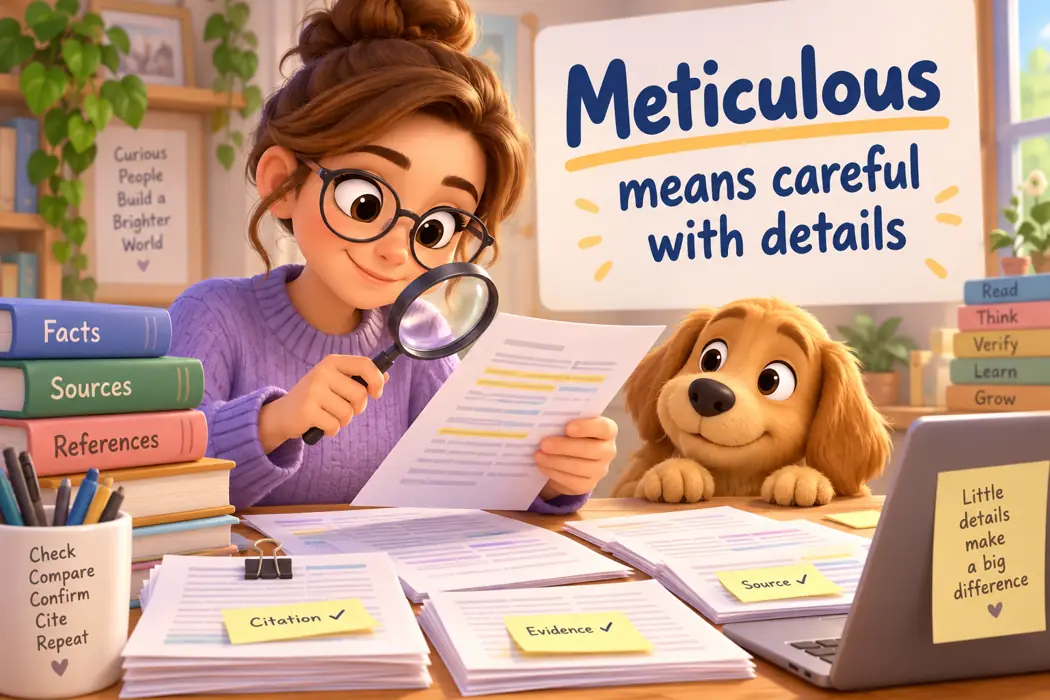
- Meticulous suggests great care with details: “He made a meticulous review of the citations before submission.”
Some words carry a critical tone. Pedantic is disapproving and suggests too much attention to formal rules or small details. Use it only when that criticism is intended; precise or meticulous may fit when you mean careful attention without the negative judgment.
Before choosing a descriptor, name the person or work being described, identify the relevant behavior, and check whether the word’s connotation matches the evidence. For respectful, clear writing, keep the adjective attached to a specific noun—such as “a rigorous analysis”—rather than using it as a label for a whole group.
Match the word to the academic task
Academic work includes teaching, reading, testing ideas, writing, and discussing evidence. One person may be collaborative in a seminar, meticulous when editing references, and innovative when designing a project. These adjectives describe different aspects of the work. They do not compete for a single permanent label.
| What you want to describe | Useful adjective | Example sentence |
|---|---|---|
| Close examination of an argument | Analytical | The analytical essay separates the claim from its supporting evidence. |
| Careful checking of a procedure | Rigorous | A rigorous review checked the assumptions behind the model. |
| Knowledge based on sustained study | Scholarly | The scholarly introduction explains the historical context. |
| A new approach to a familiar problem | Innovative | The innovative assignment let students compare two kinds of source. |
| Attention to small but relevant details | Meticulous | The meticulous editor verified every quotation. |
Describe teaching and learning precisely
For a teacher, accessible can describe an explanation that learners can understand. Engaging describes a lesson that holds their attention. Patient describes the way someone responds when students need another explanation. Knowledgeable refers to subject knowledge. A teacher can possess all four qualities, but a sentence becomes stronger when it names the particular action: “Her patient explanation helped the class work through the calculation.”
For a student, inquisitive suggests interest in asking questions, diligent emphasizes steady effort, and receptive suggests willingness to consider feedback or new ideas. “The diligent student revised each section before handing in the essay” gives readers evidence for the adjective. Avoid treating a single missed deadline or quiet classroom moment as enough to label someone’s entire character.
Positive, neutral, and critical connotations
Critical can be positive in academic writing when it means evaluating a claim carefully: a critical analysis tests an argument instead of simply repeating it. In ordinary conversation, critical can also mean disapproving. Context resolves the difference. “The review critically examines the evidence” is clearer than saying “the reviewer is critical” without explanation.
Theoretical describes work concerned with ideas or principles, while empirical describes work based on observation or experience. Neither word automatically means better. A theoretical discussion and an empirical investigation answer different questions. Similarly, interdisciplinary means involving more than one field; it does not by itself prove that a project is original or successful.
A practical editing check
Read the adjective and noun together, then ask what detail supports the description. If you write “an excellent study,” explain the strength: a careful method, clear presentation, useful comparison, or well-supported conclusion. You may find that replacing a general compliment with a precise phrase makes the sentence more informative.
Keep descriptions proportionate. “An influential article” makes a stronger claim than “an interesting article.” The first implies an effect on other work, while the second describes interest. Choose the larger claim only when you have evidence for it.
Frequently asked questions
Is academic an adjective or a noun?
It can be either. An academic journal uses academic as an adjective. An academic who teaches at a university uses academic as a noun referring to a person. Academics can also refer collectively to academic people or, in some contexts, studies.
Are scholarly and intelligent interchangeable?
No. Scholarly points toward learning and serious study. Intelligent is a broader description of understanding or reasoning. Choose scholarly when the sentence concerns research, sources, or subject knowledge.
For a dictionary check, see Cambridge’s definition of rigorous before applying it to a method or analysis.
As an academic, I find myself constantly searching for the right words to describe my research, findings, and observations. Adjectives play a crucial role in conveying the essence of scholarly work. Whether it’s analyzing data, conducting experiments, or writing papers, having a rich vocabulary of adjectives can add depth and precision to our academic endeavors.
When it comes to describing academics themselves, there are several adjectives that come to mind. First and foremost is “knowledgeable.” Academics spend years honing their expertise in their respective fields, becoming authorities on specialized subjects. They possess a wealth of knowledge that allows them to contribute valuable insights and make significant contributions to their disciplines.
Another adjective that characterizes academics is “perceptive.” The ability to discern patterns, draw connections, and think critically is essential in academia. Academics possess keen observational skills and have a knack for uncovering hidden meanings or underlying principles within complex phenomena.
In addition to being knowledgeable and perceptive, academics are also known for being “meticulous.” Attention to detail is paramount in research and scholarly pursuits. From meticulously designing experiments to carefully analyzing data, academics leave no stone unturned in their quest for accurate information.
Overall, having a range of descriptive adjectives at our disposal enables us as academics to articulate our ideas more effectively and engage readers with precise language. So let’s embrace these adjectives as tools in our intellectual arsenal as we continue pushing the boundaries of knowledge through research and scholarship.
How to Describe Academics? – Different Scenarios
When it comes to describing academics, there are various scenarios that call for specific adjectives. Let’s explore a few of these situations and the appropriate words to capture the essence of academia.
- Classroom Setting: In the classroom, academics can be described as:
- Knowledgeable: Teachers who possess a wealth of knowledge in their respective fields.
- Engaging: Educators who captivate students’ attention and foster a love for learning.
- Innovative: Professors who employ creative teaching methods and incorporate technology into their lessons.
- Supportive: Mentors who provide guidance and encouragement to help students succeed.
- Enthusiastic: Instructors whose passion for their subject matter is contagious.
- Research Environment: Within the realm of research, academics can be characterized as:
- Meticulous: Scientists who pay close attention to detail in their experiments and analysis.
- Analytical: Researchers who possess strong critical thinking skills to interpret data accurately.
- Groundbreaking: Scholars who push boundaries, challenge existing theories, and make significant discoveries.
- Collaborative: Academics who work together across disciplines to tackle complex problems collectively.
- Published: Experts whose findings have been peer-reviewed and documented in reputable journals.
- Conference or Symposium: During academic conferences or symposiums, participants can be described as:
- Eloquent: Presenters who convey their ideas with clarity and eloquence.
- Thought-provoking: Speakers whose insights stimulate intellectual curiosity among attendees.
- Interactive: Scholars who encourage audience engagement through discussions or Q&A sessions.
- Influential: Keynote speakers or panelists with expertise that has shaped their field of study.
- Networking-savvy: Attendees adept at building professional connections within academic circles.
Remember that these adjectives are just a starting point. The world of academia is vast, encompassing diverse individuals with unique qualities that contribute to its rich tapestry.
Describing words for academics in English
When it comes to describing academics, there are a variety of adjectives that can capture the essence of this field. From intellectual prowess to scholarly dedication, these words paint a picture of what it means to be an academic. Here are some key adjectives that come to mind:
- Knowledgeable: Academics are known for their depth and breadth of knowledge in their respective fields. They have spent years studying and researching, becoming experts in their areas of expertise.
- Curious: Academics possess an insatiable curiosity that drives them to explore new ideas and question existing theories. They constantly seek out new information and strive for a deeper understanding.
- Analytical: Academics have a keen eye for detail and excel at analyzing data, texts, and research findings. They employ critical thinking skills to dissect complex problems and develop innovative solutions.
- Discerning: Academics possess discerning minds, able to distinguish between valid sources of information and unreliable ones. They carefully evaluate evidence before drawing conclusions or making assertions.
- Rigorous: In academia, rigor is highly valued. Academics follow rigorous methodologies in their research, ensuring robustness in their findings through meticulous experimentation or analysis.
- Innovative: Academics push the boundaries of knowledge by introducing new ideas or challenging existing paradigms. Their creativity leads to breakthroughs in various disciplines.
- Articulate: Effective communication is paramount in academia, as scholars need to convey complex concepts clearly and concisely. Academics excel at articulating their thoughts both orally and in writing.
- Persistent: The pursuit of knowledge can be arduous, but academics persevere through challenges and setbacks with determination and resilience.
- Objective: Objectivity is crucial in academia; scholars strive to approach topics from a neutral standpoint, relying on evidence rather than personal biases when forming conclusions.
10.Tenacious: Academic pursuits often require long-term dedication and hard work. Academics display tenacity in their pursuit of answers, refusing to give up until they have achieved their goals.
These adjectives provide a glimpse into the world of academics, highlighting the qualities that define individuals in this field. Whether it’s their knowledge, curiosity, analytical skills, or perseverance, academics embody a unique blend of traits that contribute to the advancement of human knowledge and understanding.
Adjectives for Academics
Positive Adjectives for Academics with 10 Examples
When it comes to describing academics, there are a plethora of positive adjectives that can capture their dedication, intelligence, and passion. Here are ten examples that highlight the admirable qualities often associated with academics:
- Knowledgeable: Academics possess a wealth of knowledge in their respective fields, making them authorities in their areas of expertise.
- Inquisitive: Their curiosity drives them to constantly seek new information and explore complex topics.
- Analytical: Academics possess strong analytical skills, allowing them to critically examine ideas and data.
- Creative: They approach problems from unique angles and find innovative solutions through their creative thinking.
- Passionate: Their enthusiasm for learning shines through in their work and inspires others around them.
- Dedicated: Academics exhibit unwavering commitment to their research, teaching, or both, investing countless hours into their pursuits.
- Adaptable: They embrace change and adapt quickly to new technologies and methodologies within their field.
- Meticulous: Attention to detail is a hallmark of academia as they meticulously review every aspect of their work before sharing it with the world.
- Resilient: Facing challenges head-on, academics demonstrate resilience by persevering through setbacks and obstacles on their academic journey.
- Inspiring: Through mentorship or groundbreaking research findings, academics have the power to inspire future generations.
Negative Adjectives for Academics with 5 Examples
While most adjectives used to describe academics tend to be positive, there are instances where negative attributes may arise due to various factors such as pressure or competition within academia:
- Arrogant: Some academics may exhibit an excessive sense of superiority or self-importance due to their accomplishments or expertise.
- Narrow-minded: In certain cases, academics may become overly focused on their specific niche, limiting their perspectives and openness to alternative ideas.
- Pedantic: Academics can sometimes prioritize minor details over the bigger picture, leading to excessive emphasis on trivial matters.
- Unapproachable: Due to their busy schedules or intimidating demeanor, some academics may come across as unapproachable to students or colleagues seeking guidance.
- Overworked: The demands of academia can oftentimes lead academics to become overwhelmed and burdened with an excessive workload.
It’s important to note that these negative adjectives do not represent the majority of academics but rather highlight potential challenges that individuals within this field may face from time to time.
In conclusion, academia is filled with dedicated, knowledgeable, and passionate individuals who strive for excellence in their chosen fields. While positive adjectives dominate the description of academics, it’s essential to acknowledge the challenges they may encounter along their academic journey.
Other Words for Academics – Synonyms and Antonyms With Example Usage
When it comes to discussing academics, there are plenty of words that can be used as synonyms or antonyms to describe this field. Let’s explore some alternative terms that can help us better understand the world of academia.
- Scholars: A synonym for academics, scholars refer to individuals who engage in advanced study and research in a particular field. They are known for their expertise and contributions to knowledge. For example, renowned scholars like Albert Einstein and Marie Curie have revolutionized our understanding of physics and chemistry, respectively.
- Educators: While academics primarily focus on research and scholarship, educators play a crucial role in teaching and imparting knowledge to students. They ensure that the next generation is equipped with the necessary skills and information to succeed academically. Teachers, professors, and instructors all fall into this category.
- Novices: On the opposite end of the spectrum are novices, who represent those just starting their academic journey or lacking experience in a specific subject area. Novices often seek guidance from more seasoned academics or educators as they navigate their way through learning new concepts or disciplines.
- Nonconformists: In contrast to traditional academics who adhere strictly to established norms and practices, nonconformists challenge conventional wisdom and push boundaries within their fields. These individuals bring fresh perspectives and innovative ideas that disrupt existing paradigms, leading to new breakthroughs in various disciplines.
- Practitioners: Some professionals incorporate academic knowledge into practical applications within their respective industries or fields of practice. These practitioners bridge the gap between theory and real-world implementation by utilizing academic insights in tangible ways—transforming ideas into action.
In conclusion, these alternative words provide a broader understanding of academia beyond the conventional notion of scholarly pursuits alone. Whether we think about scholars pushing boundaries or educators nurturing young minds, each term offers unique insights into different aspects of the academic world. As we delve deeper, we discover a rich tapestry of individuals contributing to the advancement of knowledge and shaping our understanding of the world around us.
Conclusion
So, we’ve come to the end of our exploration into adjectives for academics. I hope you’ve found this article informative and useful in expanding your vocabulary. Let’s recap what we’ve covered:
- Adjectives for Describing Knowledge:
- Adjectives for Describing Research:
- Adjectives for Describing Writing:
- Adjectives for Describing Presentation Skills:
- Adjectives for Describing Collaboration:
Remember, using these adjectives can enhance your academic writing, presentations, research papers, and collaborative projects.
In conclusion, expanding your academic adjective repertoire is crucial in effectively communicating complex ideas, showcasing your expertise in various fields of study, and engaging your audience. By incorporating these carefully chosen adjectives into your work, you’ll be able to convey meaning with precision while maintaining clarity.
So go ahead! Embrace the power of words by incorporating these adjectives into your academic endeavors. Happy learning and best of luck on your educational journey!
If you have any questions or want to share other adjectives that you find valuable in an academic context, feel free to leave a comment below. I’m always eager to hear from fellow language enthusiasts.


