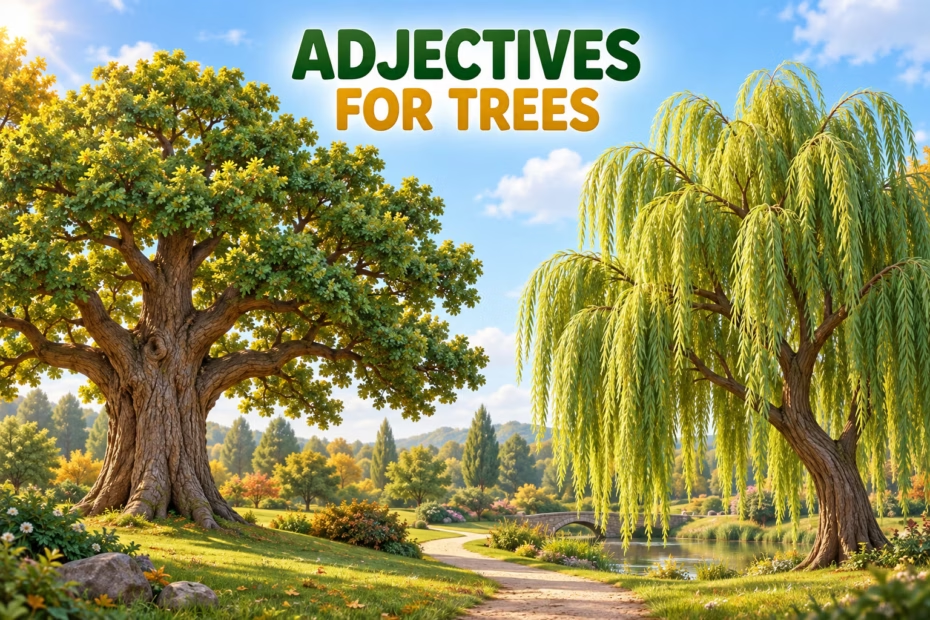
Choose adjectives for trees by the trait you want to show: towering for height, spreading for a wide crown, furrowed for bark, and leafy for abundant foliage. Deciduous and evergreen describe seasonal leaf retention, while conifer names a plant group; the terms are not synonyms. Words such as majestic or serene express an impression, so pair them with details readers can picture.
Tree Adjectives at a Glance
- Size and age: towering, small, mature, or young; do not guess exact age from height alone.
- Crown and branches: upright, rounded, spreading, columnar, or weeping.
- Bark and texture: smooth, furrowed, flaky, ridged, or rough.
- Foliage and season: broad-leaved, needle-like, evergreen, deciduous, or leafless.
- Flowers and fruit: flowering, blossom-covered, fruit-bearing, or fruit-laden.
- Setting and impression: riverside names a location; graceful, majestic, and peaceful convey a viewer’s response.
Choose an Adjective for the Tree Feature You See
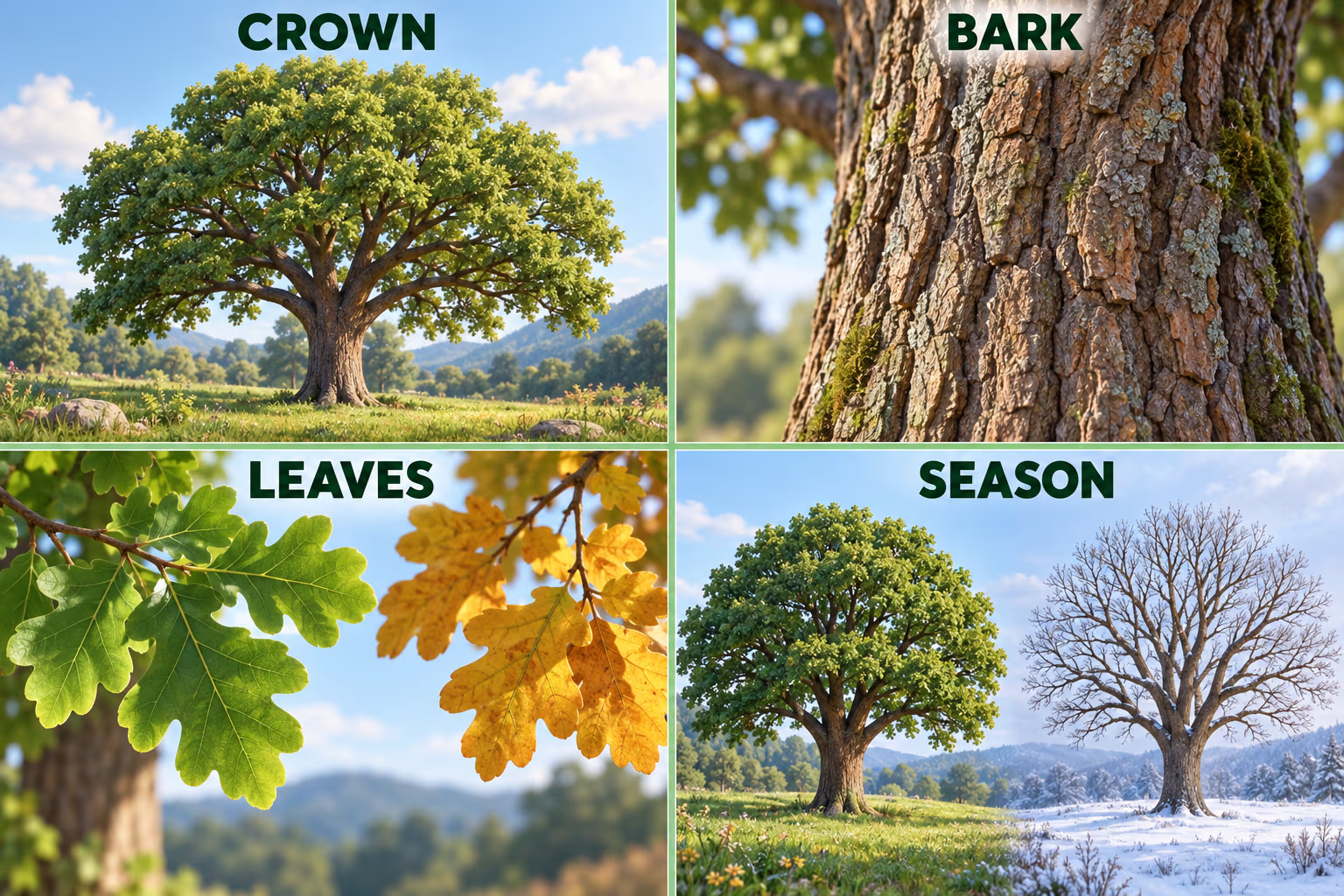
A useful tree description moves from observation to word choice. Arbor Day Foundation’s tree anatomy guide treats leaves, branches, roots, trunk, and bark as distinct parts, while its planting guide asks readers to consider mature height, canopy spread, form, foliage, fruit, and site conditions. These categories are useful for writing because each points to a different visible or contextual detail; they are not interchangeable labels for a tree’s overall quality.
| Feature | Useful adjectives | Example |
|---|---|---|
| Height and scale | towering, tall, stunted, mature | A towering pine rose above the low garden wall. |
| Crown and branching | rounded, spreading, columnar, weeping | The weeping branches curved toward the pond. |
| Bark and surface | smooth, furrowed, ridged, flaky | Deeply furrowed bark marked the lower trunk. |
| Leaves and season | broad-leaved, needle-like, evergreen, deciduous | The deciduous maple held amber leaves in late autumn. |
| Flower, fruit, or seed | flowering, blossom-covered, fruit-bearing, cone-laden | A fruit-bearing apple tree shaded the path. |
| Condition you can observe | leafless, damaged, weathered, bare | The leafless branches traced a pattern against the winter sky. |
| Setting or impression | urban, riverside, stately, serene | A stately elm stood beside the town library. |
Evergreen and Conifer Describe Different Things
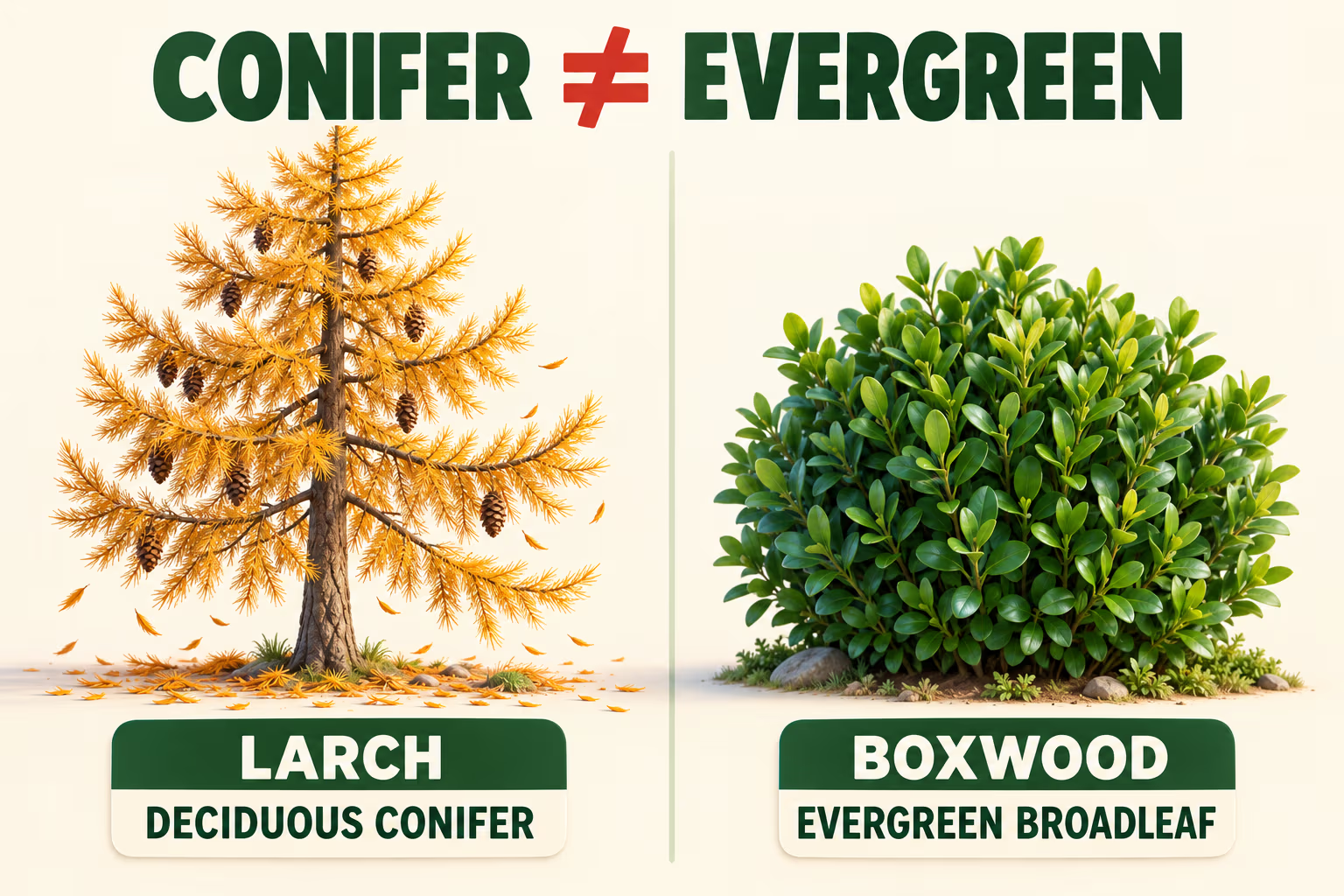
Evergreen describes a plant that retains foliage through the year, although it may replace older leaves or needles gradually. Conifer refers to a group of cone-bearing plants, many of which have needle-like or scale-like foliage. The University of Minnesota Extension notes that evergreens can be conifers such as pine or spruce, or broadleaf plants such as boxwood and rhododendron. The USDA Forest Service identifies European larch as a deciduous conifer, so being a conifer does not guarantee that a tree keeps its needles all winter. The terms answer different questions: what kind of plant it is, and how it retains foliage. See UMN Extension’s trees and shrubs guide and the Forest Service profile of European larch.
| Term | What it describes | Example |
|---|---|---|
| Evergreen | Foliage remains on the plant through the year, with gradual replacement possible | Boxwood is a broadleaf evergreen; many pines are evergreen conifers. |
| Deciduous | Foliage is shed seasonally | A maple may be leafy in summer and leafless after its autumn leaves fall. |
| Conifer | A plant group that includes cone-bearing trees such as pines and larches | European larch is a conifer whose needles turn color and fall seasonally. |
| Broadleaf | A foliage form with leaf blades broader than needles or scales | Some broadleaf trees and shrubs, including boxwood, retain foliage year-round. |
The Forest Service’s tree-identification guide also separates needle-like or scale-like foliage from broad, flat leaves, and notes that some larches shed their needles in winter. A seasonal snapshot therefore needs context. Leafless or bare can accurately describe a deciduous tree in its normal dormant season; by itself, it does not prove that the tree is dead or unhealthy. If the goal is to assess damage or declining health, appearance should not be treated as a diagnosis. UMN Extension recommends professional tree-care help for diagnosis when a problem is suspected.
Use Contrasts for the Same Tree Trait
There is no single adjective that acts as the opposite of every meaning of tree. A tree is a kind of plant, while forest, woodland, grove, copse, and orchard describe places, groupings, or managed plantings. These are related words, not exact substitutes for one individual tree. Likewise, shrub, vine, and stump name different growth forms or stages rather than strict antonyms.
| Trait | Useful contrast | Contextual example |
|---|---|---|
| Height | tall / short | A tall young tree rose above a short hedge. |
| Crown spread | spreading / narrow | A spreading oak filled the corner; a narrow cedar fit beside the path. |
| Foliage density | leafy / sparse | The leafy crown shaded the bench, while sparse branches let more light through. |
| Seasonal foliage | evergreen / deciduous | Evergreen foliage persisted through winter; the deciduous maple shed its leaves. |
| Surface texture | smooth / rough | Smooth young bark contrasted with the rough ridges lower on the older trunk. |
Positive and Negative Impressions Depend on Context
Words such as majestic, charming, overgrown, and bare can carry an opinion, but their effect depends on the scene and purpose. A bare tree may be an elegant winter silhouette or simply a deciduous tree after leaf fall. “Overgrown” may signal unwanted growth beside a path, while a spreading crown may be welcome for shade. State what is visible first, then use a mood word when it adds a clear point of view.
For related nature vocabulary, browse adjectives for nature, adjectives for a forest, or adjectives for scenery. The best fit still depends on the tree, the season, and the detail you want readers to notice.
When it comes to describing the beauty and majesty of trees, the right adjectives can truly bring them to life. From towering giants to delicate saplings, trees are not only essential for our environment, but they also possess a unique character of their own. In this article, I’ll be exploring a wide range of adjectives that can be used to describe trees, allowing you to paint a vivid picture in your writing or conversation. Whether you’re an arborist, a nature enthusiast, or simply someone who appreciates the wonders of the natural world, this list of adjectives will help you capture the essence of trees in all their splendor.
From the moment you set eyes on a tree, you can’t help but be captivated by its presence. The adjective “majestic” perfectly encapsulates the grandeur and awe-inspiring nature of a tall, sturdy oak or a graceful weeping willow. On the other hand, “charming” might be the ideal word to describe a small, whimsical tree that adds a touch of enchantment to a garden or park. Whether you’re describing the size, shape, color, or texture of a tree, there’s an adjective out there that can bring your description to life. So, let’s dive into the world of adjectives for trees and discover the perfect words to capture their unique beauty and character.
How to Describe Trees? – Different Scenarios
When it comes to describing trees, there are so many adjectives that can capture their beauty and character. Depending on the scenario or context, certain adjectives might better convey the unique qualities of trees. Here are some different scenarios and the adjectives that can be used to describe trees in each:
- In a Park Setting:
- In a Forest Environment:
- In an Urban Landscape:
- During Different Seasons:
Remember, the choice of adjectives will vary depending on the specific tree and the emotions or impressions you want to convey. Experiment with different words to capture the essence of trees in the various scenarios you encounter.
Examples of Descriptive Adjectives for Trees
| Adjectives |
|---|
| Majestic |
| Serene |
| Elegant |
| Graceful |
| Whimsical |
| Ancient |
| Breat |
Describing Words for Trees in English
When it comes to describing trees, there are a plethora of adjectives in the English language that can help capture their beauty, character, and unique qualities. Here are some describing words that can be used to paint a vivid picture of trees in different scenarios:
1. Majestic Trees:
- Towering: Tall and impressive
- Sturdy: Strong and solid
- Graceful: Elegant and refined
| Adjective | Definition |
|---|---|
| Towering | Tall and impressive |
| Sturdy | Strong and solid |
| Graceful | Elegant and refined |
2. Lush Trees:
- Leafy: Covered in abundant leaves
- Verdant: Green and vibrant
- Exuberant: Full of life and energy
| Adjective | Definition |
|---|---|
| Leafy | Covered in abundant leaves |
| Verdant | Green and vibrant |
| Exuberant | Full of life and energy |
3. Whimsical Trees:
- Twisted: Curved or bent in unique shapes
- Knotted: Characterized by intricate knots and patterns
- Curly: Having winding or spiral branches
| Adjective | Definition |
|---|---|
| Twisted | Curved or bent in unique shapes |
| Knotted | Characterized by intricate knots and patterns |
| Curly | Having winding or spiral branches |
- Colorful: Displaying a range of vibrant hues
- Rustling: Making soft, crackling sounds as leaves fall
- Golden: Gleaming and radiant like gold
| Adjective | Definition |
|---|---|
| Colorful | Displaying a range of vibrant hues |
| Rustling | Making soft, crackling sounds as leaves fall |
| Golden | Gleaming and radiant like gold |
Remember, the choice of adjectives will vary depending on the specific tree and the emotions or impressions you want to convey. So go ahead and experiment with different words to capture the essence of trees in various scenarios.
Adjectives for Trees
Positive Adjectives for Trees with 12 Example Sentences
When it comes to describing trees, there are plenty of positive adjectives that can accurately capture their beauty and appeal. Here are twelve examples of positive adjectives that can be used to describe trees:
- Majestic: The towering oak tree cast a majestic shadow over the park.
- Graceful: The willow tree swayed gracefully in the breeze.
- Stately: The tall, slender pine trees stood stately in the forest.
- Regal: The maple tree displayed its regal colors in the fall.
- Elegant: The cherry blossom tree was an elegant sight in the spring.
- Vibrant: The orange leaves of the beech tree added a vibrant touch to the landscape.
- Resilient: Despite the harsh weather, the evergreen trees remained resilient.
- Peaceful: The quiet grove of trees created a peaceful atmosphere.
- Majestic: The sprawling magnolia tree possessed a certain majestic charm.
- Nurturing: The banyan tree provided shade and acted as a nurturing presence.
- Harmonious: The row of birch trees created a harmonious visual rhythm.
- Strong: The sturdy oak tree served as a strong symbol of resilience.
Negative Adjectives for Trees with 5 Example Sentences
While trees are mostly admired for their positive qualities, there are negative adjectives that can also be used to describe certain aspects of trees. Here are five examples of negative adjectives that can be used when describing trees:
- Drooping: The weeping willow had drooping branches that reached towards the ground.
- Sparse: The young sapling had sparse foliage, lacking the fullness of a mature tree.
- Decaying: The old oak tree showed signs of decaying with its chipped bark and dying branches.
- Invasive: The invasive species of tree spread rapidly, crowding out native plants.
- Overgrown: The untended tree had become overgrown, obstructing the view of the surrounding area.
Remember, the choice of adjectives will depend on the specific tree and the emotions or impressions one wants to convey. Feel free to experiment with different words to accurately describe trees in various scenarios.
Synonyms and Antonyms with Example Sentences
Synonyms for Trees
When it comes to describing trees, there is a wide range of synonyms that can help us paint a vivid picture. Here are some alternative words that can be used interchangeably with “trees”:
- Woodland: The lush woodland was filled with towering trees.
- Forest: We ventured deep into the dense forest, surrounded by ancient trees.
- Grove: The peaceful grove was the perfect spot for a picnic under the shade of the trees.
- Copse: The small copse of trees provided a serene backdrop for the quiet meadow.
- Orchard: The apple orchard was a colorful sight, with rows of trees laden with fruit.
Let’s take a closer look at these words with example sentences:
| Synonym | Example Sentence |
|---|---|
| Woodland | The woodland was filled with colors as the leaves changed in autumn. |
| Forest | We took a leisurely walk through the forest, enjoying the soothing sounds of the rustling trees. |
| Grove | We found a cozy spot in the grove, surrounded by tall, majestic trees. |
| Copse | The sun peeked through the copse of trees, casting dappled shadows on the forest floor. |
| Orchard | The orchard was a delightful sight, with rows and rows of beautifully blooming fruit trees. |
Antonyms for Trees
To fully capture the different facets of trees, we should also explore their antonyms. These words can help us highlight the contrasting characteristics of trees. Here are some antonyms for “trees”:
- Barren: The barren landscape was devoid of any trees or vegetation.
- Bare: In winter, the trees stood bare, with no leaves or signs of life.
- Empty: The empty field stretched out before us, void of any tree or shrub.
- Infertile: The soil in that area was infertile, making it difficult for trees to thrive.
- Deforested: The deforested land served as a stark reminder of the trees that once stood tall.
Let’s explore these antonyms further with example sentences:
| Antonym | Example Sentence |
|---|---|
| Barren | The arid desert was barren, with no trees or plants in sight. |
| Bare | The harsh winter stripped the trees, leaving them bare against the cold, gray sky. |
| Empty | The abandoned field looked sad and empty without a single tree to provide shade. |
| Infertile | The rocky terrain and lack of nutrients in the soil made the area infertile for tree growth. |
| Deforested | The deforested area was a somber reminder of the importance of preserving our forests and trees. |
Remember, the choice of words depends on the specific tree and the emotions or impressions we want to convey. Feel free to experiment with different adjectives to accurately describe trees in various scenarios.
Conclusion
Describing trees can be a creative and powerful way to evoke emotions and paint vivid pictures in writing. In this article, I have provided a list of positive and negative adjectives that can be used to describe trees, along with synonyms and antonyms for the word “trees” itself.
By using words like “majestic,” “lush,” or “towering,” we can capture the beauty and grandeur of trees. On the other hand, words like “barren,” “bare,” or “deforested” can convey a sense of desolation or destruction.
It’s important to remember that the choice of adjectives depends on the specific tree and the emotions or impressions we want to convey. Whether we’re describing a woodland, forest, grove, copse, or orchard, the right adjective can bring our writing to life.
I encourage you to experiment with different adjectives to accurately describe trees in various scenarios. So next time you’re writing about nature or simply want to add depth to your descriptions, don’t forget to utilize the power of adjectives to bring trees to life on the page.
Frequently Asked Questions About Adjectives for Trees
What are good adjectives to describe a tree?
Choose for the feature you mean. Towering describes height, spreading describes a wide crown, furrowed describes bark, and leafy describes abundant foliage. For mood, words such as majestic or serene express an impression, so support them with a detail such as size, shape, or setting.
Are evergreen and conifer the same thing?
No. Evergreen describes foliage retained through the year; conifer names a group of plants. Many conifers are evergreen, but European larch is a deciduous conifer. Some broadleaf plants, such as boxwood, are evergreen, which shows why the words should not be used as synonyms.
Does a leafless tree mean it is dead?
Not necessarily. Many deciduous trees lose their leaves in fall and remain bare through part of winter as part of their normal seasonal cycle. A leafless appearance alone cannot establish a tree’s health or cause of change. Consider species, season, and other evidence; consult a qualified tree-care professional if you need a health assessment.
What is the antonym of “tree”?
Tree has no simple direct antonym. A forest, grove, or orchard is a place or group of trees, while a shrub or vine is a different plant form. To create a contrast, choose an adjective for a specific quality, such as tall and short for height or leafy and sparse for foliage.
Are “bare” and “deciduous” synonyms?
No. Deciduous describes a plant that sheds foliage seasonally; bare describes how a tree looks at a particular moment. A deciduous tree may be leafy for much of the year and bare after seasonal leaf fall. The words describe related but different things: a recurring plant trait and a temporary appearance.
Make the Description Match the Tree
Start with an observable feature, choose an adjective that names it, and add a mood or style impression only when context supports it. Whether the tree is flowering, leafless, evergreen, mature, or simply elegant, a precise detail helps readers see what makes that particular tree distinctive.


