How to Choose an Adjective for an Audience
The best adjective makes an audience easier to picture without pretending that every person in it is the same. Start with what the group is doing, what members already know, and what would help them. A curious audience wants to explore a subject; a novice audience is new to it; a multigenerational audience includes people from different age groups. Each word describes a different feature, so choose the one that matters to your sentence.
Before describing people, ask what evidence supports the label. A registration question, interview, search query, event format, or reader comment may reveal a real need. If you have no evidence, use a qualified phrase such as “readers who may be new to the topic” instead of presenting a guess as a fact. The Office for National Statistics recommends defining user needs from evidence and considering several needs when a page serves different kinds of users. Its user-needs guidance also suggests asking who needs the content, what they want to do, and why.
Five Useful Ways to Describe an Audience
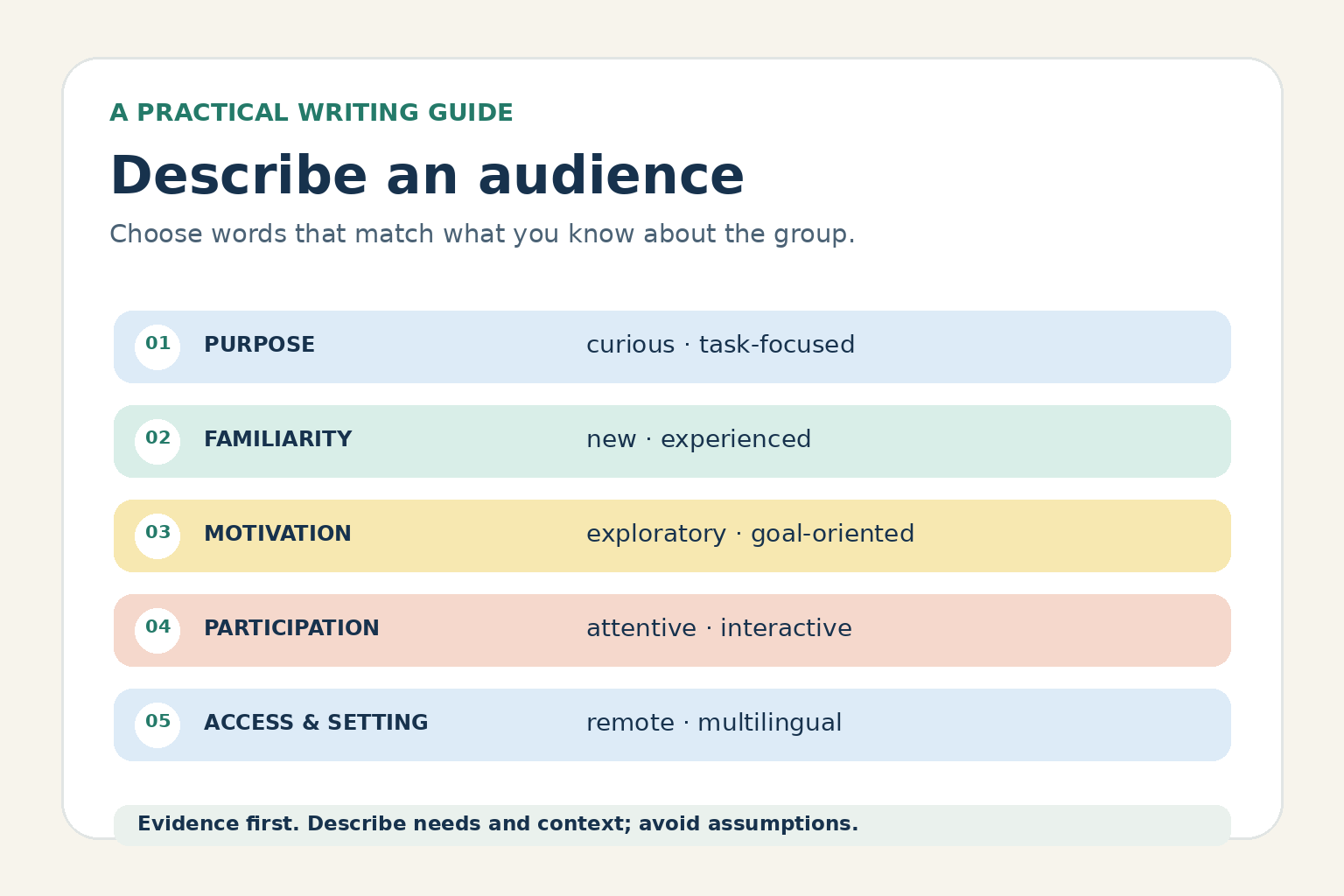
Audience adjectives work best when they name a particular dimension. These groups offer a practical starting point for a speech, lesson, book, event, newsletter, or website.
- Purpose or interest: curious, topic-focused, recreational, career-minded, research-oriented, community-minded.
- Familiarity with a subject: new, novice, informed, experienced, specialist, expert.
- Motivation: goal-oriented, exploratory, task-focused, enthusiastic, cautious, undecided.
- Participation: attentive, interactive, reflective, question-asking, discussion-oriented, independent.
- Situation or access: remote, local, multilingual, first-time, time-pressed, mixed-age, cross-disciplinary.
Some of these are compound adjectives, and some are short phrases. “Time-pressed readers” may tell you more than “busy people”; “first-time visitors” is clearer than “inexperienced users” when the detail is simply that they have not used a site before. For a mixed group, combine two dimensions: a local, multilingual audience of first-time visitors. Avoid stringing together a long chain of labels when one or two will do.
Positive, Neutral, and Critical Audience Adjectives
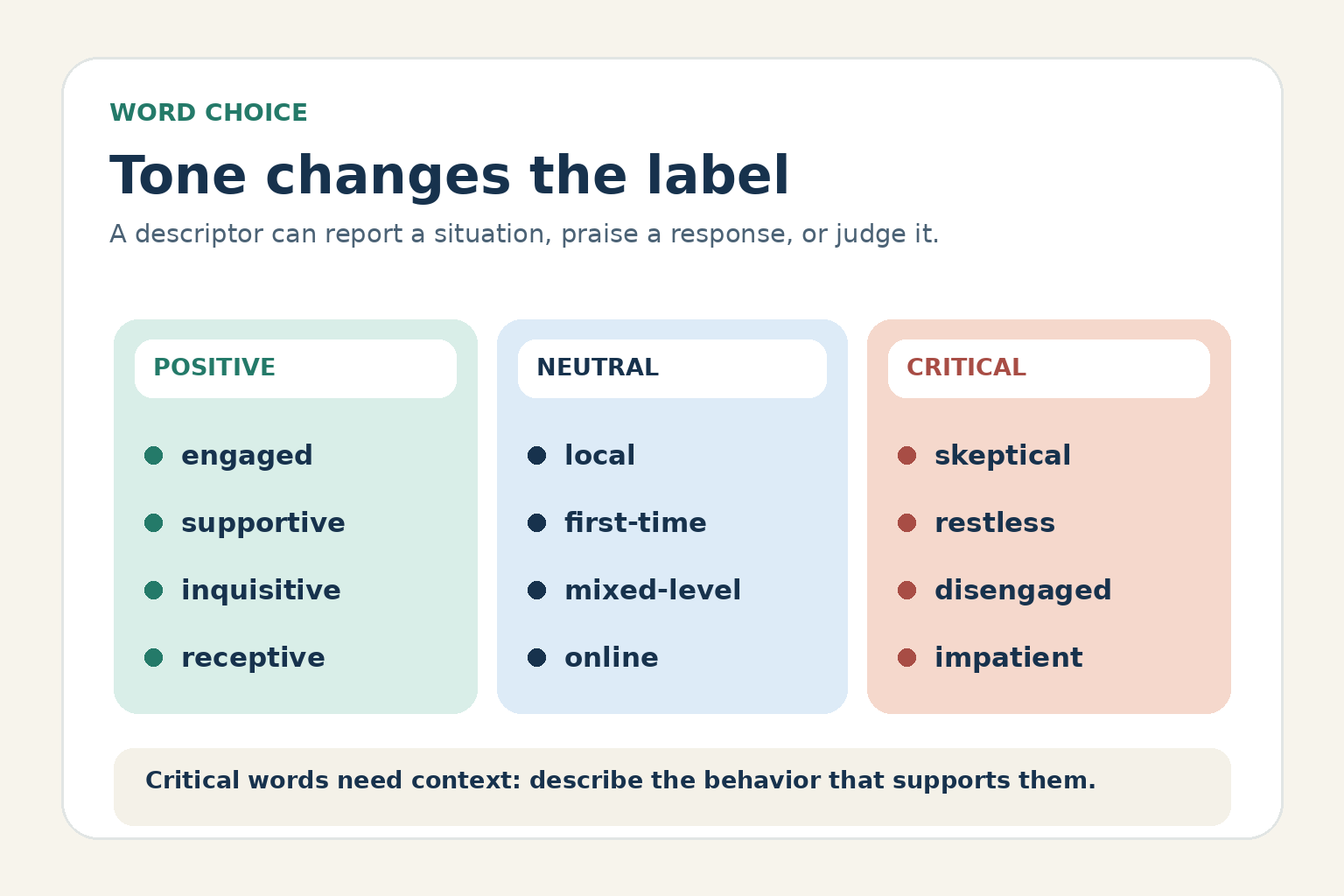
Positive adjectives include engaged, enthusiastic, supportive, receptive, inquisitive, attentive, and appreciative. They can describe visible participation or a favorable response: The engaged audience stayed for the question period. Use them only when the evidence supports the judgment. Attendance alone does not prove that everyone is enthusiastic, and quiet listeners may still be attentive.
Neutral adjectives can identify a group without praising or blaming it: local, online, international, mixed-age, first-time, specialist, general, small, large, or multilingual. A neutral description is useful when the audience’s response is unknown or irrelevant. For example, The online audience included participants from three time zones states a circumstance rather than an attitude.
Critical adjectives include skeptical, distracted, restless, resistant, impatient, and disengaged. These words can be accurate, but they also frame the group from the writer’s point of view. Whenever possible, name the observed behavior: Several attendees checked the schedule during the presentation is more specific than The audience was impatient. A skeptical audience may be asking reasonable questions; a silent audience may be taking notes, translating, or waiting for a suitable moment to speak.
Adjectives for Different Audience Scenarios
For a children’s book: young, emerging, imaginative, early-reader, curious, or family-oriented may describe age range, reading stage, or interest. Match vocabulary and examples to the intended reading level, but do not assume that every child has the same ability or interest. This interactive story is designed for early readers who enjoy solving simple puzzles gives a clearer picture than “a playful audience.”
For a fitness blog: beginner, experienced, recreational, goal-oriented, strength-focused, or time-conscious can help explain who a plan serves. Take care with words such as disciplined or motivated: they can suggest that someone who does not follow a routine lacks character, when the real barriers may be time, access, health, or preference. A useful description is concrete: Readers looking for short, equipment-free workouts.
For a business seminar: cross-functional, decision-making, early-career, senior, entrepreneurial, or specialist may be relevant. Avoid calling a group “ambitious” or “success-driven” unless those traits come from research or the event’s stated purpose. Instead, identify the work people do or the task they came to complete: a seminar for small-business owners comparing payment systems.
For a museum or community event: local, intergenerational, first-time, returning, family, or neighborhood-based may help describe who is expected. “Diverse” can be vague when used on its own. If a specific difference matters, name it respectfully and accurately—languages offered, age groups invited, or communities consulted—and explain why it affects the event.
For a website or newsletter: returning, prospective, mobile-first, specialist, casual, or information-seeking can describe a relationship with the content. When visitors have different goals, write for more than one kind of user: a first-time reader may need a definition, while a returning reader may want the latest update. Clear headings and plain language help both find what they need.
Audience Description Examples in Sentences
Here are examples that show how an adjective can make a sentence more precise. The wording describes a particular audience in a particular context, not a universal trait of a demographic group.
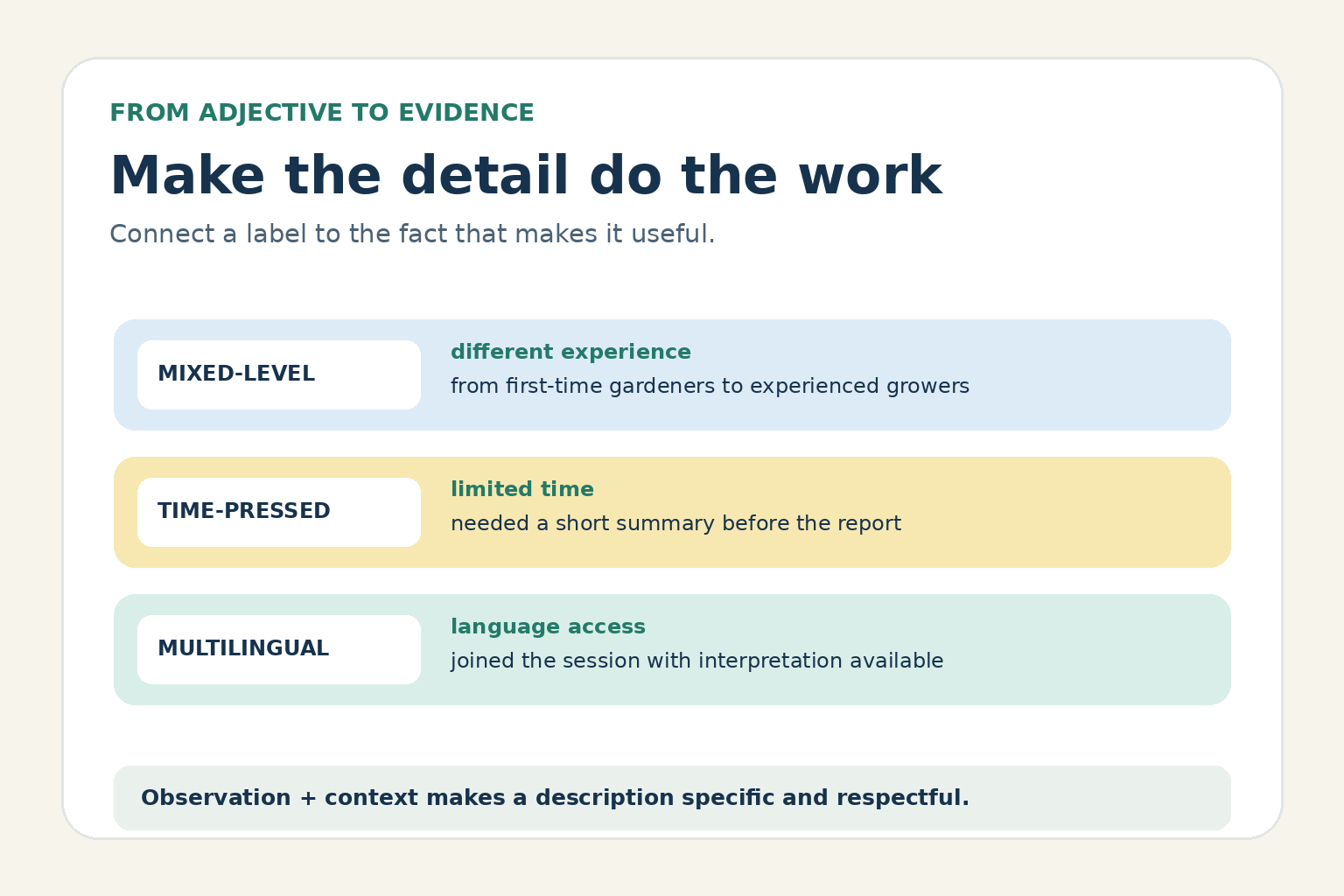
- The workshop welcomed a mixed-level audience, from first-time gardeners to experienced growers. — names differences in familiarity.
- Our curious readers asked for examples of how the new rule works in practice. — connects the adjective to observable questions.
- The time-pressed audience needed a short summary before the detailed report. — identifies a constraint that affects format.
- A multilingual audience joined the online session from several regions. — describes language and setting without implying a shared background.
- The skeptical audience wanted to see the evidence behind the proposal. — makes a critical-sounding trait useful by showing the reason.
- Returning visitors found the updated schedule quickly through the page headings. — uses behavior and outcome rather than an assumed personality.
How to Describe an Audience Without Stereotyping
Demographic labels do not predict what every person wants, knows, or believes. Age, profession, location, or identity may matter to a project, but they are not substitutes for evidence about people’s goals. If a label is not necessary to explain the content, leave it out. If it is relevant, describe the specific need rather than turning a group into a caricature.
Separate what you observed from what you inferred. “Twenty participants asked about cost” is an observation; “the audience was cheap” is a judgment. “Several readers opened the glossary” is an observation; “readers are confused” is an interpretation that needs more evidence. You can also mark uncertainty: Survey responses suggest that many subscribers prefer short weekly updates is more careful than Subscribers hate long emails.
Use people-first, respectful wording and the terms a community uses for itself. Avoid labels that reduce people to deficits or treat a group as a single viewpoint. Consider accessibility and practical circumstances: someone may read on a phone, use assistive technology, have limited time, or be unfamiliar with a specialist term. The W3C Web Accessibility Initiative’s writing tips recommend simple language and formatting suited to context. Clear writing can help people with different levels of subject knowledge.
How to Choose the Right Word
Use this quick sequence when revising a description:
- State the task. Are you describing readers, listeners, customers, students, visitors, or participants?
- Name the useful dimension. Is their familiarity, purpose, situation, response, or access need relevant?
- Check the evidence. Is the label based on research, a stated preference, or something you observed? If it is a guess, qualify it or choose a neutral phrase.
- Prefer the clearest term. Use familiar language and explain a technical label if readers may not know it.
- Check the effect. Could this adjective sound dismissive, patronizing, or more certain than the evidence allows?
When a sentence feels crowded with adjectives, replace the list with one concrete detail. Instead of an eager, passionate, enthusiastic audience, write the audience stayed after the session to ask follow-up questions. That detail lets readers understand the response and gives the description a stronger foundation.
Frequently Asked Questions
What is a good adjective to describe an audience?
Engaged, curious, attentive, mixed-level, and multilingual can all work, depending on what you need to describe. Choose a word that fits the context and can be supported by evidence.
What are positive adjectives for an audience?
Engaged, enthusiastic, receptive, supportive, inquisitive, and attentive are generally positive. Some describe behavior, while others interpret attitude, so make sure the context supports the word.
What is a neutral way to describe an audience?
Use a factual detail such as online, local, first-time, mixed-age, specialist, or large. A neutral term identifies the setting or group without assuming how its members feel.
Is “diverse audience” a useful description?
It may be, but it is often too broad by itself. If a specific difference matters, explain it—for example, the audience includes several language groups or a range of professional backgrounds—and connect that detail to the audience’s needs.
Are you struggling to find the right words to describe your audience? Look no further! In this article, I’ll be sharing a list of powerful adjectives that you can use to effectively describe your audience. Whether you’re a marketer, a writer, or a speaker, understanding your audience is essential for creating engaging content. By using the right adjectives, you can paint a vivid picture of your target demographic and tailor your message to resonate with them. So, let’s dive in and explore the world of adjectives for audience together!
How to Describe audience? – Different Scenarios
As a marketer, writer, or speaker, understanding your audience is crucial for creating engaging content. By using the right adjectives, you can create a clear image of your target demographic and customize your message to connect with them. Let’s explore how to describe an audience in different scenarios:
1. Describing an Audience for a Children’s Book
When writing a children’s book, it’s important to consider the age group and interests of your target audience. Here are some adjectives to describe a young audience:
- Curious: Children are naturally curious, so describing your audience as curious can help you create engaging and educational content.
- Imaginative: Kids have vivid imaginations. By describing your audience as imaginative, you can capture their attention and transport them to a world of wonder.
- Energetic: Children are full of energy, so describing your audience as energetic can help you create lively and dynamic content.
Remember to use simple and age-appropriate language in your writing, and include colorful illustrations to captivate young readers.
2. Describing an Audience for a Fitness Blog
If you’re writing a fitness blog, you’ll want to know your audience’s motivations and goals to provide relevant and inspiring content. Here are some adjectives to describe a fitness-focused audience:
- Motivated: Fitness enthusiasts are often motivated individuals who are committed to reaching their health goals. Describing your audience as motivated can inspire them to take action.
- Dedicated: People who are passionate about fitness tend to be dedicated to their exercise routines and healthy lifestyle habits. Using this adjective can resonate with their commitment.
- Health-conscious: A common trait among fitness enthusiasts is their focus on maintaining good health. Describing your audience as health-conscious shows that you understand their values.
In your fitness blog, provide practical tips, workout routines, and healthy recipes that align with your audience’s interests and goals.
3. Describing an Audience for a Business Seminar
- Ambitious: Business professionals often have ambitious career goals and aspirations. Describing your audience as ambitious can encourage them to strive for success.
- Entrepreneurial: If your audience consists of entrepreneurs or aspiring business owners, describing them as entrepreneurial can
Describing Words for audience in English
When it comes to creating engaging content, understanding your audience is paramount. By using the right adjectives, you can effectively describe your target audience and tailor your message to resonate with them. In this section, I’ll provide you with a list of descriptive words that you can use to describe different types of audiences.
- Children’s Book Audience:
- Curious
- Adventurous
- Imaginative
- Playful
- Eager
- Enthusiastic
A children’s book audience is full of young minds ready to embark on exciting adventures and explore their imagination. Using these descriptive words will help you create characters and narratives that capture their curiosity and keep them engaged throughout the story.
- Fitness Blog Audience:
- Motivated
- Health-conscious
- Active
- Determined
- Goal-oriented
- Disciplined
For a fitness blog audience, it’s important to use words that inspire them to pursue their health and wellness goals. These descriptive words will resonate with fitness enthusiasts who are looking for motivation, guidance, and tips to lead an active and healthy lifestyle.
- Business Seminar Audience:
- Ambitious
- Driven
- Success-oriented
- Entrepreneurial
- Innovative
- Goal-focused
When addressing a business seminar audience, you want to use words that captivate their drive for success and inspire them to take action. These words will help you convey your expertise and establish credibility, making your message more relatable and impactful.
Remember, understanding your audience is key to effectively connecting with them. By using these descriptive words, you can create content that speaks directly to their needs, interests, and aspirations. So, go ahead and experiment with these adjectives to create a powerful impact on your audience.
- Children’s Book Audience:
- Fitness Blog Audience:
-
- Ambitious
- Driven
- Success-oriented
- Entrepreneurial
- Innovative
- Goal-focused
Adjectives for audience
Positive Adjectives for Audience with 12 Example Sentences
When it comes to describing your audience, using positive adjectives can help create a favorable impression and engage your readers. Here are 12 examples of positive adjectives that can be used to describe different types of audiences:
- Enthusiastic: My audience was enthusiastic about the new children’s book I published.
- Curious: The fitness blog readers are always curious to learn new exercises and tips.
- Knowledgeable: The audience at the business seminar was knowledgeable and eager to learn.
- Supportive: I am grateful for the supportive audience that always encourages me in my writing.
- Motivated: The kids attending the storytelling event were motivated to listen and participate.
- Open-minded: The fitness blog attracts an open-minded audience who are willing to try new approaches to wellness.
- Empathetic: The audience for my self-help book was empathetic and connected with the message.
- Adventurous: The children’s book captivated an adventurous audience, who loved exploring new worlds.
- Inquisitive: The attendees of the business seminar were inquisitive and asked insightful questions.
- Creative: The children’s book aimed at nurturing the imagination of a creative audience.
- Active: The fitness blog readers are active individuals who prioritize their health and well-being.
- Passionate: The business seminar attracted a passionate audience who were driven to succeed.
Using these positive adjectives in your content can help you tailor your message and connect with your audience in a meaningful way.
Negative Adjectives for Audience with 5 Example Sentences
While positive adjectives help create a positive impression, it’s important to also be aware of negative adjectives that might describe your audience. Understanding the limitations or challenges your audience might face can help you address them effectively. Here are 5 examples of negative adjectives for describing an audience:
- Unresponsive: The children at the event were unresponsive and seemed disinterested.
- Indifferent: The fitness blog doesn’t resonate with an indifferent audience that lacks motivation.
- Skeptical: The business seminar struggled to win over a skeptical audience who doubted the effectiveness of the strategies.
- Disengaged: The readers of my blog seemed disengaged, showing little interest in the content.
- Cynical: The attendees at the workshop were cynical and skeptical about the speaker’s expertise.
Identifying these negative adjectives can help you adjust your approach to better engage your audience and overcome any potential obstacles.
Remember, understanding your audience is key to effectively connecting with them and creating content that speaks directly to their needs, interests, and aspirations. By using the right adjectives, you can paint a clear picture of your target demographic and customize your message to connect with them on a deeper level. So, whether you’re writing a children’s book, a fitness blog, or conducting a business seminar, choosing the right adjectives can make all the difference in capturing the attention and interest of your audience.
Synonyms and Antonyms with Example Sentences
When it comes to describing your audience, the right choice of adjectives can make a significant impact. Synonyms and antonyms provide an opportunity to create a clearer and more diverse picture of your target demographic. Let’s explore some examples:
Synonyms for Audience
- Crowd: A large audience gathered to witness the event.
- Gathering: The gathering comprised people from various walks of life.
- Assembly: The assembly of enthusiastic supporters cheered on the team.
- Spectators: The spectators were captivated by the thrilling performance.
- Viewers: The viewers tuned in to watch the live broadcast.
Using different synonyms for “audience” allows you to avoid repetition and adds variety to your content, keeping it engaging and interesting for your readers.
- Individuals: Each individual in the audience had their own unique perspective.
- Isolated: The program aimed to reach isolated individuals who may feel disconnected.
- Solitary: The solitary listener absorbed the speaker’s message intently.
- Absent: Unfortunately, the keynote speaker’s illness left the auditorium absent of an audience.
- Unattended: The unattended presentation failed to convey its intended message.
Describing the opposite of an audience can help you address the challenges or limitations that your target demographic may face. By acknowledging these factors, you can tailor your content to better connect with them on a deeper level.
Remember, understanding your audience is the key to effectively connecting with them. By using a variety of synonyms and antonyms, you can paint a clear and comprehensive picture of your target demographic, allowing you to customize your message and content according to their needs, interests, and aspirations.
Conclusion
Understanding your audience is crucial when it comes to effective communication and marketing strategies. By using a diverse range of adjectives to describe your target demographic, you can paint a clearer and more vivid picture of who they are. This allows you to tailor your message to their specific needs, interests, and aspirations.
In addition to describing your audience, it’s also important to consider the opposite. By understanding the challenges and limitations that your target demographic may face, you can address them in your messaging and find ways to overcome them. This shows empathy and helps establish a stronger connection with your audience.
Remember, your audience is not a monolithic entity. They are individuals with unique preferences, desires, and characteristics. By using a variety of adjectives, you can capture the nuances and complexities of your audience, ensuring that your message resonates with them on a deeper level.
So, take the time to truly understand your audience and choose your adjectives wisely. By doing so, you’ll be able to create more impactful and successful marketing campaigns that speak directly to the hearts and minds of your target demographic.


