Build a precise description from what you can see
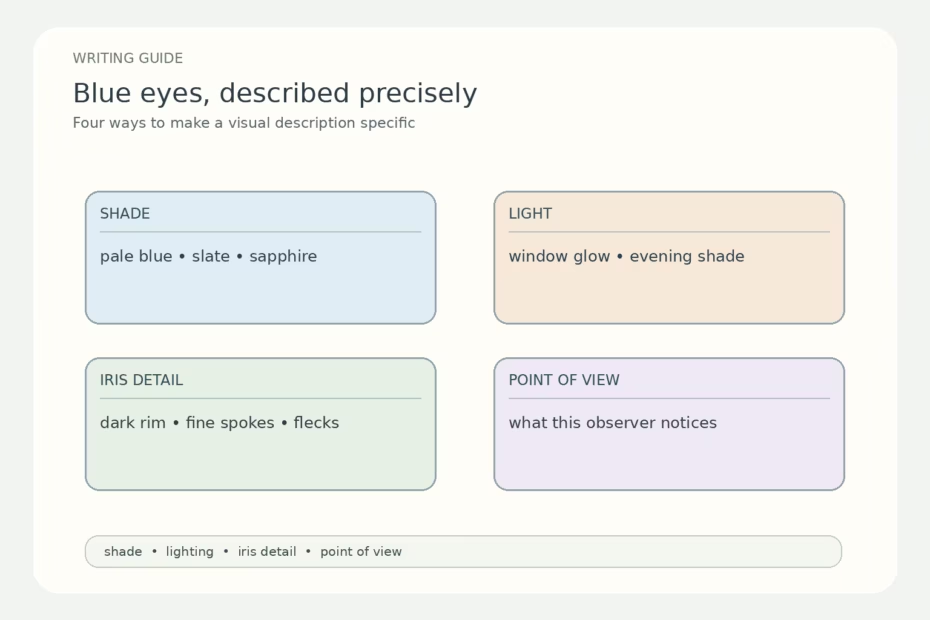
A useful description of blue eyes does more than stack flattering adjectives. First name the shade, then add one observable detail and a comparison that fits the scene. “Pale blue” gives a different impression from “deep navy”; “a silver ring around the iris” adds detail without guessing what the person feels. A small, specific observation often creates a clearer image than several synonyms for beautiful.

Blue eyes vary in shade and appearance
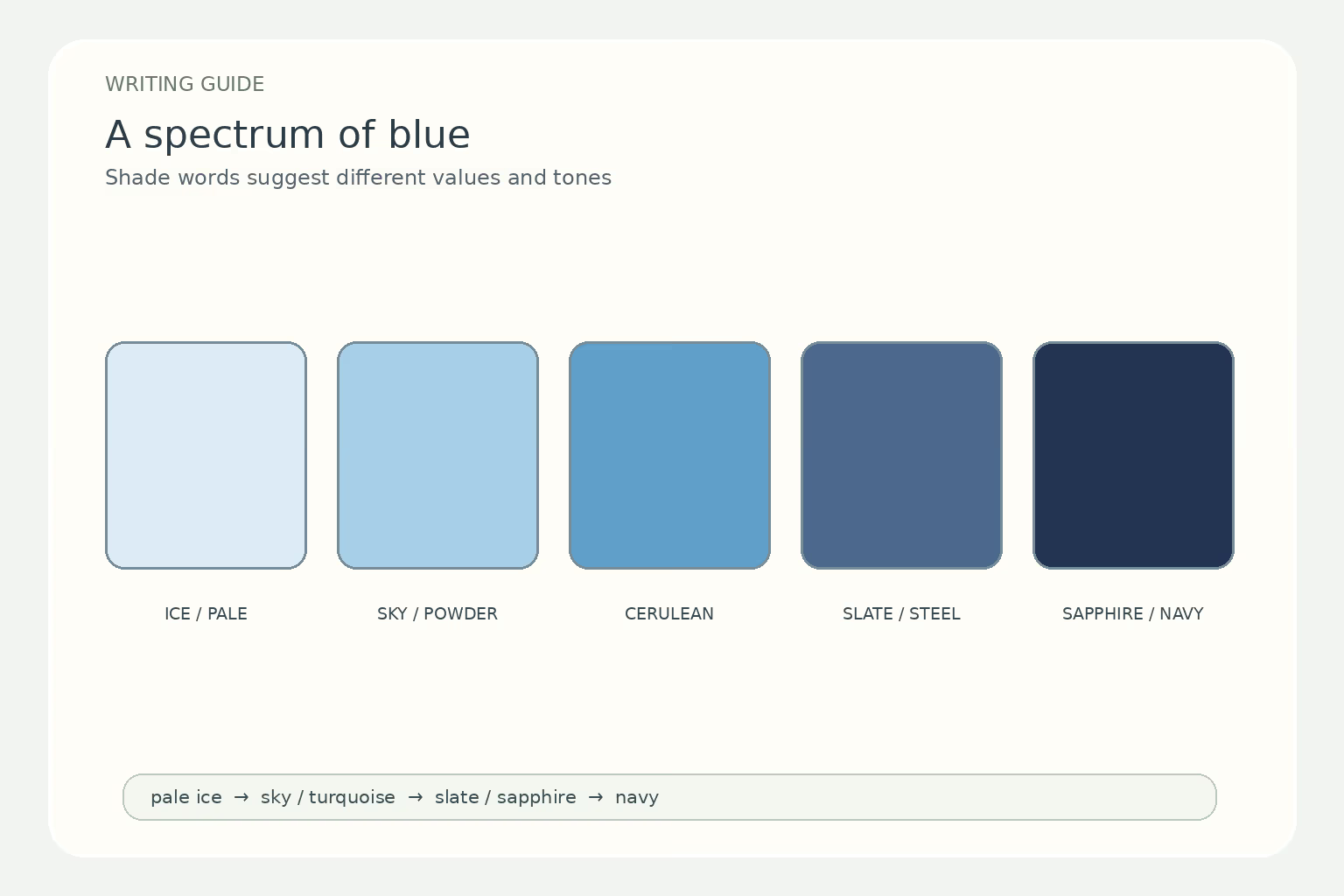
Blue is a broad color family. A writer might choose pale blue, powder blue, sky blue, cornflower blue, cerulean, steel blue, slate blue, blue-gray, deep blue, or sapphire. These comparisons suggest different values and tones: powder and ice are light, steel and slate lean gray, while sapphire and navy suggest greater depth. They are descriptive comparisons, not fixed scientific categories, so use one that matches the scene you are writing.
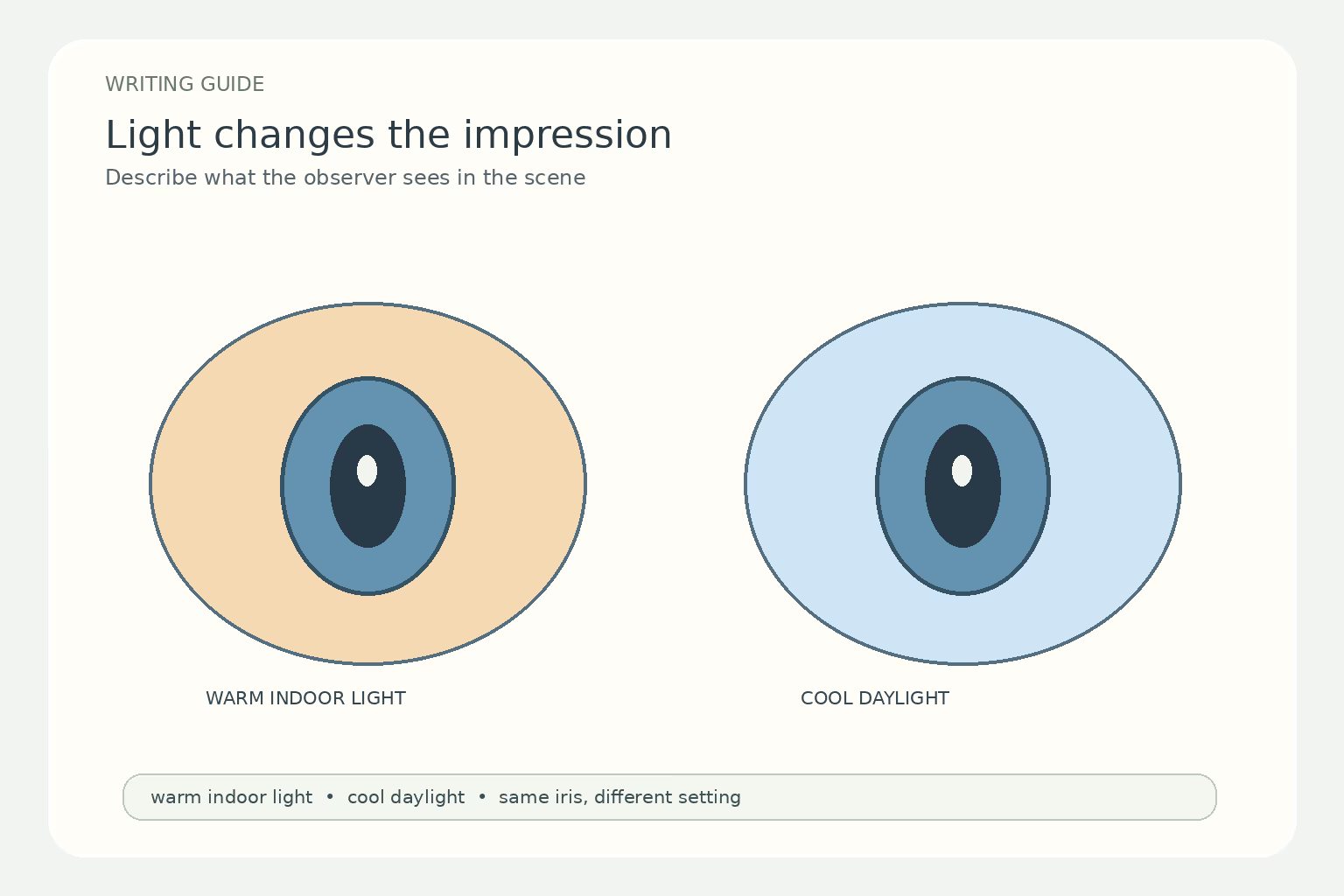
Light and surroundings can affect how an observer perceives an iris. Daylight, indoor lamps, clothing, makeup, and the colors nearby may change the impression; that does not mean the iris itself changes color every time the lighting does. If lighting matters to a scene, make it explicit: “In the window light, her blue-gray eyes looked almost silver.” This grounds the adjective in the observer’s conditions instead of presenting the color as an objective measurement.
Notice the iris, not just its color
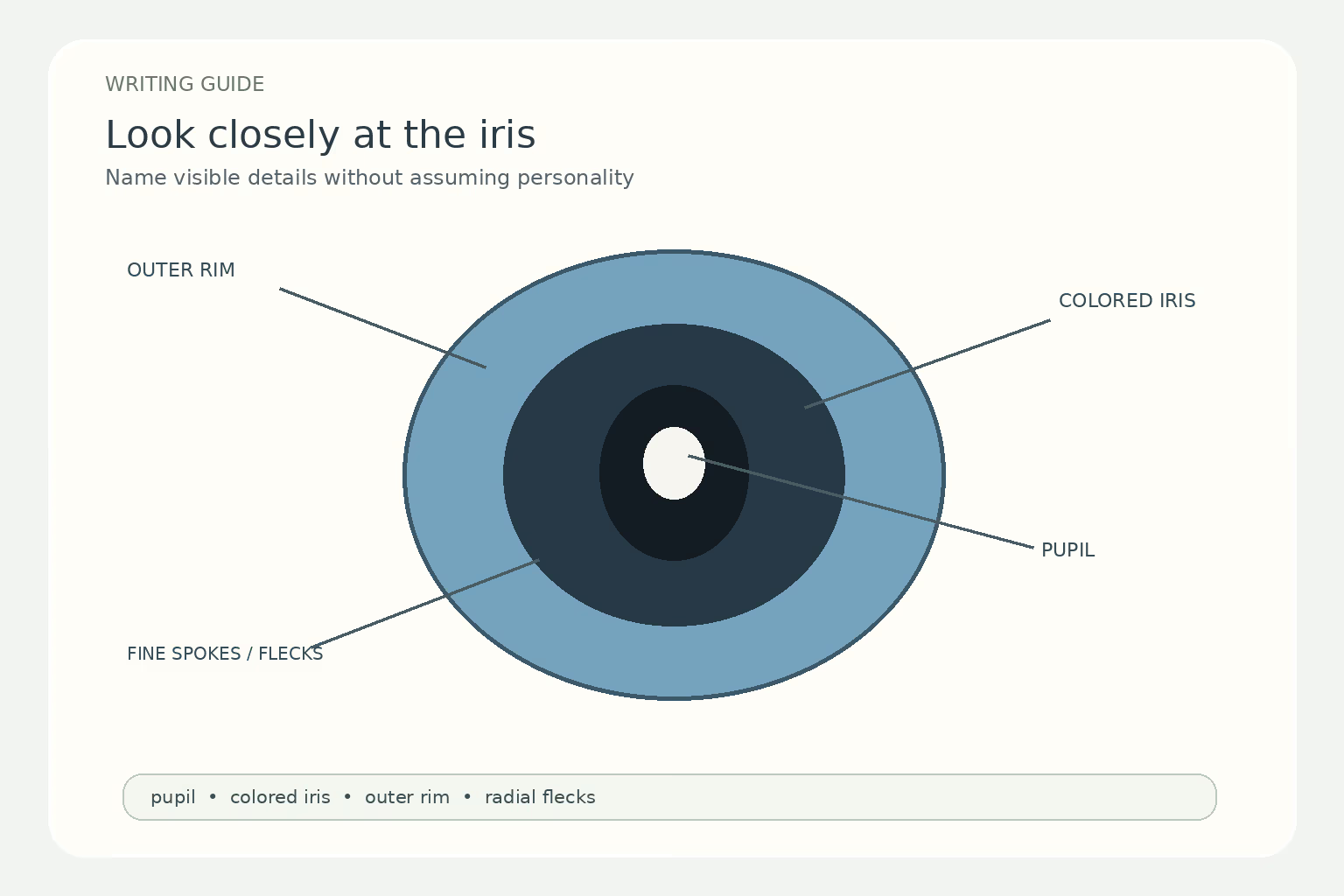
The iris is the colored ring around the pupil. Rather than relying only on “sparkling” or “captivating,” a writer can notice whether the color looks uniform, whether there is a darker outer ring, or whether fine spokes and flecks are visible. Keep the description observational: “Fine gray spokes radiated from the pupil” is more concrete than “her eyes revealed a mysterious soul.” Do not imply that eye color predicts personality, honesty, intelligence, or emotion. Those are stereotypes, not reliable conclusions from appearance.
Eye color is also more complex than a simple one-gene dominant/recessive chart. MedlinePlus Genetics explains that color reflects pigmentation in the iris and that melanin amount contributes to the range from lighter to darker eyes. OCA2 and HERC2 have major roles, while several other genes also contribute. This helps explain why eye color runs along a continuum and why family inheritance cannot always be predicted by a single rule. A literary shade such as “ice blue” is a visual comparison, not a genetic category.
Match the adjective to the mood and point of view
Some words mainly describe appearance: clear, bright, pale, deep, muted, or gray-blue. Others describe how the eyes seem to a particular observer: steady, searching, sleepy, or welcoming. Make the point of view clear so a subjective impression does not sound like a permanent trait. Instead of “He had cold eyes,” try “From across the quiet room, his pale eyes seemed distant to Mara.” That sentence identifies the observer and lets the context carry the mood.
- For a calm portrait: “Her soft, sky-blue eyes matched the quiet morning light.”
- For a close visual detail: “A dark rim framed the gray-blue iris, with tiny gold flecks near the pupil.”
- For a dramatic scene: “Under the cold station lights, his deep blue eyes looked almost slate.”
- For a neutral description: “Their eyes were a clear, medium blue with a subtle gray cast.”
A quick editing check
Before choosing a word, ask what you want the reader to picture: the shade, the way light falls, a visible iris pattern, or a character’s reaction. Keep the comparison proportionate, avoid repeating several near-synonyms, and separate what the narrator sees from what the narrator assumes. “Sapphire” can suggest rich depth; “icy” may convey coolness in the observer’s voice; neither word should be used as a shortcut for the person’s character. For inclusive writing, describe the eyes only when that detail matters to the scene, and do not assume everyone wants their appearance evaluated.
These choices make descriptive language more precise while leaving room for individual variation. Blue eyes are not one fixed shade, and the best adjective is the one that fits the visible details and the purpose of the sentence.
Hey there! Have you ever been captivated by someone’s mesmerizing blue eyes? Well, I certainly have. Blue eyes have a way of drawing you in and leaving you breathless. But have you ever struggled to find the right words to describe them? Don’t worry, I’ve got you covered. In this article, I’ll be sharing a list of adjectives that perfectly capture the beauty and allure of blue eyes. So whether you’re a writer looking for inspiration or simply someone who appreciates the enchantment of blue eyes, keep reading to discover the perfect words to describe those stunning azure orbs.
Blue eyes have always been associated with a sense of mystery and depth. They hold a certain allure that is hard to resist. From the palest baby blue to the deepest sapphire, each shade of blue eyes has its own unique charm. In this article, I’ll be diving into a wide range of adjectives that can be used to describe blue eyes. Whether you’re looking for words to describe the color, the sparkle, or the intensity, you’ll find plenty of options here. So get ready to explore the world of adjectives and discover the perfect words to describe those captivating blue eyes.
How to Describe blue eyes? – Different Scenarios
When it comes to describing blue eyes, there are various scenarios that can evoke different emotions and visuals. Here are some examples of how you can describe blue eyes in different contexts:
1. Color and Shades
- Icy blue: Their eyes were like pools of icy blue, captivating and cold.
- Sapphire blue: Her eyes sparkled with a deep sapphire blue, like precious gemstones.
- Turquoise: His eyes were a stunning shade of turquoise, reminiscent of tropical waters.
- Cerulean: The sky reflected in her cerulean eyes, bringing a sense of tranquility.
- Denim blue: His eyes had a rugged charm, with a hue that resembled faded denim.
2. Sparkle and Shine
- Gleaming: Her eyes gleamed with a captivating brightness, like stars in the night sky.
- Twinkling: Their eyes twinkled with delight and mischief, full of playful energy.
- Dazzling: His eyes had a dazzling sparkle, as if stardust had been sprinkled within.
- Radiant: The sunlight caught her eyes, making them appear radiant and full of life.
- Glimmering: His eyes glimmered with anticipation, like a hidden gem waiting to be discovered.
- Piercing: His intense blue eyes seemed to pe
netrate my soul, leaving me unable to look away. - Enigmatic: Her eyes held a mysterious allure, with a depth that seemed to hide secrets.
- Intense: Their eyes had an intense gaze that could make anyone feel seen and understood.
- Captivating: His eyes were so captivating, it was impossible to look away from their magnetic pull.
- Soulful: Her eyes had a soulful quality, conveying deep emotions and a profound connection.
Remember, every set of blue eyes is unique, and each description should capture the individuality and beauty within them. Use these examples as a starting point to find the perfect words that resonate with the specific blue eyes you are describing.
Describing Words for blue eyes in English
As someone who has written about descriptive words for years, I have come across many different ways to describe blue eyes. Blue eyes have a captivating quality that makes them stand out, and finding the right words to describe them can be a fun and creative task. Here are some adjectives that can be used to perfectly capture the essence of blue eyes:
- Sparkling: Blue eyes often have a shimmering quality, as if tiny stars are twinkling within them. They can be described as sparkling, giving off a radiant and enchanting glow.
- Glistening: Another way to describe blue eyes is by using the word glistening. This word conveys the idea of light reflecting off the surface of the eyes, creating a luminous and mesmerizing effect.
- Sapphire: Blue eyes can resemble the deep blue color of sapphires. This word not only describes the color, but also brings to mind a sense of elegance and sophistication.
- Icy: If you’re looking for a more unique and vivid description, you can use the word icy to describe blue eyes. This adjective evokes a sense of coolness and freshness, like looking into a pair of icy blue lakes.
- Piercing: Blue eyes can have an intense and penetrating gaze that seems to see right through you. Describing them as piercing captures this captivating quality and adds a touch of mystery.
- Cerulean: Cerulean is a word that specifically describes the color of a clear, blue sky. Using this word not only paints a vivid picture, but also creates a sense of tranquility and calmness.
- Vibrant: Blue eyes can be vibrant, full of life and energy. This adjective highlights the brightness and vivacity of blue eyes, making them impossible to ignore.
- Captivating: Blue eyes have a way of drawing people in and capturing their attention. Describing them as captivating conveys the idea of being spellbound and utterly fascinated.
Adjectives for blue eyes
Positive Adjectives for Blue Eyes with 12 Example Sentences
When it comes to describing the mesmerizing beauty of blue eyes, there are countless positive adjectives that come to mind. Let me share with you a collection of words that can truly capture the stunning allure of blue eyes. Here are twelve examples:
- Sparkling: Her blue eyes glistened like shimmering diamonds.
- Glistening: The sunlight reflected off her blue eyes, making them glisten with an ethereal glow.
- Sapphire: His deep blue eyes resembled the brilliance of a precious sapphire gem.
- Icy: There was a chilling intensity in her ice-blue eyes that sent shivers down my spine.
- Piercing: His piercing blue eyes seemed to see right through me, unraveling the depths of my soul.
- Cerulean: The vivid cerulean hue of her eyes resembled the endless expanse of a clear sky.
- Vibrant: The bright and vibrant blue color of his eyes immediately caught my attention.
- Captivating: Her captivating blue eyes had an irresistible allure that held my gaze.
- Enchanting: The enchanting beauty of her blue eyes was simply spellbinding.
- Magnetic: His magnetic blue eyes drew me in, leaving me unable to look away.
- Hypnotic: There was a hypnotic quality to her blue eyes that had an entrancing effect on everyone around her.
- Mesmerizing: I couldn’t help but be captivated by the mesmerizing depth of his blue eyes.
Negative Adjectives for Blue Eyes with 5 Example Sentences
While blue eyes are often seen as breathtakingly beautiful, there are also negative adjectives that can be used to describe them. Here are five examples:
- Dull: His blue eyes lacked the brightness and vibrancy that often characterizes this eye color.
- Washed-out: Her blue eyes appeared faded and washed-out, lacking the intensity that makes them stand out.
- Pale: The pale blue color of his eyes made them appear less vibrant and striking.
- Lifeless: There was a certain lifelessness in her blue eyes, as if their sparkle had faded away.
- Empty: His blue eyes seemed empty, devoid of any emotion or depth.
Remember, these adjectives are just a starting point. Feel free to get creative and combine them with other words to create unique and vivid descriptions. Whether you are writing a poem, a story, or simply admiring someone’s eyes, these adjectives will help you capture the essence of blue eyes in a captivating and engaging way.
Synonyms and Antonyms with Example Sentences
Synonyms for Blue Eyes
When it comes to describing blue eyes, there are several synonyms that can help paint a vivid picture. Here are some words you can use to capture the mesmerizing beauty of blue eyes:
- Sparkling: Her eyes were as sparkling as the ocean on a sunny day.
- Glistening: His glistening blue eyes shone with excitement.
- Sapphire: She had deep blue sapphire eyes that seemed to hold secrets.
- Icy: His icy blue eyes pierced through the crowd.
- Piercing: Her piercing blue eyes could see right through your soul.
- Cerulean: The artist used shades of cerulean blue to capture the intensity of her eyes.
- Vibrant: His vibrant blue eyes captivated everyone in the room.
- Captivating: The actress had a pair of captivating blue eyes that drew you in.
- Enchanting: Her enchanting blue eyes had a magical quality.
- Magnetic: His magnetic blue eyes had a way of attracting attention.
- Hypnotic: I couldn’t look away from her hypnotic blue eyes.
- Mesmerizing: The deep, mesmerizing blue of her eyes held me spellbound.
Antonyms for Blue Eyes
While blue eyes are often associated with beauty, there are also antonyms that describe blue eyes in a less vibrant and striking way. Here are a few words to describe blue eyes in a more subdued manner:
- Dull: His dull blue eyes lacked the sparkle of excitement.
- Washed-out: The once vibrant blue of her eyes had become washed-out with age.
- Pale: Her pale blue eyes contrasted with her dark hair.
- Lifeless: His blue eyes appeared lifeless and devoid of emotion.
- Empty: She had a pair of empty blue eyes that seemed to hold no emotion.
Whether you choose to use positive or negative adjectives to describe blue eyes, each word will bring a different tone and imagery to your writing. Experiment with different combinations to create unique and vivid descriptions that capture the essence of blue eyes.
Conclusion
Describing blue eyes can be a fascinating and creative endeavor. Throughout this article, I have provided a range of adjectives that can be used to capture the captivating beauty of blue eyes. From sparkling and glistening to sapphire and icy, these words paint a vivid picture of the mesmerizing allure that blue eyes possess.
On the other hand, we have also explored antonyms such as dull, washed-out, and pale, which offer a more subdued description of blue eyes. These words can be used to convey a different mood or atmosphere when describing someone’s eyes.
By experimenting with different combinations of these adjectives, you can create unique and captivating descriptions that truly capture the essence of blue eyes. Whether you want to emphasize their vibrancy and magnetism or highlight a more subtle and mysterious quality, the possibilities are endless.
So, the next time you find yourself in need of words to describe blue eyes, remember the plethora of options available to you. Let your imagination run wild and paint a vivid picture with your words.


