
Busy is a neutral, flexible adjective for someone who has a lot to do, a place full of activity, or a schedule with little free time. Choose hectic when the pace feels rushed, bustling for lively places, occupied for focused attention, and productive when the work leads to a useful result.
The best adjective depends on what you want readers to notice: the amount of activity, its pace, the person’s attention, or the outcome. A full calendar can be busy without being stressful, and a busy day is not automatically a productive one.

Which Adjectives Mean Busy?
Use this quick guide to choose a word that fits the situation. Some choices are neutral, while others suggest speed, pressure, or a positive result.
| Word | What it emphasizes | Example |
|---|---|---|
| Busy | Many tasks, activity, or people | I have a busy week, but Friday afternoon is open. |
| Occupied | A person’s time or attention is in use | She is occupied with the monthly report until noon. |
| Hectic | A very active, fast-paced period | The first week of school was hectic for the office team. |
| Bustling | A lively place full of activity | We met at a bustling café near the station. |
| Productive | Useful work or a good result | The team had a productive planning session. |
| Demanding | Work that requires sustained effort | It was a demanding month with several deadlines. |
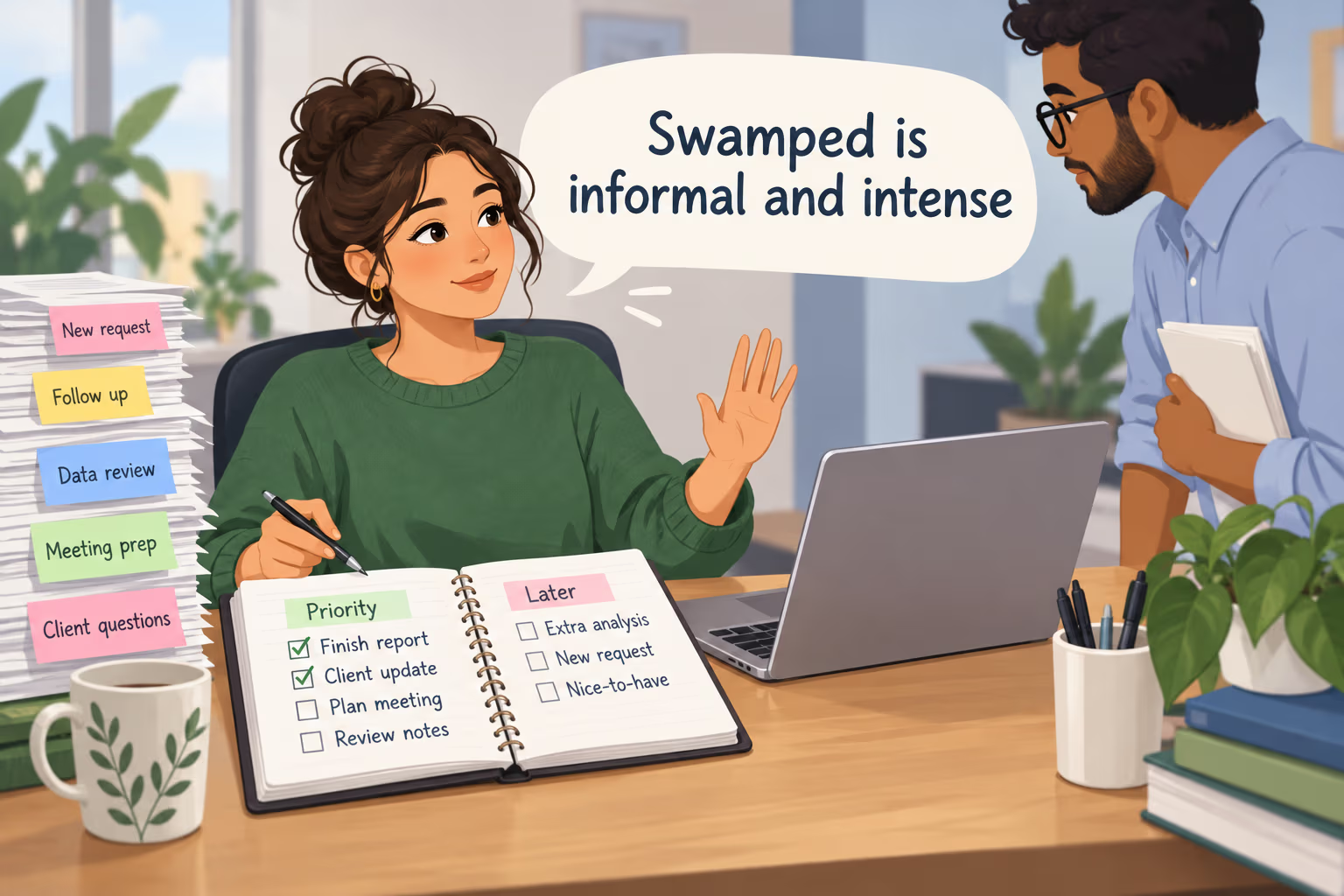
| Swamped | More work than someone can easily handle; informal | I’m swamped with orders, so I’ll reply tomorrow. |
| Packed | A schedule or place filled nearly to capacity | My calendar is packed with appointments today. |
How Are Hectic, Bustling, and Busy Different?
Busy is the broadest choice: it says that a person, place, or time has a lot going on. Hectic adds a sense of very fast or intense activity, so it often describes a day, schedule, workplace, or pace. Bustling usually describes a place or scene where people are moving and activity is lively. Cambridge Dictionary defines a bustling place as one full of busy activity and describes hectic as full of activity or very busy and fast.

Compare the emphasis: “The market was busy” reports activity; “the market was bustling” makes it feel lively; “my morning was hectic” suggests the pace was demanding. These words overlap, but they are not interchangeable in every sentence.
Positive Adjectives for a Busy Person
When a description should sound positive, choose words that name a useful quality or result rather than treating constant activity as proof of success. Match the adjective to observable evidence.
- Productive: completing useful work or reaching a clear result. “We had a productive afternoon and finished the draft.”
- Purposeful: acting with a clear aim. “She took a purposeful approach to the event schedule.”
- Organized: arranging tasks or materials in a workable way. “He stayed organized while coordinating three deliveries.”
- Engaged: actively interested or involved. “The class was engaged during the group activity.”
- Industrious: working steadily and with effort. “The industrious volunteers prepared every table before the doors opened.”
- Efficient: completing work without unnecessary steps or waste. “An efficient check-in process kept the line moving.”

A positive description is more convincing with a specific action: “a productive editor who completed the revisions by Thursday” gives the reader more information than “a very busy editor.” Use productive only when the work achieved something useful; having many tasks is not, by itself, evidence of a good result.
Words for an Overloaded or Fast-Paced Schedule
Use hectic, frantic, or overloaded when you want to signal strain or an unusually fast pace. Use swamped in conversational writing when someone has more work or requests than they can readily manage. Cambridge Dictionary marks swamp in this “too much” sense as a verb, as in “I’m swamped with work,” so it sounds natural in informal messages but may be too casual for a formal résumé.
| Context | Clear wording | Why it fits |
|---|---|---|
| Professional update | “My schedule is full through Wednesday; I can review this Thursday.” | Neutral and specific about availability. |
| Casual message | “I’m swamped with requests today, but I’ll get back to you tomorrow.” | Conversational and conveys excess work. |
| Formal report | “The team managed a demanding launch period with overlapping deadlines.” | Professional and focused on the work. |
| Personal reflection | “It was a hectic week, so I set aside a quiet evening to reset.” | Communicates pace and its effect. |
How to Use Adjectives for Busy in a Sentence
Most of these adjectives can go before a noun or after a linking verb. Keep the description tied to what is busy: a person, a schedule, a place, or a period of time.
- Before a noun: “We chose a busy restaurant for lunch.”
- After a linking verb: “The team is occupied with the launch.”
- For a place: “A bustling station filled with commuters.”
- For intensity: “A hectic afternoon of calls and revisions.”
- For an outcome: “A productive meeting produced a clear action list.”
- For workload strain: “I’m swamped with customer questions this morning.”
Avoid piling up near-synonyms such as “busy, hectic, packed, and swamped.” One accurate adjective plus a concrete detail is easier to understand. In a résumé, replace a vague phrase such as “busy and hardworking” with an honest example of work completed, people supported, or responsibilities coordinated.
Frequently Asked Questions
What is a positive word for busy?
Productive is positive when the work leads to a useful result. Organized, purposeful, and engaged can also work when the sentence supports them with a real action.
Is hectic a synonym for busy?
Yes, in some contexts, but hectic suggests a faster or more intense pace. Use busy for a neutral description and hectic when the activity feels especially demanding.
Does bustling describe a person or a place?
Bustling most often describes a lively place, such as a market, street, café, or station. For a person, busy, occupied, or engaged is usually more natural.
Is swamped formal?
Swamped is conversational in “I’m swamped with work.” In formal writing, consider overloaded, handling a heavy workload, or a specific description of the tasks instead.
Sources and Further Reading
- Cambridge Dictionary: busy — uses for people, schedules, and active places.
- Cambridge Dictionary: hectic — a fast, very active pace.
- Cambridge Dictionary: bustling — lively activity in a place.
- Cambridge Dictionary: swamp — the “too much work or demand” sense of swamped.
- Cambridge Dictionary: productive — work that achieves positive results.

How to Describe busy? – Different Scenarios
When it comes to describing a busy schedule, there are a variety of adjectives that can help capture the essence of busyness in different scenarios. Whether you are writing a resume, a blog post, or simply expressing yourself, choosing the right words can make a big difference in conveying the level of activity and productivity in your life. Here are some examples of how you can use descriptive adjectives to accurately describe busy in various situations:- Professional Setting
- Personal Life
- Education
- Social Life
Describing Words for busy in English
Describing Words for Busy in English
As someone with a busy schedule, I understand the importance of finding the right words to describe the level of busyness and engagement in different scenarios. By using descriptive adjectives, we can effectively communicate our level of activity and productivity. In this section, I will provide you with a list of adjectives to describe being busy in English.Adjectives to Describe Being Busy
Here are some descriptive words that can be used to express busyness in various contexts:- Hectic: This adjective is perfect for describing a schedule that is filled with activity and demands constant attention.
- Chaotic: When your schedule feels disorganized and overwhelming, this word effectively conveys the sense of busyness.
- Crazy: Use this adjective to describe a schedule that is exceptionally busy and perhaps even a bit overwhelming.
- Jam-packed: This phrase is great for describing a schedule that is filled to the brim with commitments and activities.
- Demanding: When a schedule requires a lot of time and effort, this adjective accurately portrays the level of busyness.
Examples of Describing Words
To help you understand how these adjectives can be used in context, here are a few examples:| Situation | Descriptive Word |
|---|---|
| My work week is filled with meetings and deadlines. | Hectic |
| The classroom was chaotic during art time. | Chaotic |
| Planning a wedding can be crazy with all the details to organize. | Crazy |
| My vacation itinerary was jam-packed with sightseeing and activities. | Jam-packed |
| The final month before exams is always demanding for students. | Demanding |
Adjectives for busy
Positive Adjectives for Busy with 12 Example Sentences
When describing a busy schedule, there are several positive adjectives that can be used to convey a sense of productivity and efficiency. Here are twelve examples of positive adjectives you can use:- Productive: I had a productive day, accomplishing all my tasks.
- Efficient: I managed to complete the project in an efficient manner.
- Organized: Despite the busyness, I remained organized and focused.
- Driven: I am feeling driven and motivated to meet all the deadlines.
- Dynamic: Our team is dynamic and always ready to take on new challenges.
- Energetic: I am feeling energetic and ready to tackle my to-do list.
- Proactive: Being proactive helped me stay on top of my busy schedule.
- Ambitious: I have an ambitious plan to finish all my work this week.
- Goal-oriented: I am focused and goal-oriented, making progress every day.
- Engaged: I am fully engaged in my work, which makes me more productive.
- Resourceful: Even in the busyness, I found resourceful ways to manage my time.
- Multi-tasking: I am skilled at multi-tasking, which helps me handle a busy workload.
Negative Adjectives for Busy with 5 Example Sentences
While a busy schedule can be challenging, there are also negative adjectives that can be used to describe the overwhelming aspects of being busy. Here are five examples of negative adjectives you can use:- Overwhelming: The workload is overwhelming, and I need to find ways to manage it.
- Stressful: A busy schedule can sometimes be stressful, but I strive to stay calm.
- Hectic: It’s been a hectic week, with back-to-back meetings and deadlines.
- Chaotic: My schedule feels chaotic, but I am working on bringing order to it.
- Demanding: The workload is demanding, but I am up for the challenge.
Synonyms and Antonyms with Example Sentences
When it comes to describing busyness, there are a variety of adjectives that can be used to accurately convey the level of activity and productivity. In this section, I will provide you with a list of synonyms and antonyms for the word “busy,” along with example sentences to help you understand how these adjectives can be used in context.Synonyms for busy
When you want to express that you are busy in a positive way, there are several synonyms that can be used. These words not only convey a sense of productivity and efficiency, but they also highlight your ability to handle multiple tasks and responsibilities. Take a look at the table below for some synonyms for busy: Synonyms- Productive
- Efficient
- Organized
- Driven
- Dynamic
- Energetic
- Proactive
- Ambitious
- Goal-oriented
- Engaged
- Resourceful
- Multi-tasking
- I am productive at work, always meeting my deadlines and accomplishing tasks efficiently.
- She is organized and manages her time well, making her a valuable asset to the team.
- He is a driven individual who is constantly pushing himself to achieve his goals.
- Our team is dynamic and always ready to adapt to new challenges.
- The CEO is energetic and motivates the employees with her enthusiasm.
- Being proactive allows me to stay ahead of the game and tackle problems before they arise.
- I have always been ambitious, striving for success in everything I do.
- Being goal-oriented keeps me focused and motivated to achieve my objectives.
- She is fully engaged in her work, always giving her best effort.
- Being resourceful helps me find creative solutions to problems.
- I am skilled at multi-tasking, allowing me to juggle multiple responsibilities effectively.
Antonyms for busy
On the other hand, there are also adjectives that can be used to describe the overwhelming aspects of being busy. These antonyms convey a sense of stress, chaos, and demand. Here are some antonyms for busy: Antonyms- Overwhelming
- Stressful
- Hectic
- Chaotic
- Demanding
- The workload can sometimes be overwhelming, but I am learning to manage my time better.
- His job is incredibly stressful, with tight deadlines and high expectations.
- The office environment can be quite hectic with constant phone calls and meetings.
- The project was chaotic due to poor planning and communication.
- Meeting the demands of my job can be quite demanding, but it’s also rewarding.


