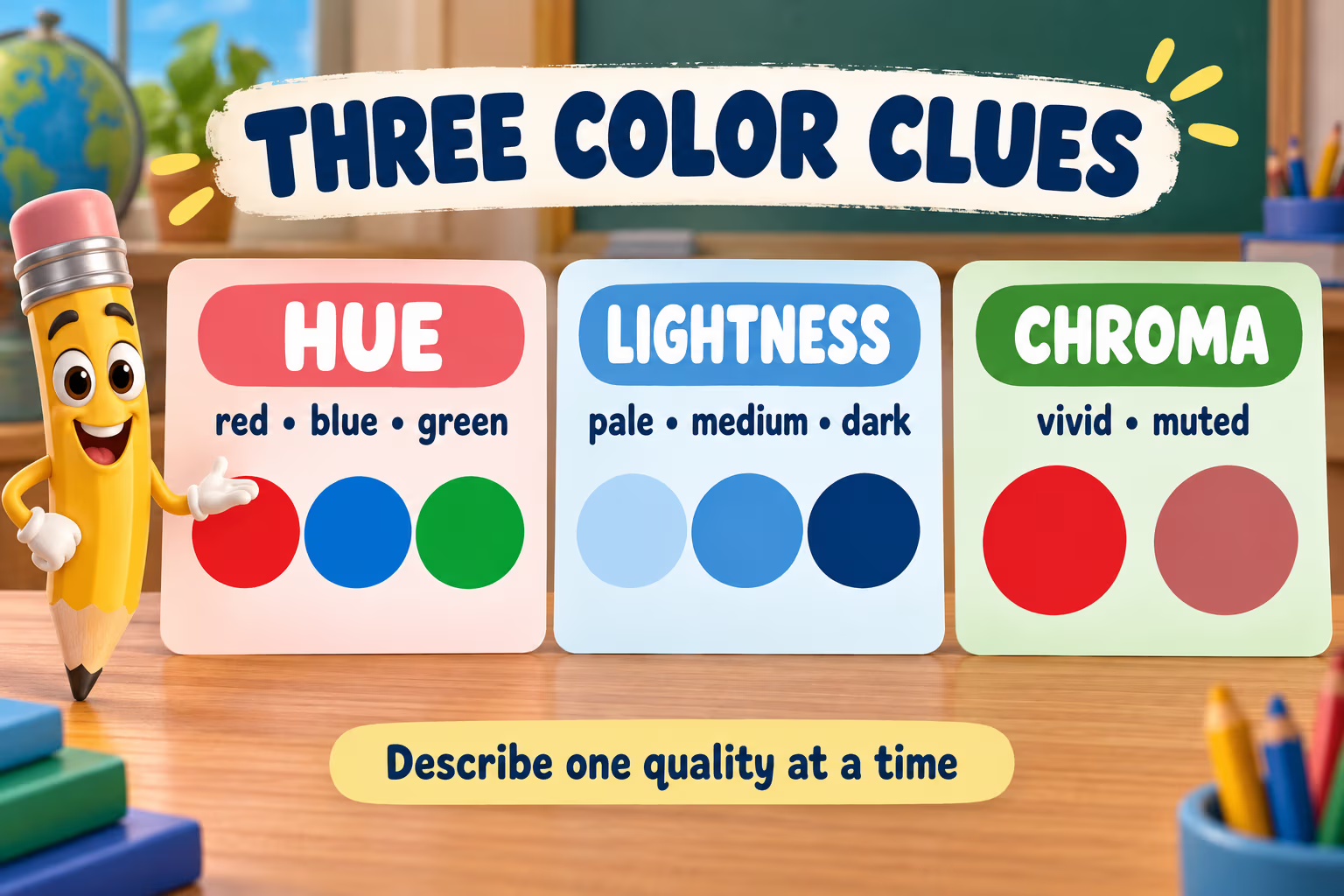
Color adjectives tell readers which visual quality you mean. Hue words name a color family, such as crimson or teal; lightness words compare pale, light, and dark; intensity words such as vivid or muted describe colorfulness. These descriptions are relative to their material, lighting, nearby colors, display, and reader—not universal measurements.
Adjectives for Colors at a Glance
- Hue: name a family or shade, as in scarlet, cobalt, or olive.
- Lightness: compare how light or dark the sample appears, using words such as pale, light, deep, or dark.
- Colorfulness: use vivid or muted for an everyday description; these are not precise measurements by themselves.
- Temperature and association: warm and cool depend on the palette, lighting, and comparison.
- Surface and finish: glossy, matte, and metallic often describe a material or surface, not its hue.
What do color adjectives describe?
Some adjectives identify a color family; others describe how light, colorful, warm, or reflective it appears. CIE’s international lighting vocabulary describes perceived color through attributes including hue, brightness or lightness, and colourfulness-related terms such as saturation or chroma. These concepts help explain what writers may notice, but familiar words do not always map neatly to a technical measurement.
Lighting, surrounding colors, the surface, the display, and the viewer can all affect appearance. A blue cloth under warm indoor bulbs may look different from the same cloth near a window. For descriptions, say what the color seems like in that setting; for exact production or design specifications, name the color system and viewing conditions instead of relying on an adjective alone.
Choose an adjective by the visual quality
Use this word bank to move from the quality you observe to a useful description. The categories are practical writing distinctions, not fixed scientific bins; a sample can be both dark and vivid, or pale and muted.
| Quality | Useful adjectives | What the words emphasize | Original example |
|---|---|---|---|
| Hue or color family | scarlet, crimson, coral, cobalt, teal, olive, amber, lilac | A named family or recognizable shade; the names are approximate and can vary by reference. | “A coral scarf softened the red-and-orange display.” |
| Lightness or darkness | pale, light, medium, deep, dark, shadowed | How light or dark the color looks in comparison with other samples. | “The pale blue paper stood out against the deep navy cover.” |
| Colorfulness or intensity | vivid, saturated, muted, subdued, dull, washed-out | Everyday impressions of strength or restraint; dull may imply a negative judgment. | “Muted greens kept the room quiet, while one vivid red cushion drew the eye.” |
| Temperature or association | warm, cool, icy, golden, earthy | A relative visual grouping or mood; nearby colors and the light source influence the comparison. | “Warm ochre beside cool blue made the poster feel balanced.” |
| Surface or finish | glossy, matte, metallic, translucent, pearlescent | Reflection, material, transparency, or finish rather than hue alone. | “The glossy teal tile reflected the window; the matte one looked softer.” |
Hue answers “which color family or shade?” Lightness answers “how light or dark does it look?” Colorfulness answers “how vivid or restrained does it seem?” A writer may use intense broadly, but the word can refer to strong color, bright light, or emotional effect; clarify the intended sense when precision matters.
The CIE definition of perceived colour notes that perception depends not only on a stimulus but also on its surround, the observer’s visual adaptation, and experience. That is why adjectives such as bright, warm, or rich should be read in context. “Bright yellow” might mean a strong yellow swatch; “brightly lit yellow fabric” explicitly describes illumination.
Why are “bright,” “pale,” “muted,” and “vivid” not interchangeable?
Pale commonly suggests a light-looking, comparatively low-strength shade; dark and deep point toward lower lightness, though deep can also imply richness. Muted suggests a softened or subdued appearance; vivid suggests strong colorfulness. These are useful ordinary-language distinctions, not calibrated readings.
Bright is especially ambiguous: it can refer to a high-lightness appearance, strong emitted or reflected light, or a vivid-looking color. Add a noun or comparison to make the intended meaning clear: “a bright red signal” may be vivid; “a red panel lit brightly from above” describes the illumination.
For digital work, the W3C CSS Color specification defines HSL values for sRGB with hue, saturation, and lightness components. HSL is a way to specify colors, not a universal model of perceived appearance: the specification cautions that HSL lightness does not match perceived lightness across hues. In its example, pure blue and yellow at the same HSL lightness look very different. Use visual comparison or a suitable colorimetric model when measured appearance matters.
See the W3C CSS Color 4 terminology and HSL discussion for the technical details. In everyday prose, avoid implying that vivid, intense, or bright has one exact numeric value unless you give a specified measurement and conditions.
Are color names true synonyms or antonyms?
Not usually. Shade names within a broad family can be related without being exact substitutes: crimson, scarlet, ruby, and burgundy all point toward varieties of red, but each suggests a different shade or association. Likewise, navy, cobalt, indigo, and azure are blue-family names, not interchangeable synonyms.
Pairs in a “contrasting colors” list are not lexical antonyms in the way light and dark can be opposites within a description. Red and green, for example, may be treated as complements in a particular color wheel or design context, but the relationship depends on the color model and the colors selected. The original synonym and antonym tables below are kept intact; read them as related shade names and possible visual contrasts, not exact synonyms or universal word opposites.
| Original type of entry | More precise reading | Example in context |
|---|---|---|
| Crimson / scarlet / ruby / burgundy | Related red-family shade names with different customary associations and appearances. | “The scarlet banner looked brighter than the deep burgundy curtains.” |
| Navy / cobalt / indigo / azure | Related blue-family names, not four names for one identical swatch. | “She chose cobalt for the bright icon and navy for the small caption.” |
| Red / green | A possible visual contrast in some systems, not a dictionary antonym pair. | “The red and green marks were also labeled ‘urgent’ and ‘complete.’” |
How should you describe color in writing, art, and charts?
- In prose: pair one color adjective with the object and a concrete comparison: “a muted green coat beside the vivid yellow umbrella.”
- In product descriptions: identify the family and lightness or finish when useful—“deep blue, matte glaze”—and avoid promising an exact screen-to-object match.
- In art notes: name the relationship you want, such as warmer, cooler, lighter, or less vivid than a reference swatch.
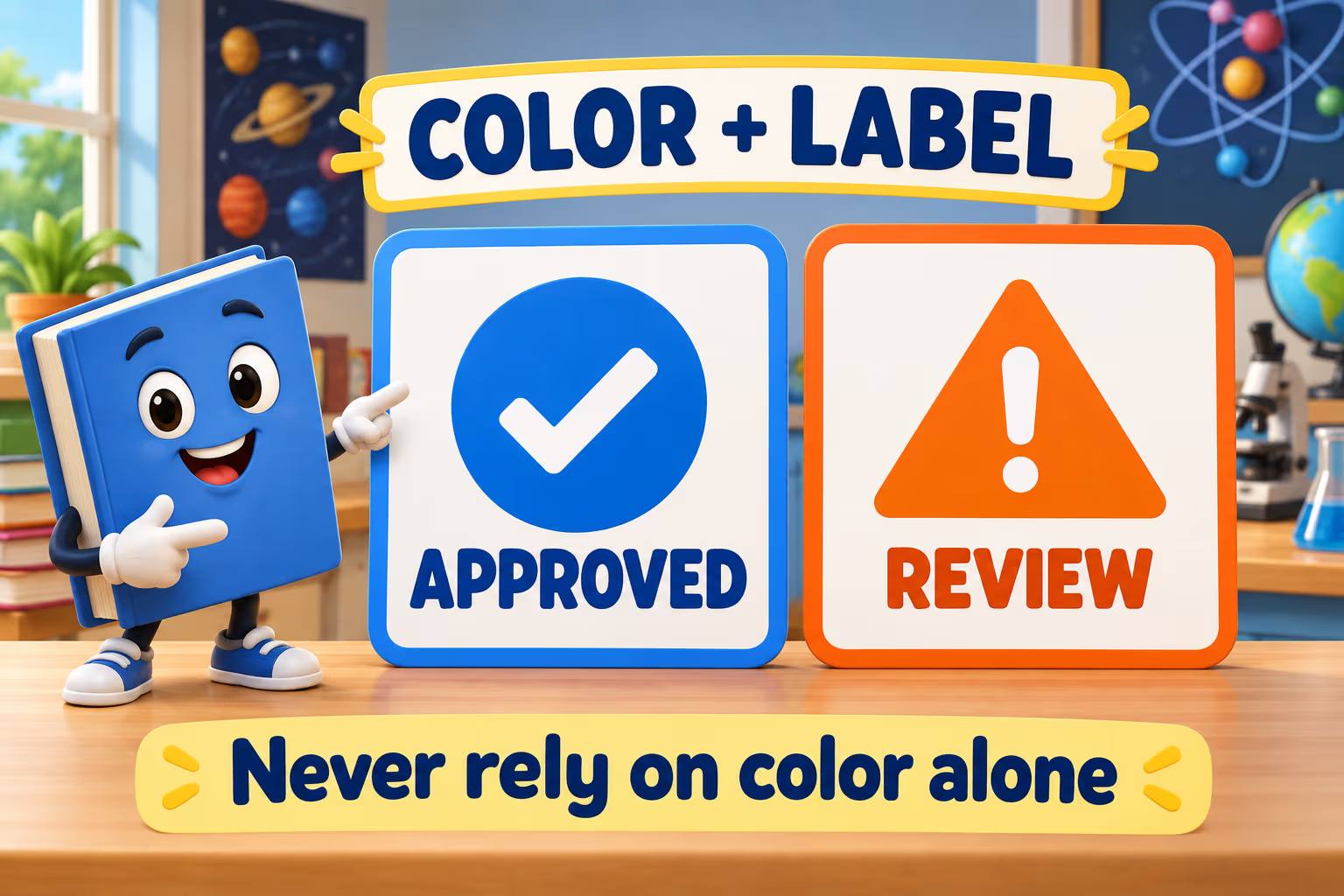
- In charts and interfaces: include labels, symbols, or patterns alongside color. W3C’s WCAG guidance says color should not be the only visual means of conveying information.
For example, a legend that marks “approved” only in blue and “review” only in orange can be hard to interpret for some readers or on a monochrome display. Add the words and distinct shapes—such as a checkmark and a warning triangle—so the categories stay identifiable without color. The WCAG guidance on use of color explains this principle.
When you are describing a person’s emotional response to a color rather than its appearance, choose a feeling word and make the viewpoint clear. Our guide to adjectives for feelings can help distinguish the color itself from the reaction it evokes.
How to choose a color adjective
- Identify the purpose: are you naming a shade, comparing lightness, describing color strength, setting a mood, or explaining a finish?
- Check the reference: compare it with a nearby sample or name the object and lighting.
- Use the narrowest useful word: choose burgundy for a named red-purple shade, dark red for the lightness comparison, or muted red for a subdued appearance.
- Clarify subjective language: explain why a color seems warm, harsh, cheerful, or elegant in this particular scene.
The more precise the context, the less you need to stack adjectives. “A glossy, vivid, bright, dazzling blue vase” gives several overlapping signals; “a glossy cobalt vase caught the window light” names a shade and a visible surface effect.
Original color-adjective sections
The original scenario guide, adjective lists, examples, five tables, and conclusion follow unchanged. Their shade-name and contrast tables remain useful as a vocabulary starting point when read with the distinctions above.
When it comes to describing colors, the right adjectives can make all the difference. As an expert in the field, I’ve compiled a comprehensive list of adjectives that will help you vividly express the nuances of different hues. From vibrant and dazzling to subtle and muted, these descriptive words will bring your color descriptions to life. So whether you’re a writer looking to add depth to your descriptions or simply someone who appreciates the beauty of colors, this article is for you. Get ready to explore the world of adjectives for colors with plenty of examples to inspire your creativity.
Colors have the power to evoke emotions and create visual impact. As I delve into the world of adjectives for colors, I’ll provide you with a range of words that will enhance your ability to paint a picture with words. Imagine being able to accurately convey the richness of a deep purple, the warmth of a golden sunset, or the coolness of a crisp blue sky. With the right adjectives, you can do just that. From primary colors to pastels and everything in between, this article will equip you with the vocabulary you need to captivate your readers or simply appreciate the beauty around you. So let’s dive in and explore the fascinating world of adjectives for colors together.
How to Describe colors? – Different Scenarios
When it comes to describing colors, it’s important to choose the right adjectives to accurately convey their nuances. In different scenarios, we may need to describe colors in specific ways. Here are some tips on how to describe colors effectively:
- Describing Colors in Nature:
When describing colors found in nature, it’s essential to capture their vividness and beauty. Here are some adjectives that can help you paint a picture with words:
- Radiant: The sunflower’s petals had a radiant yellow color.
- Lush: The forest was filled with lush shades of green.
- Vibrant: The tropical bird had vibrant feathers in blue, green, and yellow.
- Describing Colors in Art:
When describing colors in artwork, it’s important to consider the emotions and visual impact they convey. Use powerful adjectives to bring the colors to life:
- Bold: The artist used bold strokes of red to create a sense of passion.
- Subtle: The watercolor painting had subtle shades of pastel colors.
- Harmonious: The color palette of the painting was harmonious and soothing.
- Describing Colors in Fashion:
In the world of fashion, colors play a crucial role in creating different styles and moods. Use descriptive adjectives to communicate the essence of colors in clothing:
- Elegant: She wore an elegant dress in a deep shade of navy blue.
- Playful: The children’s collection showcased playful colors like bright pink and sunny yellow.
- Sophisticated: The runway featured models wearing sophisticated shades of gray and silver.
- Describing Colors in Food and Drinks:
When describing colors in food and drinks, adjectives can evoke sensations of taste and appetite. Use sensory words to make the colors come alive:
- Juicy: The watermelon slices had a juicy red color.
- Refreshing: The lemonade was a refreshing shade of yellow.
- Rich: The chocolate cake was topped with a rich, velvety brown frosting.
Remember, the right adjectives can make a significant difference in how colors are perceived and understood. Experiment with different adjectives and explore the world of colors with creativity and imagination.
| Scenario | Adjectives |
|---|---|
| Nature | Radiant, Lush |
Describing Words for colors in English
In this section, I’ll provide you with a list of adjectives that can be used to describe colors in the English language. These words will help you accurately convey the different shades, hues, and tones of colors. From bright and vibrant to soft and muted, here are some adjectives you can use to describe colors effectively:
- Vibrant: This adjective is perfect for colors that are full of life and energy. Use it to describe bold and intense shades that catch your eye, like “vibrant red” or “vibrant yellow.”
- Subtle: When you want to describe colors that are delicate and understated, “subtle” is the word to use. Think of soft pastel colors like “subtle pink” or “subtle lavender.”
- Luminous: This adjective is used to describe colors that seem to emit light and glow, like a beautiful sunset. Use it to describe colors like “luminous orange” or “luminous turquoise.”
- Deep: When a color has depth and richness, use the word “deep” to describe it. For example, “deep blue” or “deep purple” evoke a sense of intensity and richness.
- Muted: Use this word to describe colors that are toned down or dulled, giving them a more subdued appearance. For instance, think of colors like “muted green” or “muted gray.”
- Pastel: Pastel colors are light and gentle, often associated with springtime. Use this adjective to describe colors like “pastel pink” or “pastel blue.”
- Bold: This adjective is perfect for describing colors that are bright, daring, and attention-grabbing. Use it to describe colors like “bold red” or “bold yellow.”
- Warm: When colors evoke a sense of heat and coziness, use the word “warm” to describe them. For example, “warm orange” or “warm brown” create a sense of comfort.
- Cool: Use this word to describe colors that give off a refreshing and calming vibe, like “cool blue” or “cool green.”
- Neutral: Neutral colors are versatile and can be used to describe colors that are neither warm nor cool, like “neutral beige” or “neutral gray.”
Adjectives for colors
When it comes to describing colors, choosing the right adjectives can make a significant difference. Adjectives help us convey the various shades, hues, and tones that colors possess. In this section, I will provide you with a list of positive and negative adjectives for colors, along with example sentences to better understand their usage. So, let’s dive right in!
Positive Adjectives for Colors
Positive adjectives allow us to express the beauty, vibrancy, and energy of different colors. Here’s a list of 12 positive adjectives along with example sentences:
| Adjective | Example Sentence |
|---|---|
| Vibrant | The vibrant red flowers caught my eye from afar. |
| Bold | She wore a bold and striking yellow dress to the party. |
| Cheerful | The room was painted a cheerful shade of orange, which brightened up the space. |
| Lively | The painting seemed to come to life with its lively combination of blues and greens. |
| Energetic | The energetic blue sky made me want to go on an adventure. |
| Radiant | The bride looked absolutely radiant in her ivory-colored gown. |
| Enchanting | The sunset over the ocean was truly enchanting with its warm pink and purple hues. |
| Exquisite | The jewelry showcased an exquisite array of gemstones in different colors. |
| Glamorous | The actress stepped onto the red carpet in a glamorous black gown. |
| Sophisticated | The living room had a sophisticated ambiance with its neutral and rich-colored furniture. |
| Gorgeous | The autumn leaves were a gorgeous mosaic of reds, oranges, and yellows. |
| Brilliant | The artist used a brilliant combination of colors to create a captivating masterpiece. |
Negative Adjectives for Colors
While colors are often associated with positivity, negative adjectives can be used to describe colors that evoke a different mood or feeling. Here are 5 negative adjectives for colors, along with example sentences:
| Adjective | Example Sentence |
|---|---|
| Dull | The dull gray sky matched my mood on that gloomy day. |
| Muddy | The river water had a muddy brown color after the rainstorm. |
| Gloomy | The room felt gloomy with its dark and somber color scheme. |
| Drab | The building’s exterior was painted a drab and uninspiring shade of beige. |
| Bland | The dish lacked flavor and had a bland pale yellow color. |
Remember, these adjectives provide a starting point for your color descriptions. Feel free to explore, experiment, and mix them up to create your own unique and colorful descriptions!
Next, I will continue with more sections to help you expand your vocabulary and understanding of color adjectives. Stay tuned!
Note: The continuation of the article will continue in the next sections with different headings and content based on the reader’s request.
Synonyms and Antonyms with Example Sentences
Synonyms for colors
When it comes to describing colors, it’s important to have a wide range of adjectives at your disposal. Here are some synonyms for different colors:
| Color | Synonyms |
|---|---|
| Red | Crimson, Scarlet, |
| Ruby, Burgundy | |
| Blue | Navy, Cobalt, |
| Indigo, Azure | |
| Green | Emerald, Lime, |
| Olive, Mint | |
| Yellow | Golden, Daffodil, |
| Sunflower, Lemon |
Using these synonyms allows you to add variety and depth to your descriptions. For example, instead of saying “the house is red,” you can say “the house is crimson,” which paints a more vivid picture in the reader’s mind.
Antonyms for colors
Sometimes, it’s useful to describe colors by using their opposite or antonyms. Here are some antonyms for different colors:
| Color | Antonyms |
|---|---|
| Red | Green, Blue, Yellow |
| Blue | Red, Orange, Yellow |
| Green | Red, Orange, Purple |
| Yellow | Blue, Purple, Green |
By using antonyms, you can create interesting contrasts in your descriptions. For example, instead of saying “the sky is blue,” you can say “the sky is orange,” which immediately sparks the reader’s curiosity.
Remember, incorporating a variety of adjectives and antonyms adds depth and creativity to your writing. This will make your descriptions more engaging and captivating for the reader. So go ahead, explore these synonyms and antonyms, and have fun playing with language to bring colors to life.
Stay tuned for more sections that will further expand your vocabulary and understanding of color adjectives.
Conclusion
In this article, I have emphasized the significance of using the right adjectives to describe colors. By providing a comprehensive list of synonyms and antonyms for different colors, along with example sentences, I have aimed to enhance your understanding and usage of color adjectives. The synonyms offer a wider range of descriptive options, enabling you to add depth and variety to your descriptions. On the other hand, the antonyms create intriguing contrasts that can captivate your readers. Remember to incorporate a mix of adjectives and antonyms to make your descriptions more engaging and captivating.
I hope this article has expanded your vocabulary and provided you with valuable insights into the world of color adjectives. Stay tuned for future sections that will further enrich your understanding and usage of these descriptive words. With the right adjectives, you can paint vivid pictures with your words and truly bring your descriptions to life. Happy writing!
Frequently Asked Questions About Color Adjectives
What is the difference between hue and lightness?
Hue identifies a color family, such as red, blue, or green. Lightness describes how light or dark a color appears relative to a comparison or viewing context. A sample can keep roughly the same hue while becoming lighter or darker; “pale blue” and “deep blue” show that distinction in ordinary language.
Are “vivid” and “saturated” exact synonyms?
They overlap in everyday descriptions, but they are not always interchangeable. Vivid is a broad impression of strong, noticeable color; saturation is also a defined component in particular color models such as HSL. Give the model and conditions when technical precision matters, and use the ordinary word when describing an impression.
Is “bright” a lightness adjective or an intensity adjective?
It can mean either, depending on the sentence. “Bright yellow” may suggest a vivid-looking hue, while “brightly lit yellow fabric” clearly refers to illumination. Because the word has several common senses, name the comparison or light source when readers need to know which quality you mean.
Are crimson and scarlet synonyms for red?
They are related names in the red color family, but they suggest different customary shades and associations. The exact appearance may vary by sample, medium, or reference system. Use the broad word red when the family is enough, and use a shade name when that distinction helps your reader picture it.
Can red and green be called antonyms?
Not as ordinary dictionary opposites. Red and green may be contrasting or complementary in a particular color wheel or design, but that relationship depends on the chosen system and samples. In writing, call them contrasting colors; reserve antonym for words with opposite meanings, such as light and dark.


