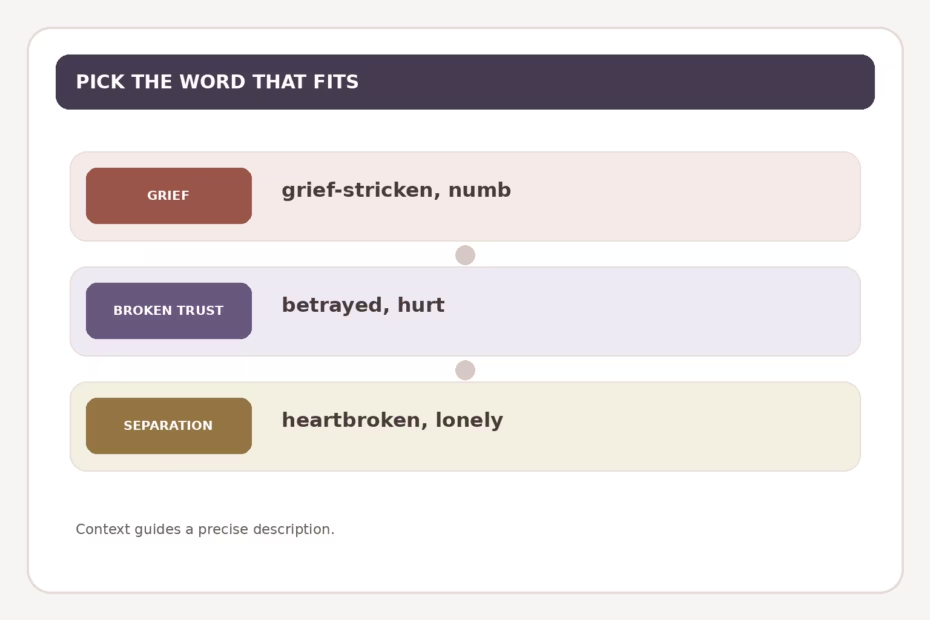
Emotional-pain adjectives describe how a person, feeling, memory, or event is experienced. The best choice depends on the source of the pain, its intensity, and the sentence. “Heartbroken” describes someone who feels profound sadness; “heartbreaking” describes something that causes it. “Bereaved” usually describes someone whose close friend or relative has died, while “anguish” is a noun. Those distinctions make descriptions more precise.
Choose an adjective by situation and intensity
These words are options for writing and reflection, not labels to assign to someone else. If you are describing a real person, use their own words when possible. People respond differently to grief, rejection, betrayal, and disappointment; an outside observer cannot always tell how someone feels from their expression.
| Situation | Possible adjectives | Usage note |
|---|---|---|
| Grief or loss | Grieving, grief-stricken, numb, sorrowful | “Bereaved” describes a person after the death of someone close; it does not mean every bereaved person feels the same way. |
| Betrayal or broken trust | Betrayed, hurt, disillusioned, mistrustful | “Betrayed” often names the person’s experience; “hurtful” usually describes an action or remark that causes hurt. |
| Rejection | Rejected, disappointed, wounded, lonely | “Rejected” can describe someone’s feeling or the treatment they received; use context to show which. |
| Heartbreak or unreturned love | Heartbroken, crushed, desolate, lovesick | “Unrequited” most often modifies love or affection that is not returned: unrequited love. |
| Frustration or setback | Frustrated, disheartened, discouraged, let down | These words fit a setback or unmet expectation; they do not necessarily imply grief or betrayal. |
| Shame or regret | Ashamed, embarrassed, remorseful, regretful | “Ashamed” and “remorseful” refer to a person’s feelings; “shameful” usually judges an action or situation. |
How strong is the feeling?
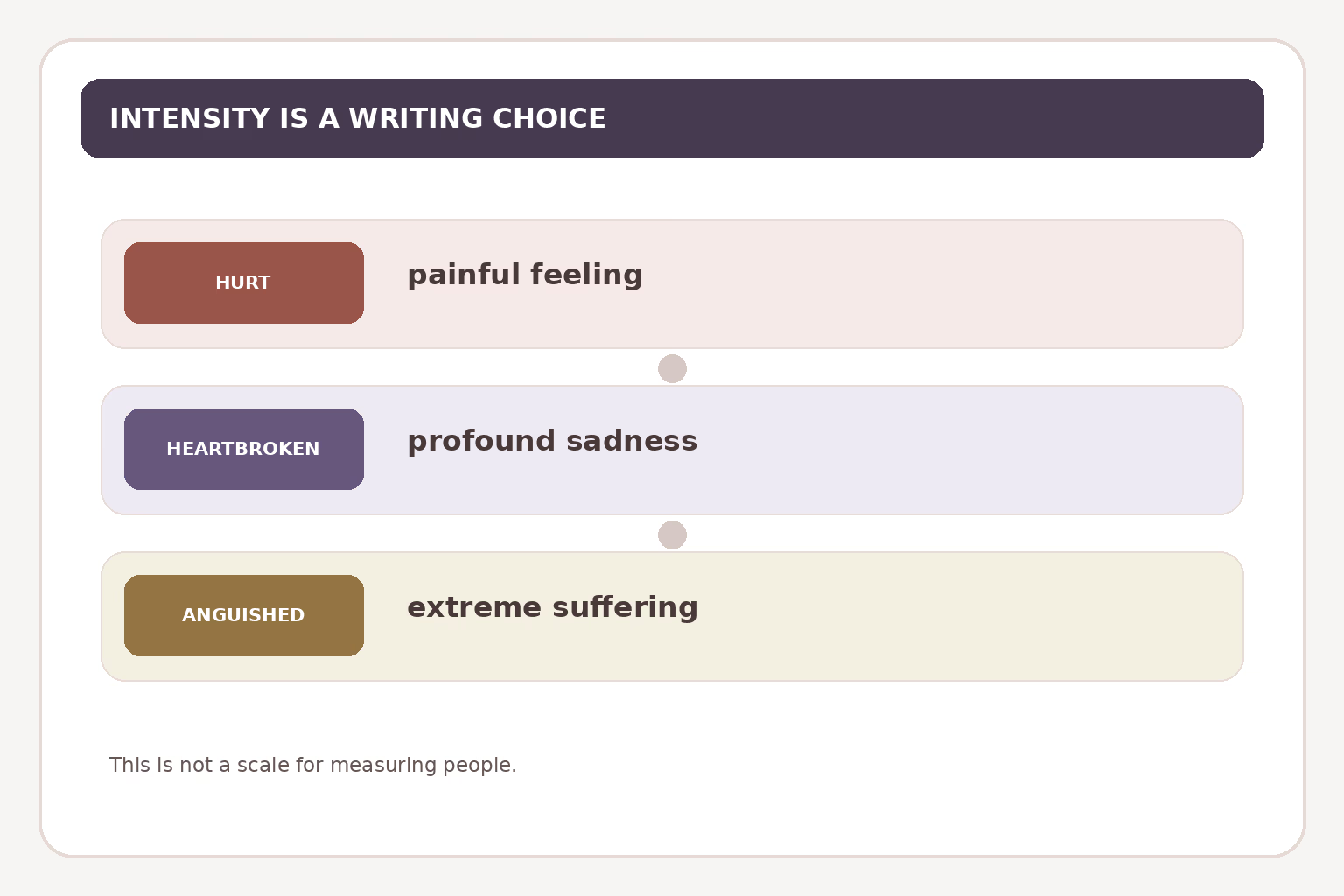
Some adjectives point to a feeling without specifying how intense it is: hurt, sad, disappointed. Others suggest greater distress: heartbroken, grief-stricken, anguished, devastated. This is a rough writing guide, not a scale for measuring anyone’s emotions. “Devastated” can mean very shocked and upset, while “anguished” suggests extreme suffering; avoid using the strongest word simply for dramatic effect.
Compare these sentence choices:
- “I felt hurt by the careless comment.” (The feeling is painful, but the sentence does not claim it overwhelmed the speaker.)
- “She was disappointed when the event was canceled.” (A setback or unmet expectation.)
- “They felt betrayed when private messages were shared.” (Broken trust.)
- “He was heartbroken after the relationship ended.” (Intense sadness linked to loss or separation.)
- “The family was grief-stricken after their loss.” (Strong grief.)
- “The announcement left her devastated.” (Very shocked and upset.)
Adjectives, nouns, and word forms
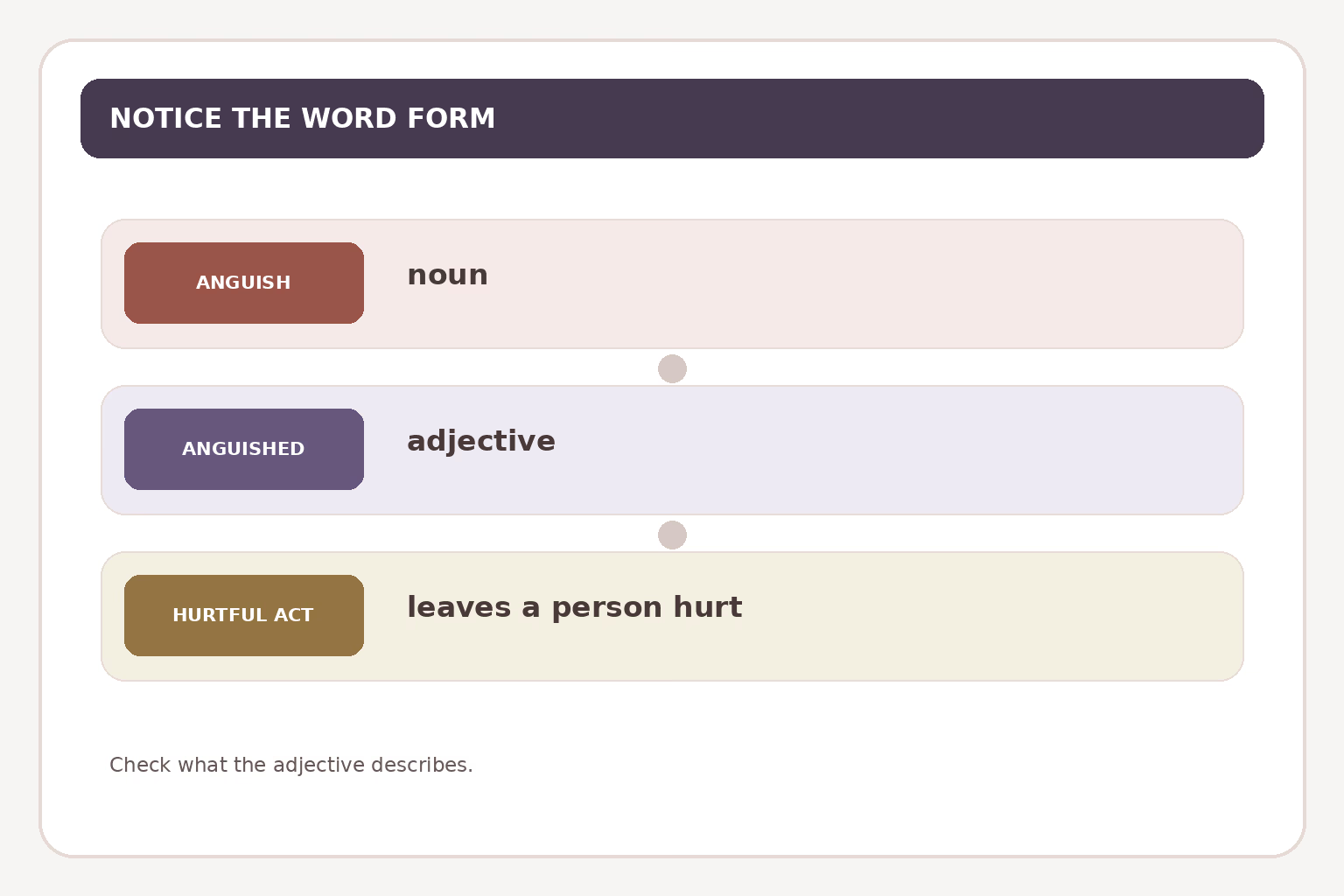
Some words in lists about emotional pain name related ideas rather than adjectives for the pain itself. For example, anguish is a noun and anguished is an adjective; heartbreak is a noun and heartbroken is an adjective. Bereavement is the experience of losing someone through death, and bereaved commonly describes the person who has experienced that loss. Unrequited most naturally describes love that is not returned. A grammar check can prevent an otherwise vivid word from sounding awkward.
Also notice the difference between words describing a person and words describing what caused the feeling:
- “The hurtful remark left me feeling hurt.”
- “It was a heartbreaking goodbye; afterward, I felt heartbroken.”
- “The devastating news left the team devastated.”
Cambridge Dictionary identifies anguished as showing extreme physical or mental suffering, heartbroken as extremely sad, and bereaved as having recently lost someone close through death. See the linked entries for examples and detail.
Using “positive” words without romanticizing pain
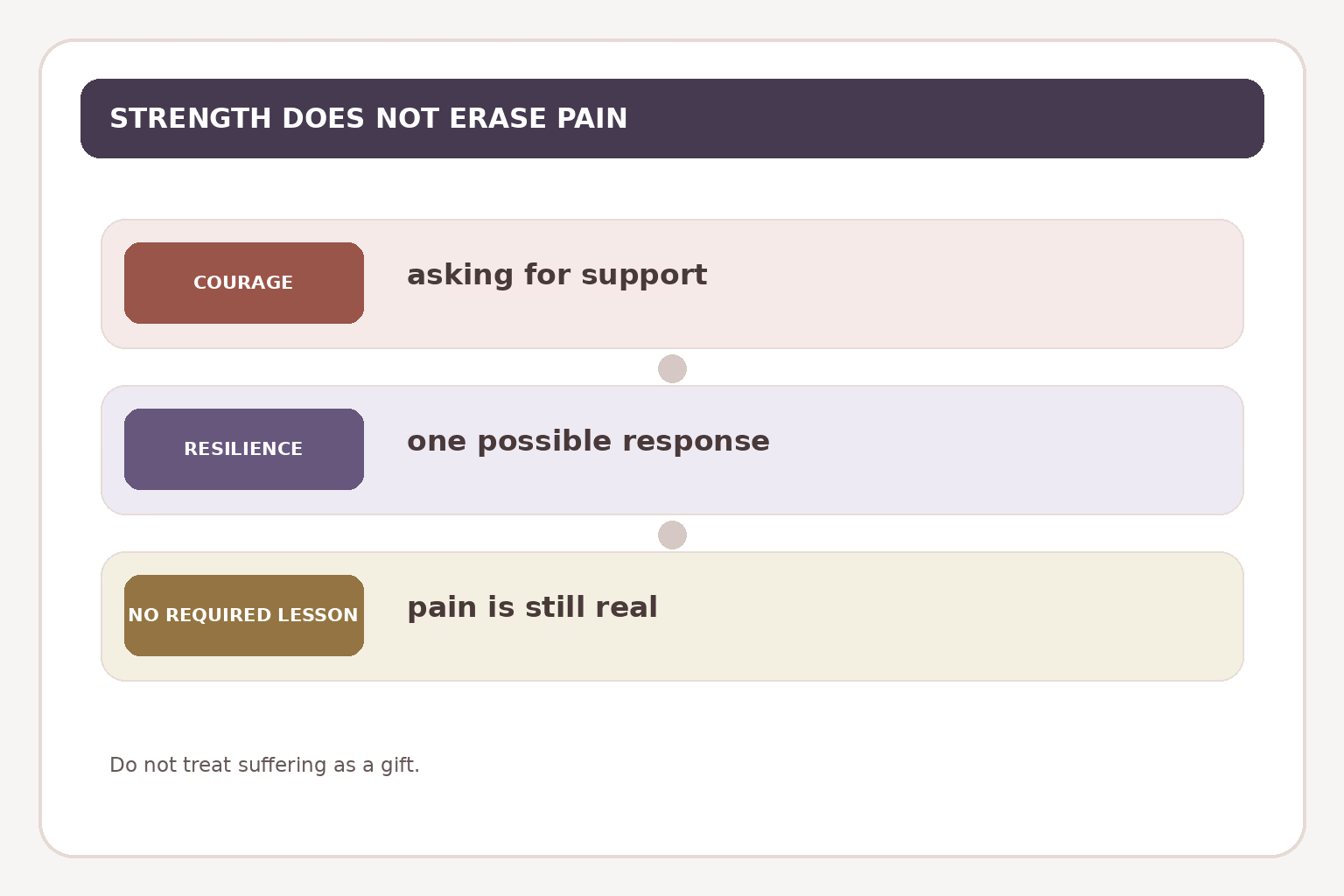
Words such as resilient, compassionate, courageous, or empowered can describe a person’s response or qualities during a difficult time. They do not make the painful event beneficial, and no one should be expected to become stronger, wiser, or more compassionate because they suffered. In a sentence like “She showed courage in asking for support,” the adjective describes her action, not the pain as a gift.
Likewise, healing does not follow one schedule. If you are writing about someone else, avoid declaring that they are “over it,” “healed,” or “resilient” unless that is how they describe themselves. You can acknowledge what happened and let them choose the words for their response.
Quick sentence patterns
- “After [event], [person] felt [adjective], though they described the feeling in their own words as [phrase].”
- “The [adjective] [event, news, or comment] left [person] feeling [adjective].”
- “[Person] showed [quality] when they [specific action]; that does not make the loss or hurt any less real.”
- “For a [mild / strong / intense] sense of [emotion], consider [word], [word], or [word], depending on the context.”
For reference, Cambridge Dictionary defines “anguished” as having or showing extreme physical or mental suffering; its “heartbroken” entry gives the meaning extremely sad; and “bereaved” refers to having recently lost a close relation or friend through death. These distinctions can help you choose a precise word without assuming everyone experiences pain in the same way.
The examples and word groups below offer starting points. Let context—and the speaker’s own description—guide the final choice.
When it comes to describing emotional pain, words can sometimes fail us. The weight of heartbreak, the sting of rejection, the ache of loneliness – these are experiences that can be difficult to put into words. But fear not, for I’m here to help you navigate the vast landscape of emotions and find the perfect adjectives to express your inner turmoil. In this article, I’ll be sharing a comprehensive list of adjectives that capture the essence of emotional pain, along with examples to illustrate their usage. Whether you’re a writer searching for the right words or someone looking to better understand their own emotions, this guide is here to lend a helping hand. So let’s dive in and explore the rich tapestry of adjectives that can bring emotional pain to life.
How to Describe emotional pain? – Different Scenarios
When it comes to describing emotional pain, a wide range of adjectives can be used to capture the complex and nuanced nature of our feelings. Whether you’re a writer trying to evoke emotions in your readers or an individual seeking to understand your own emotions, finding the right words can make all the difference. Let’s explore how to describe emotional pain in different scenarios:
- Grief and Loss
- Betrayal and Disloyalty
- Rejection and Abandonment
- Heartbreak and Unrequited Love
- Frustration and Disappointment
- Shame and Embarrassment
Remember, everyone experiences emotional pain differently, and these adjectives may not always capture the exact feeling you’re trying to describe. Don’t be afraid to explore different words and combinations to find the ones that resonate with you or your readers. Emotional pain is personal, and finding the right words can help us process and heal.
Examples of Emotional Pain Descriptions:
| Emotional Pain | Adjectives |
|---|---|
| Grief and Loss | Overwhelming, Heartbroken, Bereaved, Devastated, Numb |
| Betrayal | Betrayed, Deceived, Broken trust, Disillusioned, Hurt |
| Rejection | Rejected, Abandoned, Unwanted, Alone, Hurt |
| Heartbreak | Heartbroken, Unrequited, Crushed, Desolate, Empty |
| Frustration | Frustrated, Disappointed, Let down, Defeated, Disheartened |
Describing Words for emotional pain in English
When it comes to describing emotional pain, finding the right words can be a challenge. Our feelings can be complex and hard to put into words. In this section, I’ll share some adjectives that can be used to describe emotional pain, along with examples to help you understand their usage.
- Grief and Loss: The deep sadness that accompanies the loss of a loved one or something meaningful in our lives.
- Heartbreaking: It was heartbreaking to say goodbye to my beloved pet.
- Numb: After the sudden loss of my friend, I felt numb and couldn’t process my emotions.
- Betrayal and Disloyalty: The feeling of being let down and hurt by someone we trusted.
- Betrayed: I felt betrayed when my best friend spread rumors about me.
- Hurtful: His disloyalty was incredibly hurtful, and it took time to heal from the pain.
- Rejection and Abandonment: The feeling of being unwanted or left alone.
- Rejected: I felt rejected when my artwork was criticized and not appreciated.
- Abandoned: The feeling of being abandoned by my parents still haunts me.
- Heartbreak and Unrequited Love: The intense pain that comes from unreciprocated love or a failed relationship.
- Crushed: I was crushed when my long-term relationship ended abruptly.
- Unrequited: Dealing with unrequited love is one of the most agonizing experiences.
- Frustration and Disappointment: The feeling of annoyance and letdown when things don’t go as expected.
- Frustrated: I felt frustrated when I couldn’t achieve my goals despite putting in my best efforts.
- Disappointed: His constant absence and lack of support left me feeling disappointed.
- Shame and Embarrassment: The feeling of humiliation or guilt caused by our actions or circumstances.
- Ashamed: I was deeply ashamed of my behavior at the party last night.
- Embarrassed: I felt embarrassed when I tripped and fell in front of everyone.
Remember, emotions are unique to each individual, and these adjectives may not fully capture how you feel. Use them as a starting point and explore different words that resonate with your own experiences of emotional pain.
Adjectives for emotional pain
As someone who has experienced emotional pain, I understand how challenging it can be to find the right words to describe it. In this section, I will provide you with a range of adjectives that can help you articulate and understand your emotions. Remember, emotions are unique to each individual, so explore the words that resonate with your own experiences of emotional pain.
Positive Adjectives for Emotional Pain
Despite the negative connotation associated with emotional pain, there are positive adjectives that can help us navigate and grow from these experiences. Here are twelve examples:
| Adjective | Definition | Example Sentence |
|---|---|---|
| Resilient | able to recover quickly from pain | Despite the heartbreak, I’ve come out stronger and more resilient. |
| Empowered | feeling strong, capable, and confident | I may have been betrayed, but I’m determined to become empowered. |
| Enlightened | having gained new understanding | The rejection I faced has left me enlightened about who I truly am. |
| Transformative | causing a significant change or growth | The loss I experienced was transformative, propelling me into a new chapter of life. |
| Courageous | showing bravery in the face of pain | Despite the emotional pain, I admire her courageous willingness to start anew. |
| Tenacious | holding firmly to one’s beliefs | Though I’ve been hurt, I remain tenaciously hopeful for the future. |
| Empathetic | showing understanding and compassion | My heartbreak has made me more empathetic towards others’ struggles. |
| Resolute | determined and unwavering in resolve | Despite the disappointment, I’m resolute in my pursuit of happiness. |
| Liberating | freeing from emotional constraints | The process of healing has been liberating, allowing me to break free from pain. |
| Growth-oriented | focused on personal development | The rejection I faced has made me more growth-oriented in my approach to relationships. |
| Empowered | feeling strong, capable, and confident | I may have been betrayed, but I’m determined to become empowered. |
| Compassionate | showing kindness and understanding | Although my heart is broken, I remain compassionate towards others’ pain. |
Negative Adjectives for Emotional Pain
While it’s important to acknowledge the positive aspects of emotional pain, it’s equally important to recognize and understand the negative emotions that can accompany it. Here are five examples:
| Adjective | Definition | Example Sentence |
|---|---|---|
| Devastated | extremely shocked or upset | I was devastated when I found out about the betrayal. |
| Heartbroken | overwhelmed by grief and sadness | The breakup left me heartbroken, unable to see a way forward. |
| Betrayed | deceived or misled by someone close | I felt betrayed when my best friend shared my secret. |
| Rejected | not accepted or acknowledged | The rejection made me question my worth and left me feeling unwanted. |
| Alone | feeling lonely or isolated | After the loss, I felt alone, as if no one could understand my pain. |
Emotional pain is a complex and deeply personal experience, and adjectives can help us pinpoint and express it. Remember, these words are just tools to help you understand and articulate your emotions. Feel free to explore different adjectives that resonate with your own experiences.
Synonyms and Antonyms with Example Sentences
Synonyms for Emotional Pain
When it comes to describing emotional pain, there are a variety of adjectives that can convey the depth and intensity of our feelings. Here are some synonyms that can help paint a vivid picture of the pain we experience:
- Agonizing – I remember the agonizing pain of losing my best friend.
- Devastating – The news of his betrayal was absolutely devastating.
- Heart-wrenching – The heart-wrenching feeling of rejection stayed with me for months.
- Crushing – The loss of a loved one can be crushing, leaving an emptiness that seems impossible to fill.
- Tormenting – The thought of what could have been tormented me day and night.
These synonyms demonstrate the various ways in which emotional pain can manifest in our lives. It is important to remember that everyone’s experience is unique, and these synonyms can serve as a starting point to find words that truly capture your own emotions.
Antonyms for Emotional Pain
While emotional pain can be excruciating, it is helpful to explore antonyms that provide a glimpse of hope and healing. Here are some antonyms that represent the opposite of emotional pain:
- Joyful – Despite the challenges I faced, I found joy and happiness in the little moments.
- Content – I learned to be content with myself and found peace in acceptance.
- Fulfilled – The journey of healing allowed me to feel fulfilled and whole again.
- Liberated – After letting go of the past, I felt liberated and free to embrace new experiences.
- Empowered – Overcoming emotional pain empowered me to grow and discover my inner strength.
These antonyms provide a sense of relief and growth, highlighting the possibility of healing and moving forward from emotional pain.
Exploring synonyms and antonyms can help us better understand and express our emotional pain. However, it is important to remember that these words are just tools and our experiences are unique. Take the time to find words that truly resonate with your own journey and use them as a means of self-expression and healing.
Conclusion
In this article, I have provided a comprehensive list of adjectives that can be used to describe emotional pain. These adjectives, such as agonizing, devastating, heart-wrenching, crushing, and tormenting, allow individuals to express the depth and intensity of their emotional experiences. On the other hand, I have also included antonyms like joyful, content, fulfilled, liberated, and empowered, which represent the opposite of emotional pain.
It is important to note that these words are simply tools to help individuals articulate their emotions. Each person’s experience of emotional pain is unique, and it is up to them to find the words that resonate with their own journey. By exploring different adjectives and finding ones that accurately capture their feelings, individuals can engage in self-expression and potentially find healing.
Remember, the power of words lies in their ability to convey our innermost thoughts and emotions. So, embrace the power of these adjectives and use them as a means of understanding, expressing, and ultimately healing from emotional pain.


