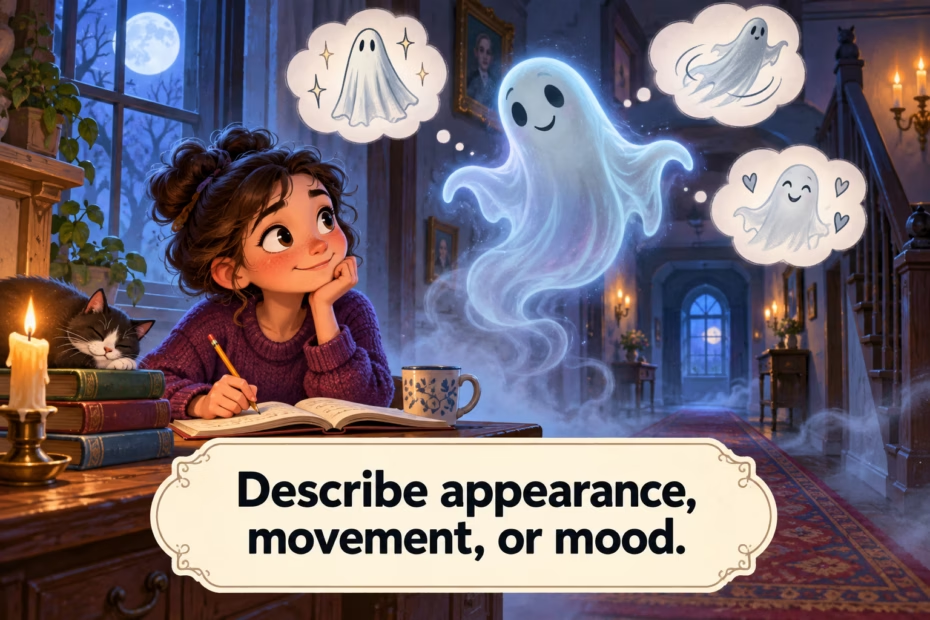
Ghost stories use adjectives to shape what a reader imagines: a spectral outline may look different from a mournful voice, and a benevolent character plays a different role from a malevolent one. This guide sorts ghost adjectives by appearance, movement, mood, and intent, with examples for fiction and creative writing.
- Choose an adjective for one clear feature rather than stacking near-synonyms.
- Separate appearance words such as translucent from mood words such as eerie.
- Use ghost-related nouns such as apparition or specter when naming a being, not when an adjective is needed.
- Treat supernatural details as beliefs, traditions, or fictional conventions rather than established facts.
How to choose an adjective for a ghost
First decide whether you are describing a character, an appearance, a sound, or the feeling of a scene. Then choose a word that fits that detail. The Oxford Learner’s Dictionaries entry for ghost frames the spirit sense as something a living person believes they can see or hear. In writing, signal whether a ghost is part of a character’s belief, a local legend, or the imagined world of a story.
| What you describe | Useful adjectives | Question to ask | Example |
|---|---|---|---|
| Appearance | translucent, wispy, hazy, spectral, tattered | What can the narrator see? | “A wispy outline hovered beyond the curtain.” |
| Movement | gliding, drifting, hovering, flickering, elusive | How does it move or appear? | “The spectral shape flickered at the end of the hall.” |
| Sound or presence | murmuring, silent, eerie, chilling, haunting | What does the character hear or sense? | “A chilling whisper came from the empty room.” |
| Mood or response | mournful, unsettling, frightening, serene, enigmatic | What feeling does the scene create? | “The mournful melody made the encounter feel sad rather than threatening.” |
| Intent or story role | benevolent, mischievous, vengeful, malevolent | What does the character seem to want? | “The benevolent spirit guided the lost traveler toward the door.” |
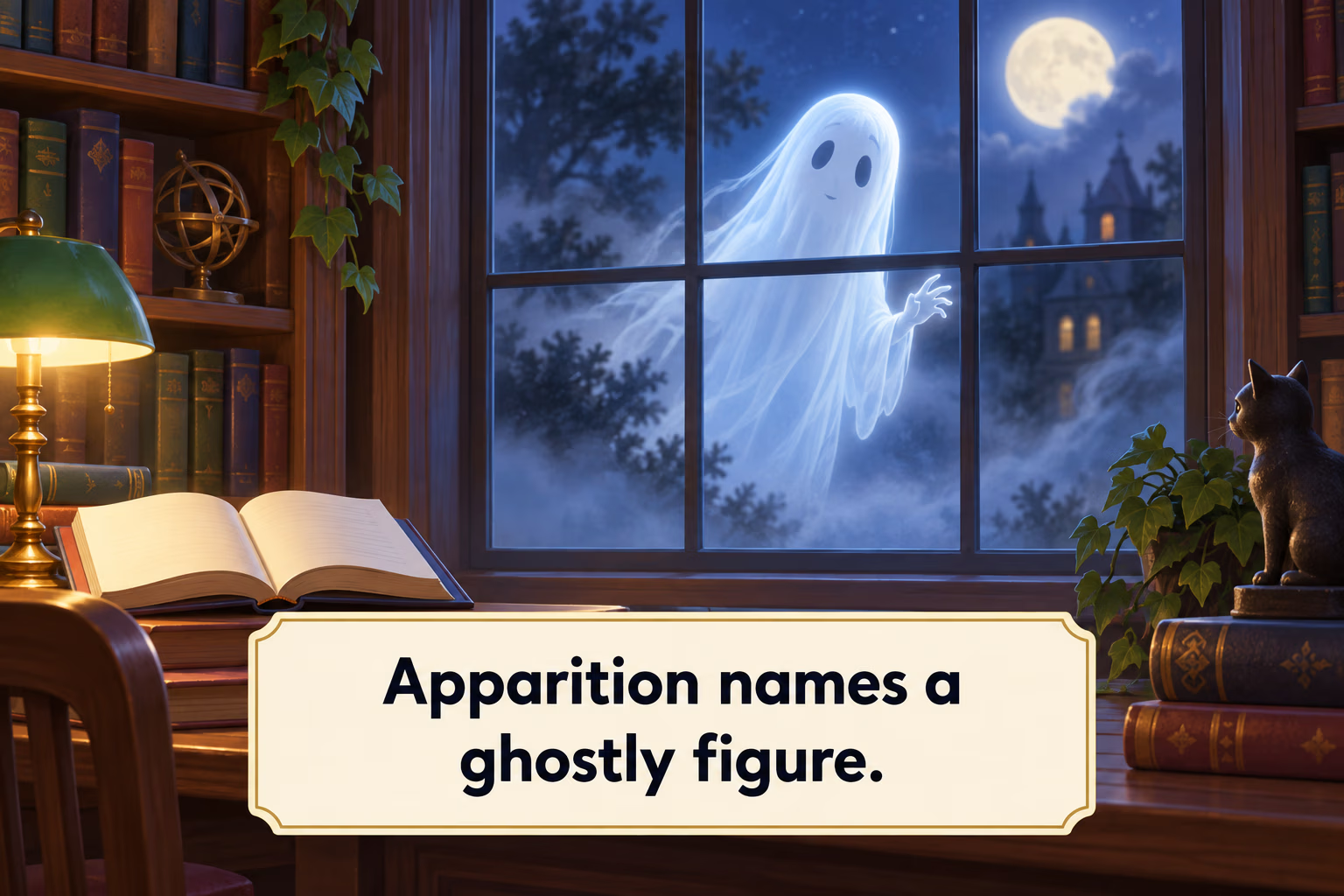
Apparition is a noun for a ghost or ghost-like image, not an adjective. The sentence “A pale apparition appeared in the doorway” names the figure; “a spectral figure appeared” uses an adjective to describe it. Oxford Learner’s Dictionaries and Cambridge both classify apparition as a noun.
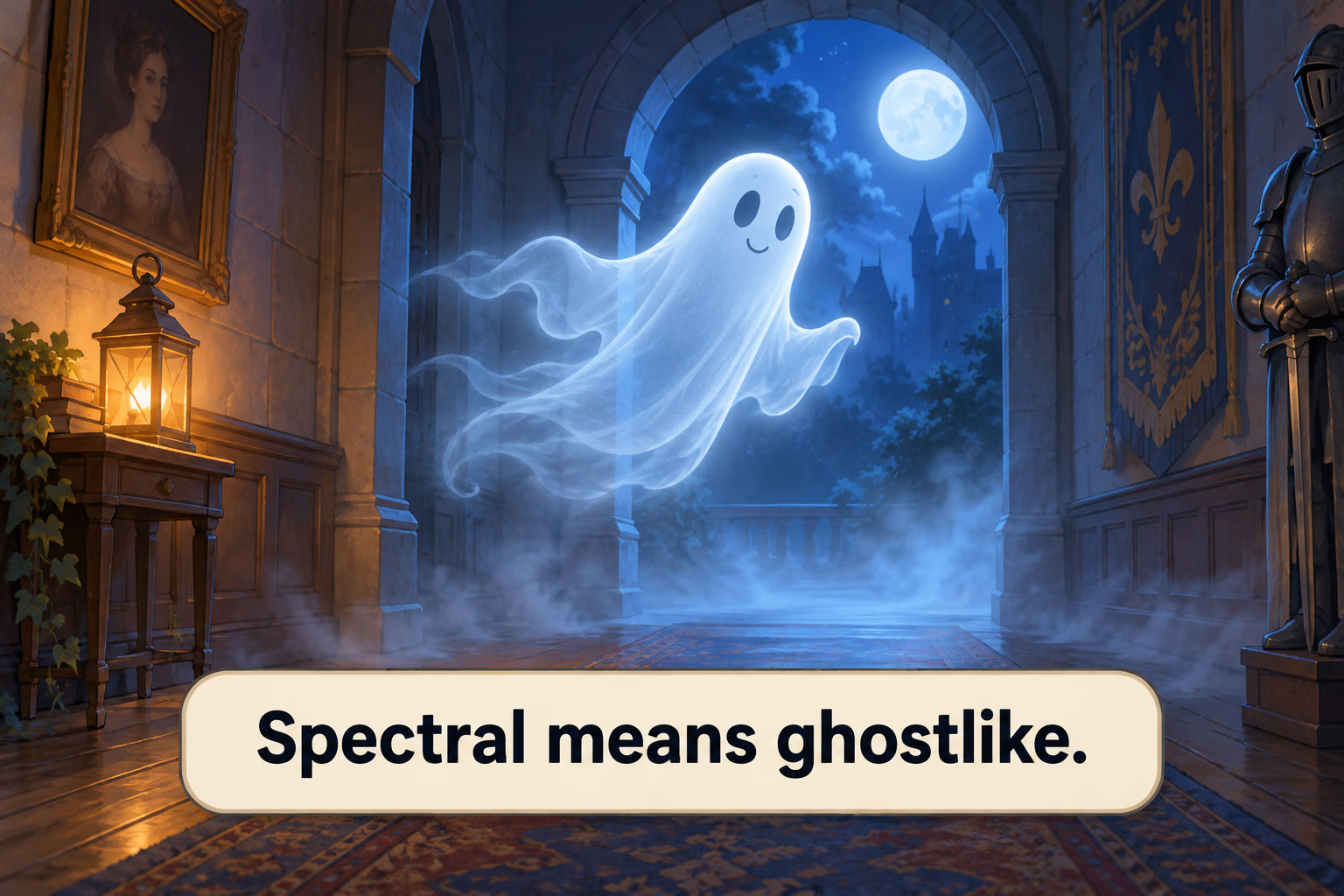
Spectral means coming from or seeming like the spirit of a dead person. Other appearance adjectives narrow the image: translucent suggests that light passes through; wispy suggests something thin and insubstantial; tattered describes ragged clothing or fabric. These terms describe familiar fictional imagery, not proof of what ghosts are.
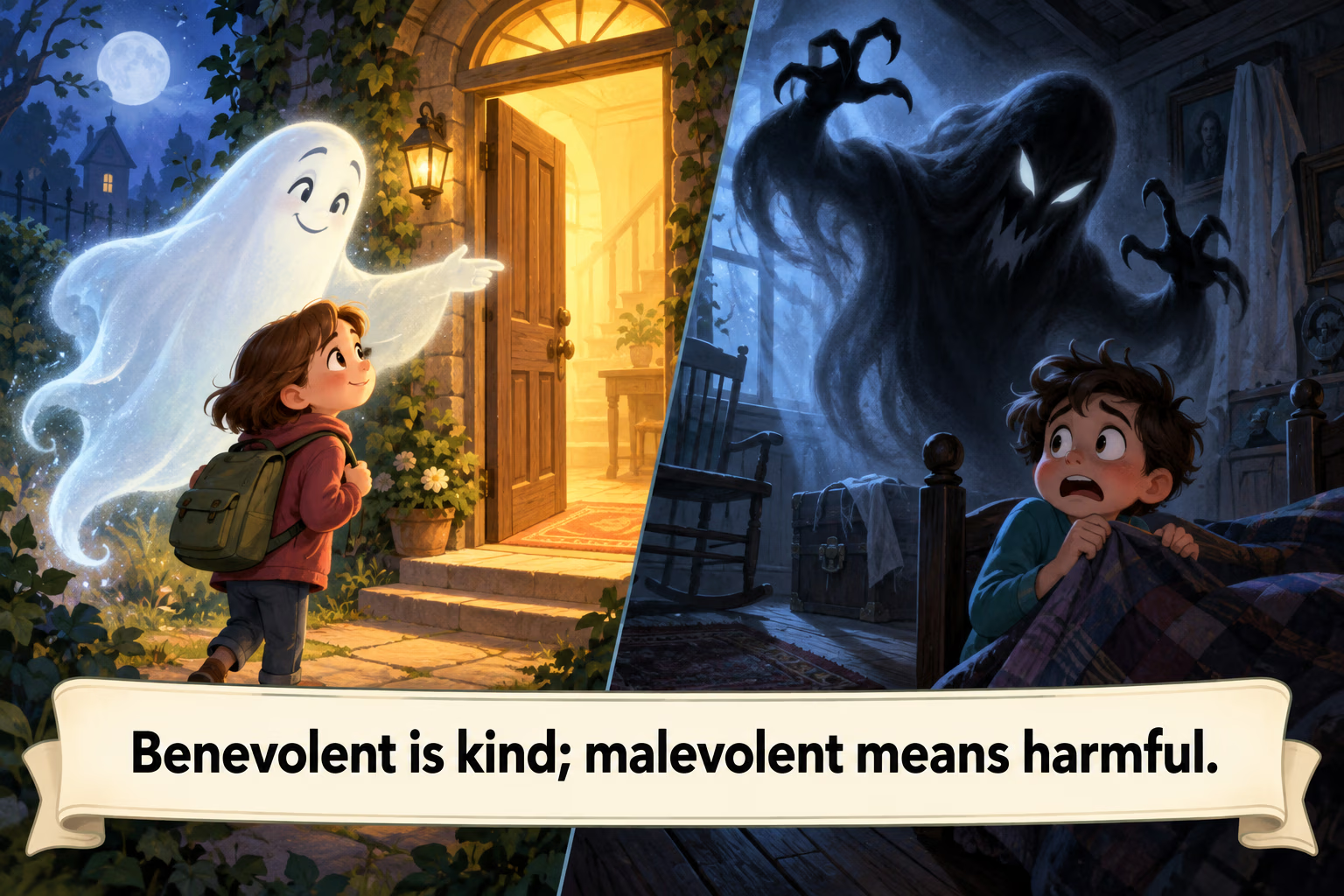
Benevolent means kind or well-meaning; malevolent means harmful or ill-intentioned. They describe a character’s apparent attitude or role, not its visible form. A writer can show that role through actions: a spirit that warns a traveler seems helpful, while one that deliberately misleads them may seem threatening.
Ghost adjectives by scene
- In a haunted-house story: use flickering, murmuring, restless, or foreboding for a sound, movement, or atmosphere.
- For an apparition: use translucent, hazy, spectral, or shrouded for appearance.
- In a cemetery scene: somber, silent, or mournful can establish tone without claiming a spirit is present.
- For poltergeist-style activity: describe the observable fictional effects—rattling windows, unexplained noises, or moving objects—rather than assigning an emotion to an unseen figure.
- In a forest scene: misty, shadowy, still, or disorienting can describe the setting; the ghost itself may be elusive or beckoning.
Is “phantom” an adjective or a synonym for ghost?
Phantom can be a noun meaning a ghost, and Cambridge also lists it as an adjective before a noun meaning “like a ghost,” as in a phantom coach. Other related nouns include apparition, spirit, specter, and wraith. Adjectives include ghostly, spectral, spooky, and incorporeal. The words are related, but they do different jobs in a sentence.
Similarly, the article’s “synonyms” tables mostly contain adjectives that describe a ghost, rather than nouns that can replace ghost. A noun synonym might fit “a ghost appeared” → “an apparition appeared.” An adjective instead fits “a ghostly figure appeared.”
Are “earthly” and “ordinary” antonyms of ghost?
Not in a strict grammatical sense: ghost is a noun, while earthly, ordinary, and mundane are adjectives. They can create a contrast in a story—“an ordinary room after an uncanny encounter”—but they are not direct antonyms of the noun. When building an adjective contrast, compare qualities on the same scale: eerie and ordinary can contrast atmosphere, while benevolent and malevolent contrast intent.
Keep mood words specific
Spooky is informal and means strange and frightening. Chilling may describe fear or a cold sensation; haunting can describe an image or sound that stays in the mind; mournful emphasizes sadness. Pick the word that matches the effect you want. “A mournful voice drifted through the corridor” suggests sadness; “a chilling cry split the silence” creates alarm.
Positive and negative labels are viewpoint-dependent. Serene, enchanting, and benevolent may present a ghost as gentle or appealing; sinister, vengeful, and terrifying present it as threatening. Make clear whether the narrator is reporting a character’s impression or stating a story fact.
Related vocabulary guides
For words focused on a character’s reaction, see adjectives for fear and adjectives for feeling afraid.
Sources and further reading
- Oxford Learner’s Dictionaries: ghost — Ghost as a countable noun: a spirit a living person believes they can see or hear.
- Cambridge Dictionary: ghost — Ghost as a noun associated with belief and representation; supports framing ghost descriptions as stories or beliefs rather than settled fact.
- Oxford Learner’s Dictionaries: apparition — Apparition is a noun for a ghost or ghost-like image of a dead person.
- Cambridge Dictionary: spectral — Spectral is an adjective meaning seeming to come from the spirit of a dead person.
- Cambridge Dictionary: phantom — Phantom functions as both a noun (a ghost) and an adjective before a noun (like a ghost).
- Cambridge Dictionary: spooky — Spooky is an informal adjective meaning strange and frightening.
- Cambridge Dictionary: apparition — Apparition is a countable noun for a dead person’s spirit appearing in visible form.
- Cambridge Dictionary: benevolent — Benevolent describes a person or action that is kind and generous.
- Cambridge Dictionary: malevolent — Malevolent describes a person or action that causes or wants harm.
Hey there! If you’ve ever tried to describe a ghost, you know it can be a bit challenging. Ghosts are mysterious beings that evoke a wide range of emotions and feelings. That’s why I’ve put together this handy guide to help you find the perfect adjectives to describe these ethereal entities. Whether you’re writing a spooky story or just want to expand your vocabulary, I’ve got you covered with a list of descriptive words and examples that will bring your ghostly encounters to life. So, let’s dive in and explore the enchanting world of adjectives for ghosts!
When it comes to describing ghosts, there are a multitude of adjectives that can capture their essence. From eerie and ethereal to haunting and otherworldly, these words paint a vivid picture of the supernatural. Imagine a ghostly figure gliding through the darkness, its translucent form sending shivers down your spine. By using the right adjectives, you can create a spine-tingling atmosphere that will leave your readers captivated and wanting more. So, join me on this linguistic adventure as we unravel the enigmatic nature of ghosts and discover the perfect words to bring them to life.
How to Describe ghost? – Different Scenarios
When it comes to describing ghosts, it’s important to use the right adjectives to evoke the eerie and mysterious nature associated with these supernatural entities. Depending on the scenario or context, there are various adjectives that can be used to paint a vivid picture. Let’s explore different scenarios and the adjectives best suited for each one.
1. Haunted House:
- Appearance: Ethereal, shimmering, translucent, wispy, tattered, decaying, mournful, sorrowful, vengeful.
- Behavior: Moaning, groaning, sobbing, whispering, flickering, appearing and disappearing, manipulating objects.
- Emotions: Trapped, lost, angry, heartbroken, seeking help, vengeful.
2. Ghostly Apparition:
- Appearance: Incorporeal, spectral, nebulous, translucent, hazy, shrouded, chilling, mysterious, unsettling.
- Behavior: Floating, gliding, flickering, vanishing, observing, beckoning.
- Emotions: Lost, searching, mournful, enigmatic, benevolent, malevolent.
3. Cemetery Encounter:
- Appearance: Somber, mournful, melancholic, grave, silent, transparent, spectral, wispy.
- Behavior: Lingering, hovering, weeping, searching, beckoning.
- Emotions: Sorrowful, lost, searching for peace, mournful, nostalgic.
4. Poltergeist Activity:
- Appearance: Unseen, mischievous, playful, energetic. (Focus more on the effects of their presence than their physical form)
- Behavior: Moving objects, creating noises, causing electrical disturbances, flickering lights.
- Emotions: Energetic, restless, playful, sometimes mischievous or even aggressive.
5. Eerie Forest Encounter:
- Appearance: Shadowy, elusive, wispy, shrouded in mist, barely visible, ancient, foreboding.
- Behavior: Whispering, beckoning, leading astray, disappearing into the mist.
- Emotions: Lost, searching, connected to the land, mysterious, potentially dangerous.
Remember, describing ghosts requires employing words that elicit emotions and create a sense of mystery. By using the appropriate adjectives, you can transport readers or listeners into a world where the supernatural meets reality.
Describing Words for ghost in English
When it comes to describing ghosts, there are a variety of adjectives that can help paint a vivid picture in the reader’s mind. From the hauntingly eerie to the mysteriously ethereal, these words bring the supernatural world of ghosts to life. Here are some of the most effective adjectives for describing ghosts:
- Spooky: Ghosts are often associated with spookiness, which conveys a sense of fright and unease. This adjective is perfect for describing haunted houses or encounters with apparitions.
- Otherworldly: Ghosts exist in a realm that is beyond our understanding, making them seem otherworldly. Using this adjective emphasizes the idea that ghosts are not of this world.
- Spectral: Spectral is a word used to describe something ghostly or appearing as a spirit. It creates a vision of a ghostly figure that is barely visible, adding an element of mystery.
- Phantom: This adjective evokes a sense of something fleeting or elusive. When describing a ghost as a phantom, it suggests that it may appear and disappear without warning.
- Chilling: Ghostly encounters can send shivers down your spine. Describing a ghost as chilling captures the eerie and bone-chilling sensation one might feel when confronted by a spectral presence.
In addition to these adjectives, it’s important to consider the emotions and atmosphere associated with ghosts. Words like forbidding, mournful, haunting, and ethereal can further enhance the description and immerse the reader in the world of the supernatural.
Remember, when describing ghosts, it’s essential to use adjectives that elicit emotions and create a sense of mystery. By carefully choosing the right words, you can transport your readers into a world where the supernatural meets reality.
Examples of Adjectives for Ghosts
Here are some examples of how these adjectives can be used to describe ghosts in different scenarios:
| Scenario | Adjective |
|---|---|
| Haunted house | Spooky |
| Ghostly apparition | Otherworldly |
| Cemetery encounter | Spectral |
| Poltergeist activity | Phantom |
| Eerie forest encounter | Chilling |
Adjectives for ghost
When it comes to describing ghosts, there’s a wide range of adjectives that can help evoke the emotions and atmosphere associated with these supernatural entities. In this section, I will discuss both positive and negative adjectives that can be used to describe ghosts, along with example sentences to demonstrate their usage. Let’s dive in!
Positive Adjectives for Ghost
Using positive adjectives can help create a sense of wonder and intrigue when describing ghosts. Here are 12 examples of positive adjectives for ghost, along with sentences to illustrate their usage:
| Adjective | Definition | Example Sentence |
|---|---|---|
| Ethereal | Light, delicate, and otherworldly. | The ghost floated through the room, its ethereal figure glowing softly. |
| Enchanting | Delightful and charming, with a touch of magic. | The enchanting ghost whispered secrets in my ear, filling me with wonder. |
| Mystical | Supernatural and possessing a mysterious aura. | The mystical ghost appeared out of thin air, leaving everyone in awe. |
| Translucent | Semi-transparent, allowing light to pass through. | The ghost’s translucent form shimmered in the moonlight, casting an eerie glow. |
| Serene | Calm, peaceful, and exuding a serene presence. | The ghost floated gracefully, emanating a serene energy that soothed my fears. |
| Majestic | Grand and regal, with an air of authority. | The majestic ghost stood tall, its ethereal cloak billowing in the wind. |
| Radiant | Emitting a glowing or shining light. | The radiant ghost illuminated the room, casting a gentle glow on everything around it. |
| Graceful | Elegant, with smooth and flowing movements. | The ghost moved with a graceful fluidity, captivating all who watched. |
| Benevolent | Kind and gentle, with a positive intention. | The benevolent ghost guided lost souls to safety, offering them comfort and solace. |
| Enigmatic | Mysterious and puzzling, leaving questions unanswered. | The enigmatic ghost appeared for a fleeting moment, leaving behind an air of uncertainty. |
| Resplendent | Dazzling and magnificent, radiating brilliance. | The resplendent ghost shimmered with an otherworldly beauty, captivating all who beheld it. |
| Harmonious | In perfect balance and unity, creating a sense of peace. | The harmonious ghost sang a haunting melody, filling the air with a sense of tranquility. |
Negative Adjectives for Ghost
On the other hand, negative adjectives can be used to describe ghosts that evoke fear, danger, or a sense of foreboding. Here are 5 examples of negative adjectives for ghost, along with sentences to demonstrate their usage:
| Adjective | Definition | Example Sentence |
|---|---|---|
| Sinister | Suggesting evil or danger. | The sinister ghost loomed in the shadows, its eyes gleaming with malevolence. |
| Malevolent | Having a harmful or malicious intent. | The malevolent ghost cackled with glee as it stirred up chaos and fear. |
| Haunting | Evoking a feeling of persistent unease or fright. | The haunting ghost’s mournful cries echoed through the abandoned house, chilling us to the bone. |
| Vengeful | Seeking revenge or retribution, filled with anger. | The vengeful ghost appeared, seeking vengeance for the injustice done to it in life. |
| Terrifying | Causing extreme fear or terror. | The terrifying ghost materialized in front of us, sending shivers down our spines. |
Synonyms and Antonyms with Example Sentences
Synonyms for ghost
When it comes to describing ghosts, there are various synonyms that can help to paint a vivid picture in the reader’s mind. Here are some effective synonyms to add depth to your descriptions:
| Adjective | Definition | Example Sentence |
|---|---|---|
| Spooky | Strange or eerie, often associated with fear or unease | The old, creaky house had a spooky atmosphere. |
| Otherworldly | Having qualities that seem supernatural or unearthly | The figure floating in the mist appeared otherworldly. |
| Spectral | Relating to or resembling a ghostly figure | The moonlight cast a spectral glow on the abandoned graveyard. |
| Phantom | Existing only as an apparition or illusion | The ghostly figure vanished into thin air like a phantom. |
| Chilling | Causing a feeling of coldness or fear | The icy breeze sent a chilling shiver down my spine. |
Antonyms for ghost
On the opposite end of the spectrum, we have antonyms that describe the absence of ghostly presence. These words can be used to create contrast in your writing or to provide a sense of relief:
| Adjective | Definition | Example Sentence |
|---|---|---|
| Earthly | Relating to the physical world or mortal beings | The old house had an earthly charm that put me at ease. |
| Mundane | Lacking excitement or supernatural qualities | The normal sounds of the city replaced the mundane eeriness. |
| Ordinary | Common, regular, lacking extraordinary qualities | The room returned to its ordinary silence after the ghostly encounter. |
| Normal | Conforming to a standard, usual or typical | Once the ghostly presence dissipated, everything went back to normal. |
| Real | Existing or occurring in fact, not imagined or mythical | I took a deep breath, reassured that the ghost was not real. |
Remember, choosing the right adjectives can greatly enhance your descriptions and captivate your audience. Whether you opt for spooky, otherworldly, or any other synonym, make sure it aligns with the intended tone and emotion of your writing. Conversely, employing antonyms like earthly, mundane, or ordinary can help balance out the presence of ghosts and create contrast within your narratives.
Conclusion
Describing ghosts can be an intriguing and challenging task. Throughout this article, we have explored a variety of adjectives that can help bring these ethereal beings to life in our writing. By using words like spooky, otherworldly, spectral, phantom, and chilling, we can paint vivid pictures and evoke a sense of mystery and fear.
However, it’s important to remember that sometimes, using the right adjectives isn’t just about choosing words that are synonymous with “ghost.” In fact, incorporating antonyms like earthly, mundane, ordinary, normal, and real can add depth and contrast to our descriptions, making them even more captivating.
Whether you’re writing a ghost story, a paranormal investigation report, or simply trying to create an eerie atmosphere, the adjectives you choose can make all the difference. So, take your time, experiment with different words, and let your imagination run wild. With the right adjectives, you can transport your readers to a world where ghosts lurk in the shadows, waiting to be discovered.
Examples: describe the detail, not just the label
- “A translucent figure drifted past the window, then vanished into the fog.”
- “The mournful voice sounded more sorrowful than threatening.”
- “The narrator called the apparition malevolent after it led the hikers away from the trail.”
- “A spooky silence settled over the house when the clock stopped.”
These examples pair an adjective with a detail that supports it. That makes the description clearer and leaves room for different interpretations of the supernatural in fiction and folklore.


