Choose grass adjectives by what you can observe
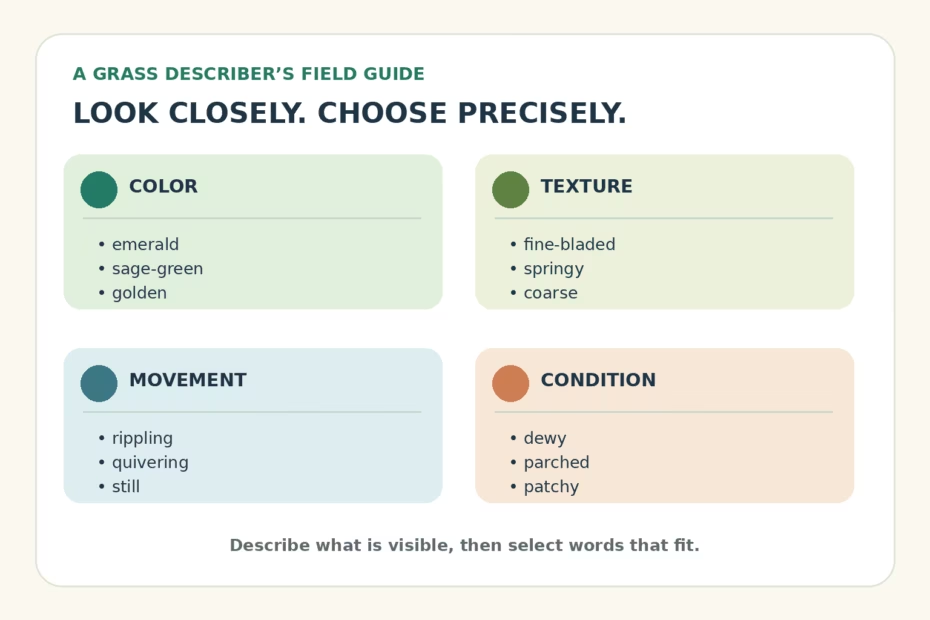
The clearest description starts with a visible or physical detail. “Green grass” gives a color, while “fine, blue-green grass bending after rain” adds texture, hue, movement, and a setting. Before choosing an adjective, ask what the grass is doing, how it looks in the light, and what a person might feel or hear nearby. A precise detail often says more than several general compliments.
Color and light
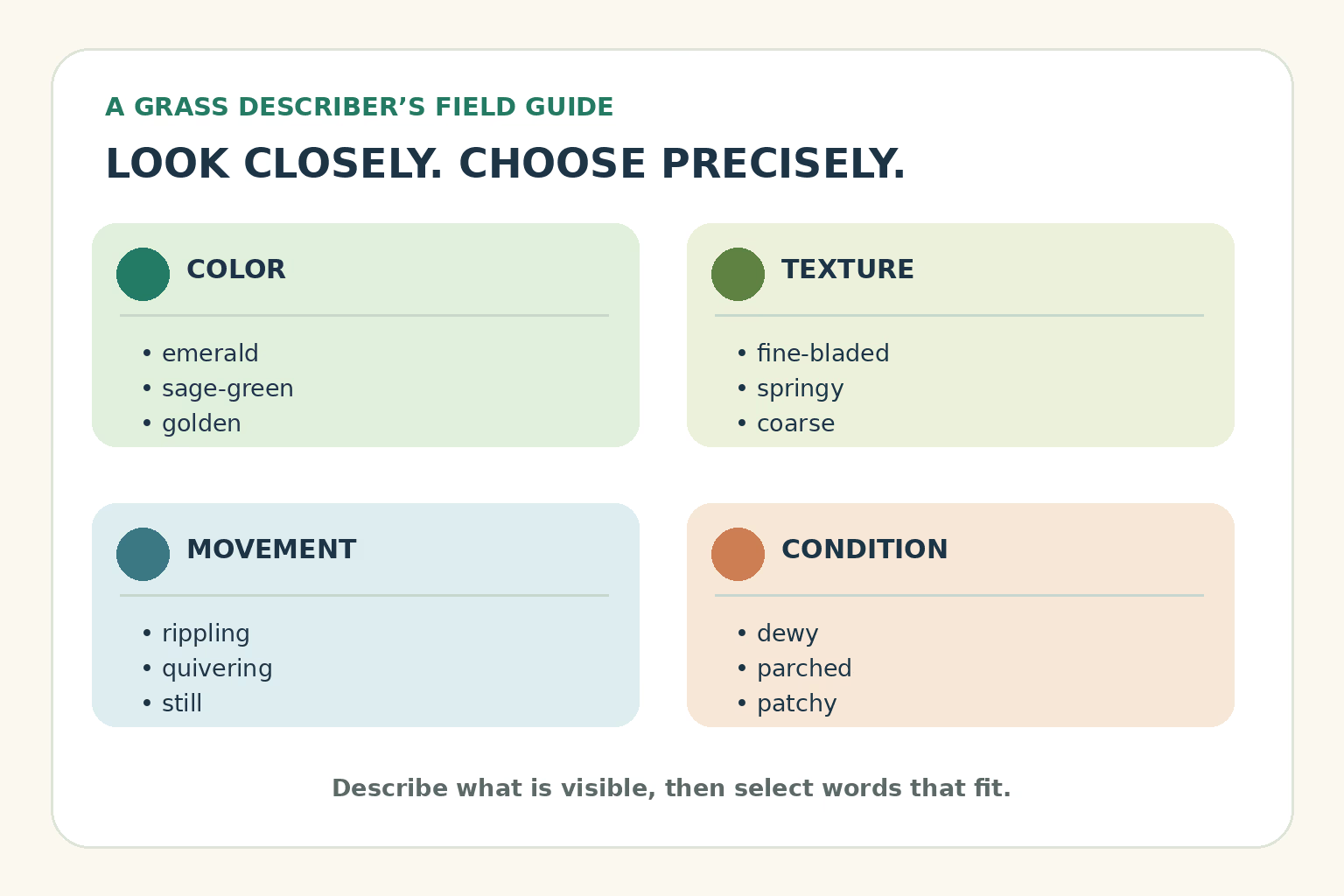
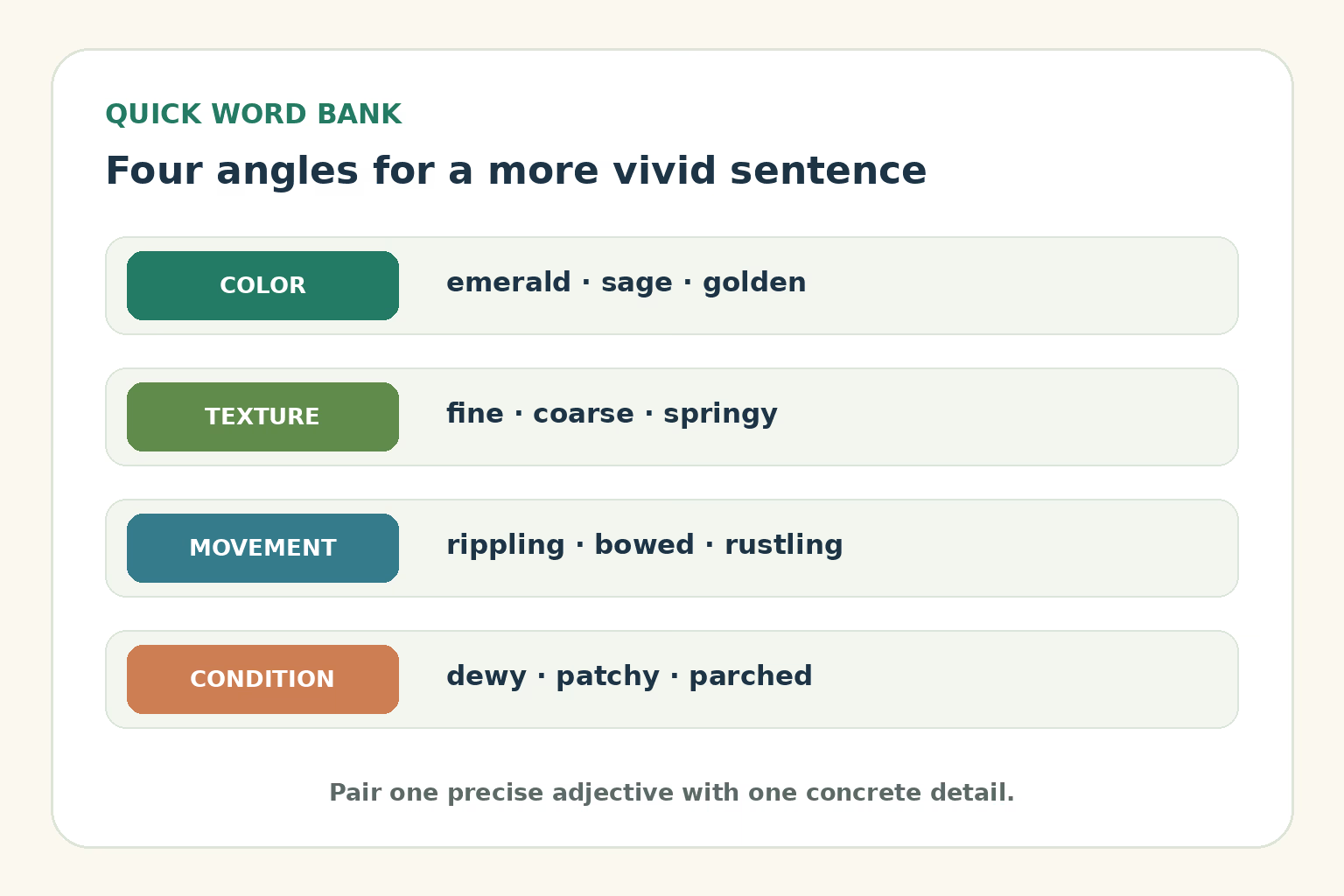
Emerald suggests a vivid, rich green; sage describes a softer gray-green; and blue-green points to a cooler cast. Golden may describe sunlit blades or mature grass, while straw-colored is more exact for dry, pale yellow-brown grass. Silvered and frosted work when dew or frost catches the light. These words describe different things: the grass’s underlying color, its temporary lighting, or moisture on its surface.
Examples: “The emerald lawn framed the pale stone path.” “At sunset, the meadow looked golden at the edges.” “Frosted blades glittered along the shaded fence.”
Texture, height, and density
Fine or narrow-bladed describes slim leaves; coarse describes broader, rougher-looking blades. Close-cropped means cut short, while tall, knee-high, and waist-high give a reader a clearer sense of scale. Dense grass grows closely together; sparse grass leaves soil visible between plants. For touch, use silky, springy, scratchy, or stiff only when that sensation is relevant to the scene. Texture varies by species and growing conditions, so one adjective should not stand in for every lawn.
Examples: “Fine blades softened the border beneath the lilacs.” “The sparse patch exposed dry soil.” “A springy turf cushioned each step.”
Movement and sound
Rippling suggests repeated waves across a broad area; quivering suggests small, quick movements; and bowed describes blades bent under rain or wind. Rustling and hissing name sounds, while still creates a quiet contrast. These verbs and participles help describe a scene without claiming that the grass literally speaks or dances.
Examples: “A breeze sent rippling bands through the meadow.” “Rain-bowed blades brushed the garden path.” “The dry stalks hissed softly against one another.”
Moisture, growth, and condition
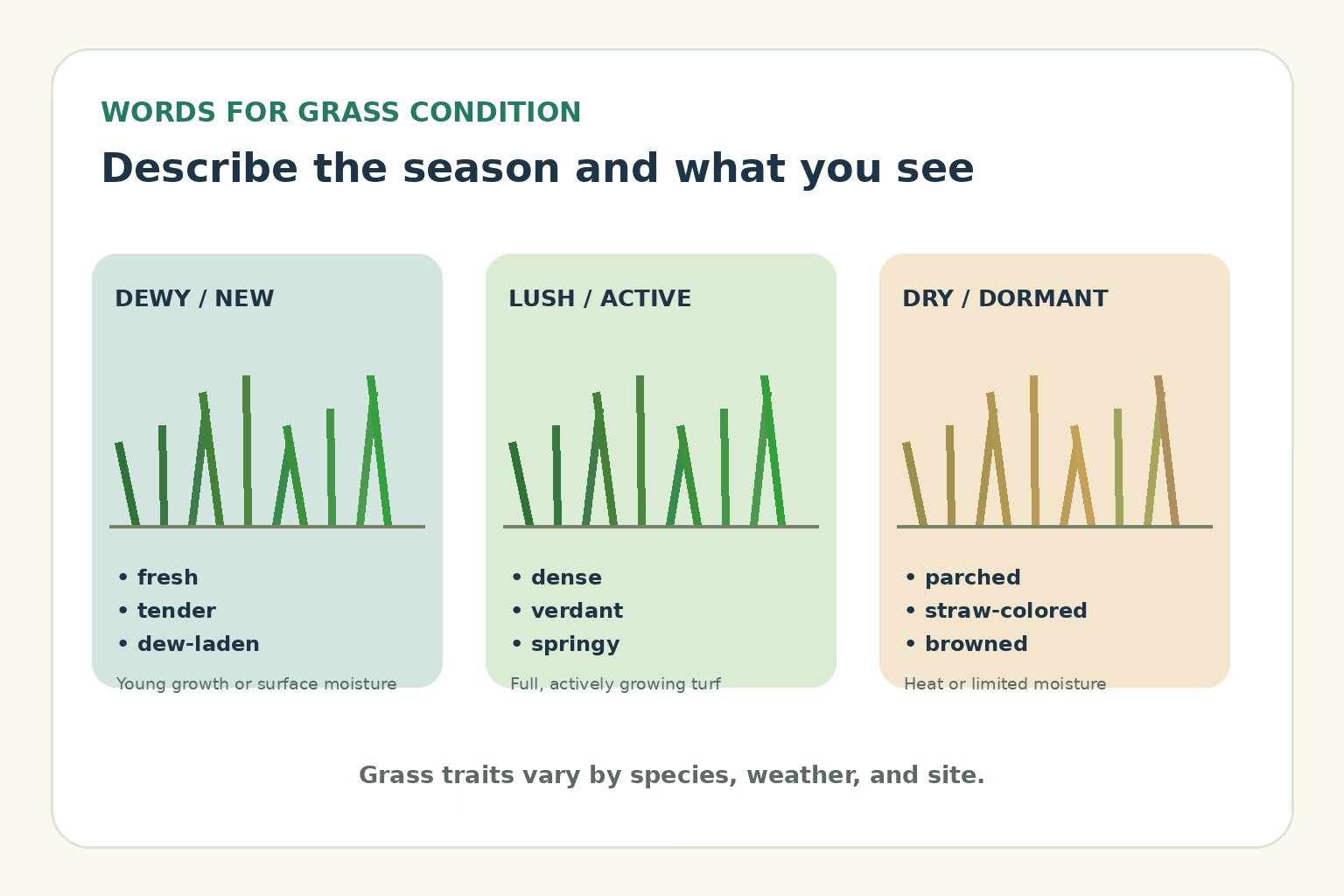
Dewy means beaded with morning moisture; dripping signals heavier water; and parched describes grass made extremely dry by heat or lack of rain. Newly sprouted and tender fit young growth; mature or seed-bearing fits later stages. Thick, healthy-looking, and vigorous communicate fullness or active growth, whereas patchy, wilted, and browned point to visible problems. “Dormant” can be accurate for some lawn grasses under seasonal stress: brown color alone does not prove that the plants are dead.
Grass adjectives with meanings and examples
Use this list as a word bank. Some terms describe appearance, others describe touch, sound, or growth; choose the group that matches the point of view.
| Adjective | What it suggests | Example |
|---|---|---|
| Verdant | Green and flourishing, often of a landscape | Verdant slopes surrounded the farmhouse. |
| Emerald | Bright, saturated green | Emerald blades lined the path. |
| Sage-green | Muted, slightly gray green | Sage-green grass grew beneath the olive trees. |
| Golden | Yellow-green or lit by warm sunlight | Golden grass glowed in the late sun. |
| Straw-colored | Pale yellow-brown and dry | Straw-colored grass covered the summer hillside. |
| Fine-textured | Made of narrow, delicate-looking blades | Fine-textured grass edged the flower bed. |
| Coarse | Rough-looking, broad-bladed, or uneven | Coarse grass rose beside the trail. |
| Dense | Growing closely together | Dense turf hid most of the soil. |
| Sparse | Thinly spread, with gaps | Sparse grass struggled beneath the tree. |
| Close-cropped | Recently cut short | Close-cropped grass bordered the court. |
| Tufted | Growing in visible clumps | Tufted grasses dotted the rocky bank. |
| Springy | Resilient underfoot | The springy lawn softened the children’s landing. |
| Silky | Smooth and soft in appearance or touch | Silky blades brushed her ankles. |
| Scratchy | Unpleasantly rough against skin | Scratchy stalks caught on his socks. |
| Dew-laden | Holding many drops of dew | Dew-laden grass soaked the hem of her trousers. |
| Frosted | Covered with a thin layer of frost | Frosted grass glittered in the dawn. |
| Rippling | Moving in broad, wave-like patterns | Rippling grass swept toward the river. |
| Quivering | Shaking with small movements | Quivering blades framed a butterfly. |
| Rustling | Making a soft dry sound as it moves | Rustling grass masked the birds’ footsteps. |
| Parched | Extremely dry from heat or lack of rain | Parched grass crunched underfoot. |
| Patchy | Uneven, with areas of better and poorer growth | The patchy lawn showed where shade fell. |
| Seed-bearing | Carrying seed heads | Seed-bearing grass nodded along the verge. |
| Whisper-thin | Very fine or slight; a poetic impression | Whisper-thin blades traced the stream bank. |
| Unmown | Not recently cut | Unmown grass leaned over the stepping stones. |
Match the adjective to the kind of writing
- For a poem or story: Choose sensory words such as “dew-laden,” “whispering,” or “rippling,” then ground the image in light, weather, or movement. “The rippling meadow caught the last copper light” gives the reader a specific scene.
- For a garden or landscape description: Prefer measurable details such as “knee-high,” “sparse,” “fine-bladed,” or “seed-bearing.” They help someone picture the site without relying on “beautiful” or “nice.”
- For a lawn note or maintenance report: Use neutral terms such as “patchy,” “browned,” “dense,” or “close-cropped.” Describe where the condition occurs and when you observed it; the adjective alone does not diagnose its cause.
Grass appearance depends on species and site. Pennsylvania State University Extension notes that turfgrass species differ in leaf texture, color, shade tolerance, and drought response; for example, fine fescues are narrow-leaved, while tall fescue is described as more heat- and drought-tolerant among cool-season grasses. Illinois Extension also explains that cool-season lawns can slow growth or go dormant during hot, dry weather. Treat words such as “fine,” “dark green,” or “dormant” as descriptions of a particular plant or moment, not universal qualities of all grass.
Quick tips for describing grass
- Be specific about the feature. Is the grass fine or coarse, lush or sparse, wet or dry?
- Separate color from lighting. “Golden in sunset” describes reflected light; “straw-colored” describes a dry yellow-brown appearance.
- Use sensory language deliberately. A reader cannot feel “velvety” grass in a report, but touch can enrich a first-person scene.
- Vary repeated words. Instead of repeating “green,” consider “emerald,” “sage-green,” or “blue-green” when each one is accurate.
- Keep the image consistent. “Dewy,” “parched,” and “frosted” usually signal different conditions, so avoid piling them into one description unless the scene changes.
For more on turfgrass texture, growing conditions, and seasonal water needs, see Penn State Extension’s turfgrass species guide, its guide to shaded turf, and Illinois Extension’s lawn watering guidance.
When it comes to describing the beauty and allure of nature, grass plays a vital role. Its vibrant green color and soft texture can instantly transport us to a peaceful and serene state of mind. But have you ever wondered how to capture the essence of grass in words? In this article, I’ll be sharing a variety of adjectives that perfectly describe grass, accompanied by examples that will help you paint a vivid picture with your words. So whether you’re a writer looking to add depth to your descriptions or simply a nature enthusiast wanting to appreciate the subtleties of grass, this article is for you.
Grass, with its lush and verdant appearance, is a true marvel of nature. It can be velvety, like a plush carpet under your feet, or it can be wispy and delicate, swaying gently in the breeze. From the emerald blades that tickle your toes to the dew-kissed strands that sparkle in the morning light, grass has a multitude of qualities that deserve to be acknowledged. In this article, I’ll be sharing a curated list of adjectives that will help you capture the essence of grass in all its glory. So get ready to explore the descriptive world of grass and elevate your writing to new heights.
How to Describe grass? – Different Scenarios
When it comes to describing grass, there are various scenarios that can help us to paint a vivid picture with words. Whether you’re writing a poem, a story, or simply want to appreciate the beauty of nature, here are some ways to describe grass in different contexts:
1. Grass in the Morning Dew:
In the early morning, as the dew settles on the grass, a whole new world awakens. The grass becomes glistening with moisture, and the droplets create a shimmering effect. It’s a breathtaking sight to witness!
2. Grass Under Bare Feet:
Imagine taking off your shoes and walking across a field of grass. The sensation is incredibly soothing. The grass feels cool, soft, and ticklish against your bare feet. It’s a great way to connect with nature and find relaxation.
3. Grass in the Wind:
On a windy day, the grass seems to come alive. It dances and sways with each gust, creating a mesmerizing spectacle. The movement of the grass is graceful, fluid, and ethereal, lending an air of tranquility to the surroundings.
4. Grass in the Summer Sun:
Under the warm rays of the summer sun, the grass transforms into a vibrant carpet of green. It’s lush, verdant, and energetic. The sunlight filters through the blades, casting long, delicate shadows that add depth to the landscape.
5. Grass After Rainfall:
After a refreshing rainfall, the grass appears rejuvenated and invigorated. It looks refreshing, revitalized, and renewed. The raindrops cling to the blades, creating a glimmering effect that adds an extra touch of magic to the scenery.
6. Grass in Winter Frost:
In the colder months, the grass is blanketed by a thin layer of frost. It glistens in the morning light, creating a magical winter wonderland. The frost gives the grass a crisp, icy, and sparkling appearance, making it truly enchanting.
Describing Words for grass in English
When it comes to describing grass, there are plenty of adjectives that can help us paint a vivid picture in our minds. Whether you’re a writer looking to add more detail to your description or a nature enthusiast who loves to observe the beauty of grass, using descriptive words can bring a new level of richness to your experience. Here are some examples of adjectives that can be used to describe grass:
- Lush: Thick, healthy, and vibrant, like a lush green carpet.
- Velvety: Soft, smooth, and slightly springy to the touch, like a velvet fabric.
- Glistening: Shimmering with dewdrops, reflecting the light like tiny diamonds.
- Tender: Delicate and soft, giving a gentle sensation under bare feet.
- Whispering: Rustling gently in the wind, creating a soft and soothing sound.
- Swaying: Moving gracefully with the breeze, creating a mesmerizing dance.
- Sun-kissed: Bathed in the warm rays of the sun, radiating a golden hue.
- Fresh: Newly grown, with a clean and invigorating scent.
- Dewy: Covered in droplets of water, sparkling with freshness.
- Resilient: Able to withstand harsh conditions, bouncing back after being trodden upon.
Using these descriptive words, you can convey the different qualities and characteristics of grass in various contexts. Whether you’re trying to capture the beauty of grass in the morning dew or the serene atmosphere of a grassy meadow, these adjectives can help bring your descriptions to life.
Here’s a table summarizing the adjectives for grass:
| Adjective | Description |
|---|---|
| Lush | Thick, healthy, and vibrant |
| Velvety | Soft, smooth, and slightly springy |
| Glistening | Shimmering with dewdrops |
| Tender | Delicate and soft |
| Whispering | Rustling gently in the wind |
| Swaying | Moving gracefully with the breeze |
| Sun-kissed | Bathed in the warm rays of the sun |
| Fresh | Newly grown, with a clean scent |
| Dewy | Covered in droplets of water |
| Resilient | Able to withstand harsh conditions |
Using these adjectives, you can create more vivid and engaging descriptions of grass.
Adjectives for grass
Grass is a ubiquitous and versatile plant that is an essential part of our natural environment. It not only adds beauty to landscapes but also serves important ecological functions. When it comes to describing grass, there are numerous adjectives that can capture its various qualities and characteristics. In this section, I’ll explore both positive and negative adjectives that can be used to vividly describe grass.
Positive Adjectives for Grass
Grass, with its rich green color and soft texture, can evoke feelings of serenity and freshness. Here are twelve examples of positive adjectives that can be used to describe grass, along with example sentences:
| Adjective | Example Sentence |
|---|---|
| Lush | The lush grass spread across the meadow, creating a vibrant and welcoming scene. |
| Velvety | I couldn’t resist running my fingers through the velvety grass, feeling its luxurious texture. |
| Glistening | In the morning light, the glistening grass blades sparkled with dewdrops, like tiny diamonds. |
| Tender | The tender grass shoots sprouted from the ground, signaling the arrival of spring. |
| Whispering | As the wind blew gently, the whispering grass rustled in harmony, creating a soothing melody. |
| Swaying | The tall grass swaying in the breeze created a mesmerizing dance that captivated my senses. |
| Sun-kissed | The sun-kissed grass glowed golden in the sunlight, creating a warm and inviting atmosphere. |
| Fresh | Walking barefoot on the fresh grass was a refreshing and invigorating experience. |
| Dewy | The dewy grass sparkled in the early morning light, making the whole landscape come alive. |
| Resilient | Despite being trampled upon, the resilient grass quickly bounced back, showing its strength and adaptability. |
Negative Adjectives for Grass
While grass is often associated with positive attributes, there are also negative adjectives that can be used to describe certain aspects or conditions of grass. Here are five examples, along with example sentences:
| Adjective | Example Sentence |
|---|---|
| Patchy | The patchy grass in the backyard detracted from the overall neatness of the landscape. |
| Overgrown | The neglected garden was filled with overgrown grass that obscured the path and made it hard to walk. |
| Dry | Without sufficient water, the dry grass turned brown and brittle, losing its lushness and vibrancy. |
| Weed-ridden | The once well-maintained lawn became weed-ridden, with unsightly invaders overshadowing the grass. |
| Matted | In areas with heavy foot traffic, the grass became matted and flattened, losing its natural texture. |
Synonyms and Antonyms with Example Sentences
Synonyms for grass
When it comes to describing grass, there are several synonyms that can be used to convey its different qualities and characteristics. Here are a few examples:
- Lush: The meadow is covered in lush green grass.
- Velvety: I love the feel of velvety grass beneath my feet.
- Glistening: The morning dew made the grass glisten in the sunlight.
- Tender: The tender grass shoots were a sign of spring.
- Whispering: The wind rustled through the grass, whispering a peaceful melody.
- Swaying: The tall grass was swaying in the gentle breeze.
- Sun-kissed: The sun-kissed grass illuminated the field with its golden glow.
- Fresh: The freshly cut grass filled the air with its clean scent.
- Dewy: The grass was dewy after the overnight rain shower.
- Resilient: Despite the heavy foot traffic, the grass remained resilient.
Antonyms for grass
On the other hand, there are also antonyms that can be used to describe certain aspects or conditions of grass. Here are a few examples:
- Patchy: The patchy grass in the yard needed some care.
- Overgrown: The neglected field was filled with overgrown grass.
- Dry: The scorching sun had turned the grass dry and brittle.
- Weed-ridden: The untended garden was overrun with weed-ridden grass.
- Matted: The grass under the fallen leaves was matted and messy.
Using these synonyms and antonyms can help add variety and depth to your descriptions of grass, allowing you to paint a more vivid picture for your readers or young learners. Remember to choose the right word to convey the specific qualities or conditions you want to emphasize.
To summarize the synonyms and antonyms for grass:
| Synonyms | Antonyms |
|---|---|
| Lush | Patchy |
| Velvety | Overgrown |
| Glistening | Dry |
| Tender | Weed-ridden |
| Whispering | Matted |
| Swaying | |
| Sun-kissed | |
| Fresh | |
| Dewy | |
| Resilient |
Using a combination of these descriptive words will help you create engaging and accurate descriptions of grass, whether you’re teaching young learners or writing for a wider audience.
Conclusion
Describing grass can be a fun and creative exercise for writers and educators alike. By using a variety of adjectives, we can paint a vivid picture of the different qualities and characteristics of grass. In this article, we explored positive synonyms such as lush, velvety, glistening, and many more, which can help bring to life the vibrant and inviting nature of grass. We also discussed negative antonyms like patchy, overgrown, and dry, which can be used to describe the less desirable aspects of grass.
By incorporating these descriptive words into our writing, we can engage our readers and provide them with a clear and accurate depiction of grass. Whether we are describing a beautiful meadow or a neglected lawn, the right adjectives can make all the difference. So, the next time you find yourself in need of words to describe grass, remember the examples we’ve explored in this article. Happy writing!


