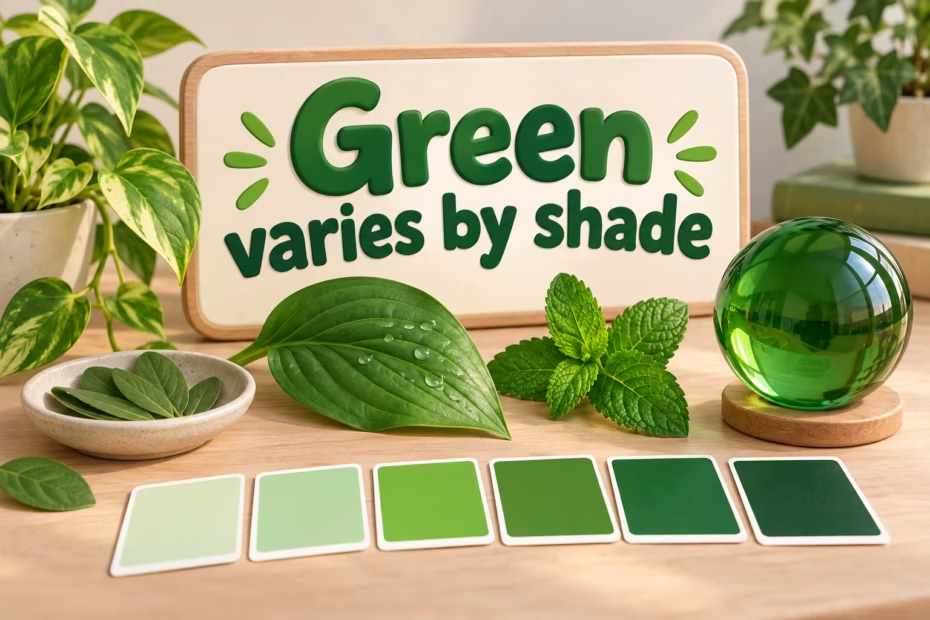
Adjectives for Green: Shades, Examples & Color Words
Adjectives for green describe what you can see and the effect you intend: mint and sage suggest lighter or muted greens, while emerald and forest green suggest richer or deeper shades. For precise writing, separate color from texture, mood, plant health, and technical color values.
Green at a Glance
- Use shade words: pale, vivid, muted, and deep describe different visual qualities.
- Choose comparisons carefully: mint, sage, olive, emerald, and forest green evoke different green families but are not universal measured standards.
- Describe what the word modifies: leafy describes foliage; mossy describes a surface with or resembling moss; verdant usually describes lush vegetation.
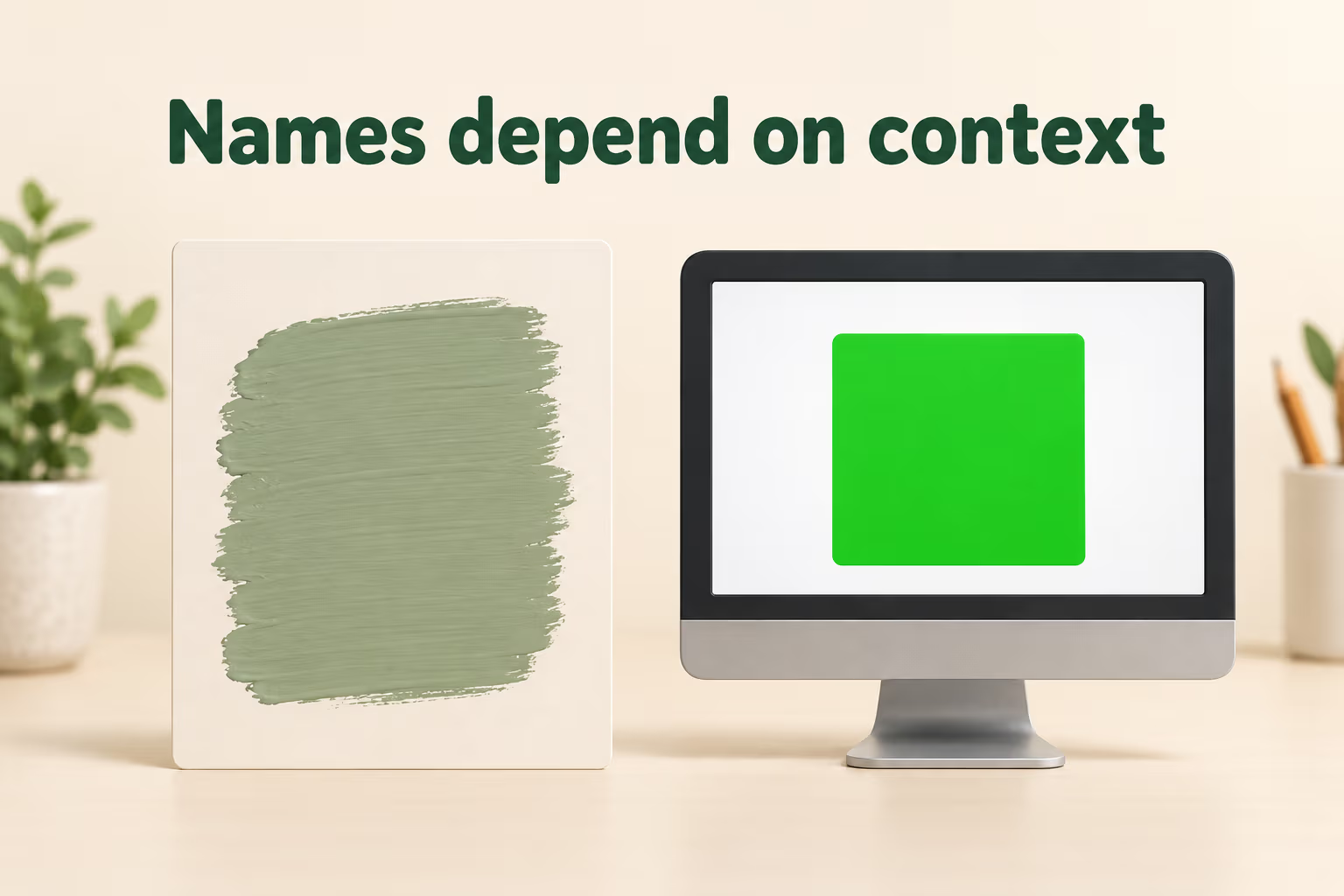
- Lighting changes appearance: a paint chip, leaf, fabric, and screen can appear different under different illuminants and viewing conditions.
- Meaning depends on context: green can mean the color, inexperienced, environmentally oriented, or unripe; surrounding words clarify the sense.
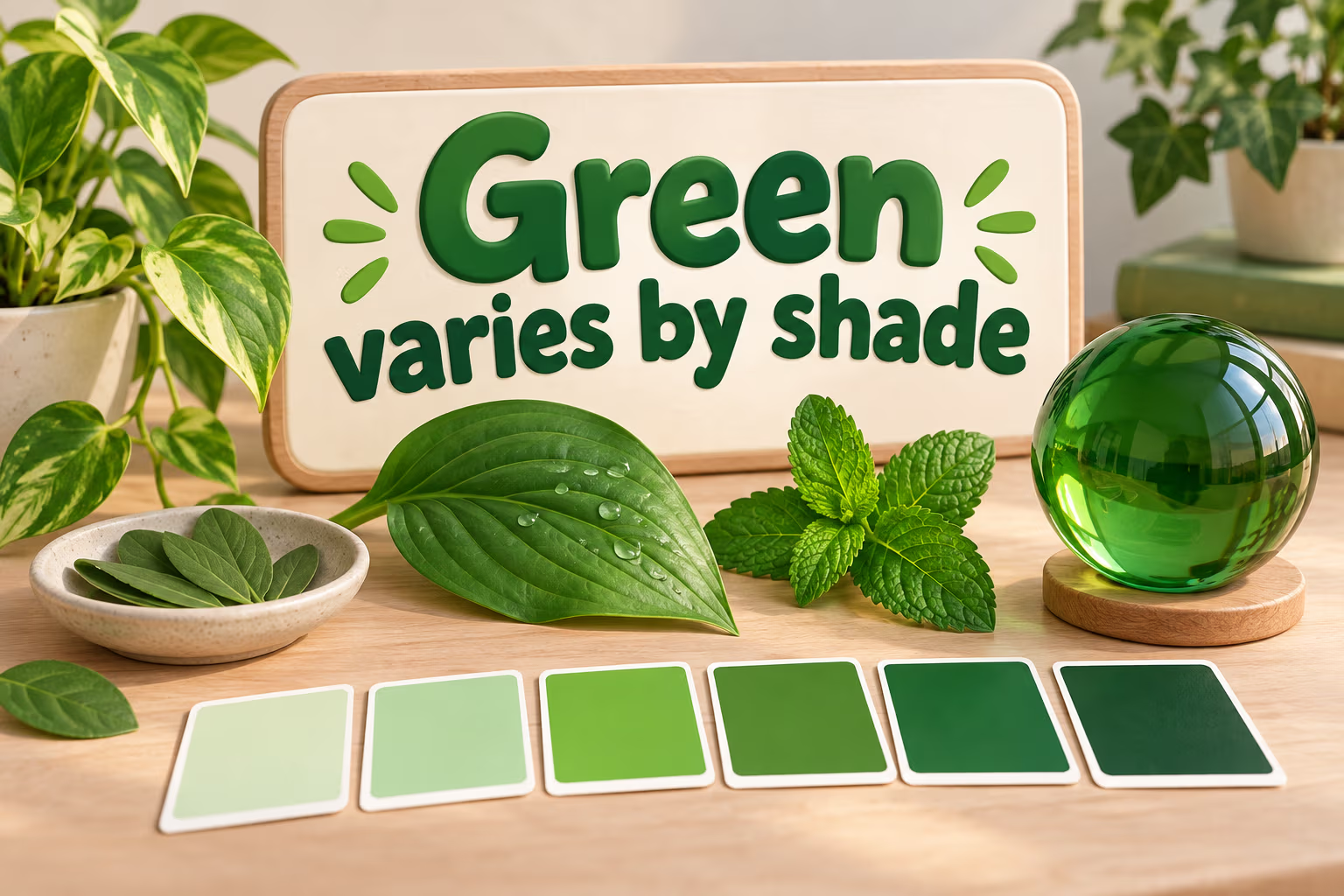
How do you choose the right adjective for green?
Name the thing first, then add the feature you want readers to notice. “A muted sage-green wall” gives a hue comparison and a lower-intensity impression; “a leafy green canopy” describes plant coverage rather than a paint shade. One or two accurate modifiers usually make a clearer picture than a string of near-synonyms.
Color language is approximate unless it is tied to a defined system, sample, or measurement. The Royal Horticultural Society uses its RHS Colour Chart as a reference for recording plant colors, while web design can use standardized color values. In CSS Color Module Level 3, the keyword green maps to sRGB #008000; CSS lime maps to #00FF00. Those values name specific digital colors, not every shade people call green.
| What you notice | Words to try | Example |
|---|---|---|
| Lightness | pale, light, soft, deep, dark | Pale green paint brightened the narrow hallway. |
| Intensity | vivid, bright, saturated, muted, subdued | A muted green cushion balanced the vivid artwork. |
| Color leaning | yellow-green, blue-green, gray-green, olive | The gray-green stone looked warmer beside the cream tile. |
| Natural comparison | mint, sage, mossy, leafy, forest | Sage-green leaves softened the contrast with the brick. |
| Surface or material | glossy, matte, translucent, lustrous | The translucent green glass let sunlight pass through. |
| Figurative impression | fresh, tranquil, dramatic, jewel-like | The jewel-like green fabric caught the stage light. |
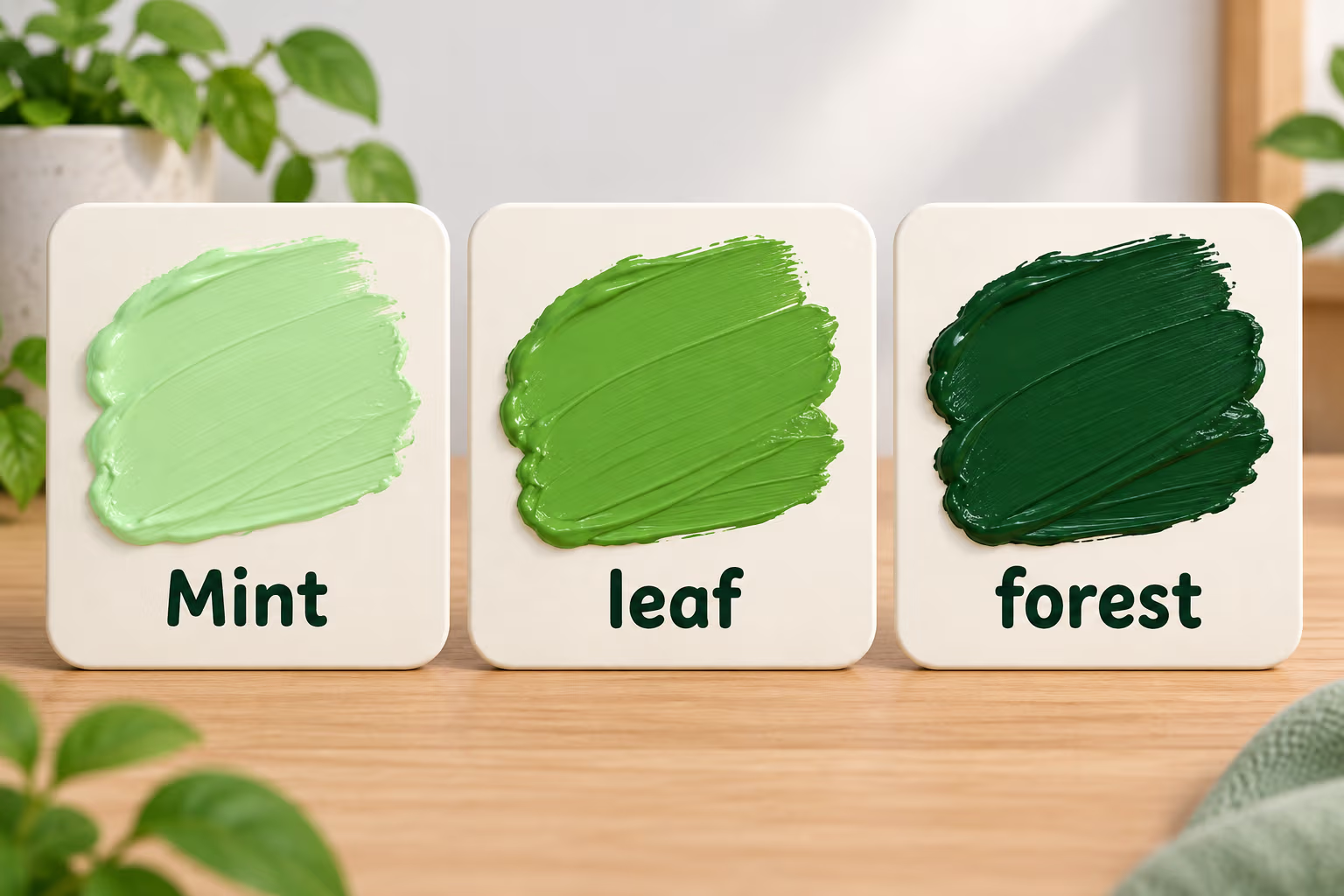
Which green shade words fit common descriptions?
Use the comparison as an image, not as a guarantee of an exact color: mint often suggests a light green, sage a subdued gray-green, olive a yellow-leaning or earthy green, and emerald a vivid jewel-like green. A reader may picture these names differently, so technical work needs a sample or a named color system.
| Word | Typical impression | Useful with |
|---|---|---|
| Mint | Light, cool, and often slightly blue-green | Paint, fabric, décor, candies |
| Sage | Soft, muted, gray-green | Walls, leaves, clothing |
| Olive | Earthy green with a yellow or brown cast | Cloth, skin-tone palettes, foliage |
| Lime | Bright yellow-green; meaning varies between everyday and technical contexts | Fruit, paint, digital color (check the system) |
| Emerald | Rich, vivid jewel-like green | Gemstones, fabric, literary comparisons |
| Viridian | A blue-leaning green associated with a specific artists’ pigment/color name | Painting and palette discussion |
| Forest green | A familiar comparison for a deep, shaded green | Foliage, clothing, design |
| Mossy | Green that resembles moss or appears on a moss-covered surface | Stones, bark, shaded gardens |
These are conventional associations, not binding definitions. For a product listing, paint order, or accessibility review, show a swatch or specify a color system and value instead of relying on a shade name alone.
How does light affect a green color description?
Light can change how a surface color appears because the object reflects light from its surroundings and different light sources have different spectral output. The U.S. National Institute of Standards and Technology describes this as color rendering and notes that people can interpret colors differently even under the same illumination. A green shirt may appear warmer under an incandescent-style lamp and cooler in daylight, while a camera or screen can add another layer of variation.
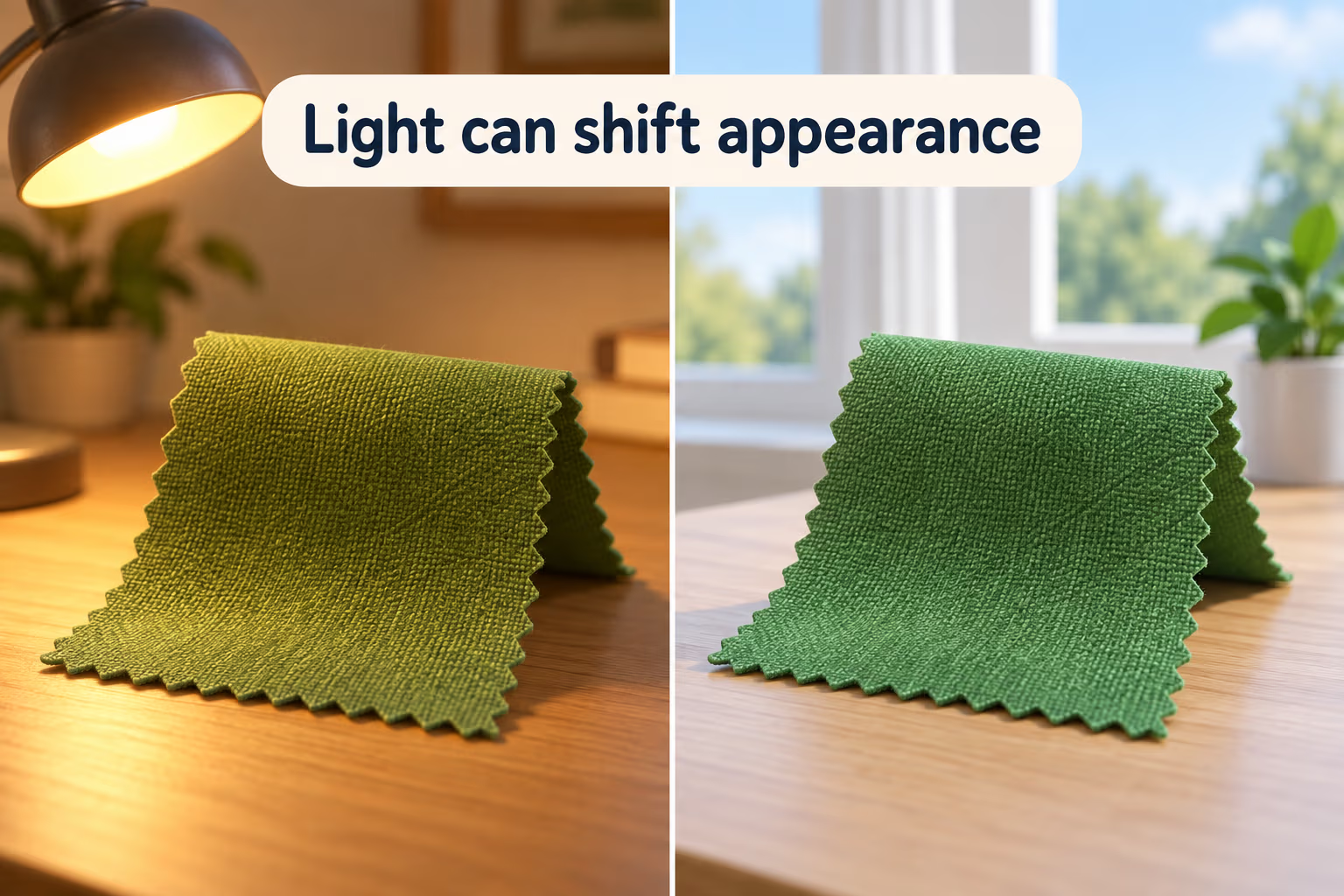
When a match matters, compare the object with its reference sample under consistent, neutral lighting and view it directly rather than trusting a compressed photograph. In creative writing, you can simply name the conditions: “The olive fabric looked almost gray beneath the warm lamp.” That describes the scene without claiming that the fabric permanently changed color.
What is the difference between color adjectives and related words?
Some green descriptors name a hue; others describe the object’s surface, condition, or association. Glossy is a surface quality, lush or verdant usually characterizes abundant vegetation, and unripe describes a stage of development that may be signaled by green color in some foods. These words are related to green descriptions, but they are not interchangeable color synonyms.
Gem names also need context. Emerald is a gemstone name that writers use as a color comparison; jade can suggest a shade or material; malachite refers to a mineral and may evoke its banded green appearance. When describing an actual stone, name the material only when it is known. A green-looking stone is not automatically emerald, jade, or malachite.
Are red and other colors antonyms for green?
Colors do not have ordinary dictionary antonyms in the way that hot and cold do. Red is often treated as green’s complement in traditional color-wheel discussions, but “complementary” means a relationship in a chosen color model or design system, not a universal lexical opposite. Brown, blue, yellow, and gray can contrast with green in a scene without being antonyms.
For design, describe the effect you mean: “red-green complementary contrast,” “green against neutral gray,” or “a yellow-green palette.” The Royal Horticultural Society explains that adding white creates a tint, adding black creates a shade, and adding gray creates a tone. These terms help compare a color’s treatment without pretending there is one opposite green.
How do you use green in a sentence?
Put green before a noun when it identifies color (green apples), after a linking verb when it describes a state (the glass turned green), or as a noun when the color itself is the topic (green pairs with cream). In figurative uses, green can mean inexperienced (“a green recruit”) or relate to environmental concerns (“green transport”). The sentence context tells readers which meaning applies.
| Use | Example | Meaning |
|---|---|---|
| Color adjective | She chose a muted green jacket. | Describes visible color. |
| Predicate adjective | The copper roof turned green. | Describes a resulting appearance. |
| Figurative adjective | The green recruit asked careful questions. | Means inexperienced or new in that role. |
| Environmental modifier | The city funded a green transit plan. | Signals an environmental purpose; the exact claim depends on the plan. |
Frequently asked questions about green adjectives
What are the best adjectives to describe green?
Choose words that match the feature: sage or olive for muted green, emerald or vivid for a stronger impression, pale or deep for lightness, and leafy or verdant for vegetation. A specific shade name is a comparison, so use a swatch or value when exact color matching matters.
Is emerald a synonym for green?
Emerald can work as a color comparison meaning a rich green, but it is not a synonym for every green shade. It is also the name of a gemstone, so a sentence should make clear whether it describes color (“emerald fabric”) or an actual stone (“an emerald ring”).
What is a positive adjective for green?
Lush, verdant, and vibrant often sound positive when describing thriving foliage or a vivid palette. Their fit depends on context: lush vegetation suggests abundance, while vibrant signals strong color. Avoid using positive wording as evidence that a plant is healthy; visible greenness alone cannot diagnose its condition.
What is the opposite of green?
Green has no single dictionary antonym. Red is often called its complementary color in traditional color-wheel contexts, while other colors can simply contrast with green. State the design relationship you mean—such as complementary, contrasting, lighter, or darker—rather than calling another color the universal opposite.
Does green mean inexperienced?
Yes. In an informal figurative sense, green can describe someone new or inexperienced in a task, as in “a green player.” Context prevents confusion with the literal color. In formal writing, new, inexperienced, or novice may be more precise and less idiomatic.
Sources and further reading
The W3C CSS Color Module Level 3 defines basic color keywords and their sRGB values. The National Institute of Standards and Technology overview of lighting and color perception explains why object colors vary with illumination. The NIST guide to color rendering describes how light sources affect the appearance of reflective samples. The Royal Horticultural Society guide to color in planting design explains hues, tints, shades, and tones; the RHS also describes its Colour Chart as a 920-color reference used by horticulturists.
The Bottom Line
Choose adjectives for green by the exact feature you want to show: hue, lightness, intensity, surface, or impression. Treat words such as mint, sage, olive, and emerald as useful comparisons, not universal color standards. Lighting and context shape how a green appears and what the word means, so use a sample or defined value whenever precision is important.
Original source article, preserved in full
Green is a color that is often associated with nature, growth, and freshness. It is a versatile hue that can evoke a sense of tranquility or vibrancy, depending on the shade. In this article, I’ll be exploring a wide range of descriptive adjectives that can be used to paint a vivid picture of all things green. From lush forests to emerald gemstones, we’ll delve into the world of green and discover the perfect words to bring it to life.
Whether you’re a writer looking to add depth to your descriptions or simply someone who appreciates the beauty of the natural world, this article will provide you with a comprehensive list of adjectives to enhance your vocabulary. From the palest mint to the deepest forest green, we’ll explore words that capture the essence of each shade. Get ready to dive into a sea of verdant words and discover new ways to describe the color that symbolizes life and renewal.
In the following paragraphs, we’ll explore adjectives that describe the various shades of green, from light and refreshing to dark and mysterious. We’ll also provide examples of how these adjectives can be used in sentences to create vivid imagery. So, let’s embark on this journey together and uncover the rich tapestry of adjectives that bring the color green to life.
How to Describe green? – Different Scenarios
When it comes to describing the color green, there are countless words that can be used to paint a vivid picture. Let’s explore some different scenarios where these adjectives can come in handy:
1. Nature and Environment
Green is inherently associated with nature and the environment. Here are some adjectives that can be used to describe lush forests, vibrant meadows, and flourishing landscapes:
Adjectives
- Serene
- Verdant
- Bountiful
- Majestic
- Sprawling
- Luxuriant
Example: The serene forest was filled with verdant trees and luxuriant foliage, creating a truly magical scene.
2. Freshness and Vitality
Green is often associated with freshness, vitality, and new beginnings. Here are a few adjectives that capture these qualities:
Adjectives
- Vibrant
- Revitalizing
- Energizing
- Invigorating
- Brisk
- Renewing
Example: The vibrant grass and energizing scent of flowers in bloom brought a sense of renewing energy to the park.
3. Jewelry and Gemstones
Green gemstones, like emeralds, can be described using a variety of adjectives. Here are some examples:
Adjectives
- Dazzling
- Radiant
- Brilliant
- Sparkling
- Glittering
- Translucent
Example: The stunning necklace adorned with dazzling emerald stones caught everyone’s attention.
Remember, using descriptive adjectives can bring your descriptions to life and make them more engaging for your readers. Experiment with different combinations of words to create vivid imagery.
Now that we have explored how to describe green in various scenarios, let’s move on to the next section to discover even more adjectives that can enhance your vocabulary.
Describing Words for green in English
When it comes to describing the color green, there are many descriptive words that can paint a vivid picture in our minds. In this section, I’ll explore some adjectives that can be used to bring the color green to life. Let’s dive in!
1. Nature and Environment
Green is often associated with nature and the environment. It represents growth, fertility, and harmony. Here are some descriptive words that capture the essence of green in nature:
- Lush: The lush green leaves of the trees created a peaceful atmosphere.
- Verdant: The verdant meadow was a sight to behold, with its vibrant green grass.
- Leafy: The leafy canopy provided a cool shade on a hot summer’s day.
- Grassy: The grassy hills stretched as far as the eye could see, dotted with colorful wildflowers.
- Sylvan: The sylvan forest whispered with the sound of rustling leaves and chirping birds.
2. Freshness and Vitality
Green is often associated with freshness and vitality. It can evoke a sense of renewal and energy. Here are some adjectives that capture the lively and vibrant side of green:
- Crisp: The crisp green apples had a refreshing crunch with every bite.
- Vibrant: The vibrant green color of the field added a burst of energy to the landscape.
- Energetic: The energetic dance of the green leaves in the wind was mesmerizing.
- Zesty: The zesty lime green walls brought a pop of color to the room.
- Invigorating: The invigorating scent of freshly cut grass filled the air.
3. Green Gemstones
Green is also a popular color for gemstones, each with its own unique shade and beauty. Here are a few adjectives to describe green gemstones:
- Emerald: The emerald gemstone sparkled with an alluring green hue.
- Jade: The jade pendant had a smooth texture and a deep, rich green color.
- Peridot: The peridot gemstone shimmered with a light, vibrant green glow.
- Malachite: The malachite stone displayed beautiful bands of dark and light green.
Adjectives for green
Positive Adjectives for Green with 12 Example Sentences
When it comes to describing the color green, there are plenty of positive adjectives that can bring vivid imagery to mind. Let me share with you 12 examples of positive adjectives that perfectly capture the essence of green:
- Lush: The lush green leaves of the trees swayed gently in the breeze.
- Vibrant: The vibrant green grass glistened with morning dew.
- Refreshing: The refreshing green cucumbers provided a cool crunch in my salad.
- Revitalizing: After a long hike, I felt revitalized by the sight of the green meadow.
- Enchanting: The enchanting green glow of fireflies lit up the summer night.
- Nurturing: The nurturing green leaves shielded the delicate flowers from the scorching sun.
- Energetic: The energetic green color of the sports field inspired us to give our all.
- Hopeful: The hopeful green shoots emerging from the ground signaled the arrival of spring.
- Tranquil: Sitting by the tranquil green lake, I felt a deep sense of calm.
- Fertile: The fertile green fields stretched as far as the eye could see, promising a bountiful harvest.
- Renewable: Harnessing the power of renewable green energy is crucial for a sustainable future.
- Peaceful: The peaceful green countryside provided a much-needed escape from the city hustle.
Feel free to use these adjectives to engage children in creative writing exercises or to enhance their vocabulary!
Negative Adjectives for Green with 5 Example Sentences
While green is often associated with positivity and vitality, there are also negative adjectives that can be used to describe this color. Here are 5 examples of negative adjectives that portray a different side of green:
- Sickly: The sickly green tint of the water warned us of pollution in the river.
- Moldy: The moldy green spots on the bread made it unfit for consumption.
- Unripe: The unripe green apples had a sour taste that wrinkled my face.
- Putrid: The putrid green odor emanating from the garbage bin was unbearable.
- Jealous: The jealous green monster in the story symbolized envy and covetousness.
Although these negative adjectives represent less favorable aspects of green, they still contribute to a comprehensive understanding of the color.
Synonyms and Antonyms with Example Sentences
Synonyms for Green
When it comes to describing the color green, there are numerous synonyms that can add depth and variety to your writing. Here are some examples of synonyms for green and how they can be used:
| Synonym | Definition | Example Sentence |
|---|---|---|
| Verdant | Lush and green, especially in reference to plants or landscapes. | The verdant meadows stretched as far as the eye could see. |
| Emerald | A bright and vivid shade of green, often associated with the gemstone. | Her eyes sparkled with the brilliance of emerald. |
| Viridian | A blue-green color that is reminiscent of a clear sky. | The painting showcased a calming combination of viridian and white. |
| Leafy | Covered in or full of leaves, typically used to describe trees or plants. | We took a leisurely walk through the leafy forest. |
| Mossy | Covered in or resembling moss, giving a soft and earthy green appearance. | The stone wall was adorned with mossy patches, adding a touch of nature to the garden. |
Using these synonyms can help you paint a vibrant picture with your words and make your descriptions more engaging.
Antonyms for Green
On the other end of the spectrum, we have antonyms for green. These words can be used to describe colors that are opposite or contrasting to green. Here are some examples:
| Antonym | Definition | Example Sentence |
|---|---|---|
| Red | The color at the opposite end of the spectrum to green, often associated with warmth and intensity. | The fiery sunset painted the sky in shades of red, contrasting with the green fields below. |
| Brown | A color that is often associated with earth, soil, and wood. | The fallen leaves carpeted the ground in various shades of brown, providing a beautiful contrast to the green foliage. |
| Yellow | A bright and cheerful color that is often associated with sunshine and happiness. | The fields of sunflowers added a burst of yellow to the otherwise green landscape. |
| Blue | A cool and calming color that is often associated with the sky and water. | The green leaves of the trees stood out against the clear blue sky. |
| Gray | A neutral color that is often associated with simplicity and elegance. | The modern building’s glass exterior stood in stark contrast to the lush green park surrounding it. |
By incorporating these antonyms into your writing, you can create a vivid contrast to highlight different aspects of the color green.
Remember, when using synonyms and antonyms, it’s important to consider the context and choose the word that best suits your intended meaning. Experiment with different words to add depth and variety to your descriptions, captivating your readers and bringing your writing to life.
Conclusion
In this article, I have explored various adjectives that can be used to describe the color green. By using synonyms such as verdant, emerald, viridian, leafy, and mossy, writers can bring depth and variety to their descriptions. These words evoke vivid imagery and create a more engaging reading experience. On the other hand, antonyms like red, brown, yellow, blue, and gray can be used to create contrast and highlight different aspects of green. By carefully considering context and choosing the right words, writers can bring their descriptions to life and captivate their readers.
Describing the color green is not just about stating the obvious. It’s about using the right words to paint a picture in the reader’s mind. Whether you’re describing a lush forest, a vibrant meadow, or the soothing calmness of a green room, the adjectives you choose can make all the difference. So, next time you’re writing about green, remember to explore the vast array of adjectives available and choose the ones that best convey the specific image or emotion you want to portray.
By expanding your vocabulary and being mindful of the impact of your word choices, you can elevate your writing and create a more immersive experience for your readers. So go ahead, experiment with different adjectives, and let your descriptions of green come to life.



