Adjectives for Halloween describe the mood, setting, costumes, sounds, and activities associated with October 31. Words such as eerie, whimsical, and macabre create different effects, so the best choice depends on the scene and intended audience. Use a precise detail rather than stacking several near-synonyms.

How do you choose adjectives for Halloween?
Choose an adjective by deciding what the reader should notice or feel. Eerie suggests something strange and frightening; sinister hints at a possible threat; whimsical suggests playful imagination. The words may overlap in a Halloween scene, but they are not interchangeable.
| What you are describing | Useful adjectives | Example |
|---|---|---|
| Quiet setting | eerie, hushed, shadowy, deserted | An eerie path disappeared into the fog. |
| Possible danger | sinister, ominous, menacing, foreboding | A sinister shape moved behind the curtain. |
| Playful decoration | whimsical, cheerful, colorful, silly | Whimsical paper bats swung above the table. |
| Magic or fantasy | enchanted, mystical, fantastical, spellbinding | The children followed an enchanted trail of lanterns. |
| Death-themed fiction | macabre, ghastly, grisly, morbid | The story used macabre portraits to unsettle its guests. |
| Autumn details | crisp, misty, rustling, amber | Rustling leaves covered the crisp garden path. |
Dictionary meanings help keep the tone accurate. Cambridge defines eerie as strange in a frightening and mysterious way, sinister as suggesting something bad may happen, and macabre as unpleasantly connected with death or violence. Enchanting, by contrast, means very pleasant or charming. See the entries for eerie, sinister, macabre, and enchanting.
Which words fit a spooky or frightening scene?
Use spooky for a broad Halloween mood, eerie for quiet strangeness, and frightening or terrifying when something causes strong fear. Creepy is informal and can describe an unsettling fictional setting, but it also has a serious negative meaning when applied to a person’s unwelcome behavior.
- Light suspense: spooky, mysterious, shadowy, ghostly, uncanny.
- Unsettling quiet: eerie, hushed, deserted, spectral, otherworldly.
- Threat or warning: sinister, ominous, foreboding, menacing.
- Strong horror: frightening, chilling, terrifying, ghastly, gruesome.
- Death-related horror: macabre, grisly, morbid, ghoulish. These words carry a darker tone and may not suit a child-friendly party invitation.
For example, “a spooky porch” gives a broad seasonal impression; “an eerie porch with a single flickering lamp” adds a quiet, uncanny detail; “a sinister porch” hints that danger may follow. Cambridge’s entry for creepy also notes that the word can describe behavior that makes someone uncomfortable, so use it carefully when describing real people.
What are cheerful and magical Halloween adjectives?
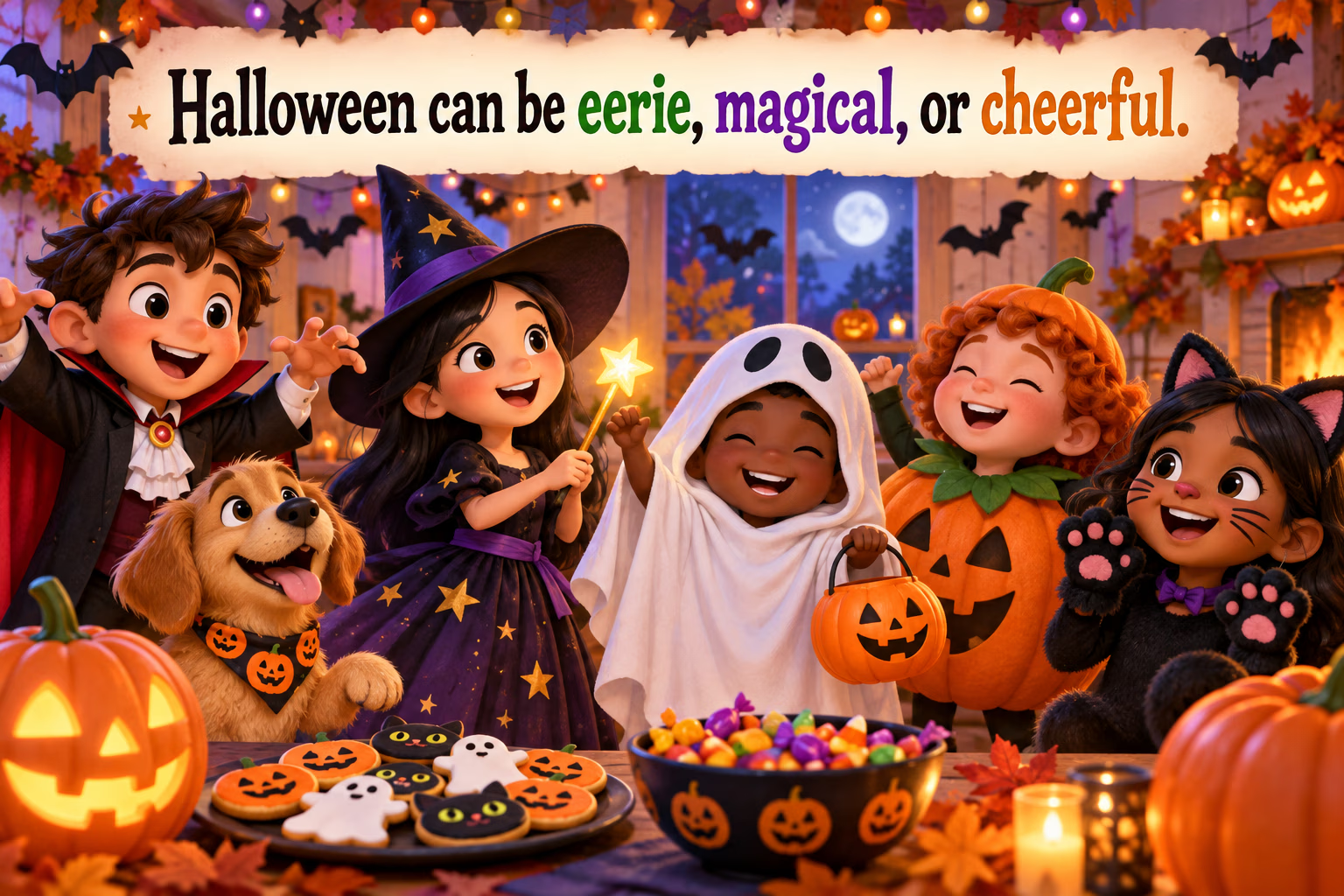
Halloween writing does not have to sound frightening. For a family event, school activity, or lighthearted story, use words that emphasize color, invention, and celebration.
- Playful: whimsical, silly, goofy, playful, quirky.
- Festive: lively, cheerful, joyful, spirited, colorful.
- Magical: enchanted, mystical, fantastical, spellbinding, bewitching.
- Welcoming: cozy, friendly, charming, warm, inviting.
These words describe a positive tone rather than a separate kind of Halloween. Compare “a frightening haunted-house walk” with “a whimsical costume parade”: both can take place on Halloween, but the adjectives tell readers to expect different experiences.
How can you describe a costume, party, or decoration?
Pair the adjective with a visible or audible feature. “Elaborate” works when a costume has many carefully made details; “tattered” describes worn fabric; “flickering” describes an unsteady light. This makes a description more useful than a string of general words such as “spooky, creepy, and scary.”
- Name the subject: a mask, porch, story, party, or path.
- Notice one concrete detail: cracked paint, drifting fog, bright paper stars, a rattling gate.
- Choose the effect: playful, eerie, threatening, or magical.
- Use one or two adjectives: “a weathered gate rattled in the fog” gives the reader more than “a creepy gate.”
| Subject | Specific description |
|---|---|
| Costume | A tattered cape and a crooked hat made the wizard look mysterious. |
| Decoration | Flickering orange lights cast shifting shadows across the porch. |
| Sound | A hollow, rattling noise echoed through the empty hallway. |
| Party | Colorful streamers and playful masks gave the room a festive mood. |
| Story | The ominous silence made the next knock feel unexpected. |
Are “Samhain” and “Halloween” synonyms?
No. Halloween, also called All Hallows’ Eve, is the October 31 observance; Samhain is a related Celtic seasonal festival often discussed as part of Halloween’s historical roots. The Library of Congress describes connections between the traditions, but that relationship does not make the words interchangeable synonyms in ordinary modern sentences.
Likewise, bright, cheerful, and joyful are not antonyms of the holiday Halloween. They are words that contrast with a spooky or frightening mood. You can write “a cheerful Halloween party,” but “Halloween is the opposite of cheerful” does not make sense as a lexical definition.
For a more precise vocabulary list, label entries as related terms, alternate spellings, or contrasting moods. Hallowe’en is a spelling variant; Samhain is historically related; bright and cheerful describe a different tone. The Library of Congress offers a history note on October 31 and a broader Halloween and Día de Muertos research guide.
Frequently Asked Questions About Halloween Adjectives
What is a good adjective for Halloween?
Spooky is a flexible choice for a general Halloween mood. Use eerie for strange quiet, whimsical for playful fantasy, or sinister when a scene suggests danger. The best word depends on what the sentence describes.
What is a child-friendly Halloween adjective?
Whimsical, colorful, playful, cozy, and festive can suit a gentle Halloween activity. A word such as grisly or macabre signals death or graphic horror and may set a much darker expectation.
What is the difference between “eerie” and “creepy”?
Eerie often suggests a strange, mysterious atmosphere, especially in a quiet place. Creepy is informal and can describe something that causes fear or discomfort; when used about a person’s behavior, it may imply that the behavior is unwelcome or inappropriate.
Can “Halloween” have antonyms?
Not in the ordinary sense: Halloween is the name of a holiday, not a quality with an opposite. Words such as bright or cheerful can contrast with a dark or spooky mood in a description, but they are not antonyms of the holiday itself.
Use Halloween adjectives precisely
Adjectives for Halloween work best when they match the scene: use eerie for mysterious unease, whimsical for playful imagination, and macabre for death-related horror. Combine one clear mood word with a concrete detail, and treat historical connections or contrasting tones as related ideas rather than literal synonyms or antonyms.
Sources: Cambridge Dictionary: eerie; Cambridge Dictionary: creepy; Cambridge Dictionary: sinister; Cambridge Dictionary: macabre; Cambridge Dictionary: enchanting; Library of Congress: October 31.
Note on the original vocabulary lists: The source below is preserved unchanged. It labels Samhain and All Hallows’ Eve as synonyms for Halloween, although they are historically related terms rather than interchangeable modern synonyms; it also presents bright, cheerful, and joyful as antonyms, although they are contrasting mood words, not opposites of the holiday. Treat those preserved entries as brainstorming prompts and choose wording that fits the sentence.
Halloween is a time of spooky fun, costumes, and all things eerie. As we immerse ourselves in the spirit of this bewitching holiday, it’s important to have the right words to describe the atmosphere and the things we encounter. In this article, I’ll be sharing a collection of adjectives that perfectly capture the essence of Halloween. From sinister to enchanting, these words will help you bring your Halloween descriptions to life.
When it comes to describing Halloween costumes, we have a plethora of adjectives at our disposal. Whether it’s a creepy vampire, a wicked witch, or a mysterious ghost, these adjectives will help you paint a vivid picture. From “ghastly” to “macabre,” you’ll be able to convey the spine-chilling nature of these costumes. But it’s not just the costumes that need describing – the decorations, the atmosphere, and the overall vibe of Halloween also require the perfect adjectives. From “haunting” to “eerie,” these words will help you set the scene and create an immersive Halloween experience.
So, get ready to add some flair to your Halloween descriptions. Let’s dive into the world of adjectives for Halloween and discover how to capture the essence of this enchanting holiday.
How to Describe halloween? – Different Scenarios
When it comes to describing Halloween, it’s important to capture the essence of the different scenarios encountered during this festive time. From spooky haunted houses to colorful costume parties, Halloween offers a wide range of experiences that can be described in unique and imaginative ways. Let’s explore how to describe Halloween in different scenarios:
1. Haunted Houses:
Haunted houses are a staple of Halloween festivities, and describing the eerie atmosphere is essential to creating a spine-chilling experience. Here are some adjectives to help you bring the haunted house to life:
- Creepy: The haunted house had a creepy, sinister vibe.
- Gloomy: The dimly lit corridors of the haunted house felt gloomy and foreboding.
- Mysterious: There was an air of mystery as we wandered through the haunted house, unsure of what awaited us around each corner.
- Chilling: The chilling drafts and creaking floorboards added to the overall sense of terror.
2. Costume Parties:
When it comes to costume parties, describing the vibrant and imaginative outfits can help paint a picture of the lively atmosphere. Here are some adjectives to describe Halloween costumes:
- Whimsical: The party was filled with whimsical and fantastical costumes, from fairies and unicorns to superheroes and monsters.
- Elaborate: People had put so much effort into their costumes, with elaborate details and intricate designs.
- Colorful: The room was a burst of color, with vibrant costumes that lit up the party.
- Playful: The costume party had a playful and jovial atmosphere, with everyone embracing the spirit of Halloween.
3. Trick-or-Treating:
Trick-or-treating is a cherished Halloween tradition, and describing the excitement and anticipation can make the experience come alive. Here are some adjectives to describe trick-or-treating:
- Exciting: The children’s faces lit up with excitement as they went from house to house, collecting candy.
- Magical: There was a magical feeling in the air as the streets came alive with costumed children and brightly lit decorations.
- Energetic: The neighborhood was filled with the energetic laughter and chatter of kids going door to door.
- Enchanting: The sight of decorated houses and glowing jack-o’-lanterns created an enchanting ambiance.
Describing Words for halloween in English
When it comes to describing Halloween, there are countless adjectives that can capture the spooky and exciting atmosphere of this holiday. From haunted houses to costume parties, let’s explore some adjectives that will help bring your Halloween descriptions to life.
1. Eerie: Halloween is all about creating an atmosphere of mystery and unease. The word “eerie” perfectly encapsulates this feeling, describing something strange or spooky.
2. Ghastly: Halloween is the time to embrace all things ghoulish and macabre. Use the word “ghastly” to describe something shockingly frightful or terrifying.
3. Sinister: To add a touch of darkness to your Halloween descriptions, use the word “sinister.” It conveys a sense of menace and evil, perfect for describing haunted houses or mysterious costumes.
4. Spooky: This classic Halloween adjective is a must-have in your vocabulary. “Spooky” describes something eerie, but not necessarily scary. It’s ideal for capturing the playful and slightly creepy atmosphere of Halloween.
5. Ghoulish: Halloween wouldn’t be complete without the presence of ghouls and other supernatural creatures. Use the word “ghoulish” to describe something resembling or associated with these spooky beings.
6. Enchanting: Halloween also has a magical side, with witches, wizards, and spells. The word “enchanting” adds a touch of wonder and charm to your descriptions, perfect for Halloween parties with a mystical theme.
7. Creepy: Another essential Halloween adjective, “creepy” describes something that causes an uncomfortable and slightly eerie feeling. It’s perfect for describing haunted houses, cobweb-covered corners, or even a sinister-looking costume.
8. Mysterious: Halloween is a time of mystery and hidden identities. Use the word “mysterious” to evoke a sense of intrigue and curiosity in your descriptions.
9. Frightful: If you want to emphasize the scary aspect of Halloween, use the word “frightful.” It describes something that inspires fear or terror, making it ideal for haunted attractions or spooky decorations.
10. Magical: Lastly, Halloween has an element of magic and enchantment. The word “magical” is versatile and can be used to describe anything that seems fantastical or imbued with supernatural powers.
Adjectives for halloween
Positive Adjectives for Halloween
Halloween is a time filled with excitement, creativity, and fun. It’s a chance to embrace the spooky and mysterious, with a touch of enchantment. Here are some positive adjectives that can be used to describe the magic and wonder of Halloween:
- Enchanting – Halloween has a way of casting a spell on us, making every moment feel enchanted.
- Magical – From witches to wizards, Halloween is a time when anything feels possible.
- Whimsical – Halloween brings out the playful and whimsical side in all of us.
- Mystical – There’s a sense of mystery and wonder that surrounds Halloween, making it feel mystical.
- Thrilling – The anticipation and excitement of Halloween can send shivers down your spine.
- Captivating – Halloween captivates our imagination and draws us into its spellbinding world.
- Energetic – The energy and buzz of Halloween festivities can be electrifying.
- Creative – Halloween is a celebration of creativity, inspiring us to come up with unique and imaginative costumes and decorations.
- Joyful – Halloween brings joy to people of all ages, as we come together to celebrate and have a good time.
- Spooky – Embrace the spooky side of Halloween and let the chills run down your spine.
- Epic – Halloween is a time for epic adventures and unforgettable memories.
- Wholesome – While Halloween can be scary, it’s also a wholesome holiday that brings people together in a spirit of community and fun.
Negative Adjectives for Halloween
While Halloween is often associated with fun and excitement, it can also be a time for darker and scarier elements. Here are some negative adjectives that capture the eerie and unsettling aspects of Halloween:
- Sinister – Halloween can have a sinister allure, with its dark costumes and haunting decorations.
- Creepy – Feel the hairs on the back of your neck stand up as you embrace the creepy atmosphere of Halloween.
- Ghastly – Halloween is known for its ghastly sights and startling surprises.
- Frightful – The fear factor is in full swing during Halloween, as we delight in all things frightful.
- Chilling – Get ready for a chillingly spooky Halloween experience, where the goosebumps are never far away.
Remember, these adjectives are just tools to help you bring your Halloween descriptions to life. Whether you choose positive or negative adjectives, use them to create a vivid and immersive experience for your readers.
Synonyms and Antonyms with Example Sentences
Synonyms for Halloween
When it comes to describing Halloween, there are a variety of synonyms that can help us capture the essence of this festive holiday. Let’s take a look at some words that can be used interchangeably with “Halloween” to add depth and creativity to our descriptions:
Synonyms
- All Hallows’ Eve
- Samhain
- Hallowe’en
For example, instead of saying “I love Halloween,” we can say “I adore All Hallows’ Eve” or “I’m a big fan of Samhain.” These alternative words not only make our sentences more interesting but also showcase our vocabulary skills.
Antonyms for Halloween
In contrast to synonyms, antonyms provide us with words that have an opposite meaning to “Halloween.” By using antonyms, we can create a broader range of descriptions and capture different aspects of the holiday. Let’s explore some antonyms for “Halloween”:
Antonyms
- Bright
- Cheerful
- Joyful
For instance, instead of saying “Halloween is spooky,” we can say “Halloween is not bright” or “Halloween is the opposite of cheerful.” These antonyms allow us to highlight the contrasting emotions and themes associated with Halloween.
By using synonyms and antonyms effectively, we can paint a more vivid picture of Halloween and engage readers with our descriptive writing. Let’s continue exploring more descriptive adjectives for Halloween in the following sections of this article.
Conclusion
By exploring synonyms and antonyms for Halloween, we have discovered a wide array of adjectives that can be used to describe this festive holiday. These alternative words not only add depth and creativity to our descriptions, but they also allow us to engage our readers with more vivid and engaging writing.
Using synonyms for Halloween, such as “spooky,” “eerie,” or “haunting,” can help us paint a more detailed picture of the holiday and its associated themes. On the other hand, employing antonyms like “bright,” “cheerful,” or “joyful” can provide a contrasting perspective, allowing for a broader range of descriptions.
By incorporating these adjectives into our writing, we can capture the essence of Halloween in a more captivating and imaginative way. Whether we are describing a haunted house, a spooky costume, or the eerie atmosphere of a Halloween night, these adjectives will help us create a more immersive experience for our readers.
So, let’s embrace the power of words and explore the endless possibilities of adjectives when it comes to describing Halloween. With the right choice of words, we can transport our readers into the enchanting world of this beloved holiday.


