Hate is a powerful emotion that can consume us, fueling negativity and animosity. As a writer, I understand the importance of finding the right words to accurately convey the intensity of hate. In this article, I’ll be exploring a range of adjectives that can aptly describe this intense feeling. Whether you’re looking to express your own emotions or seeking to add depth to your writing, these adjectives will help you capture the essence of hate.
From seething to loathing, the English language offers a plethora of adjectives that perfectly encapsulate the intensity of hate. By using these descriptive words, you can create vivid and evocative descriptions that resonate with your readers. In this article, I’ll not only provide you with a comprehensive list of hate-related adjectives, but I’ll also provide examples to illustrate how they can be used effectively in sentences. So, let’s dive in and explore the world of adjectives for hate together.
How to choose precise adjectives for hate
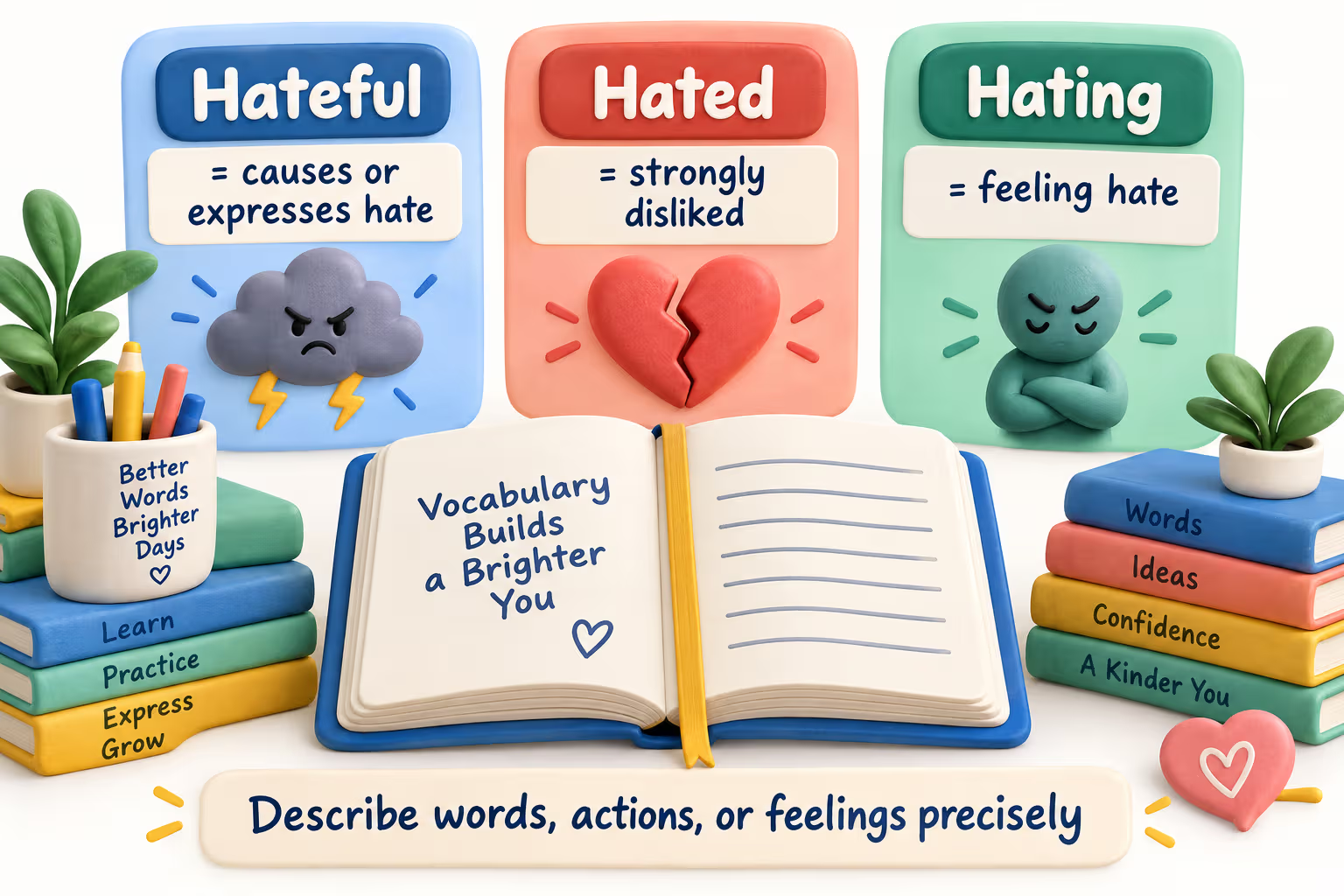
“Hate” can name a strong feeling, express a person’s attitude, or describe something that inspires intense dislike. The adjective you choose should show which meaning you intend. Hateful usually describes something that expresses or causes hate; hated describes a person or thing that is strongly disliked by someone; and hating points to the person feeling the emotion. These forms are related, but they do not mean the same thing.
Hateful, hated, and hating
- Hateful: expresses, encourages, or causes strong dislike or hostility. It commonly describes language, conduct, or an attitude: “The moderator removed a hateful comment.” It can also describe something the speaker finds extremely offensive: “She called the unfair rule hateful.”
- Hated: strongly disliked by a person or group. It describes the target of that reaction: “The unpopular policy was widely hated.” In another construction, hated can mean that someone experienced the emotion in the past, as in “He hated waiting.” Context shows which sense is intended.
- Hating: the present-participle form of the verb hate, as in “They are hating the new schedule.” It may modify a noun in some phrases, but it is usually clearest to name who feels the emotion and what the target is.
- Hate-filled: filled with or strongly marked by hate, often used for a message, exchange, or atmosphere: “The discussion became hate-filled after the insults began.”
A quick grammar check helps: if you mean “causes or expresses hate,” try hateful; if you mean “is disliked,” try hated; if you mean “feels hate,” name the person or subject doing the hating.
Words for different kinds of strong dislike
Not every adjective connected with hate points to the same feeling. Choose a word that matches the evidence and degree of intensity instead of treating all the words as interchangeable.
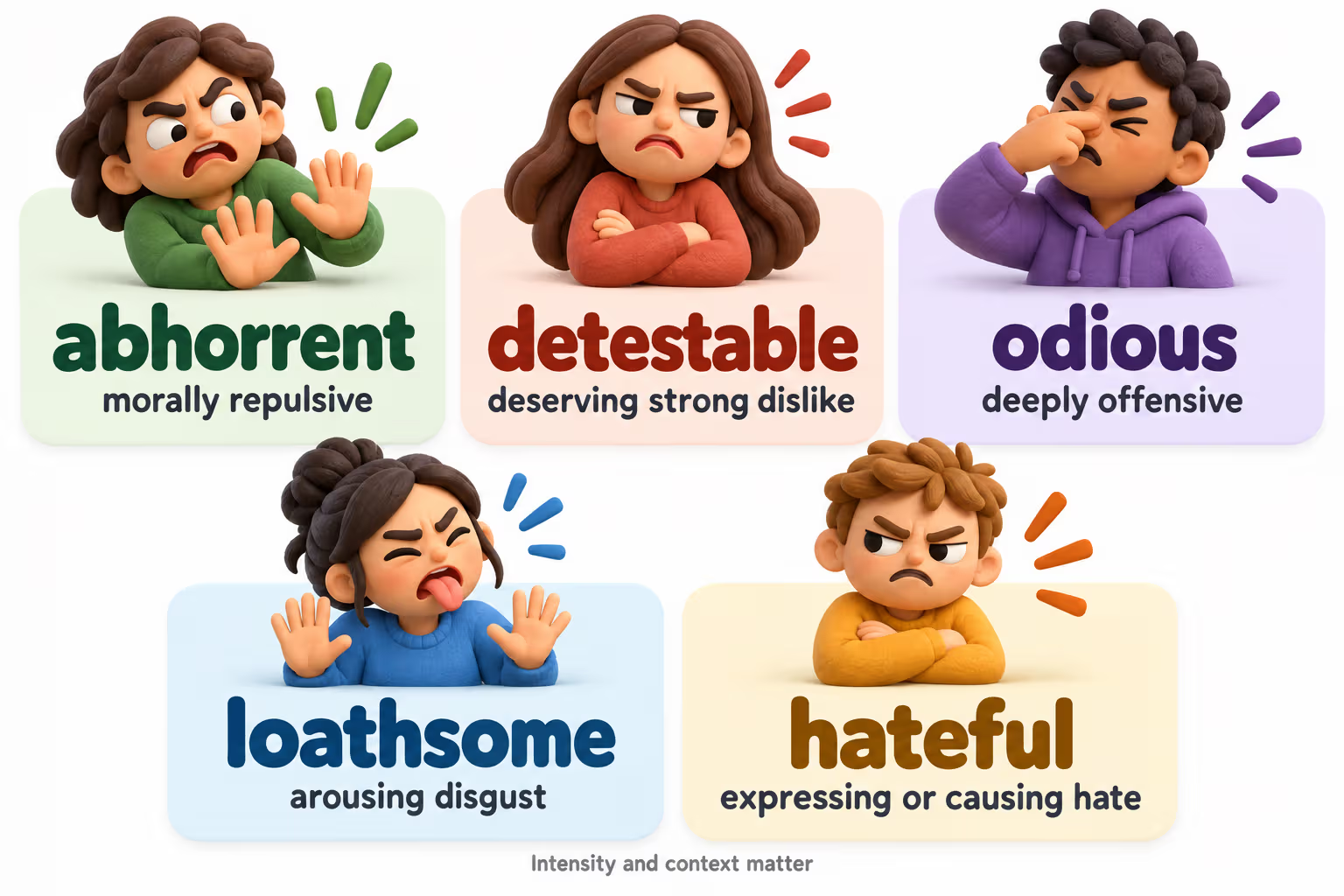
- Abhorrent: intensely repugnant, often because something conflicts with a person’s moral standards. “The committee described the deliberate cruelty as abhorrent.” The word makes a strong judgment, so it suits serious conduct better than a minor annoyance.
- Detestable: deserving or inspiring very strong dislike. “The character’s betrayal was detestable to the other players.” This is emphatic and can sound formal.
- Odious: extremely unpleasant, offensive, or hateful. “The article condemned the odious practice.” It is a forceful, somewhat formal choice.
- Loathsome: arousing intense disgust or revulsion. “The novel portrays the villain’s loathsome cruelty.” It often emphasizes a feeling of revulsion as well as dislike.
- Repugnant: sharply offensive or disgusting to someone. “The proposal seemed repugnant to residents who feared its effects.” Naming whose judgment it is can make the sentence more accurate.
These descriptions are not objective measurements. When the judgment belongs to a speaker or community, phrases such as “many readers found it offensive” or “the reviewer called it abhorrent” make the viewpoint clear. Merriam-Webster’s thesaurus entry for hate groups abhor, abominate, detest, and loathe among its close verb synonyms, while noting differences in their connotations. That entry is about the verb; the adjectives above describe related reactions or qualities.
Describe behavior, tone, and feeling separately
Some useful words describe what a person says or does; others describe an emotion that may be private or long-lasting. Keeping those categories separate makes feedback clearer and avoids turning one action into a sweeping claim about someone’s character.
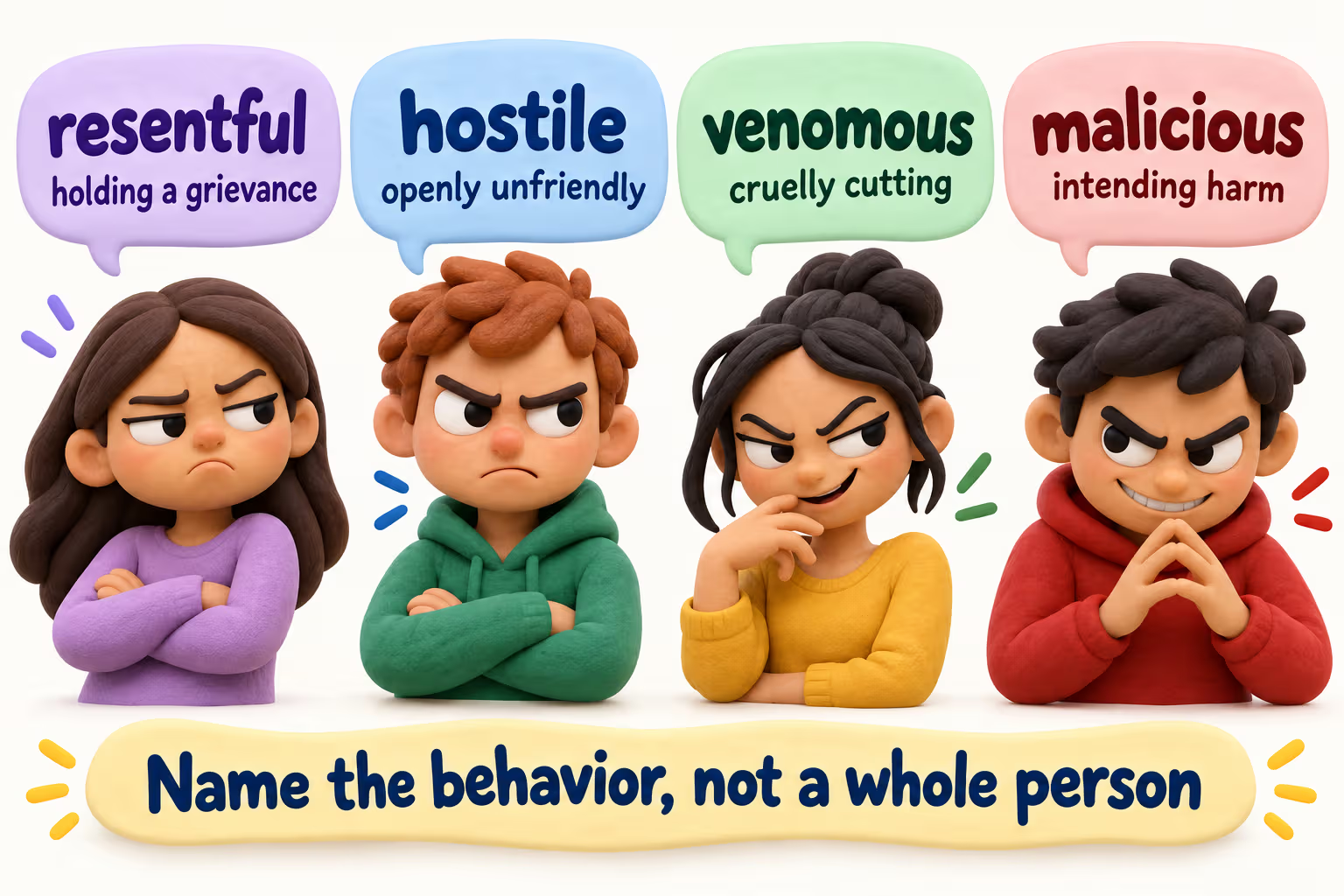
- Hostile: openly unfriendly, antagonistic, or opposed. “The reply was hostile: it rejected the idea and included personal insults.” It can describe a tone or action without claiming to know the writer’s inner motive.
- Resentful: feeling bitterness about a perceived wrong or unfair treatment. “She felt resentful after her contribution went unacknowledged.” Resentment may be intense, but it is not automatically the same as hatred.
- Venomous: bitterly malicious or cutting in speech or writing. “The debate shifted when one speaker made a venomous personal remark.” This figurative use is vivid and strongly negative.
- Malicious: showing a desire to cause harm or trouble. “The malicious message threatened to damage his work.” Because this word makes a claim about intent, use it when the context supports that claim.
- Bitter: marked by hurt, anger, or resentment, often after disappointment or conflict. “Their conversation ended with a bitter exchange.” It can describe a mood, dispute, or remark.
For a sentence about conduct, identify the words, actions, or effect you observed: “The post used slurs and called for excluding a group” is more specific than “The writer is hateful.” A behavior-focused description is easier to support and leaves room for context, correction, or change.
Build a clear sentence
Use this three-step pattern: identify the target, choose the adjective that fits, and give a concrete detail that shows why. The sample below calls a reply hostile because of its observable tone and content; it does not assume the writer’s private motive.
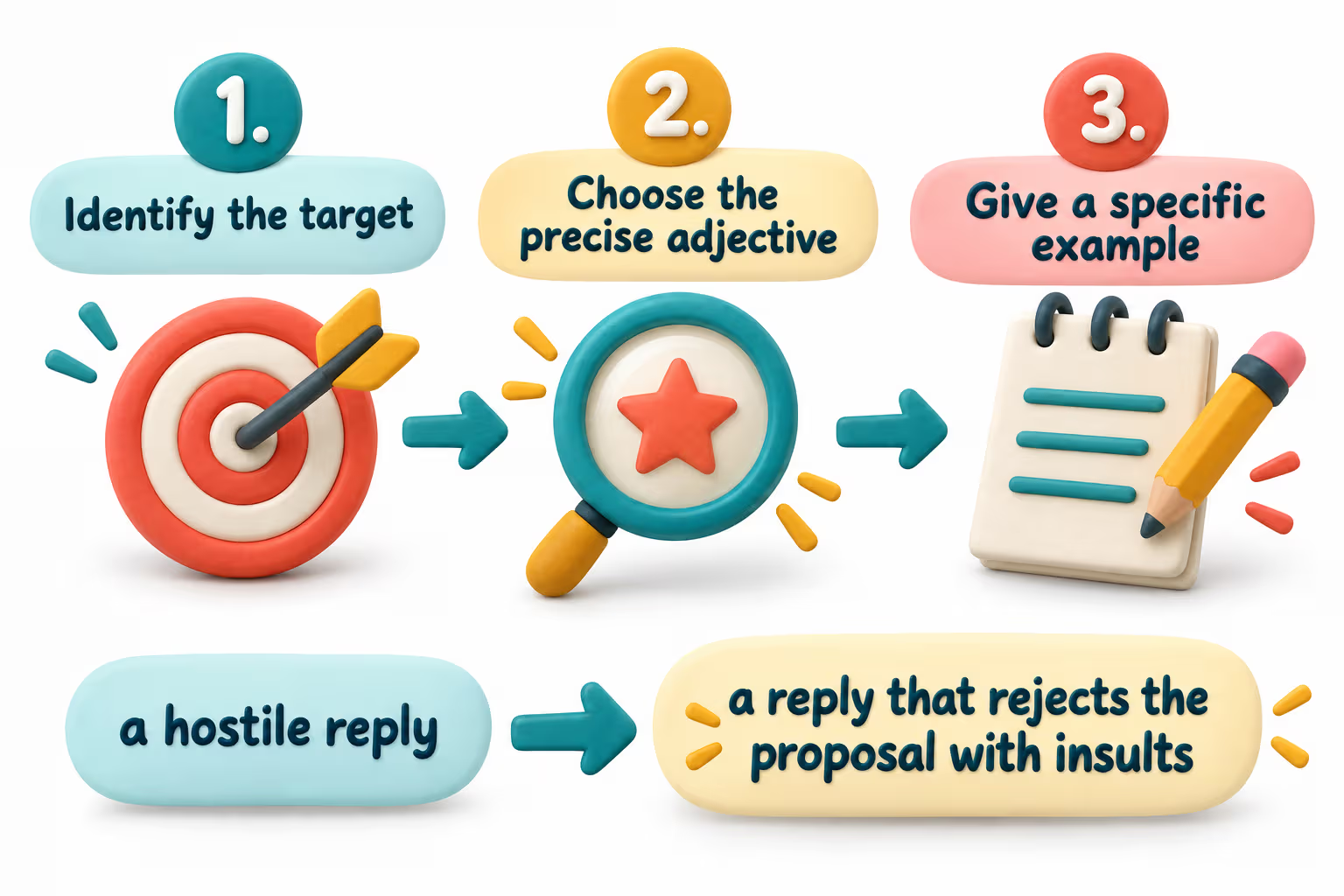
- Identify the target: Is the adjective describing a remark, policy, character, feeling, or person?
- Choose the precise adjective: Is the key quality moral repugnance, offense, hostility, resentment, or harmful intent?
- Give a specific example: Add the action or language that supports the description, and attribute a subjective judgment to the person or group who holds it.
For example: “The character’s detestable decision left the team without food” identifies a fictional act and its consequence. “Several readers found the scene abhorrent because it celebrated cruelty” shows whose judgment is being reported and why. “The reply was hostile: it dismissed the suggestion with insults” points to visible evidence. These patterns help writers convey intensity without relying on a vague string of near-synonyms.
When the subject is a real person or group, describe a particular statement or action rather than assigning a permanent label. Adjectives can communicate strong criticism, but precise examples make that criticism more useful and fair.
How to Describe hate? – Different Scenarios
When it comes to describing hate, finding the right words can accurately convey its intensity and depth. Let’s explore various scenarios where hate can manifest and the adjectives that best capture its essence.
- Personal Hate
- Social Hate
- Political Hate
- Online Hate
- Historical Hate
By using these descriptive adjectives, you can effectively convey the intensity and complexity of hate in different contexts. Remember, words have power, and choosing the right ones can help create a more nuanced understanding of this powerful emotion.
Now that we have explored the various scenarios where hate can be described, let’s delve into some practical examples that illustrate how these adjectives can be used in sentences.
Describing Words for hate in English
Hate is a powerful emotion that can be difficult to express in words. However, finding the right adjectives can help us articulate and understand this intense feeling more effectively. In this section, I’ll share some descriptive words that can help convey the intensity and depth of hate in English.
1. Intense Hate:
- Vicious: Brutally cruel, savage, merciless.
- Vitriolic: Filled with bitter hatred, venomous.
- Searing: Burning with intense dislike, scorching.
- Unrelenting: Merciless, never-ending, obsessive.
- Consuming: All-encompassing, devouring, destructive.
2. Personal Hate:
- Scornful: Disdainful, mocking, contemptuous.
- Loathing: Intense disgust and dislike, abhorrence.
- Bitter: Filled with resentment and anger, unforgiving.
- Vindictive: Seeking revenge, wanting to inflict harm.
- Envious: Jealous and resentful of another’s success or happiness.
3. Social Hate:
- Prejudicial: Based on preconceived opinions and biases, discriminatory.
- Bigoted: Intolerant of others’ beliefs or practices, narrow-minded.
- Xenophobic: Fearful and hateful of foreigners or strangers.
- Chauvinistic: Patriotically prejudiced against outsiders, arrogant.
- Misogynistic: Hatred or prejudice against women.
4. Political Hate:
- Ideological: Driven by strong political beliefs, often extreme.
- Dogmatic: Inflexible and intolerant of opposing views.
- Demagogic: Appealing to emotions and prejudices, manipulative.
- Totalitarian: Seeking complete control and suppressing dissent.
- Divisive: Creating hostility and conflict between groups.
5. Online Hate:
- Anonymous: Hiding behind anonymity to express hateful views.
- Abusive: Using insulting and harmful language.
- Trolling: Intentionally provoking others with inflammatory comments.
- Cyberbullying: Using electronic communication to harass and intimidate others.
- Doxing: Sharing someone’s private information online to harm them.
6. Historical Hate:
- Genocidal: Intent on destroying an entire group of people.
- Oppressive: Systematically suppressing and exploiting a group.
- Racist: Hatred or prejudice based on race or ethnicity.
- Classist: Hatred or prejudice based on social class.
- Sexist: Discrimination or prejudice based on sex or gender.
By using these adjectives, we can paint a more vivid picture of the different contexts in which hate can arise. It is important to note that hate is a strong and negative emotion, and using these words can help us better understand its impact on individuals, societies, and historical events. Teaching children about these words in an age-appropriate manner can promote empathy, tolerance, and understanding.
Remember, words have power, and choosing the right ones can make a difference in how we communicate and comprehend complex emotions like hate. By expanding our vocabulary and using descriptive adjectives, we can foster a more nuanced understanding of the intensity and impact of hate.
Examples of Descriptive Words for Hate in English
| Context | Adjectives |
|---|---|
| Intense Hate | Raging, Fierce, Burning, Consuming |
| Personal Hate | Vengeful, Bitter, Resentful, Malicious |
| Social Hate | Prejudiced, Bigoted, Discriminatory, Hostile |
| Political Hate | Divisive, Partisan, Radical, Revolting |
| Online Hate | Cyberbullying, Trolling, Toxic, Malevolent |
| Historical Hate | Genocidal, Oppressive, Atrocious, Brutal |
Adjectives for hate
Hate is a strong and powerful emotion that can manifest in various contexts. It’s important to have the right words to accurately describe the intensity of hate. In this section, I’ll provide a list of adjectives for hate categorized into positive and negative descriptions. Let’s explore them further:
Positive Adjectives for Hate with 12 Example Sentences
When describing hate in a positive light, we mean to express intense dislike or aversion towards something or someone. Here are some examples of positive adjectives that can be used to describe hate:
| Adjective | Definition | Example Sentence |
|---|---|---|
| Fierce | Showing a powerful and aggressive intensity of hate | I felt a fierce hate burning within me. |
| Passionate | Expressing hate with strong emotions or beliefs | She had a passionate hate for injustice. |
| Fiery | Displaying a burning and intense hatred | His fiery hate fueled his actions. |
| Blazing | Emitting strong and overwhelming hate | The room was filled with his blazing hate. |
| Seething | Feeling or expressing hate with suppressed anger | I could see the seething hate in his eyes. |
| Consuming | Completely occupying the mind or emotions with hate | The anger inside of me was consuming hate. |
| Relentless | Not giving up or becoming less intense in hate | Her relentless hate fueled her determination. |
| Vehement | Showing strong, intense, and passionate dislike | His vehement hate was evident in his words. |
| Unyielding | Not yielding or compromising in feelings of hate | He had an unyielding hate for his rival. |
| Intense | Exhibiting a high level of hate with strong emotions | The hatred between them was intense and palpable. |
| Raging | Characterized by intense, uncontrollable hatred | Her raging hate consumed her thoughts. |
| Overwhelming | Extremely intense, overpowering hate | The overwhelming hate made it hard to breathe. |
Negative Adjectives for Hate with 5 Example Sentences
On the other hand, negative adjectives for hate describe the destructive and harmful aspects of this powerful emotion. Here are some examples:
| Adjective | Definition | Example Sentence |
|---|---|---|
| Toxic | Exhibiting harmful and poisonous hate | The toxic hate in the air was palpable. |
| Destructive | Causing great harm or damage due to hate | Their destructive hate led to irreversible consequences. |
| Bitter | Characterized by intense and long-lasting resentment | Their bitter hate towards each other was well-known. |
| Unhealthy | Indicating a detrimental and negative impact from hate | The unhealthy hate between them affected their mental health. |
| Malicious | Motivated by a desire to harm or cause suffering through hate | They spread malicious hate through their actions. |
Words have the power to convey the depth and intensity of emotions like hate. By using these adjectives, we can better understand and describe the impact of hate in various situations. It’s important to promote empathy, tolerance, and understanding in order to overcome hate and create a more harmonious society.
Synonyms and Antonyms with Example Sentences
Synonyms for hate
When it comes to describing intense negative emotions like hate, it’s important to have a wide range of vocabulary at our disposal. Here are some synonyms for hate that can help to paint a more accurate picture of the intensity and depth of this emotion:
- Loathe – I loathe the taste of brussels sprouts.
- Despise – I despise people who are dishonest.
- Detest – I detest having to wake up early in the morning.
- Abhor – I abhor cruelty towards animals.
- Dislike intensely – I dislike intensely the sound of nails on a chalkboard.
Antonyms for hate
While hate is a powerful and negative emotion, it’s also important to consider its opposite. Here are some antonyms for hate that can provide a contrasting perspective:
- Love – I love spending time with my family.
- Adore – I adore cuddling with my pet.
- Like – I like the taste of chocolate.
- Appreciate – I appreciate all the support I’ve received.
- Enjoy – I enjoy listening to music.
Choosing the right words to describe our emotions is crucial in promoting empathy, understanding, and communication. Whether it’s using synonyms to capture the intensity of hate or exploring the antonyms to highlight the opposite emotions, having a diverse vocabulary helps us convey our feelings accurately.
When teaching children about emotions, it is important to introduce them to a variety of words to express their feelings. This not only expands their vocabulary, but it also helps them develop self-awareness and empathy for others.
In the next section, we’ll delve into some examples of how these adjectives can be used in sentences to provide context and further understanding.
Table: Synonyms for hate
| Synonym | Example Sentence |
|---|---|
| Loathe | I loathe the taste of brussels sprouts. |
| Despise | I despise people who are dishonest. |
| Detest | I detest having to wake up early in the morning. |
| Abhor | I abhor cruelty towards animals. |
| Dislike intensely | I dislike intensely the sound of nails on a chalkboard. |
Table: Antonyms for hate
| Antonym | Example Sentence |
|---|---|
| Love | I love spending time with my family. |
| Adore | I adore cuddling with my pet. |
| Like | I like the taste of chocolate. |
| Appreciate | I appreciate all the support I’ve received. |
| Enjoy | I enjoy listening to music. |
By teaching children a wide range of emotions, including both positive and negative ones, we equip them with the necessary language skills to express themselves and understand others. This fosters a sense of empathy and emotional intelligence, essential qualities for healthy relationships and effective communication.
Conclusion
Understanding the power of hate and the impact it can have on individuals and society is crucial. Throughout this article, we have explored the different contexts in which hate can arise, including personal, social, political, online, and historical situations. By using descriptive adjectives, we have been able to capture the intensity and depth of this emotion.
By providing a list of synonyms and antonyms for hate, along with example sentences, we have given readers a more nuanced understanding of how hate can be experienced and expressed. It is important to have a wide range of emotions, both positive and negative, to develop empathy and emotional intelligence.
In our quest to find the right words to accurately convey hate, we must also remember the importance of teaching children about emotions. By educating them about the full spectrum of emotions, we can help them navigate their own feelings and develop a greater understanding and empathy for others.
The words we choose to describe hate matter. They allow us to communicate our experiences and emotions more effectively, fostering deeper connections and understanding in our relationships and communities.


