
Quick answer: Adjectives for health help you describe how you feel, what a symptom feels like, or how it affects daily activities. Words such as rested, sore, sharp, calm, or overwhelmed describe different experiences; add where it occurs and what changes it so a clinician can understand you without treating an adjective as a diagnosis.
Health Adjectives at a Glance
- Choose a word that matches your own experience; people can use different words for similar sensations.
- Separate what you feel from what you think caused it.
- For a symptom, add where it occurs, when it began, its pattern, what changes it, and how it affects your usual activities.
- Words about mood or mental well-being describe experiences; they do not establish a mental-health diagnosis.
- Positive words such as strong, robust, and resilient can express a personal impression, but they do not measure immune function or prove that a person is healthy.
- A healthcare professional interprets your description together with the rest of your history and any relevant evaluation.

What Do Health Adjectives Describe?
Health adjectives can describe a sensation, energy level, mood, physical function, or the pattern of an experience. They are useful for everyday communication because they let a person explain what they notice in their own words, but no single adjective identifies a cause or condition.
For example, tired says how someone feels; it does not explain why. Sharp describes a kind of pain, while intermittent describes a pattern. Adding those details is more informative than substituting a medical label that has not been given by a clinician.
How Can You Describe a Health Experience Clearly?
A clear description pairs a familiar adjective with the details around it. The U.S. National Institute on Aging suggests noting when symptoms started, when they occur, how long they last, how often they happen, what makes them better or worse, and whether they affect usual activities.
| What you are describing | Useful words | Detail to add |
|---|---|---|
| Sensation | aching, sore, sharp, dull, throbbing, tender | Where it is, when you notice it, and whether it stays in one place or moves. |
| Pattern | constant, intermittent, occasional, recurring, improving, worsening | When it began, how often it occurs, and how long each episode lasts. |
| Energy or rest | rested, tired, fatigued, energetic, groggy | Time of day, recent change from your usual pattern, and effect on activities. |
| Movement or function | stiff, steady, unsteady, flexible, limited | Which movement or task feels different, and what you can or cannot do comfortably. |
| Mood or emotional experience | calm, content, worried, stressed, overwhelmed, low | How long the feeling has lasted, what was happening, and whether it affects daily life. |
| General well-being | comfortable, refreshed, run-down, balanced, resilient | What “better” or “worse” means to you rather than assuming the word has one fixed meaning. |
The National Institute of Child Health and Human Development notes that a pain description can include its location, quality, severity, timing, triggers, and effect on activities. Words such as sharp, dull, burning, or throbbing describe how pain feels; the words alone do not identify its cause. For more examples, see our guides to adjectives for pain and words for describing illness.
Which Adjectives Fit Common Health Experiences?
Choose an adjective by the kind of experience you want to express. The same person may feel energetic at one time and fatigued at another, so a time-specific sentence is more accurate than a permanent label.
| Category | Adjectives | Example sentence |
|---|---|---|
| Positive physical sensations | strong, fit, energetic, agile, vibrant | “Today I feel energetic after my usual morning walk.” |
| Physical discomfort | achy, sore, tender, stiff, weak | “My shoulders feel stiff after sitting at my desk.” |
| Pain quality | sharp, dull, burning, throbbing, cramping | “The sensation is dull and comes and goes near my left knee.” |
| Rest and energy | rested, restful, tired, fatigued, refreshed | “I felt tired this afternoon, unlike my usual routine.” |
| Mental or emotional state | calm, content, optimistic, worried, stressed, overwhelmed | “I have felt overwhelmed at work for most of this week.” |
| Everyday well-being | balanced, comfortable, resilient, serene, nourishing | “I feel more settled today, though my sleep is still uneven.” |
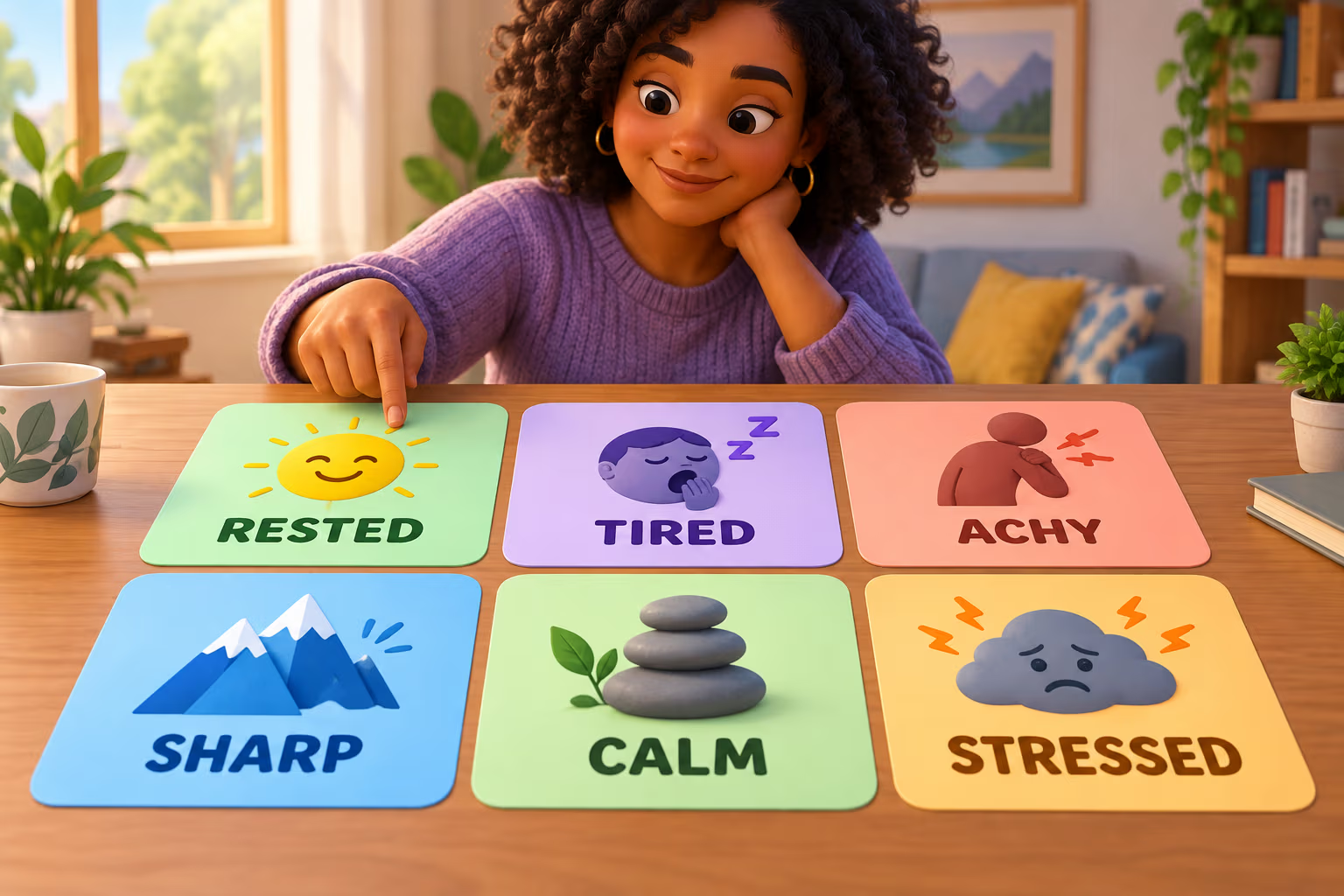
Use “healthy” carefully: It is a broad everyday description, not a measurement of every aspect of a person’s health. Words such as robust or resilient can describe how someone feels or functions in a particular context, but they do not prove immune strength, rule out illness, or replace clinical assessment. Keep the word tied to the experience or evidence you actually mean.
Are Health Adjectives the Same as Medical Diagnoses?
No. An adjective is a description, while a diagnosis is a clinical conclusion made using appropriate information and evaluation. Saying “I feel weak,” “I feel anxious,” or “I am fatigued” reports an experience; it does not establish the cause or confirm a disorder.
| Everyday word | What it communicates | What it does not establish by itself |
|---|---|---|
| Fatigued | A person feels unusually tired or low in energy. | The reason for the feeling or a specific medical condition. |
| Anxious or stressed | A person is describing a feeling or response in context. | A mental-health diagnosis or the cause of that experience. |
| Weak | A person reports reduced strength or a sense of weakness. | Which body system is involved or why strength feels different. |
| Healthy or robust | A broad impression of well-being, depending on the speaker. | A test result, a complete assessment, or certainty that no condition is present. |
When speaking about someone else, avoid turning a temporary experience into a judgment about character. Describe what the person says or what you directly observe, and leave the explanation of cause to an appropriate healthcare professional.
How Can You Prepare Notes for a Healthcare Visit?
A brief symptom note can help you remember details during an appointment. The National Institute on Aging recommends recording timing, frequency, duration, changes, and effects on usual activities; for pain, NICHD also suggests noting location, quality, and what makes it better or worse.
- Use your own words: Write the adjective that best fits, such as aching, sharp, restless, or tired.
- Add time and place: Note when it started, where you feel it, and whether it is constant or comes and goes.
- Describe changes: Record what seems to make it better or worse, without assuming that a change proves a cause.
- Include daily impact: Name a task, activity, or routine that has changed for you.
- Ask when a term is unclear: The Agency for Healthcare Research and Quality recommends simplifying information and confirming understanding with everyone. You can ask a clinician to explain an unfamiliar word in everyday language.
Example note: “For three days I have had a dull ache in my right shoulder. It comes and goes, feels stronger when I reach overhead, and makes it harder to put a box on a high shelf.” This describes a personal experience and a functional change; it does not try to name a cause.
The CDC Clear Communication Index advises putting the main message first, using familiar words, organizing information into short sections, and making visuals clear and relevant. Those principles also help when you prepare your own notes: state the main concern first, then add details in a simple order. The CDC tool is designed to assess communication materials, not to diagnose a health problem.
For more specific word banks, explore our guides to adjectives for mental health and adjectives for feelings.
When it comes to describing our health, finding the right words can be a challenge. We often struggle to accurately convey how we feel or explain our symptoms to healthcare professionals. That’s where adjectives for health come in. These descriptive words can help us articulate our physical and mental well-being, enabling us to communicate more effectively and seek the appropriate care.
In this article, I’ll explore a range of adjectives that can be used to describe health, along with examples to illustrate their usage. Whether you’re looking to express vitality, pain, or overall wellness, this comprehensive list of adjectives will empower you to better articulate your health experiences. So, let’s dive in and discover the power of words in describing our well-being.
How to Describe health? – Different Scenarios
When it comes to describing health, finding the right words is essential. Whether you’re talking to a healthcare professional, filling out a medical form, or simply trying to communicate how you’re feeling, using descriptive adjectives can be incredibly helpful. Let’s explore different scenarios where you might need to describe your health and the adjectives that can accurately convey your physical and mental well-being.
- Doctor’s Appointment
- Mental Health
- Daily Health Journal
Describing Words for health in English
When it comes to describing our health, finding the right words is crucial. The words we choose can effectively communicate our physical and mental well-being to healthcare professionals. Whether you’re visiting the doctor’s office, discussing your mental health, or keeping a daily health journal, using descriptive adjectives can empower you to articulate your experiences more effectively.
Here are some examples of adjectives that you can use to describe health in different scenarios:
Adjectives for Physical Health
When describing your physical health, consider using adjectives that accurately convey your condition. Here are some examples:
| Adjective | Example Sentence |
|---|---|
| Strong | I feel strong and energized after my workout. |
| Fit | I am committed to staying fit and maintaining a healthy body. |
| Energetic | I have been feeling energetic and ready for the day. |
| Vibrant | Eating a balanced diet has made my skin look vibrant. |
| Resilient | My immune system is resilient and rarely gets sick. |
Adjectives for Mental Health
Describing your mental health can sometimes be challenging, but using the right adjectives can help you communicate your emotions and mental state effectively. Here are some examples:
| Adjective | Example Sentence |
|---|---|
| Calm | Meditation helps me stay calm and centered. |
| Content | I feel content and at peace with myself. |
| Focused | Engaging in activities I enjoy helps me stay focused and motivated. |
| Optimistic | I try to maintain an optimistic outlook on life. |
| Balanced | Striking a balance between work and personal life is important for my mental health. |
| Adjective | Example Sentence |
|---|---|
| Restful | I had a restful night’s sleep and woke up refreshed. |
| Nourishing | I enjoyed a nourishing salad for lunch. |
| Invigorating | A morning walk in nature was invigorating and uplifting. |
| Serene | Spending time in nature made me feel serene and peaceful. |
| Balanced |
Adjectives for health
As an expert blogger with years of experience in writing high-quality articles, I understand the importance of finding the right words to effectively describe our health. Adjectives play a crucial role in communicating our physical and mental well-being to healthcare professionals. In this section, I will provide a comprehensive list of adjectives that can be used to describe health in different scenarios, including doctor’s appointments, mental health, and daily health journaling. By understanding the power of words in expressing well-being, this list aims to empower readers to better articulate their health experiences.
Positive Adjectives for Health
When it comes to describing our health, using positive adjectives can help convey a sense of well-being and vitality. Here are some positive adjectives along with example sentences that can be used:
| Adjective | Example Sentence |
|---|---|
| Vital | I feel vital and full of energy today. |
| Robust | My immune system is robust, and I rarely get sick. |
| Vibrant | I strive to maintain a vibrant and healthy lifestyle. |
| Resilient | Despite facing challenges, I remain resilient and bounce back quickly. |
| Energetic | Regular exercise helps me stay energetic throughout the day. |
| Radiant | A balanced diet and good skincare routine keep my skin radiant. |
| Strong | I have a strong and healthy heart thanks to my active lifestyle. |
| Agile | Yoga and stretching exercises help me stay agile and flexible. |
| Fit | I am proud of my fit physique and the effort I put into staying active. |
| Optimistic | A positive mindset contributes to my overall health and well-being. |
| Balanced | Maintaining a balanced diet and lifestyle is key to my health. |
| Blissful | Engaging in activities that bring me joy and relaxation keeps me blissful. |
Negative Adjectives for Health
While promoting positivity is important, it’s also crucial to be able to express any health concerns or challenges we may face. Here are some negative adjectives along with example sentences that can be used:
| Adjective | Example Sentence |
|---|---|
| Exhausted | After a long day at work, I feel physically and mentally exhausted. |
| Achy | I’ve been experiencing an achy sensation in my back for the past few days. |
| Stressed | My demanding schedule has left me feeling stressed and overwhelmed. |
| Weak | I haven’t been taking care of myself, and as a result, I feel weak. |
| Fatigued | The lack of sleep has left me feeling fatigued and drained. |
By having a variety of adjectives at our disposal, we can accurately describe our health experiences and provide healthcare professionals with a clear understanding of our well-being. Remember, finding the right words to express our health can help us receive the necessary care and support we need.
Word-choice note: Wellness, fitness, vigor, and vitality are related ideas, but they are not exact substitutes for one another in every sentence. Illness and disease name conditions, while fatigue and weakness can describe experiences or symptoms. They may contrast with “health” in a particular context, but they are not all strict grammatical antonyms.
Synonyms and Antonyms with Example Sentences
Synonyms for Health
When it comes to describing health, having a wide range of synonyms can help to paint a more accurate picture of our well-being. Here are some synonyms for health that can be used in various scenarios:
- Wellness: I’ll make sure to prioritize my wellness by sticking to a balanced diet and staying active.
- Fitness: Regular exercise has helped me improve my fitness levels and overall health.
- Vigor: I woke up feeling full of vigor and ready to take on the day.
- Vitality: Yoga gives me a sense of vitality and helps me feel refreshed.
- Robustness: His robustness is evident as he effortlessly completes physical tasks.
- Strength: Engaging in strength training has helped me build both physical and mental strength.
These are just a few examples of synonyms that can be used to describe health. It’s important to choose the word that best represents your own well-being.
Antonyms for Health
While synonyms can help us express positive aspects of our health, antonyms can do the opposite by highlighting the negative aspects. Here are some antonyms for health:
- Illness: She has been battling with an illness for the past week and is seeking medical attention.
- Weakness: My weakness and fatigue have been preventing me from achieving my daily tasks.
- Frailty: Age-related frailty has made it necessary for her to use a cane for support.
- Sickness: The relentless cough and fever indicate signs of sickness.
- Fatigue: The constant fatigue and lack of energy have affected my ability to concentrate.
- Disease: The diagnosis revealed that he is suffering from a chronic and life-altering disease.
By understanding the antonyms for health, we can better communicate our concerns to healthcare professionals and seek appropriate help.
Remember, finding the right words to describe our health is essential for effective communication. Whether it’s using synonyms to express vitality and well-being or antonyms to convey illness and weakness, having a varied vocabulary allows us to articulate our health experiences accurately.
Conclusion
Having a diverse vocabulary to accurately describe our health is essential. Throughout this article, I have emphasized the importance of finding the right words to communicate our well-being effectively. By utilizing synonyms, we can highlight the positive aspects of our health and convey our experiences in a more nuanced manner. Conversely, antonyms allow us to express any concerns or negative aspects of our well-being.
The comprehensive list of adjectives provided in this article serves as a valuable resource for expanding our health-related vocabulary. Whether we are discussing our physical, mental, or emotional well-being, these adjectives enable us to articulate our experiences with precision.
Understanding the power of words in describing health can greatly impact our communication with healthcare professionals. By using the appropriate adjectives, we can provide them with a clearer picture of our health, enabling them to provide more accurate diagnoses and treatments.
By incorporating these adjectives into our everyday conversations, we can effectively express our health experiences and concerns, leading to better overall communication and understanding.
Choosing Adjectives for Health Responsibly
Adjectives for health are most useful when they describe a person’s own experience in clear, everyday language. Add timing, location, pattern, and daily impact when those details matter; keep descriptions separate from guesses about causes or diagnoses, and let a qualified professional interpret health concerns in context.
Frequently Asked Questions About Adjectives for Health
What are good adjectives to describe health?
Useful words depend on the experience: rested, energetic, or refreshed may describe energy; sore, achy, sharp, or tender may describe a sensation; calm, worried, or overwhelmed may describe a feeling. Pair the adjective with context, because one word alone cannot explain a cause or represent a person’s entire health.
How can I describe symptoms to a doctor?
Use your own words and note when the symptom began, where it occurs, how it feels, how often it happens, what changes it, and whether it affects usual activities. If you are unsure about a detail, say so rather than guessing. This is a communication aid, not a way to diagnose yourself.
Does feeling fatigued mean I have a health condition?
No. Fatigued describes a person’s experience of feeling tired or low in energy; the word alone does not identify a cause or establish a condition. If you are discussing it with a clinician, add when it began, how it changes, and what activities it affects so they can consider it in context.
What adjectives can describe mental health?
Everyday words such as calm, hopeful, focused, worried, low, or overwhelmed can describe how someone feels at a particular time. They are not diagnoses. If you are talking with a professional, explain how long the feeling has lasted and how it affects daily life, using words that feel accurate to you.
Are wellness and health synonyms?
They are related, but they are not interchangeable in every context. “Health” can refer broadly to physical or mental condition, while “wellness” often describes a broader sense or practice of well-being. Choose the word that matches your meaning, and avoid using either as proof of a medical status.


