Adjectives for Information: A Practical Selection Guide
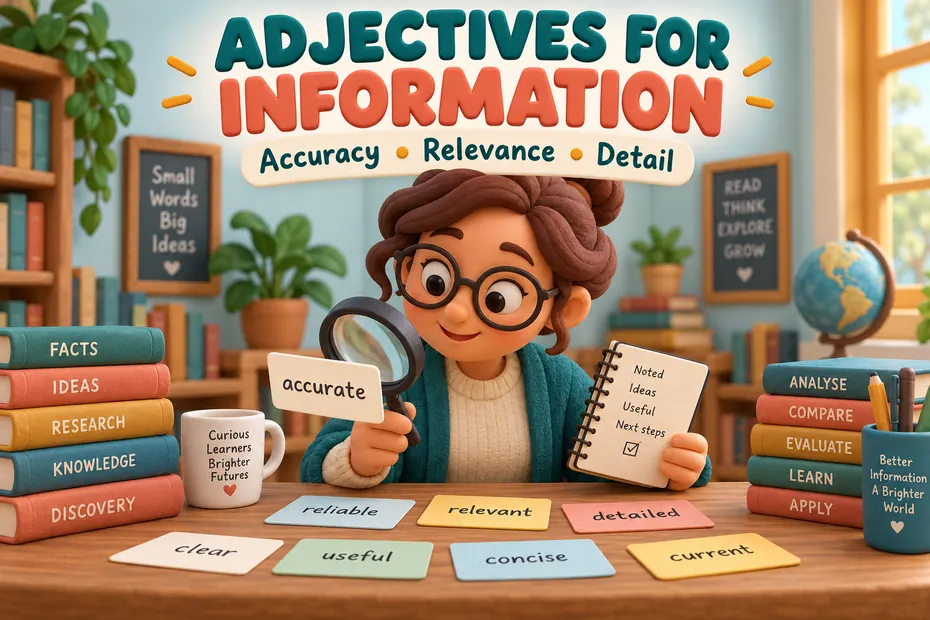
Useful adjectives for information include accurate, relevant, reliable, clear, concise, detailed, current, and incomplete. Each describes a different quality: correctness, usefulness, trustworthiness, presentation, length, specificity, timing, or coverage. For example, “The guide provides clear, relevant information.” Choose the adjective that identifies what the reader needs to know.
Choose Information Adjectives by Purpose
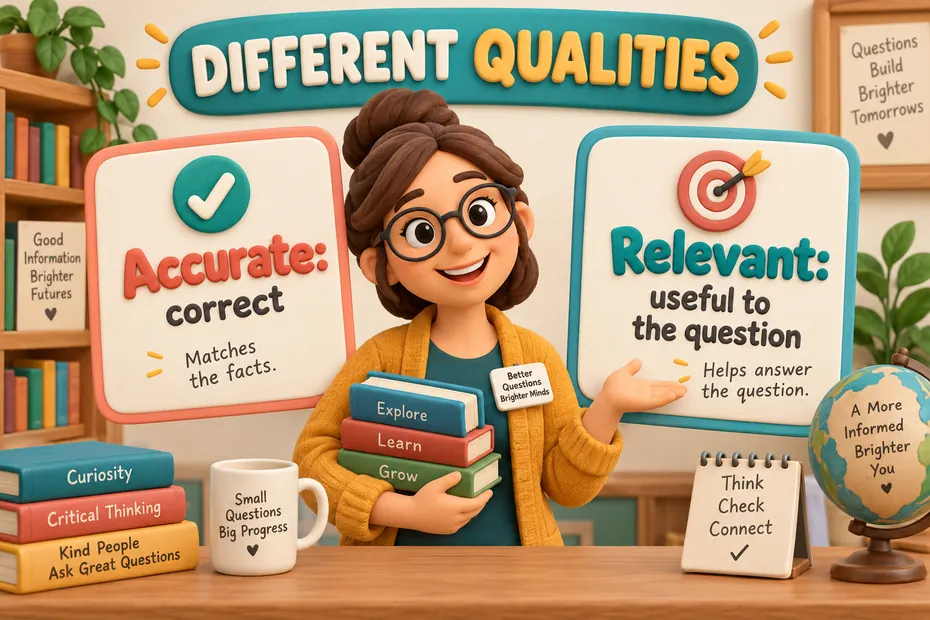
The best adjective depends on the question you are answering. If a reader needs correct figures, accurate fits. If the issue is whether a document answers the question, choose relevant. If someone cannot understand the wording, clear may be the useful target. A general compliment such as excellent does not identify the quality.
| Quality | Adjectives | Original example |
|---|---|---|
| Correctness | accurate, incorrect, misleading | The notice gives accurate information about the opening hours. |
| Connection to a question | relevant, pertinent, unrelated | Please send information relevant to the revised route. |
| Dependability | reliable, trustworthy, unverified | We checked the claim against reliable information. |
| Presentation | clear, concise, vague, confusing | The leaflet offers clear information about registration. |
| Coverage | detailed, comprehensive, partial, incomplete | The report contains incomplete information about attendance. |
| Timing | current, recent, outdated, historical | The website still displays outdated information. |
Accurate, Relevant, and Reliable Are Different
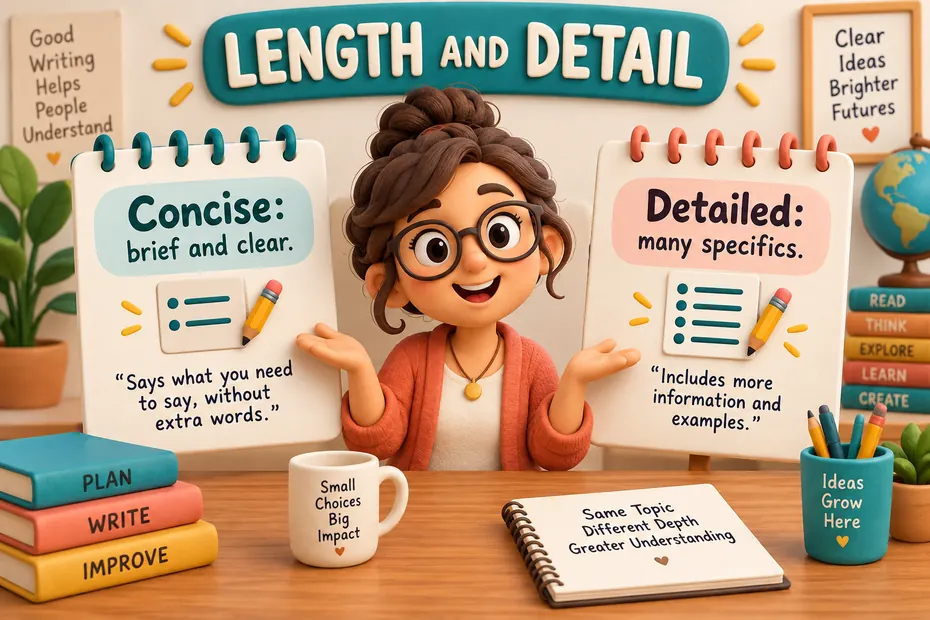
Accurate information is correct or conforms to the facts or an appropriate standard. Relevant information relates to the matter being considered. A correct fact about a different topic may be accurate but irrelevant. For example, a museum’s founding date does not answer a visitor’s question about today’s opening hours.
Reliable emphasizes dependability. Do not use it as an automatic label for information merely because the presentation looks polished. In a real report, explain how the material was checked when that matters. “The timetable information was checked against the operator’s current notice” is stronger than simply calling it reliable without support.
A single piece of information can have mixed qualities. A clear statement may be wrong, while an accurate explanation may be difficult to understand. Choose separate adjectives when you are evaluating separate dimensions: “The information is accurate but poorly organized.” This is more precise than calling the whole document good or bad.
Concise, Detailed, and Comprehensive
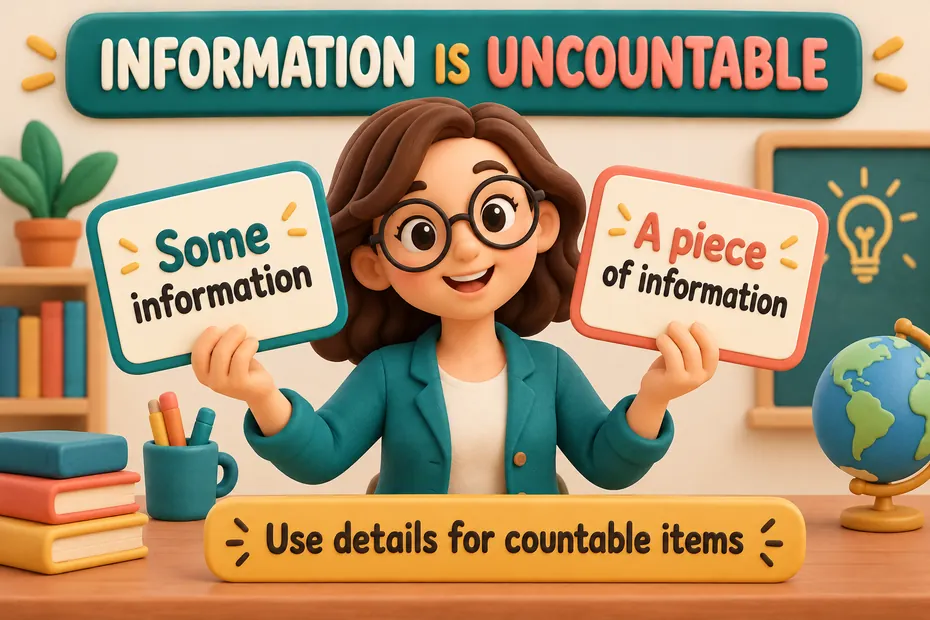
Concise means brief without unnecessary wording. Detailed means containing many particulars. Comprehensive suggests broad or thorough coverage of the relevant subject. These are not interchangeable. A short answer can be concise and still contain the exact detail a reader needs.
Compare “The card gives concise information about collection times” with “The report gives detailed information about every collection route.” The first emphasizes efficient presentation; the second emphasizes specificity. Neither sentence establishes that every possible question is answered. Reserve comprehensive for material whose coverage actually warrants that description.
Current, Recent, and Outdated
Current information applies to the present situation. Recent information was produced or received not long ago. Something can be recent yet already superseded. If the distinction matters, name the relevant date or version rather than letting a relative adjective carry the entire claim.
Outdated suggests that information no longer reflects the situation or has been superseded. Historical describes information about the past and is not automatically a criticism. An old map may be useful historical information while being unsuitable for planning a present-day route. Match the adjective to the intended use.
Information Is Usually Uncountable
In ordinary English, write some information, more information, or a piece of information. Do not write “an accurate information” or “three useful informations” for everyday facts and details. Use “three useful pieces of information,” “three useful details,” or simply “useful information.”
The adjective does not change that grammar. “Detailed information is available” uses singular agreement. “Detailed facts are available” uses plural agreement because facts is countable. If you change information to details or facts, check the verb too. Merriam-Webster records specialized meanings, but the everyday descriptive uses here concern knowledge, facts, and data.
Rewrite Vague Descriptions
- Vague: “The information is good.” Specific: “The information answers the registration question clearly.”
- Unsupported: “This is completely reliable information.” Specific: “The dates match the organizer’s published notice.”
- Unclear: “The information is old.” Specific: “The timetable information refers to last year’s service.”
- Grammatically incorrect: “We need an accurate information.” Correct: “We need accurate information.”
When reviewing a document, connect an adjective to evidence or an example. If information is incomplete, identify what is missing. If it is confusing, identify the wording or structure that causes confusion. This turns a general judgment into a useful description the writer can act on.
Frequently Asked Questions
What are positive adjectives for information?
Accurate, relevant, reliable, clear, concise, useful, detailed, and current are common positive choices. Each highlights a different quality. Use accurate for correctness, relevant for connection to the question, and clear for understandable presentation. Choose the word supported by the actual material instead of attaching every positive adjective to one sentence.
What are negative adjectives for information?
Incorrect, misleading, vague, confusing, incomplete, outdated, and irrelevant are useful choices. Name the specific problem when possible: “The information is incomplete because the deadline is missing.” An adjective helps identify the issue, while the following explanation tells the reader what needs correction or further checking.
Is accurate information always relevant?
No. Information can be correct while having little connection to the question being asked. A correct historical date does not necessarily help someone find the current entrance. Relevant concerns the information’s relationship to the task, while accurate concerns correctness. Both qualities may be important, but they answer different questions.
Can I say an information?
Not for the ordinary meaning of facts or knowledge in these examples. Use “some information” or “a piece of information.” To count items, use “pieces of information,” “details,” or “facts.” Check agreement too: information is followed by a singular verb, while plural details takes a plural verb.
Dictionary Sources
- Merriam-Webster: information.
- Merriam-Webster: accurate.
- Merriam-Webster: relevant.
- Merriam-Webster: reliable.
Are you tired of using the same old adjectives to describe information? Well, look no further! In this article, I’ll be sharing with you a comprehensive list of adjectives specifically tailored to describe information. Whether you’re a student, a professional, or just someone who loves words, this list will surely help you add depth and precision to your descriptions.
From “accurate” to “vague,” “concise” to “elaborate,” we’ll explore a wide range of adjectives that will enable you to paint a vivid picture of any type of information. I’ll also provide examples for each adjective, so you can see how they can be used in different contexts. By the end of this article, you’ll have a new arsenal of descriptive words at your disposal, allowing you to communicate your ideas more effectively and captivate your audience.
How to Describe information? – Different Scenarios
When it comes to describing information, there are various scenarios that require different approaches. In this section, I will explore some common situations and provide you with helpful adjectives to effectively describe information in each scenario.
- Scientific Data: When presenting scientific data, it’s important to use precise and accurate adjectives to convey the specific details. For example:
- Business Reports: In the world of business, it’s crucial to use adjectives that highlight the key points and convey the necessary information concisely. Consider using the following adjectives:
- News Articles: When writing news articles, it’s important to capture the attention of readers and provide them with accurate and engaging information. Here are some adjectives to consider:
- Academic Papers: Academic writing requires a more formal and scholarly tone. Consider using these adjectives when describing information in academic papers:
Remember, the adjectives you choose will depend on the context and purpose of your writing. Consider the specific needs of your audience and use descriptive words that effectively communicate the information. By carefully selecting the right adjectives, you can bring your descriptions to life and captivate your audience.
Now that we’ve explored how to describe information in different scenarios, let’s move on to the next section and delve into more adjectives for describing information in various contexts.
Describing Words for information in English
As a seasoned writer, I understand the importance of choosing the right adjectives to describe information accurately and effectively. In this section, I will provide you with a list of descriptive words specifically tailored to describe information in English. These adjectives will help you convey information clearly, whether you’re writing scientific data, business reports, news articles, or academic papers. Let’s dive in!
Scientific Data
When describing scientific data, it’s crucial to use adjectives that highlight its precision and objectivity. Here are a few examples:
| Adjective | Example Sentence |
|---|---|
| Accurate | The measurements were accurate. |
| Reliable | The data from this source is reliable. |
| Objective | The analysis was conducted in an objective manner. |
| Consistent | The findings were consistent with previous research. |
| Valid | The experiment produced valid results. |
Business Reports
When writing business reports, it’s important to use adjectives that convey professionalism and impact. Here are a few examples:
| Adjective | Example Sentence |
|---|---|
| Strategic | The company implemented a strategic marketing campaign. |
| Innovative | The new product design is innovative and unique. |
| Profitable | The company experienced a profitable quarter. |
| Efficient | The team’s efficient processes led to cost savings. |
| Promising | The partnership shows promising potential for growth. |
News Articles
News articles require adjectives that create a sense of urgency and capture the reader’s attention. Here are a few examples:
| Adjective | Example Sentence |
|---|---|
| Breaking | Breaking news: the president will address the nation tonight. |
| Shocking | The scandalous revelation had a shocking impact. |
| Unprecedented | The event was an unprecedented occurrence. |
| Controversial | The new policy proposal sparked controversial debates. |
| Informative | The article provided informative insights into the topic. |
Academic Papers
In academic writing, it’s important to use adjectives that convey depth and expertise. Here are a few examples:
Adjectives for information
When it comes to describing information, using the right adjectives is key. Precise and accurate adjectives can help captivate your audience and effectively convey the intended message. In this section, I’ll provide a variety of positive and negative adjectives for describing different types of information.
Positive Adjectives for Information with 12 Example Sentences
Positive adjectives can help create a positive tone and highlight the strengths and advantages of the information being presented. Here are some examples:
| Adjective | Definition | Example Sentence |
|---|---|---|
| Accurate | Correct, precise, without errors | The data provided in the report is accurate and can be relied upon. |
| Clear | Easy to understand, transparent | The instructions given were clear and helped me complete the task. |
| Relevant | Closely connected, applicable | The article provided relevant information that was useful for my research. |
| Informative | Providing useful or interesting information | The presentation was informative and gave a comprehensive overview of the topic. |
| Reliable | Trustworthy, dependable | The source of information is reliable and can be cited in academic papers. |
| Comprehensive | Complete, including all the necessary details | The book provides a comprehensive guide to the subject matter. |
| Credible | Believable, reliable | The news article is from a credible source and can be considered trustworthy. |
| Valid | Legitimate, based on facts and evidence | The survey data collected is valid and can be used for analysis. |
| Well-researched | Thoroughly investigated and documented | The article is well-researched, providing insights backed by extensive studies. |
| Impartial | Neutral, unbiased | The report presents the findings in an impartial manner, without favoring any particular side. |
| Concise | Brief, to the point | The summary provided a concise overview of the main findings. |
| Engaging | Interesting, captivating | The presentation was engaging and held the audience’s attention throughout. |
Negative Adjectives for Information with 5 Example Sentences
On the other hand, negative adjectives can be used to express flaws or limitations in the information. Here are some examples:
| Adjective | Definition | Example Sentence |
|---|---|---|
| Inaccurate | Not correct, containing errors | The data presented in the report is inaccurate and cannot be relied upon. |
| Confusing | Hard to understand, unclear | The instructions provided were confusing, and I struggled to follow them. |
| Irrelevant | Not closely connected, not applicable | The article contained a lot of irrelevant information that didn’t contribute to the main topic. |
| Biased | Favoring one side, lacking objectivity | The news article had a biased perspective, only presenting one side of the story. |
| Outdated | No longer current, not up to date | The textbook used outdated information that was no longer relevant to the topic. |
Remember, choosing the right adjectives can greatly enhance the impact of your message. It’s important to use them thoughtfully and accurately to ensure effective communication.
Synonyms and Antonyms with Example Sentences
Synonyms for Information
When it comes to describing information, there are several synonyms that can be used to convey different aspects and characteristics. Here are some common synonyms that can help you enhance your communication:
- Knowledge: It’s important to have knowledge about a topic before presenting it to others.
- Facts: Facts provide concrete evidence and support for the information being shared.
- Data: Data refers to the numbers and statistics that support the information being presented.
- Details: Paying attention to the details can ensure that all relevant information is conveyed accurately.
- Insights: It’s important to provide valuable insights that can help others understand the information better.
- Intelligence: Intelligence can refer to the information gathered through research or analysis.
Example Sentences:
- I have extensive knowledge about various animals and their habitats.
- The report is filled with facts that support the argument.
- The data shows a significant increase in sales over the past year.
- Let’s go over the important details of the project before presenting it to the team.
- The book provides valuable insights into the history of the ancient civilization.
- I’ve gathered intelligence on the latest market trends to give us a competitive edge.
Antonyms for Information
On the other hand, there are also antonyms that can be used to express the absence or opposite of information. Here are some antonyms that can help you describe situations where there is no information or lack of knowledge:
- Ignorance: Ignorance refers to the lack of information or knowledge about a particular subject.
- Incomprehension: Incomprehension suggests a lack of understanding or inability to grasp the information.
- Confusion: Confusion arises when there is a lack of clarity or mixed messages.
- Obscurity: Obscurity implies that the information is unclear, vague, or hard to decipher.
- Misconception: A misconception occurs when incorrect information is perceived as true.
Example Sentences:
- Their ignorance about current events was evident from their lack of knowledge.
- The complex scientific concepts left the students in a state of incomprehension.
- The conflicting instructions led to confusion among the team members.
- The meaning of the poem was obscured by its cryptic language.
- Many people have misconceptions about sharks, often viewing them as dangerous predators.
Remember, choosing the right synonyms and antonyms can greatly enhance the impact and effectiveness of your communication. Be mindful of the context and the message you want to convey, and select words that accurately describe the nature of the information being shared.
Conclusion
In this article, I have explored the power of adjectives in describing information. By using synonyms and antonyms, we can add depth and clarity to our communication. Synonyms like knowledge, facts, data, details, insights, and intelligence allow us to convey the richness and breadth of information. By incorporating these descriptive words into our sentences, we can engage our readers and make our message more impactful.
On the other hand, antonyms such as ignorance, incomprehension, confusion, obscurity, and misconception provide a contrasting perspective, allowing us to highlight the absence or opposite of information. These words can be particularly useful in emphasizing the importance of accurate and clear communication.
Throughout the article, I have provided example sentences for each synonym and antonym, demonstrating how these adjectives can be effectively used in context. By carefully choosing the right words, we can enhance the effectiveness of our communication and ensure that our message is understood.
Remember, the words we use matter. So, let’s harness the power of adjectives to describe information in a way that captivates and informs our audience.



