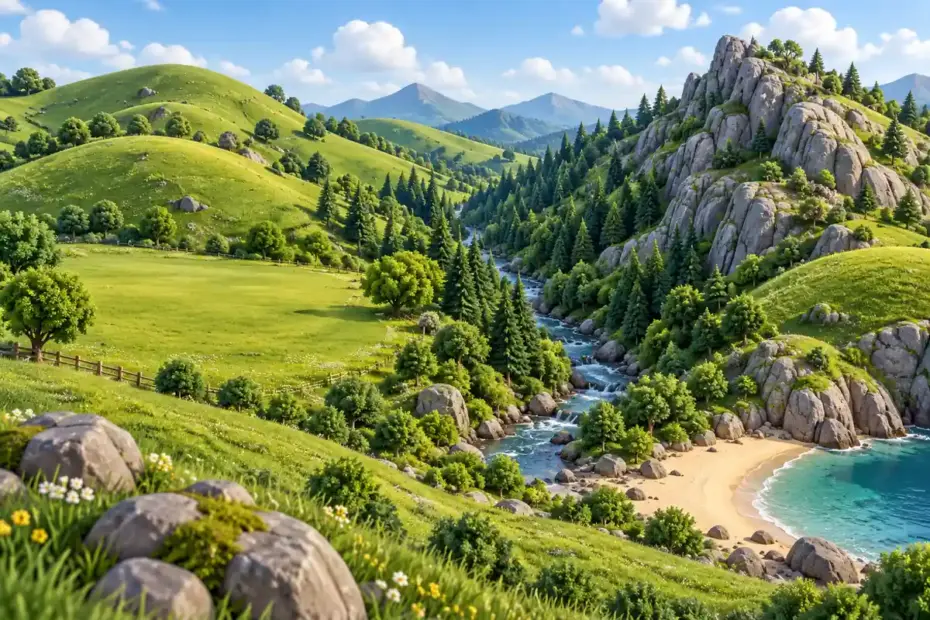
Adjectives for Land: Terrain and Soil Descriptions
Adjectives for land describe a place’s shape, surface, moisture, vegetation, or ability to grow crops. A useful description names an observable feature: “rocky hillside,” “arid plain,” or “fertile valley.” These words help readers picture terrain without treating “green,” “fertile,” and “arable” as synonyms.
- Shape: flat, rolling, sloping, steep, mountainous, or rugged.
- Surface: rocky, sandy, clayey, grassy, marshy, or wooded.
- Growing conditions: fertile, arable, barren, arid, or well-drained.
- Appearance: lush, verdant, windswept, remote, or scenic.
- Writing tip: choose words that describe separate features instead of stacking near-synonyms.
Which adjectives describe different features of land?
Choose a word based on the feature you want a reader to notice. Land may be flat in shape, sandy at the surface, arid in climate, and wooded with trees—all at once. Cambridge Dictionary’s landscape guide groups useful descriptions around vegetation, dryness, slope, rocks, and mood. (Cambridge Dictionary: describing landscapes)
| Feature | Adjectives | Example phrase |
|---|---|---|
| Shape and slope | flat, rolling, undulating, sloping, steep, mountainous, rugged | gently rolling fields |
| Surface and material | rocky, stony, sandy, clayey, muddy, peaty | a rocky hillside |
| Water and growing conditions | fertile, arable, barren, arid, marshy, waterlogged, well-drained | fertile valley soil |
| Plant cover | grassy, wooded, forested, lush, verdant, sparse | a densely wooded slope |
| Exposure and impression | windswept, exposed, remote, scenic, bleak, desolate | a windswept coastal headland |
What do terrain adjectives mean?
Terrain adjectives describe the land’s form and surface. Flat means level; rolling and undulating describe a series of gentle rises and dips; steep names a sharp incline. Rugged suggests rough, uneven ground, while mountainous means that a region contains or is dominated by mountains.
Match the word to what you can see: “a steep path climbed a rocky slope” gives more information than “a rough path climbed a rough hill.” Craggy is a more specific choice for a surface marked by projecting rocks, and coastal identifies land beside the sea rather than describing its slope.

How are fertile, arable, barren, and arid different?
Fertile describes land or soil that can produce healthy plants or good crops. Arable describes land that is used or suitable for growing crops. A place can be fertile but not arable if its trees, slope, or land use make crop growing impractical. (Cambridge Dictionary: fertile; Cambridge Dictionary: arable)
Arid means very dry, especially because the area receives little rain; it describes climate or water availability. Barren means unable to support much plant growth or produce crops. Arid land may still support drought-adapted plants, so it is not automatically barren. (Cambridge Dictionary: arid; Cambridge Dictionary: barren)
Soil terms add useful precision. The U.S. Department of Agriculture’s Natural Resources Conservation Service explains that texture—proportions of sand, silt, and clay—affects water holding, drainage, and erosion. “Sandy” and “clayey” therefore describe texture; they do not by themselves prove whether land is fertile. (USDA NRCS soil factors handout)
How can you choose precise adjectives for land?
- Name the physical feature: choose “flat,” “rocky,” or “marshy” instead of a general word such as “interesting.”
- Separate climate from soil: “arid” points to dryness; “sandy” describes soil texture.
- Separate appearance from use: “green” describes color or plant cover; “arable” describes suitability for crops.
- Use two complementary details: “a remote, windswept plateau” combines location and exposure.
- Check the tone: “desolate” and “bleak” convey a judgment or mood, not only a measurable feature.
In factual reports, prefer observable conditions such as slope, soil texture, drainage, and tree cover. In stories, travel writing, or poetry, mood words such as serene, bleak, or picturesque can help shape a scene, as long as the surrounding details support that impression.
Frequently asked questions about adjectives for land
What are good adjectives for land?
Useful adjectives depend on the feature: rolling or steep for shape, rocky or sandy for surface, fertile or arid for growing conditions, and wooded or grassy for plant cover. Combine two only when each adds a different detail for travel writing and school assignments.
What is the difference between fertile and arable land?
Fertile land or soil can support healthy plants or good crops. Arable land is used or suitable for crop growing. Fertility describes growing potential, while arability also depends on practical conditions such as slope, surface, and current land use in addition to soil quality.
Can arid land still have plants?
Yes. Arid means very dry or receiving too little rain for many plants; it does not mean every part is lifeless. Drought-adapted grasses, shrubs, and other vegetation can survive in dry environments, so use barren only when little plant growth is actually present.
How do you describe land in a sentence?
Choose one adjective for the feature you want readers to picture, then place it before the noun or after a linking verb: “rocky ground” or “the ground is rocky.” Add another adjective only if it contributes a different fact, such as “a fertile, gently sloping field.”
For clear descriptions, use adjectives for land that identify terrain, soil, moisture, vegetation, or mood—and make each word earn its place.
Are you looking for the perfect words to vividly describe the beauty and characteristics of different types of land? Look no further! In this article, I’ll be sharing a comprehensive list of adjectives that will help you paint a picture with words when describing land. Whether you’re a writer, a nature enthusiast, or simply someone who appreciates the wonders of the world, these adjectives will elevate your descriptions and captivate your readers.
From the lush green fields of the countryside to the rugged and majestic mountains, this article will provide you with a wide range of descriptive words to enhance your writing. Imagine being able to convey the tranquility of a serene beach or the vastness of a sprawling desert with just the right choice of adjectives. With the examples and explanations I’ll be sharing, you’ll be able to bring your descriptions to life and transport your readers to the landscapes you’re describing.
So, let’s dive in and explore the world of adjectives for land. Get ready to enrich your vocabulary and take your writing to the next level as we delve into the fascinating realm of descriptive words for different types of land.
How to Describe land? – Different Scenarios
When it comes to describing land, there are various scenarios that require different approaches. Whether you’re writing about a picturesque countryside or a majestic mountain range, choosing the right adjectives can enhance your descriptions and transport your readers to these beautiful landscapes. Let’s explore some different scenarios and how to describe land in each of them:
- Lush Green Fields: When describing lush green fields, you want to evoke a sense of freshness and vibrancy. Here are some adjectives that can help you paint a vivid picture:
- Rugged Mountains: Describing rugged mountains requires capturing their grandeur and imposing nature. Here are some adjectives to convey the awe-inspiring beauty of these landforms:
- Serene Beaches: Describing serene beaches requires evoking a sense of tranquility and relaxation. Here are some adjectives to help create that calm coastal ambiance:
Describing Words for land in English
When it comes to describing land, there are several adjectives that can help bring your descriptions to life. Whether you want to paint a picture of lush green fields, rugged mountains, or serene beaches, the right adjectives can transport your readers to these beautiful landscapes. Let’s explore some common adjectives used to describe land in English.
- Lush Green Fields:
- Verdant – Covered in lush green vegetation
- Expansive – Spanning a wide area
- Pristine – Unspoiled and pure
- Rolling – Having gentle, undulating hills
- Bucolic – Rustic and picturesque, like the countryside
- Rugged Mountains:
- Majestic – Impressive and awe-inspiring
- Towering – Rising high into the sky
- Formidable – Inspiring fear or respect due to size or strength
- Jagged – Having sharp, uneven edges or peaks
- Serene – Peaceful and calm despite its ruggedness
- Serene Beaches:
- Idyllic – Perfectly picturesque and peaceful
- Tranquil – Calm and peaceful, with gentle waves lapping the shore
- Sandy – Covered in soft, golden sand
- Glistening – Sparkling and shining in the sunlight
- Tideless – Not affected by the ebb and flow of tides
These adjectives can help you create vivid and captivating descriptions of different types of landscapes. Whether you’re writing a story, describing a real place, or simply trying to transport your readers to another world, choosing the right adjectives for land can make all the difference.
Remember to use these adjectives sparingly and vary your word choices to avoid repetitive descriptions. By incorporating these descriptive words into your writing, you can engage your readers’ imaginations and create a more immersive experience.
So, the next time you’re describing land in your writing, remember to choose adjectives that evoke the specific qualities you want to convey. Let your words paint a picture and take your readers on a journey through lush green fields, rugged mountains, or serene beaches.
Adjectives for land
Positive Adjectives for Land with 12 Example Sentences
When it comes to describing land, there are numerous positive adjectives that can help paint a vivid picture in your writing. Here are 12 examples of positive adjectives for land, along with example sentences to show how they can be used:
| Adjective | Definition | Example Sentence |
|---|---|---|
| Verdant | Covered in lush, green vegetation | The verdant meadows were a sight to behold. |
| Expansive | Vast and wide-ranging | The expansive plains seemed to stretch on forever. |
| Pristine | Immaculately clean and untouched | The pristine lake was crystal clear and inviting. |
| Rolling | Characterized by gentle, undulating hills | The rolling countryside was a peaceful and serene escape. |
| Bucolic | Rural and picturesque, like a countryside scene | The bucolic landscape was straight out of a storybook. |
| Majestic | Grand and impressive | The majestic mountains towered above us, dominating the horizon. |
| Towering | Tall and imposing | The towering trees cast long shadows over the trail. |
| Formidable | Inspiring fear and respect | The formidable cliffs posed a challenge for even the most experienced climbers. |
| Jagged | Sharp and rugged in shape | The jagged rocks dotted the coastline, creating a beautiful but treacherous landscape. |
| Serene | Calm, peaceful, and tranquil | The serene lake was a haven of relaxation and reflection. |
| Idyllic | Perfectly charming and picturesque | The idyllic village looked like something out of a fairy tale. |
| Tranquil | Calm and serene | The tranquil river flowed gently through the peaceful valley. |
Negative Adjectives for Land with 5 Example Sentences
While land can often be described in a positive light, there are also negative adjectives that can be used to convey a different mood or atmosphere. Here are 5 examples of negative adjectives for land, along with example sentences to help you understand their usage:
| Adjective | Definition | Example Sentence |
|---|---|---|
| Barren | Bleak and devoid of life | The barren desert stretched out before us, with nothing but sand as far as the eye could see. |
| Desolate | Deserted and lonely | The desolate plains were a stark reminder of the harsh realities of nature. |
| Eroded | Worn away by wind or water | The eroded cliffs showed the effects of time and weathering. |
| Harsh | Unpleasant and unforgiving | The harsh tundra made survival a daily struggle for the animals that called it home. |
| Grim | Gloomy and foreboding | The grim landscape matched the somber mood of the story it was set in. |
By incorporating these adjectives into your writing, you can bring your descriptions of land to life, whether you’re painting a picture of breathtaking beauty or a more desolate, forbidding landscape. Remember to choose your adjectives carefully, considering the mood and atmosphere you want to convey to your readers.
Synonyms and Antonyms with Example Sentences
Synonyms for Land
When it comes to describing land, there are several synonyms that can be used to convey different aspects and characteristics. Here are some common synonyms for land:
- Soil – The fertile soil of the farm allowed for bountiful harvests.
- Ground – The hiker decided to set up camp on a flat piece of ground.
- Earth – The earthquake caused cracks in the earth.
- Terrain – The rugged terrain made hiking difficult.
- Ground – The construction crew needed to level the ground before building the foundation.
- Landscape – The breathtaking landscape featured rolling hills and serene lakes.
Each synonym brings a different nuance to the description of land, allowing writers to choose the word that best fits their intended meaning.
Antonyms for Land
To provide a comprehensive overview of adjectives for land, it’s important to also explore the antonyms, or the opposite words, that can be used in contrast. Here are some examples of antonyms for land:
- Water – The island was surrounded by water, creating a serene and peaceful setting.
- Sea – The beachfront property offered stunning views of the vast sea.
- Ocean – The coastal town was known for its proximity to the majestic ocean.
- Beach – The sandy beach was the perfect spot for a relaxing day in the sun.
By using antonyms, writers can create a clear distinction between different types of landscapes and effectively convey the desired setting.
Synonyms and antonyms play a crucial role in expanding vocabulary and making writing more engaging. By using these words wisely, writers can paint vivid pictures and evoke specific emotions when describing land. Remember to choose adjectives that accurately reflect the desired mood and atmosphere, creating a more immersive experience for readers.
Conclusion
As a writer, I understand the importance of using the right words to bring a piece of writing to life. When it comes to describing land, the choice of adjectives can make all the difference in creating a vivid and captivating scene. Throughout this article, I have provided a comprehensive list of synonyms and antonyms for describing land, accompanied by example sentences to illustrate their usage.
By expanding your vocabulary with these descriptive words, you can add depth and richness to your writing. Whether you want to convey the serenity of a peaceful meadow or the ruggedness of a rocky cliff, these adjectives will help you paint a picture that resonates with your readers. By evoking specific emotions and setting the desired mood, you can transport your audience to the landscapes you create with your words.
Remember, choosing the right adjectives is an art form that takes practice. So, keep experimenting and refining your writing skills. With the right words, you can transform a simple description into a captivating and immersive experience for your readers.


