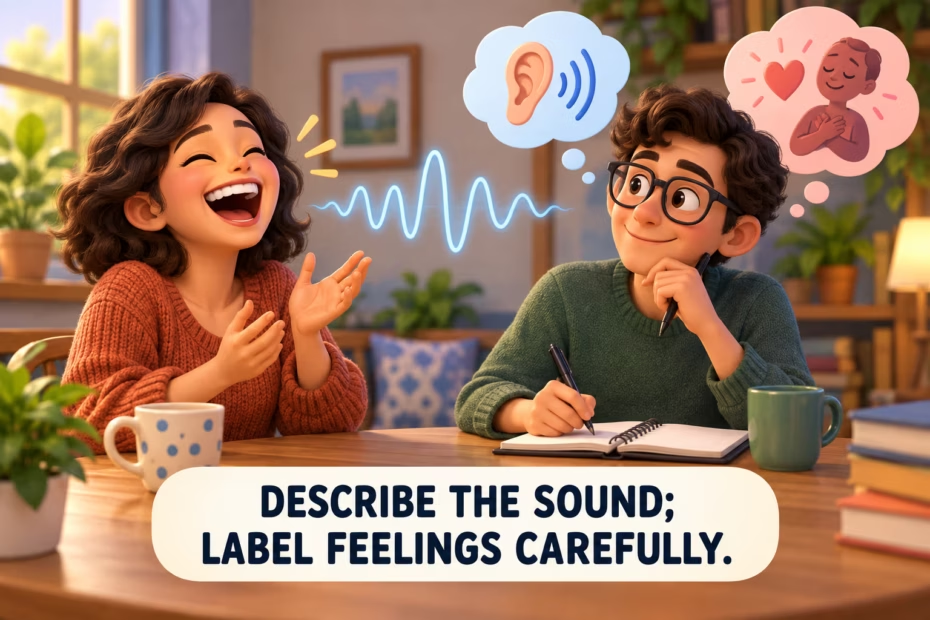
Quick answer: To describe a laugh, choose an adjective for an audible feature—such as loud, quiet, breathy, or raspy—when you can hear it. Use words such as nervous, polite, or sarcastic as interpretations tied to context, not facts proved by sound alone. “Laughable” usually means ridiculous, not simply funny.
Adjectives to Describe a Laugh: Start with What You Notice
The phrase adjectives for laugh is a common search query; in a sentence, adjectives to describe a laugh or adjectives for laughter sounds more natural. Laugh can be a verb or a countable noun (“a laugh”), while laughter names the act or sound more generally. Cambridge Dictionary records both noun and verb uses of laugh and defines laughter as the act or sound of laughing. Cambridge Dictionary: laugh; Cambridge Dictionary: laughter.
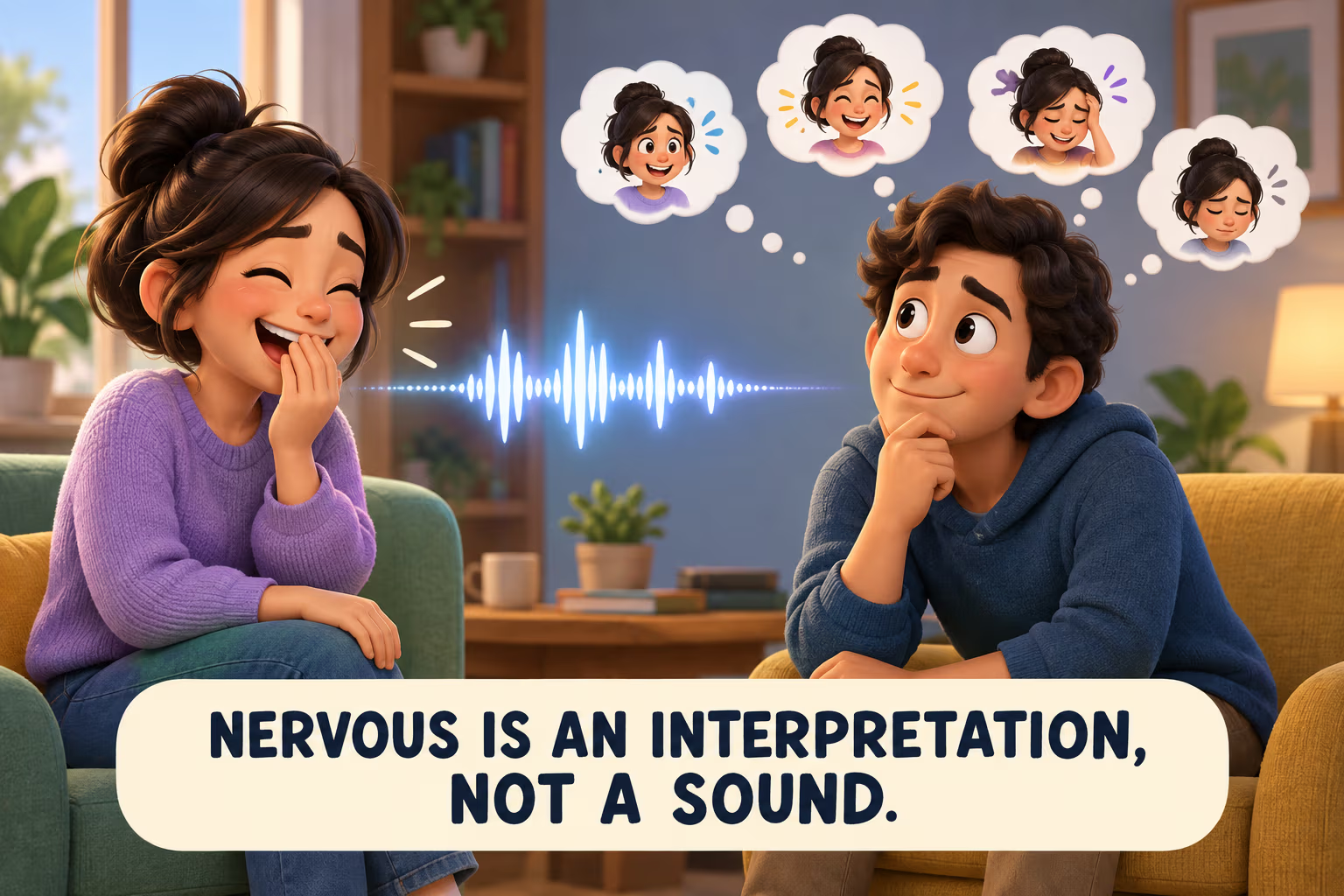
Choose a word that describes the detail you can support. “A brief, breathy laugh followed the punchline” reports sound and duration. “Her laugh was nervous” interprets a situation; it may fit a scene, but a laugh by itself cannot establish how someone feels, whether they are sincere, or what they intend.
| Description type | Useful words | Example |
|---|---|---|
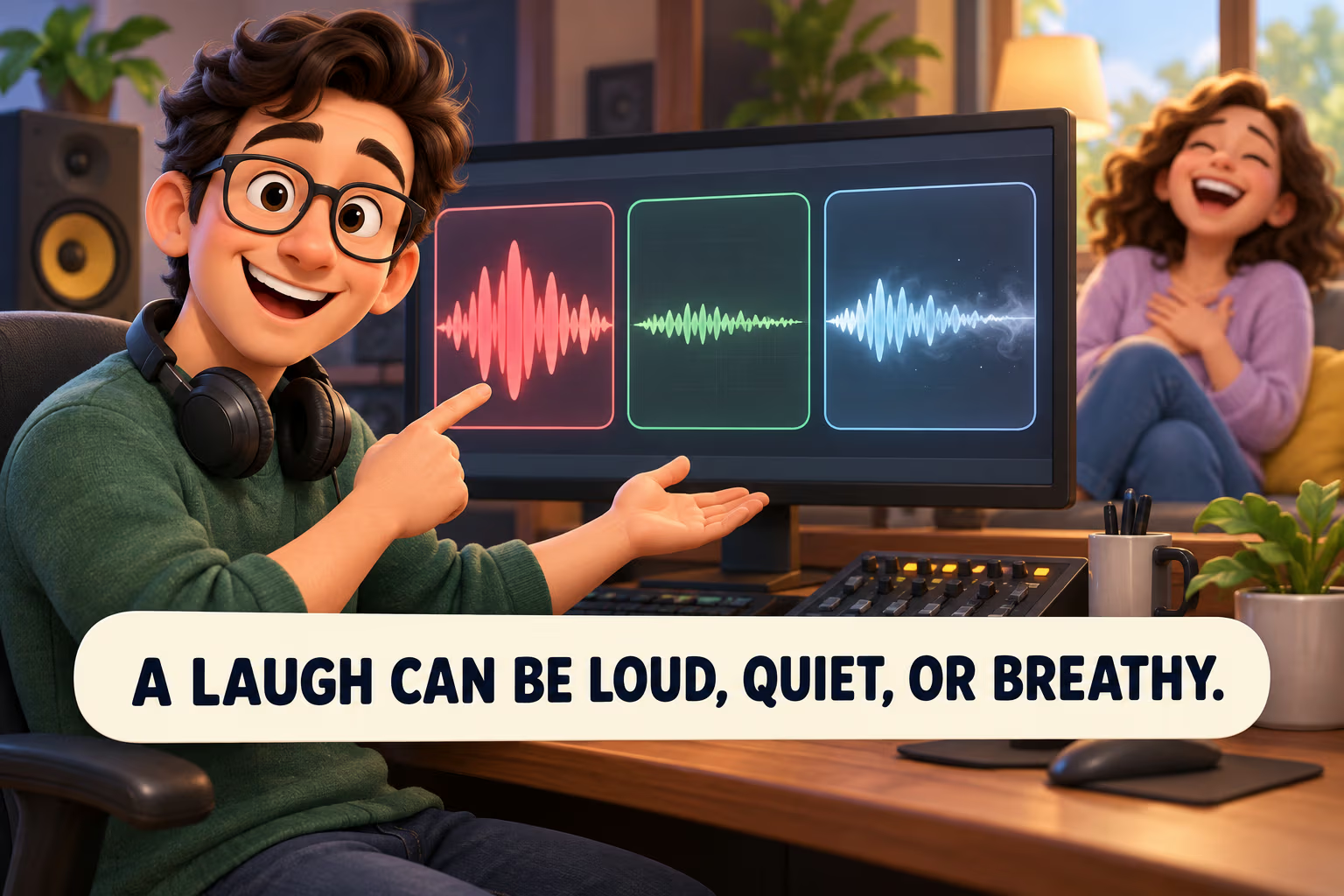
| Audible quality or volume | loud, quiet, breathy, raspy, high-pitched, bell-like | A short, breathy laugh followed the punchline. |
| Rhythm or manner | brief, sustained, restrained, unrestrained, hesitant | An unrestrained laugh rolled across the room. |
| A listener’s response | amusing, funny, humorous, hilarious | I found the story hilarious. |
| Social or interpretive tone | polite, nervous, sarcastic, derisive | To the narrator, the laugh sounded sarcastic. |
Separate Audible Qualities from Social Meaning
- Describe sound: loud, quiet, breathy, raspy, bell-like, high-pitched, booming, or dry.
- Describe timing: brief, sudden, sustained, stifled, or unrestrained.
- Describe your response: amusing, funny, or hilarious can describe a story, joke, or your reaction. They are not acoustic measurements, and people may react differently.
- Mark interpretation as interpretation: nervous, polite, forced, sarcastic, cynical, or derisive makes a claim about social tone. Connect that reading to the scene or a narrator rather than treating it as a fact audible in the laugh.
Cambridge Dictionary notes that laughing can express happiness or amusement and can sometimes express ridicule or anxiety. Those possibilities are a reminder to read the surrounding interaction, not a way to diagnose a person from one sound. If you need language for the idea or joke itself, see adjectives for humor. For a separate vocabulary list about emotion words, see adjectives for feelings.
Use “Laughable” Carefully
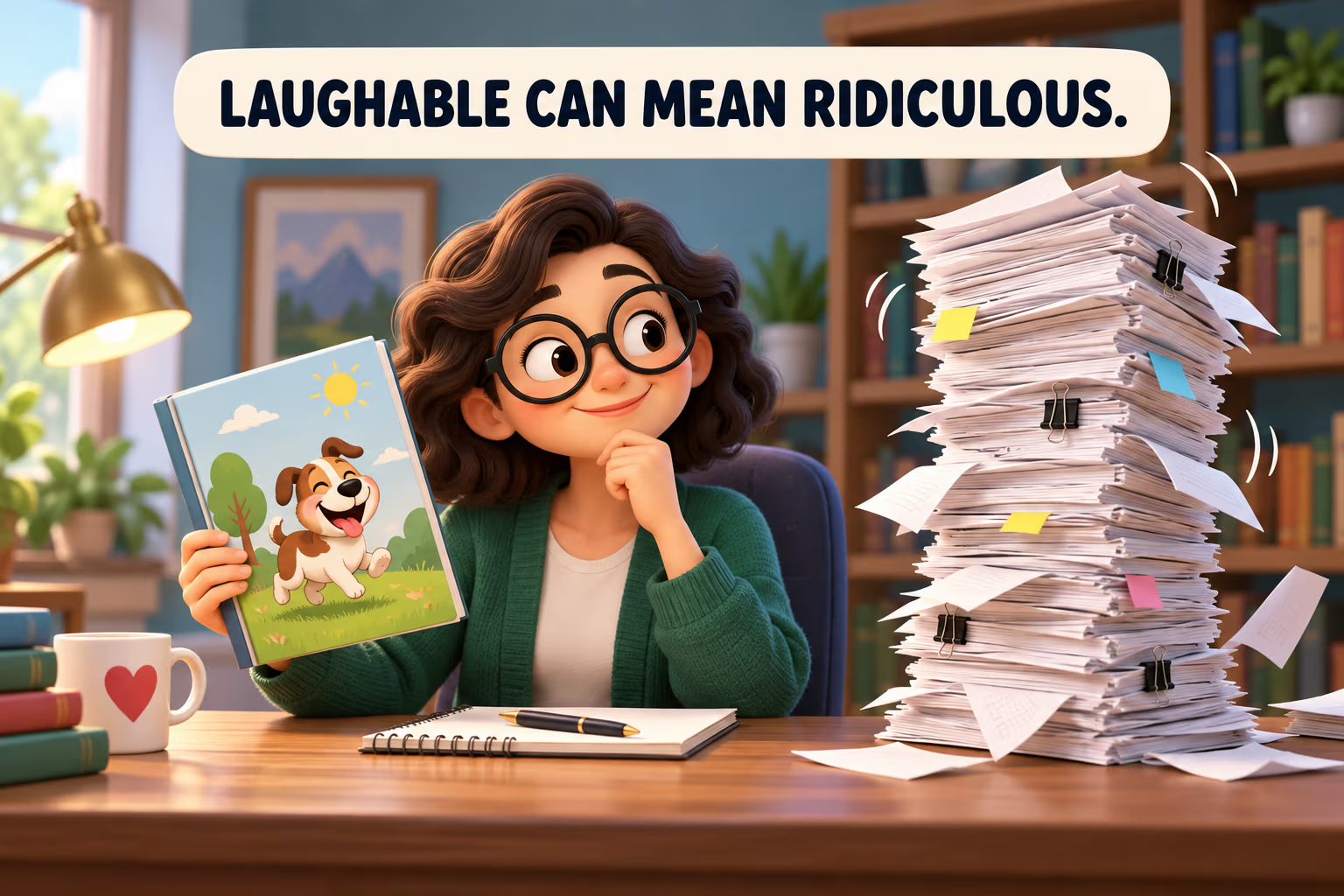
Laughable is a separate adjective. Cambridge’s main learner definition is something silly or ridiculous that does not deserve serious consideration; its American entry also includes the sense “amusing or ridiculous.” Because it often dismisses an idea as absurd, calling a person or their work “laughable” can sound insulting. If you simply mean “causing laughter,” choose funny, amusing, or comical instead. Cambridge Dictionary: laughable; funny; amusing.
The original article below contains 41 list entries and four tables with 31 total rows. Its repeated and awkward items remain in place. Notes after the source section explain how to read them without treating every entry as a sound adjective or as proof of someone’s feelings.

How to Describe laugh? – Different Scenarios
1. Genuine laughter
Genuine laughter is often heartfelt and contagious. It’s the kind of laughter that comes from pure joy or amusement. When describing genuine laughter, you can use adjectives like:- Belly-aching
- Boisterous
- Infectious
- Unrestrained
- Explosive
2. Polite Laughter
Polite laughter is a form of social courtesy often used to show politeness or to acknowledge a joke or humorous situation. It may not be as intense or genuine as other types of laughter. When describing polite laughter, consider using adjectives such as:- Muted
- Polite
- Cordial
- Gentle
- Reserved
3. Nervous Laughter
Nervous laughter can happen when someone is feeling anxious, uncomfortable, or unsure how to react in a situation. It can be a way to cope with stress or to diffuse tension. When describing nervous laughter, you can use adjectives like:- Nervous
- Nervous
- Tentative
- Awkward
- Hesitant
4. Sarcastic Laughter
Sarcastic laughter is an insincere form of amusement often used to mock or convey irony. It can be cynical or mocking in nature. When describing sarcastic laughter, consider using adjectives such as:- Sarcastic
- Mocking
- Cynical
- Ironic
- Derisive
Describing Words for laugh in English
When it comes to describing laughter, there are a variety of adjectives that can be used to capture the different nuances and characteristics of someone’s laugh. In this section, I will share some adjectives commonly used to describe laughter in English.Genuine Laughter:
- Contagious: Spreading through the room like wildfire, impossible not to join in.
- Bell-like: A clear, ringing sound, full of joy and unbridled happiness.
- Booming: Deep and hearty, filling the air with warmth and good cheer.
- Infectious: Spreading joy wherever it goes, leaving everyone feeling a little lighter.
- Uninhibited: Free and full of expression, reflecting pure enjoyment in the moment.
Polite Laughter:
- Subdued: Soft and controlled, mindful of the situation and company.
- Melodious: Pleasant and musical, adding a touch of grace to the atmosphere.
- Nervous Laughter:
- Dainty:** High-pitched and slightly breathless, revealing a hint of apprehension.
- Tentative: Uncertain and hesitant, unsure whether to fully commit to the laughter.
- Nervous Giggles: Quick, high-pitched bursts of sound, betraying underlying anxiety.
Nervous Laughter:
- High-pitched: Edgy and strained, revealing underlying anxiety or discomfort.
- Jittery: Uneven and unpredictable, reflecting the nervous energy within.
- Forced: Not fully genuine, masking awkwardness or apprehension.
- Jittery: Like a bird’s wings fluttering, conveying a sense of unease.
- Nervous giggle: A small, high-pitched sound escaping involuntarily.
Sarcastic Laughter:
- Bitter: Mocking and dismissive, laced with negativity and cynicism.
- Dry: Flat and humorless, conveying disbelief or disapproval.
- Scornful: Filled with disdain and contempt, highlighting the sarcasm.
- Snide: Underhanded and cutting, designed to belittle or insult.
- Derisive: Mocking and disrespectful, intended to wound with humor.
Adjectives for laugh
Positive Adjectives for laugh with 12 Example Sentences
When it comes to describing laughter, there are many positive adjectives that capture the joy and happiness associated with laughter. Here are some examples of positive adjectives for laugh along with sentences that demonstrate their usage:| Adjective | Example Sentence |
|---|---|
| Joyful | Her laughter filled the room with a joyful energy. |
| Infectious | His laughter was contagious, and soon everyone was laughing along. |
| Heartfelt | The couple exchanged heartfelt laughter during their wedding vows. |
| Bubbly | Her laughter was bubbly and full of excitement. |
| Amusing | The comedian’s funny jokes brought about amusing laughter from the audience. |
| Delightful | The children’s laughter at the playground was delightful to hear. |
| Radiant | Her radiant laughter brightened up the entire room. |
| Exuberant | The children’s laughter was exuberant as they played in the park. |
| Jovial | His laughter had a jovial tone that instantly lifted everyone’s spirits. |
| Genuine | You could hear the genuine laughter from the crowd as they watched the hilarious skit. |
| Melodic | Her laughter had a melodic quality that was pleasing to the ears. |
| Enthusiastic | The team’s victory brought about enthusiastic laughter and celebration. |
Negative Adjectives for laugh with 5 Example Sentences
While laughter is usually associated with positivity, there are also negative adjectives that can be used to describe certain types of laughter. Here are some examples of negative adjectives for laugh along with sentences that demonstrate their usage:| Adjective | Example Sentence |
|---|---|
| Sarcastic | His laughter had a sarcastic edge, making it clear that he was mocking her. |
| Forced | Her laughter sounded forced, as if she was trying to hide her true emotions. |
| Hysterical | The situation was so chaotic that their laughter became hysterical. |
| Cynical | His cynical laughter revealed his distrust and disbelief in what was being said. |
| Insincere | The insincere laughter was a clear indication of her lack of interest. |
Synonyms and Antonyms with Example Sentences
Synonyms for laugh
When describing laughter, there are various synonyms that can be used to add depth and variety to your language. Here are some synonyms for “laugh” along with example sentences illustrating their usage:| Synonym | Example Sentence |
|---|---|
| Chuckle | I couldn’t help but chuckle at his clever joke. |
| Giggle | The children giggled uncontrollably at the funny video. |
| Chortle | We all chortled with delight at the comedian’s antics. |
| Snicker | He tried to suppress a snicker when she tripped and fell. |
| Cackle | The witch let out a cackle before disappearing into the night. |
Antonyms for laugh
On the other hand, there are also antonyms that describe the absence of laughter or a more serious mood. Here are some antonyms for “laugh” along with example sentences:| Antonym | Example Sentence |
|---|---|
| Frown | She couldn’t help but frown when she heard the disappointing news. |
| Sulk | He retreated to his room and sulked after losing the game. |
| Scowl | The teacher scowled at the misbehaving student. |
| Grimace | He couldn’t hide his grimace of pain after stubbing his toe. |
| Sob | She couldn’t control her sobs after watching the emotional scene. |
Conclusion
Choosing the right words to describe a laugh is crucial in conveying the true emotions and intentions behind it. In this article, I have provided a comprehensive list of synonyms and antonyms for the word “laugh,” including words like “chuckle,” “giggle,” “chortle,” “snicker,” and “cackle,” as well as antonyms like “frown,” “sulk,” “scowl,” “grimace,” and “sob.” By using these descriptive adjectives, you can paint a vivid picture of the laughter and capture the essence of the moment. Whether it’s a light-hearted chuckle or a boisterous cackle, these words allow you to accurately depict the range of emotions associated with laughter. Remember to consider the context and age appropriateness when choosing your words. Each adjective carries its own connotation and can shape the perception of the laugh. So, choose wisely to ensure your description resonates with your audience. The power of descriptive adjectives lies in their ability to bring your writing to life. By incorporating these words into your descriptions of laughter, you can create a more engaging and immersive experience for your readers.How to Use the Original 41 Entries
The source section above is retained word for word, including its headings, 41 list entries, four tables, and 31 table rows. Some items repeat or use a phrase where the heading promises an adjective. The explanations here add context without deleting or silently correcting the inherited material.
Repeated or overlapping terms
The scenario list repeats nervous, and the descriptive list repeats jittery. Both occurrences remain. Contagious and infectious overlap when they describe laughter that spreads through a group; they are not separate sound qualities. When precision matters, describe the response you observed: “Several people joined in after the first laugh.”
Phrases that are not adjectives by themselves
Nervous laughter, nervous giggle, and nervous giggles are noun phrases: nervous is the adjective, while laughter or giggle is the noun. The list also includes Nervous Laughter: as an item under the polite-laughter group and the malformed-looking entry Dainty:**. Those source forms are preserved; use a clean adjective such as dainty, or a full phrase such as “a nervous giggle,” in your own sentence.
Words that imply an interpretation
Polite, nervous, forced, insincere, sarcastic, cynical, mocking, and derisive tell readers how a laugh is understood in a social moment. They do not name a guaranteed acoustic pattern. “The laugh sounded forced to the narrator” attributes the judgment; “the laugh was insincere” states a conclusion the sound alone may not support. A polite laugh is not automatically fake, and a nervous laugh does not establish anxiety.
Listener-response words and “hysterical”
Joyful, delightful, radiant, jovial, and genuine often describe a listener’s impression or a scene’s atmosphere rather than a measurable sound. Amusing, humorous, and hilarious evaluate what someone finds funny; hilarious means extremely funny, but the reaction is still personal. Cambridge defines amusing as entertaining and funny, humorous as funny or making you laugh, and hilarious as extremely funny and causing a lot of laughter. amusing; humorous; hilarious.
Hysterical can describe uncontrolled or very intense laughter, but it may also carry a strong judgment in context. Use it only when that degree or tone is intended; do not use it as a diagnosis or as shorthand for a person’s character.
Related words are not exact synonyms or antonyms
The source synonym table groups chuckle, giggle, chortle, snicker, and cackle. These are related laugh words with different sounds and connotations, not interchangeable replacements in every sentence. The antonym table lists frown, sulk, scowl, grimace, and sob; these name facial expressions, behavior, or crying rather than strict dictionary opposites of laugh. To contrast laughter plainly, try “the room fell quiet” or “nobody laughed.”
Examples That Keep Sound and Meaning Clear
- Audible: “A low, breathy laugh escaped when the punchline landed.”
- Rhythm: “His brief chuckle stopped as the speaker continued.”
- Listener response: “I found the story amusing, though my friend did not.”
- Attributed interpretation: “To the narrator, her laugh sounded hesitant; he could not know why from the sound alone.”
- Critical word choice: “The proposal seemed laughable to the reviewer” signals dismissal; “the proposal was funny” communicates a different idea.
Frequently Asked Questions About Adjectives for a Laugh
What is the natural way to say “adjectives for laugh”?
In a sentence, “adjectives to describe a laugh” or “adjectives for laughter” is more natural. Use a laugh when counting one instance, as in “a short laugh,” and laughter for the general act or sound, as in “quiet laughter.” The shorter phrase “adjectives for laugh” is kept as the search topic.
Can a laugh sound nervous?
Yes, “nervous laugh” is a familiar contextual description, and Cambridge includes “a loud/nervous laugh” as an example. Still, the adjective interprets the moment; a laugh alone does not prove anxiety. If you can hear a specific quality, name it separately, such as “a brief, high-pitched laugh.”
Does “laughable” mean funny?
Sometimes it can mean amusing, but it often means ridiculous or not worthy of serious consideration, so it may sound dismissive. If you mean that something caused laughter without criticizing it, funny, amusing, or comical is usually clearer. Choose laughable when that critical sense is intended.
Are “nervous giggle” and “nervous laughter” adjectives?
No. They are noun phrases with an adjective modifying a noun: nervous describes giggle or laughter. The source entries remain in the list because they can be useful phrases, but they are not single adjectives. Use the adjective alone when it fits, or write the full phrase in a sentence.
What words can replace “laugh” or contrast with it?
Chuckle, giggle, and chortle name particular kinds of laughter, while snicker or cackle can suggest a specific tone. They are related terms, not perfect substitutes. The source’s “antonyms” are actions or expressions; use a sentence such as “no one laughed” for a direct contrast.
Choose the Word You Can Support
A precise description gives readers a sound they can imagine and marks interpretations as a point of view. Keep the source’s broad vocabulary for exploration, then choose an adjective that fits the audible feature, the listener’s response, or the scene’s social meaning.


