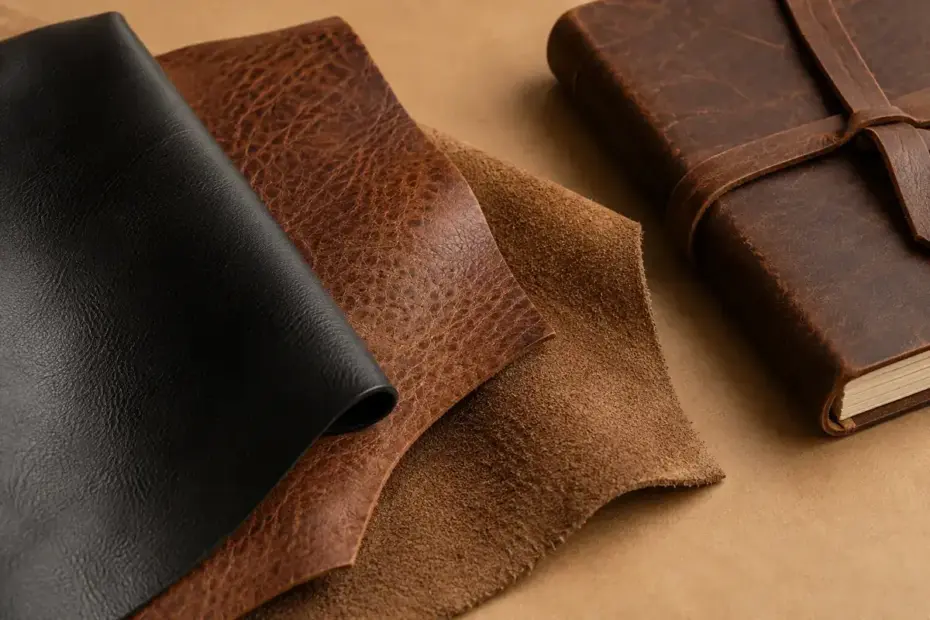
Useful adjectives for leather describe a specific quality: supple for flexibility, grained for a visible surface pattern, matte or glossy for sheen, and distressed for an intentionally aged finish. Choose words based on what a reader can see or feel, and distinguish a leather’s construction from its color, finish, and condition.
- “Supple” describes easy bending; it does not certify durability.
- “Full-grain” is a construction term, not a synonym for soft or luxurious.
- “Suede” names a napped leather surface, while “suede-like” may describe another material.
- “Patinated” describes an aged surface change; “distressed” can be an applied effect.
- Pair sensory adjectives with a concrete noun: grain, finish, edge, or surface.
Which adjectives describe leather accurately?
Accurate leather adjectives identify one observable property at a time. Use texture words for touch, grain and finish terms for the surface, color words for appearance, and condition words for wear; this keeps descriptions specific without implying that one adjective proves quality, origin, or performance.
| Adjective | Meaning in a leather description | Example |
|---|---|---|
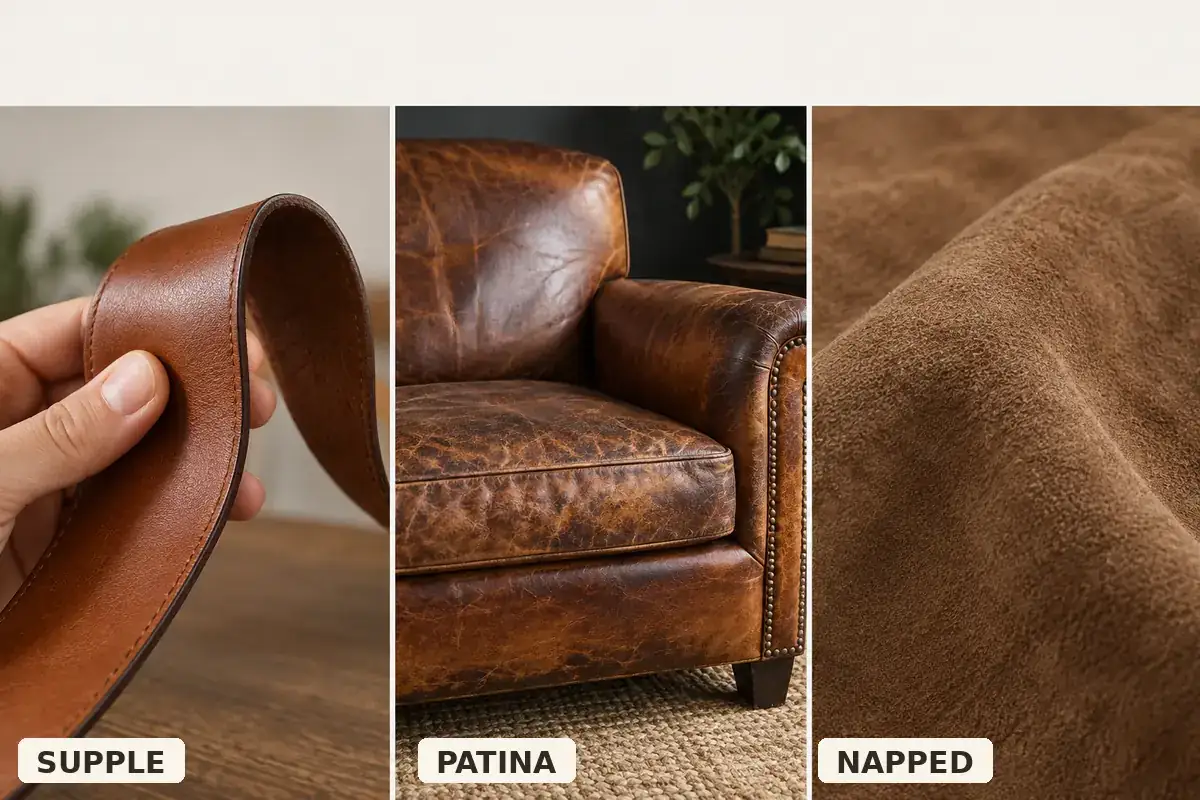
| Supple | Bends easily and feels pliable rather than rigid. | “The supple lambskin bends comfortably around the wrist.” |
| Grained | Shows a visible pebbled, natural, or patterned surface. | “The grained hide gives the briefcase a pronounced texture.” |
| Smooth | Feels even to the touch or appears relatively untextured. | “A smooth finish makes the wallet easy to wipe clean.” |
| Napped | Has a soft raised fiber surface, as on suede. | “The napped suede has a muted, velvety appearance.” |
| Matte | Reflects little light; the surface has low sheen. | “The matte black belt looks understated.” |
| Glossy | Reflects light with a noticeable shine. | “Glossy patent leather catches the light.” |
| Patinated | Has developed a changing color or sheen through age and use. | “The satchel’s patinated corners are darker than its center.” |
| Distressed | Looks worn or weathered, often by deliberate finishing. | “The distressed boots have an intentionally scuffed finish.” |
| Stiff | Resists bending; useful as a neutral or negative tactile detail. | “The new bridle leather is stiff but holds its shape.” |
| Pebbled | Has a small rounded grain pattern, natural or embossed. | “Pebbled leather disguises minor surface marks.” |
Other useful choices include soft, firm, pliable, coarse, waxy, polished, burnished, embossed, perforated, weathered, supple, supple-grained, lustrous, deep-toned, warm, cool, muted, saturated, rugged, refined, smooth-grained, cracked, scuffed, worn, supple, durable-looking, lightweight, substantial, flexible, textured, uniform, and natural-looking. Treat the final three as descriptions of an impression, not technical proof. “Durable-looking” says how an item appears; it does not promise how long it will last.
How do grain, finish, and texture differ?
Grain describes the leather’s outer surface structure, finish describes treatments or coatings applied to that surface, and texture describes the tactile or visual pattern a person notices. The terms overlap in everyday writing, but separating them prevents a product description from treating an embossed pattern as natural grain.
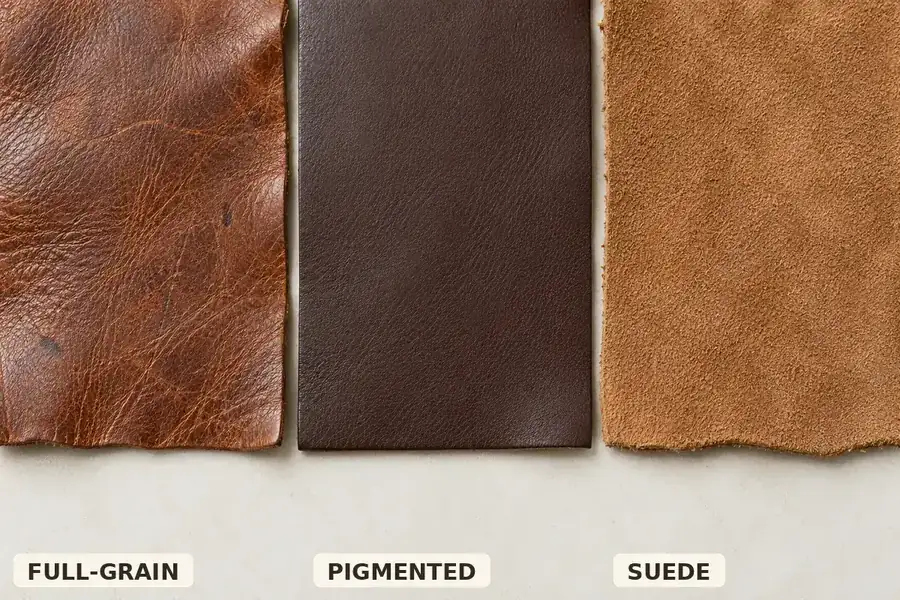
Full-grain refers to leather whose grain has not been removed by corrective mechanical treatment. That term does not guarantee a particular softness, thickness, color, or grade. A full-grain piece can be firm, flexible, smooth, or marked by natural variation depending on its hide and processing.
Corrected-grain leather has had some of the grain surface mechanically altered, such as by buffing, and then receives finishing treatment. Embossed describes a pattern pressed into the surface. An embossed leather can have a regular motif even when the underlying hide’s grain is different; therefore “embossed” is more precise than “naturally grained” for a stamped texture.
Aniline, semi-aniline, and pigmented describe finish categories. Leather Working Group definitions distinguish aniline leather, where natural grain remains clearly visible under no or non-pigmented coating, from semi-aniline leather with a small amount of pigment and pigmented leather where pigment conceals the grain. These terms explain finish, not whether leather feels “luxurious.”
Suede and nubuck are commonly used for leathers with a napped surface, but do not treat either as a generic synonym for “soft.” The nap’s direction and density affect how a surface looks and feels. Suede’s fibrous face is usually associated with the inner split, while nubuck is made by lightly sanding the grain side; exact product descriptions should follow the maker’s material specification.
Likewise, “grainy” is understandable in ordinary prose but vague in a product listing. Prefer pebbled, coarse-grained, fine-grained, embossed, shrunken-grain, or visible natural grain when that is what you mean. If the production method is unknown, describe only the visible effect: “a small, even pebble pattern” is safer than claiming the pattern is natural.
Which word fits the color, sheen, or condition?
Choose appearance adjectives that a shopper can verify under ordinary lighting. Color and sheen can shift between screens, indoor bulbs, and daylight, so avoid presenting a subjective color label as an exact specification unless the seller supplies a color standard or sample.
- Color: warm brown, cool gray, deep burgundy, pale tan, near-black, honey-toned, muted olive, or saturated red.
- Sheen: matte, satin, lustrous, glossy, polished, or waxed. State the visible effect; “waxed” implies a finish treatment and should be used only when confirmed.
- Wear: scuffed, creased, faded, cracked, weathered, or worn-in. These can describe condition, but they can also describe intentional design.
- Style: classic, minimalist, rustic, vintage-inspired, formal, or rugged. These describe the impression made by the whole item, not a measurable leather property.
“Vintage” is particularly easy to overstate. A newly made bag can be vintage-inspired or distressed; “vintage leather” can imply age or provenance. Use “genuine vintage” only when the item’s age is known and supported. “Patina” is also not a synonym for any scratch: it usually refers to a gradual change in color or sheen that develops with exposure and use, though sellers sometimes use the word loosely.
How should you choose adjectives for a sentence?
Start with the reader’s purpose: a product listing needs observable, verifiable features, while a story may prioritize mood and imagery. Select one or two precise adjectives, name the feature they modify, then add an example or contrast that helps the reader picture it.
- Identify the feature. Decide whether you are describing flexibility, grain, finish, color, condition, or style.
- Use the narrowest accurate word. Say “pebbled” instead of “grainy” when the surface has small rounded bumps; say “matte” instead of “smooth” when you mean low shine.
- Attach a concrete noun. “A supple strap,” “a matte finish,” and “a fine grain” are easier to picture than “supple, matte, fine leather.”
- Check the claim. Do not infer animal, tanning method, coating, longevity, or quality from appearance alone.
- Read it aloud. Remove adjectives that repeat the same point, such as “soft, supple, pliable” in a short product sentence.
Product copy: “The black crossbody bag has a pebbled surface, a matte finish, and an adjustable strap.” Each detail names something a shopper can inspect. If the seller confirms the leather bends easily, “supple strap” may be added; if not, keep the description to what is known.
Creative writing: “The weathered saddle creaked as its dark, burnished edges caught the lantern light.” Weathered sets age and use, burnished supplies a visual detail, and the sound and light create a scene. This works better than piling up broad praise such as “beautiful, exquisite, luxurious leather.”
Accessible descriptions: Include visual details that matter for identification—color, texture, sheen, pattern, and visible wear—without relying only on mood words. “Brown leather with a raised pebble texture and darkened edges” gives more usable information than “stylish, premium leather.”
Common mistakes when describing leather
Leather descriptions become misleading when a sensory adjective is made to carry a technical claim. Keep material facts separate from impressions, and explain the visible feature behind a subjective term.
- Calling every textured surface “natural grain.” Embossing can create a regular pattern. If you cannot verify its origin, name the appearance rather than the process.
- Using “genuine” as a quality grade. The word indicates leather is real leather in some labeling contexts; by itself it does not rank durability, workmanship, or finish.
- Treating “soft” as “high quality.” Softness is a feel, and it varies with hide, tannage, thickness, and finish. Some functional leathers are intentionally firm.
- Calling every worn surface “patina.” Patina suggests accumulated change; a factory-applied scuff effect is more accurately “distressed” or “antiqued” if the maker confirms it.
- Writing “suede” for any fuzzy material. Use “suede-like” for a synthetic or unspecified material, and confirm the composition before claiming real suede.
- Stacking near-synonyms. Three tactile terms in a row obscure the distinction. Replace “soft, smooth, supple leather” with the specific evidence: “the thin leather bends easily and has a fine, even surface.”
Frequently asked questions about leather adjectives
What is a good adjective for soft leather?
Supple is a strong choice when the leather bends easily without feeling rigid. Use soft for a general tactile impression, pliable for material that bends readily, or velvety for a surface with a soft nap. These words describe feel; they do not establish quality or durability.
Is grainy the same as pebbled leather?
Not exactly. Grainy is a broad everyday description for a visibly textured surface. Pebbled more specifically describes small rounded bumps or an embossed pebble pattern. Neither term alone tells a reader whether the pattern is natural, corrected, or pressed into the leather.
What adjective describes leather that gets better with age?
Patinated describes leather whose color or sheen has changed with exposure and use. Some leathers develop a noticeable patina, but results vary with finish, care, and conditions. “Ages beautifully” is an opinion; pair it with a concrete description such as darkened edges or a richer surface tone.
Can leather be both smooth and grained?
Yes. Smooth can mean the surface feels even, while grained describes visible pattern or grain structure. A piece may have a fine, subtle grain and still feel smooth to the hand. For clarity, write “smooth to the touch with a fine natural grain.”
What is the difference between distressed and vintage leather?
Distressed describes a worn or aged appearance that may be deliberately created during finishing. Vintage can mean genuinely old, or it can refer loosely to a style inspired by an earlier period. Use “vintage” for provenance only when the item’s age is documented.
Which adjectives should I avoid in a leather product listing?
Avoid unsupported claims such as “premium,” “genuine full-grain,” “waterproof,” or “indestructible” unless specifications substantiate them. Subjective words like “luxurious” may be used as opinion, but they should not replace useful details about texture, finish, dimensions, material composition, or condition.
Sources for material terminology
Definitions for supple and leathery were checked against Cambridge Dictionary. Leather surface and finish terminology was checked against the Leather Working Group definitions and its industry terms guide. These sources support the material distinctions; example sentences are original editorial examples.
When it comes to describing leather, the right choice of adjectives can make all the difference. Whether you’re a leather enthusiast, a fashion lover, or simply curious about the qualities of this versatile material, having a varied vocabulary of adjectives can help you paint a vivid picture. In this article, I’ll be sharing a collection of descriptive words that can be used to capture the essence of leather, along with examples to illustrate their usage. From soft and supple to rugged and weathered, we’ll explore the many facets of leather through the power of words.
Leather has long been admired for its durability and timeless appeal. But beyond its practicality, there’s a whole spectrum of adjectives that can be used to describe its texture, color, and overall aesthetic. Whether you’re describing a sleek leather jacket, a luxurious handbag, or a well-worn pair of boots, the right choice of adjectives can bring your description to life. So, let’s dive in and discover the world of adjectives for leather, and how they can help us appreciate this extraordinary material in all its forms.
How to Describe leather? – Different Scenarios
How to Describe Leather? – Different Scenarios
When it comes to describing leather, there are countless adjectives that can paint a vivid picture of its unique qualities. In different scenarios and contexts, we can use adjectives to capture the various aspects of leather, including its texture, color, and overall aesthetic. Let’s dive into the world of adjectives and explore how we can describe leather in different scenarios.
- Describing Leather Texture:
- Smooth: A smooth leather surface feels sleek and velvety to the touch.
- Grainy: Grainy leather has a textured surface with visible grains or wrinkles.
- Supple: Supple leather is flexible, soft, and easily molds to the shape of your hand or body.
- Embossed: Embossed leather has a raised pattern or design imprinted on its surface.
- Suede: Suede leather is soft and fuzzy, creating a matte and velvety texture.
- Describing Leather Color:
- Rich: Rich-colored leather exudes depth and intensity, often with tones of brown, black, or burgundy.
- Vibrant: Vibrant leather colors are bold and eye-catching, adding a burst of energy to any outfit or space.
- Subtle: Subtle leather colors are gentle and understated, often in shades of beige, gray, or pastels.
- Two-Tone: Two-tone leather combines two different colors, creating a striking contrast and visual interest.
- Patina: A leather patina refers to the natural aging process that develops a unique coloration and luster over time.
- Describing Leather Aesthetic:
- Classic: Classic leather has a timeless and elegant appeal, encapsulating tradition and sophistication.
- Rustic: Rustic leather showcases a rugged and natural aesthetic, often with visible imperfections and a worn-in look.
- Modern: Modern leather takes on a sleek and contemporary style, emphasizing clean lines and minimalist design.
- Luxurious: Luxurious leather exudes opulence and indulgence, conveying a sense of high-quality craftsmanship.
- Vintage: Vintage leather has a nostalgic charm, evoking a sense of history and nostalgia.
Describing Words for leather in English
Leather is a versatile material that can be described using various adjectives. The right choice of words can paint a vivid picture of leather’s texture, color, and overall aesthetic. Here are some adjectives that can be used to describe leather in different scenarios:
- Smooth: Smooth leather has a sleek and refined texture that is free from any noticeable imperfections. It feels luxurious to the touch and can give a polished look to any item it is used on.
- Grainy: Grainy leather has a distinct texture characterized by visible grains or patterns. This type of leather can have a rustic or vintage feel, and it adds a touch of depth and character to leather goods.
- Supple: Supple leather is known for its flexibility and softness. It is pliable and molds easily, making it comfortable to wear and handle. Supple leather tends to have a more casual and relaxed look.
- Rich: Rich leather refers to leather that has a deep and vibrant color. It looks luxurious and has a certain opulence that adds a touch of sophistication to any product made with it.
- Vibrant: Vibrant leather is characterized by intense and bold colors. It grabs attention and adds a pop of energy to any piece. It’s perfect for those who want to make a statement with their leather items.
- Classic: Classic leather signifies timeless elegance and traditional style. It has a refined and sophisticated appearance that never goes out of fashion. Classic leather items are perfect for those who prefer a more timeless and understated look.
- Rustic: Rustic leather exudes a rugged and raw aesthetic. It has a weathered and earthy appearance, often characterized by natural markings and imperfections. Rustic leather items are popular among those who appreciate a more rugged and vintage-inspired look.
- Modern: Modern leather is sleek, contemporary, and minimalist in design. It has a clean and streamlined appearance, often featuring sharp lines and minimal embellishments. Modern leather items are perfect for those who prefer a sleek and minimalist aesthetic.
- Luxurious: Luxurious leather exudes opulence and extravagance. It has a plush and indulgent feel, often associated with high-end and premium products. Luxurious leather items are perfect for those who appreciate the finer things in life.
Adjectives for leather
Positive Adjectives for Leather
Leather is known for its exquisite qualities and versatility. Here are some positive adjectives that accurately describe the various characteristics of leather:
- Smooth: The surface of leather is sleek and velvety, providing a comfortable feel.
- Grainy: Leather can have a distinct texture with visible natural grain patterns.
- Supple: Leather is flexible and can easily conform to different shapes and movements.
- Rich: Leather often has a deep, luxurious appearance that adds a touch of elegance.
- Vibrant: Leather comes in a wide range of colors that are bold and eye-catching.
- Classic: Leather has a timeless appeal that never goes out of style.
- Rustic: Certain types of leather evoke a rugged and earthy aesthetic.
- Modern: Leather can be sleek and contemporary, adding a chic element to any design.
- Luxurious: The feel and look of leather exudes opulence and sophistication.
- Vintage: Antique or distressed leather holds a unique charm that captures the essence of the past.
Example Sentences:
- “I love the feel of the smooth leather against my skin.”
- “The grainy leather on this bag adds a touch of texture.”
- “The supple leather of these gloves allows for easy movement.”
- “The rich brown leather on the sofa gives the room a luxurious touch.”
- “The vibrant red leather jacket makes a bold fashion statement.”
- “A classic leather briefcase is a staple accessory for professionals.”
Negative Adjectives for Leather
While leather has many positive qualities, there are also negative aspects that one should consider. Here are some negative adjectives that describe certain characteristics of leather:
- Stiff: Some leather can be rigid and lack flexibility.
- Scratchy: Low-quality leather may have a rough or abrasive texture.
- Fading: Exposure to sunlight can cause the color of leather to fade over time.
- Imperfections: Leather may have natural marks or blemishes that can be seen as flaws.
- Pricey: Genuine leather can be more expensive compared to synthetic alternatives.
Example Sentences:
- “The leather seats in the car were stiff and uncomfortable.”
- “The jacket made from low-quality leather felt scratchy against my skin.”
- “Over time, the leather handbag started fading due to sun exposure.”
- “I noticed a few imperfections on the leather wallet, but it added character.”
- “Although genuine leather is pricey, it offers durability and a luxurious feel.”
Synonyms and Antonyms with Example Sentences
Synonyms for Leather
When describing leather, there are several synonyms that can be used to capture its different qualities. These synonyms provide a variety of options to choose from when describing the characteristics of leather. Here are some useful synonyms for leather:
- Smooth: Leather that feels soft and velvety.
- Grainy: Leather that has a textured surface, often with visible grains.
- Supple: Leather that is flexible and bends easily.
- Rich: Leather that has a deep and vibrant color.
- Vibrant: Leather that is bold and lively in color.
- Classic: Leather that has a timeless and traditional appeal.
- Rustic: Leather that has a rough and natural look.
- Modern: Leather that has a sleek and contemporary design.
- Luxurious: Leather that is elegant and opulent.
- Vintage: Leather that has an aged and nostalgic feel.
Here are some example sentences that demonstrate the use of these synonyms:
- The leather jacket felt incredibly smooth against my skin.
- The briefcase was made of a grainy leather that added texture to its appearance.
- The gloves were made from supple leather, allowing for a comfortable fit.
- The chair was upholstered in a rich leather that added warmth to the room.
- She wore a vibrant leather purse that added a pop of color to her outfit.
Antonyms for Leather
In addition to synonyms, there are also antonyms that can be used to describe leather. These antonyms help to provide a contrasting perspective to the qualities of leather. Here are some antonyms for leather:
- Stiff: Leather that is rigid and lacking flexibility.
- Scratchy: Leather that has a rough and irritating texture.
- Fading: Leather that loses its color over time.
- Imperfections: Leather that has flaws or blemishes.
- Pricey: Leather that is expensive or costly.
Use the following example sentences to understand how these antonyms can be used:
- The new leather shoes were quite stiff and uncomfortable to walk in.
- The old leather wallet had a scratchy texture that bothered her hand.
- The leather sofa had started fading in certain areas due to sun exposure.
- Despite its imperfections, the vintage leather jacket held sentimental value.
- She couldn’t afford the pricey leather handbag that she had her eye on.
Remember, choosing the right adjectives is essential to accurately describe the characteristics of leather. Synonyms and antonyms provide you with a wide range of options to effectively convey the qualities of this material.
Conclusion
Describing leather can be a fun and creative endeavor. In this article, we discussed a variety of adjectives that can be used to describe leather, including synonyms and antonyms. By using words like smooth, grainy, supple, and rich, we can paint a vivid picture of the texture and quality of leather. These descriptive words allow us to convey the luxurious and timeless nature of this material.
On the other hand, we also explored antonyms such as stiff, scratchy, and fading, which can help us highlight the less desirable qualities of leather. By using these contrasting words, we can provide a well-rounded description and inform readers about potential drawbacks.
Remember, when describing leather, it’s important to consider the context and purpose. Whether you’re writing a product description, a fashion blog, or simply expressing your love for leather, choosing the right adjectives can make all the difference.
So, next time you’re describing leather, don’t settle for generic terms. Get creative and use words that truly capture the essence of this versatile material.


