Feeling overwhelmed? Excited? Maybe even a little bit melancholic? Our moods can be as varied as the colors of a rainbow, and sometimes, it can be hard to put them into words. That’s where adjectives come in handy. They have the power to capture the essence of our emotions and paint a vivid picture of how we’re feeling. In this article, I’ll be exploring a range of adjectives that can be used to describe different moods, along with examples to help you better understand their usage. So, whether you’re feeling ecstatic or contemplative, get ready to expand your vocabulary and express your emotions with precision.
Moods are like the weather – they can change in an instant. One moment, you may find yourself in a state of pure bliss, and the next, you might be feeling downright irritable. But fear not, because with the right adjectives, you can accurately convey these fleeting emotions. From words that describe elation, such as “ecstatic” and “thrilled,” to those that capture feelings of sadness, like “melancholic” and “gloomy,” we’ll delve into the world of mood adjectives. By the end of this article, you’ll have a collection of descriptive words at your disposal to help you articulate your emotions and connect with others on a deeper level.
Ready to dive into the fascinating world of mood adjectives? Let’s embark on this journey together and discover the power of words in expressing our innermost feelings. Whether you’re a writer looking to add depth to your characters or simply someone who wants to better understand and communicate their emotions, this article has got you covered. So, without further ado, let’s explore the rich tapestry of adjectives for mood and unlock the potential of language to capture the essence of how we feel.
How to Describe mood? – Different Scenarios
When it comes to describing mood, there are a variety of scenarios to consider. Whether you’re writing a story, describing a character, or simply trying to express your own emotional state, choosing the right words can make all the difference. Let’s explore some different scenarios and the adjectives that can be used to effectively describe mood in each situation.
- Happy and Excited
- Scenario: Imagine a child on their birthday, eagerly unwrapping presents.
- Adjectives: joyful, ecstatic, thrilled, elated, exuberant.
- Calm and Relaxed
- Scenario: Picture a serene beach with gentle waves rolling in.
- Adjectives: peaceful, tranquil, serene, content, at ease.
- Sad and Melancholy
- Scenario: Think about a rainy day when you’re feeling a bit down.
- Adjectives: melancholic, somber, gloomy, forlorn, heartbroken.
- Anxious and Nervous
- Scenario: Consider the feeling of anticipation before giving a presentation.
- Adjectives: anxious, nervous, uneasy, jittery, apprehensive.
- Angry and Frustrated
- Scenario: Visualize a person in a traffic jam, honking their horn.
- Adjectives: angry, furious, frustrated, enraged, livid.
- Surprised and Astonished
- Scenario: Envision a person receiving an unexpected gift.
- Adjectives: surprised, astonished, amazed, stunned, bewildered.
In each of these scenarios, the adjectives used to describe mood can paint a vivid picture in the reader’s mind or help us better understand our own emotions. It’s important to choose words that accurately convey the intended mood, as well as ones that resonate with the reader.
Remember, words have the power to evoke emotions and connect us with others on a deeper level. By using descriptive adjectives strategically, we can create more engaging and impactful writing.
Next, let’s explore how adjectives can play a role in storytelling and character development.
Describing Words for mood in English
As a seasoned writer, I understand the importance of choosing the right words to accurately describe different moods and emotions. When it comes to conveying the appropriate mood, adjectives play a crucial role in painting a vivid and engaging picture for the reader. In this section, I will explore a collection of describing words for mood in English, providing examples and scenarios where these words can be effectively used. By incorporating these adjectives into your writing, you can bring your stories and characters to life, creating a more immersive experience for your readers.
1. Sadness
When it comes to expressing sadness, there are a variety of adjectives that can effectively capture the emotion. Consider using words such as:
- Heartbroken: feeling profound sadness and grief
- Melancholy: experiencing a deep and reflective sadness
- Gloomy: feeling downcast or despondent
These adjectives can help convey the somber and heavy feeling of sadness, allowing your readers to empathize with the characters or situations you’re describing.
2. Excitement
In moments of excitement, it’s important to use adjectives that convey enthusiasm and energy. Here are some examples:
- Thrilling: causing great excitement or anticipation
- Exhilarating: making one feel energized and exhilarated
- Electrifying: producing intense excitement or thrill
By incorporating these adjectives into your writing, you can transport your readers into the exhilarating moments of excitement, capturing their attention and keeping them engaged.
3. Anger
When writing about anger, it’s essential to use adjectives that depict the intensity and fury of the emotion. Consider using words such as:
- Furious: feeling intense anger and rage
- Enraged: being extremely angry and incensed
- Livid: experiencing extreme anger, often displayed through a reddened face
By choosing these adjectives, you can effectively communicate the raw intensity of anger, making your readers feel the burning emotions and tension within your story.
4. Happiness
Describing happiness requires adjectives that convey joy and contentment. Here are a few examples:
- Ecstatic: feeling overwhelming joy and bliss
- Delighted: experiencing great pleasure and satisfaction
- Elated: being extremely happy and exhilarated
Adjectives for mood
Positive Adjectives for mood with 12 Example Sentences
When it comes to describing mood, positive adjectives can help us capture the happy and joyful moments in life. Here are 12 examples of positive adjectives for mood:
| Adjective | Definition |
|---|---|
| Blissful | Extremely happy or joyful |
| Ecstatic | Overwhelmingly happy or excited |
| Radiant | Beaming with joy or positivity |
| Content | Satisfied and at peace |
| Elated | Feeling great joy or delight |
| Enthusiastic | Full of excitement and energy |
| Jovial | Cheerful and jolly |
| Lighthearted | Carefree and happy |
| Optimistic | Hopeful and positive |
| Serene | Calm and tranquil |
| Grateful | Feeling thankful and appreciative |
| Delighted | Extremely pleased or satisfied |
Example Sentences:
- I felt blissful after receiving good news.
- She was ecstatic when she won the competition.
- The bride looked radiant on her wedding day.
- After a long day of hiking, I felt content sitting by the campfire.
- We were elated to see our favorite band perform live.
- The crowd was enthusiastic during the concert.
- They had a jovial gathering with lots of laughter and jokes.
- As we walked along the beach, we felt lighthearted and carefree.
- Despite the challenges, she maintained an optimistic outlook.
- The peaceful scenery made me feel serene and relaxed.
- I am grateful for the support of my friends and family.
- We were delighted with the delicious meal we were served.
Negative Adjectives for mood with 5 example sentences
While positive adjectives bring out the joy in a mood, negative adjectives help us describe the less pleasant emotions we may experience. Here are 5 examples of negative adjectives for mood:
| Adjective | Definition |
|---|---|
| Gloomy | Depressed or despondent |
| Angry | Filled with rage or hostility |
| Anxious | Worried or uneasy |
| Melancholy | Feeling sad and pensive |
| Frustrated | Feeling annoyed or hindered |
Example Sentences:
- The rainy weather made the atmosphere feel gloomy.
- I was angry when my phone suddenly stopped working.
- She felt anxious about the upcoming exam.
- He had a melancholy look on his face as he reminisced about the past.
- I was frustrated when I couldn’t find my car keys.
Remember, adjectives play a crucial role in creating a vivid and engaging experience for the reader. Incorporating these descriptive words into your writing can bring your stories and characters to life, whether you’re teaching young children or expressing your thoughts and emotions.
Synonyms and Antonyms with Example Sentences
Synonyms for mood
When it comes to describing different moods and emotions, adjectives are essential. They enable us to paint a vivid picture and engage the reader in our writing. Let’s take a look at some synonyms for different moods:
- Happy:
- Sad:
- Angry:
Antonyms for mood
Sometimes, when we want to convey a specific mood, it can be just as important to know the antonyms, or opposite meanings, of certain adjectives. Let’s explore some antonyms for different moods:
- Happy:
- Sad:
- Angry:
Remember, choosing the right adjectives to describe moods can greatly enhance your writing and bring your characters and stories to life. Whether it’s using synonyms or antonyms, these words will help you create a more engaging experience for your readers without the need for excessive repetition or a concluding paragraph.
Conclusion
Describing moods and emotions using adjectives is a powerful tool in writing. Throughout this article, we have explored the significance of choosing the right adjectives to bring characters and stories to life. By using synonyms and antonyms, we can create a more engaging experience for readers without the need for excessive repetition.
The examples provided in this article have showcased the versatility of adjectives in capturing a wide range of moods, from happiness and sadness to anger and everything in between. By incorporating these descriptive words into our writing, we can evoke specific emotions and paint vivid pictures in the minds of our readers.
Remember, adjectives are not just words on a page; they have the power to transform a simple sentence into a captivating narrative. So, the next time you sit down to write, consider the mood you want to convey and choose your adjectives wisely.
Incorporating adjectives into your writing will not only enhance your storytelling abilities but also leave a lasting impact on your readers. So, go ahead and experiment with different adjectives to create a rich and immersive reading experience. Happy writing!
How to choose an adjective for a mood
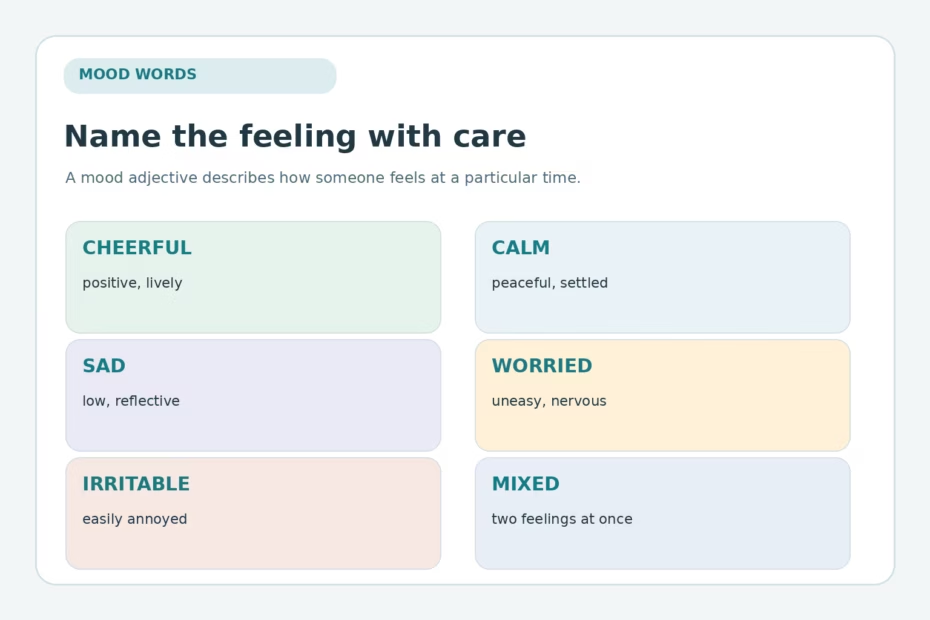
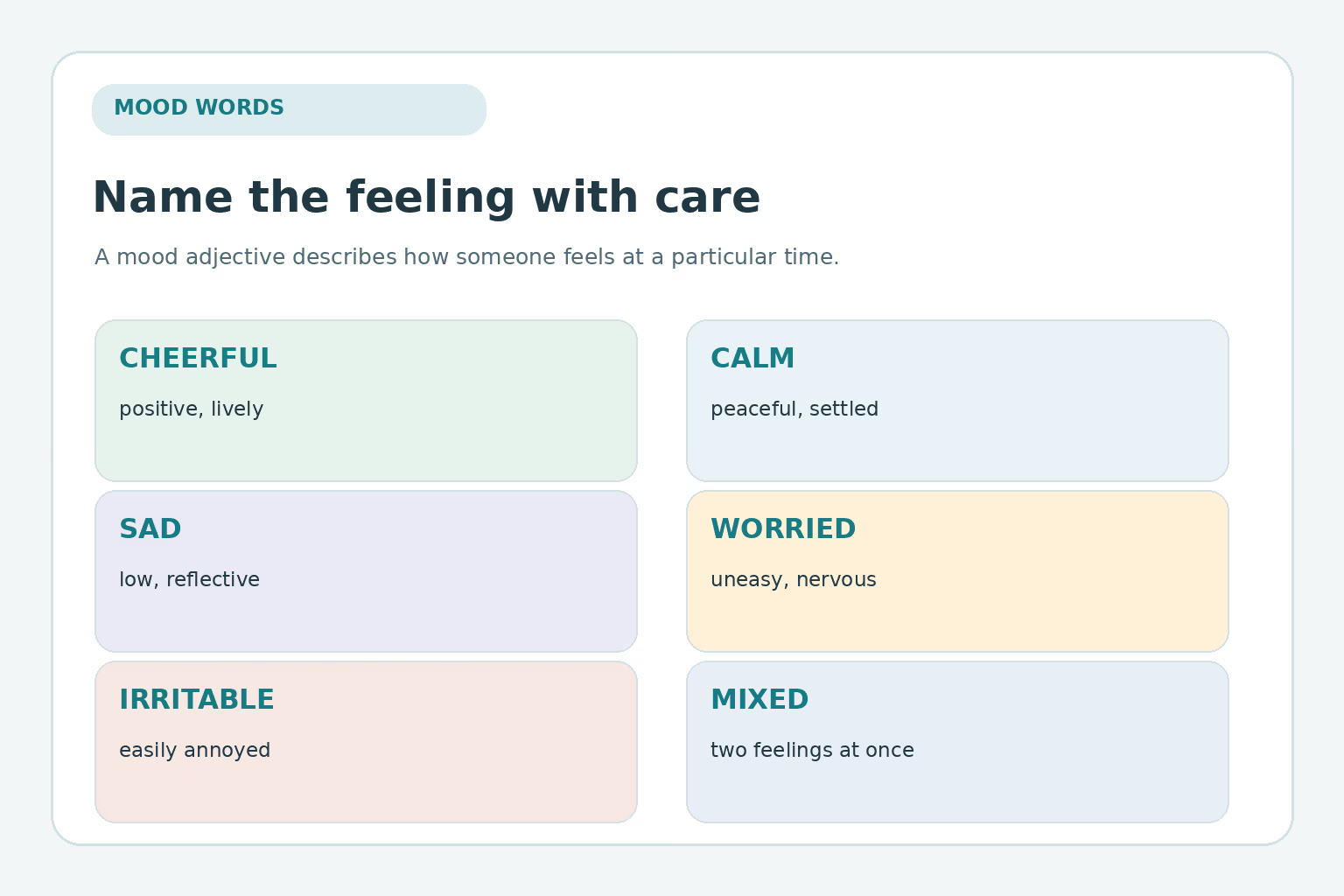
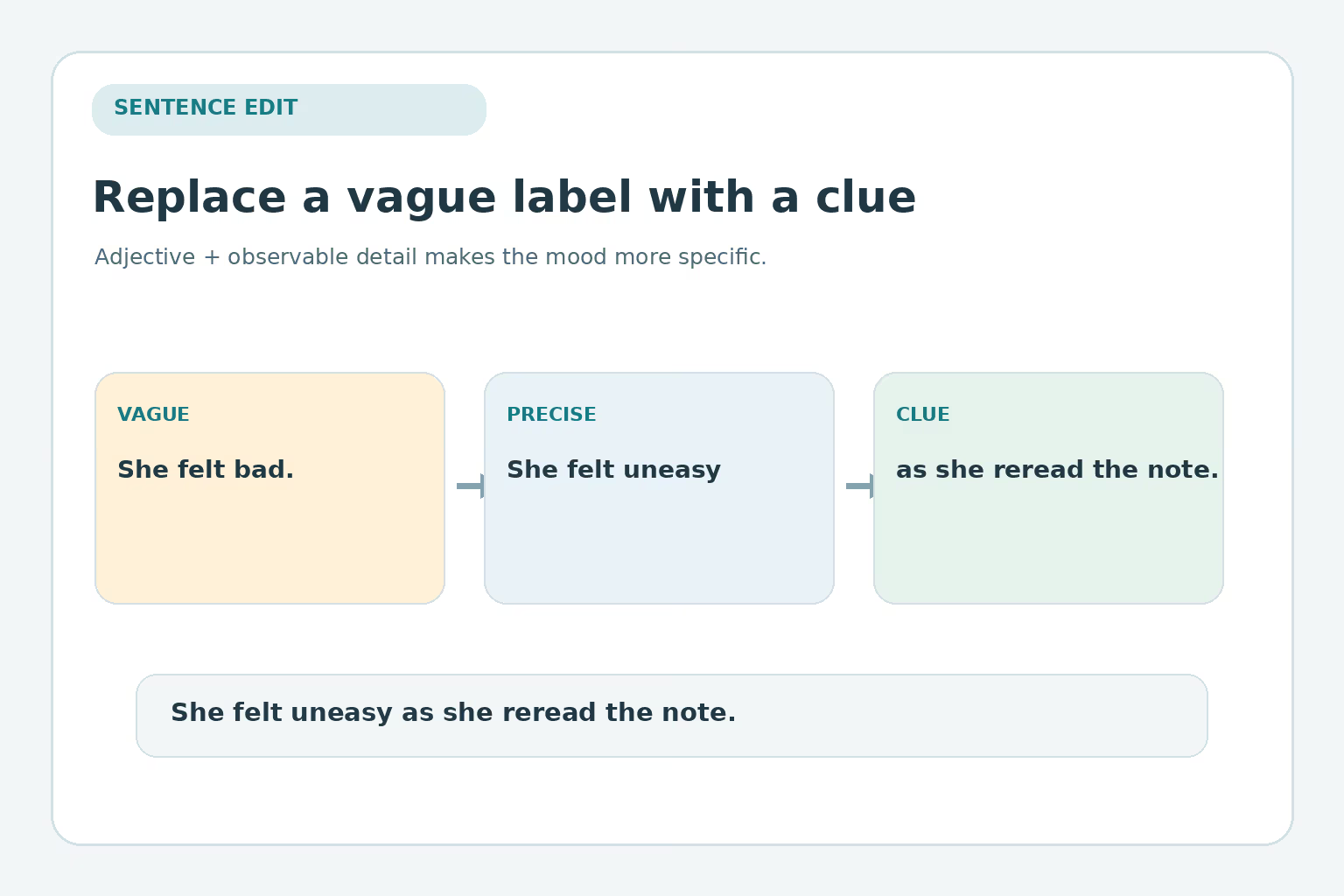
A mood is the way someone feels at a particular time. The most useful adjective names the feeling and gives readers enough context to understand its strength or cause. Instead of reaching for a dramatic word by default, ask: Is the feeling pleasant or unpleasant? Is it quiet or intense? Is it brief, mixed, or lingering? A small detail can make the choice clearer: “She felt uneasy while waiting for the results” tells us more than “She felt bad.”
For writers, mood and tone are related but different. A character can feel hopeful while the scene’s tone remains ominous because of the setting and the language around it. Use mood adjectives for the character’s emotional state; use tone words such as playful, solemn, or sarcastic for the attitude or atmosphere the writing conveys.
Positive mood adjectives and their shades of meaning
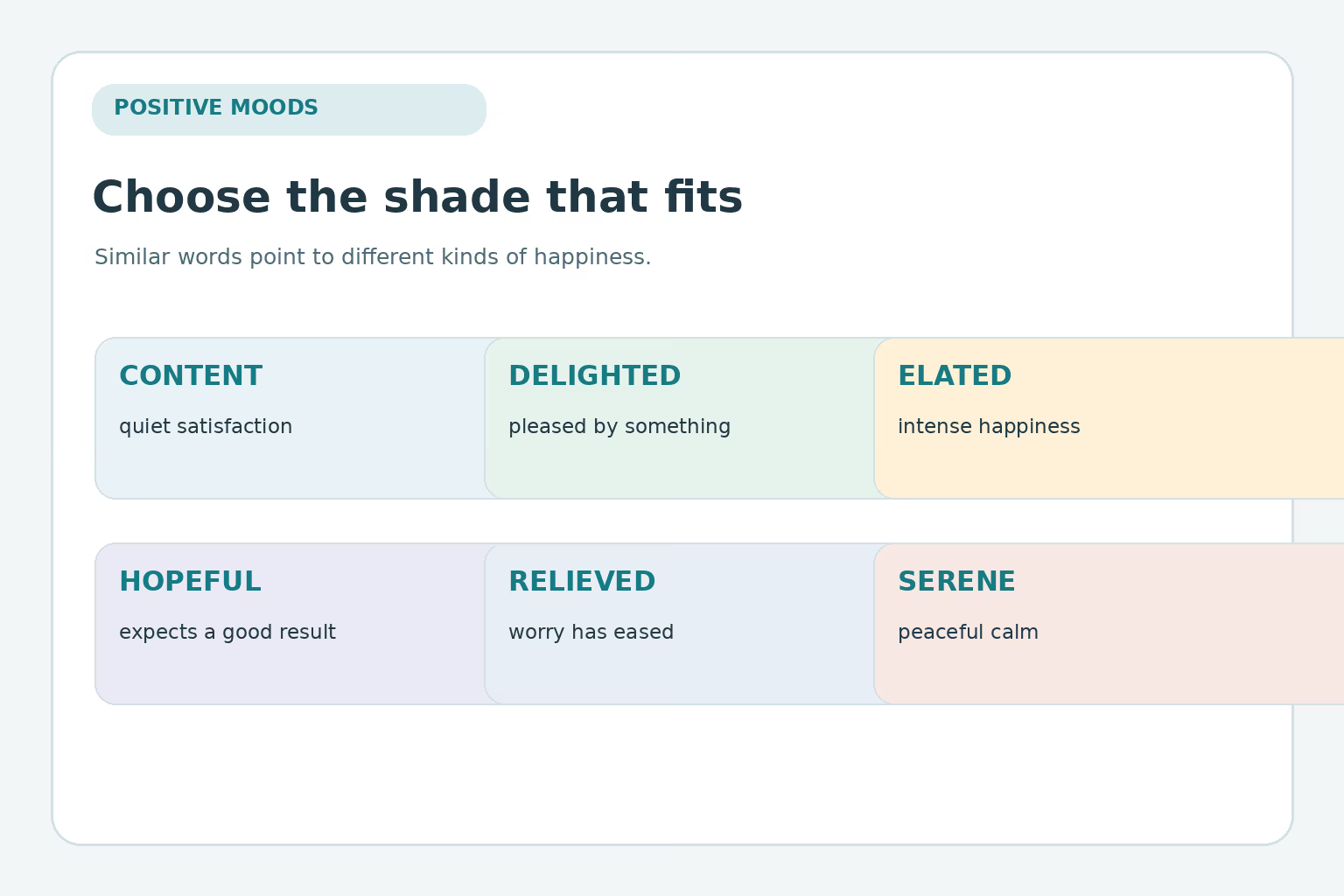
Positive words are not interchangeable. Content suggests quiet satisfaction, while delighted signals a stronger response to something pleasing. Hopeful looks toward a good possibility; relieved describes tension easing after a concern passes. Choose the word that fits the moment rather than stacking several similar adjectives.
- Cheerful: noticeably happy and positive. He sounded cheerful when he called with the news.
- Content: satisfied, often without excitement. After finishing her book, she felt content to sit quietly.
- Elated: intensely happy, often after a success. The team was elated by its unexpected win.
- Hopeful: expecting or wishing for a favorable result. We felt hopeful after the first repair worked.
- Relieved: less worried because a difficulty has passed. I was relieved when the missing keys turned up.
- Serene: peacefully calm. She felt serene during the quiet train ride.
“Excited” and “enthusiastic” emphasize energy and eagerness; “grateful” focuses on appreciation. These can accompany happiness, but each points to a different reason or quality. For example, a person may be grateful without feeling excited, or enthusiastic about a plan while also nervous about it.
Negative and mixed mood adjectives
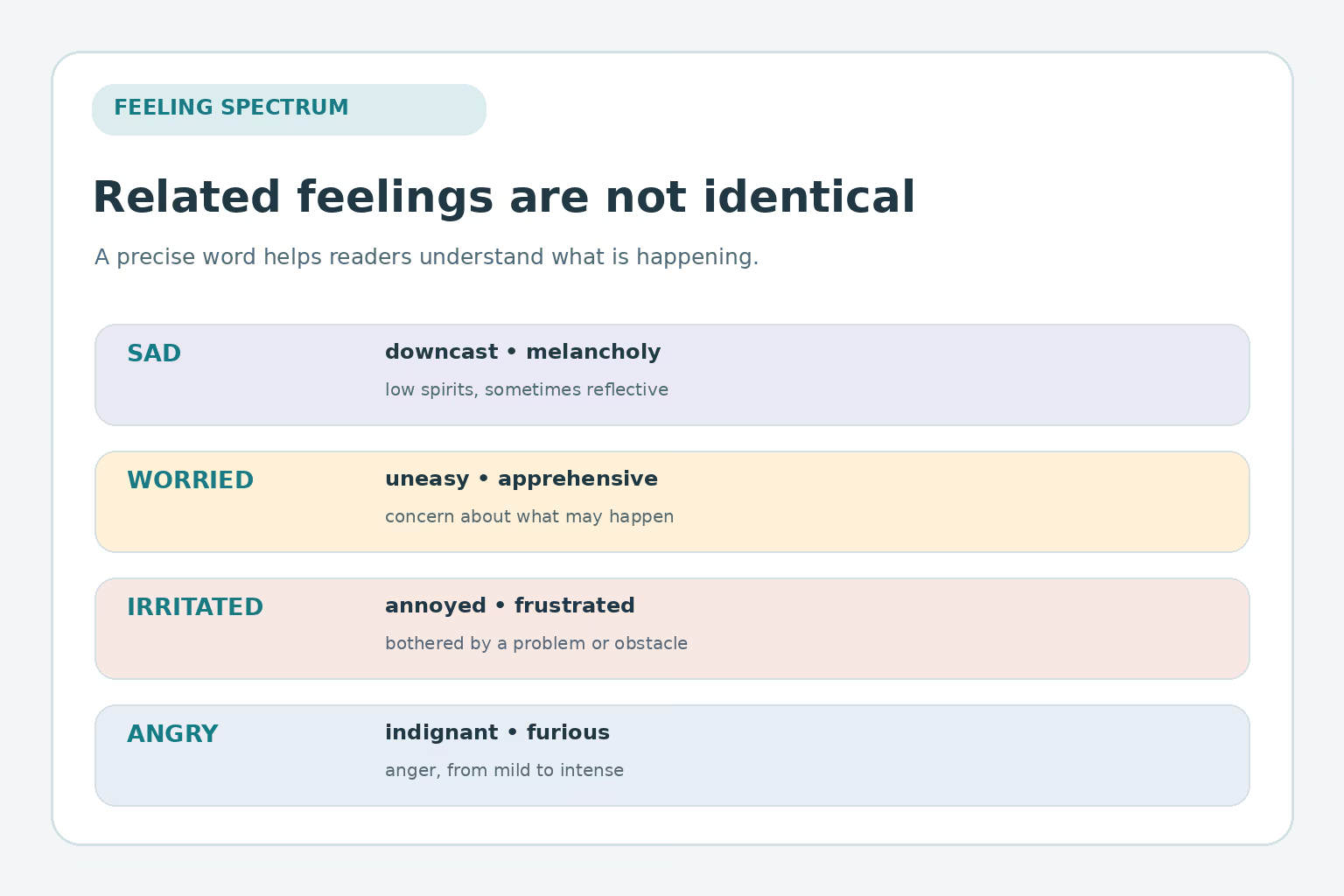
Negative mood words also carry different meanings. Sad is broad; melancholy often sounds quieter and reflective. Anxious points to worry or nervousness, while irritable suggests being easily annoyed. Frustrated often follows an obstacle or unmet goal. A person can have more than one feeling at once, so a sentence can name the mix: “She was disappointed but still hopeful.”
- Uneasy: mildly worried or uncomfortable, often without a clear explanation. He felt uneasy about the sudden change in plans.
- Apprehensive: worried about something that may happen. They were apprehensive before their first performance.
- Dejected: low in spirits, especially after a setback. She looked dejected when the proposal was rejected.
- Resentful: bitter or aggrieved about perceived unfair treatment. He felt resentful after being left out of the decision.
- Overwhelmed: feeling unable to manage the amount of emotion, work, or information. I felt overwhelmed by the number of messages.
- Ambivalent: having conflicting feelings about the same thing. She was ambivalent about moving: excited for the opportunity and sad to leave.
Use moody carefully. It commonly describes a person whose mood changes or who seems unhappy or irritable; it does not simply mean “sad right now.” To describe a temporary state more precisely, write “in a gloomy mood,” “feeling irritable,” or “quiet and withdrawn,” depending on what you mean.
Synonyms and antonyms depend on context
Words in a synonym group share some meaning but do not always fit the same sentence. Try each option aloud and check whether it preserves the cause, intensity, and duration of the feeling.
| Feeling | Near-synonyms | Useful contrast |
|---|---|---|
| Happy | cheerful, pleased, delighted, elated | sad, disappointed |
| Sad | downcast, gloomy, melancholy, dejected | cheerful, buoyant |
| Angry | irritated, annoyed, indignant, furious | calm, appeased |
| Worried | uneasy, nervous, apprehensive, anxious | confident, reassured |
| Calm | peaceful, composed, tranquil, serene | agitated, unsettled |
These are practical contrasts, not universal opposites. A person might be both calm and sad, for example. “Furious” is much stronger than “irritated,” and “pleased” is usually milder than “elated.” When replacing a word, keep its intensity and sentence context in view.
Make a mood adjective more precise
- Name the feeling: Is the person worried, disappointed, irritated, or peaceful?
- Set the intensity: Would “concerned” fit better than “terrified,” or “pleased” better than “ecstatic”?
- Add a clue: Include a thought, action, or detail that supports the description. “Nervous, she reread the note before knocking” gives the reader evidence.
- Check the point of view: If the narrator cannot know another person’s private feeling, describe observable behavior or attribute the emotion (“He seemed uneasy”).
For example, “Mara was angry” labels a feeling. “Mara was irritated when the meeting ran late, then furious when her work was blamed for the delay” shows how the feeling changes and why. A precise adjective can sharpen a sentence, but the surrounding detail is what makes the mood convincing.
Finally, emotional adjectives describe ordinary experiences; they are not diagnoses. Words such as “depressed” or “manic” can have clinical meanings, so in general writing choose a nonclinical alternative such as “downcast,” “low,” or “energetic” when that is what the scene actually shows.


