
Adjectives for movement help readers picture how an action happens: its pace, path, force, or quality. “A swift current” describes speed; “a winding path” describes direction; “a smooth glide” describes how the motion feels. Choose a word that names the feature you want readers to notice, then make sure it fits the thing moving.

What makes an adjective useful for describing movement?
A useful movement adjective gives a reader a specific, observable clue. Quick and slow describe pace; straight, curved, and zigzag describe a route; smooth and jerky describe continuity; light and heavy can suggest the apparent force or impact of steps. These dimensions can combine: a skater may make a swift, smooth turn, while a cart rolls slowly along a bumpy path.
Context matters. Graceful often praises movement that looks smooth or controlled; Cambridge’s dictionary defines it as moving in a smooth, relaxed, attractive way. Swift means moving quickly. Both words express qualities of motion, but graceful also conveys a viewpoint rather than a measurable speed. Sluggish can imply that motion is slower than expected, so it may sound critical when applied to a person. When precision matters, describe the action itself—“the arm moved slowly”—instead of turning one observed motion into a judgment about someone’s ability or character.
| Movement feature | Useful adjectives | Example |
|---|---|---|
| Pace | quick, swift, rapid, slow, gradual | A swift stream carried the fallen leaves. |
| Path or direction | straight, curved, winding, zigzag, circular | The kite traced a looping path across the sky. |
| Continuity or control | smooth, steady, fluid, jerky, uneven | The elevator rose in a steady motion. |
| Apparent force | light, gentle, forceful, powerful, heavy | The drummer made a forceful downward stroke. |
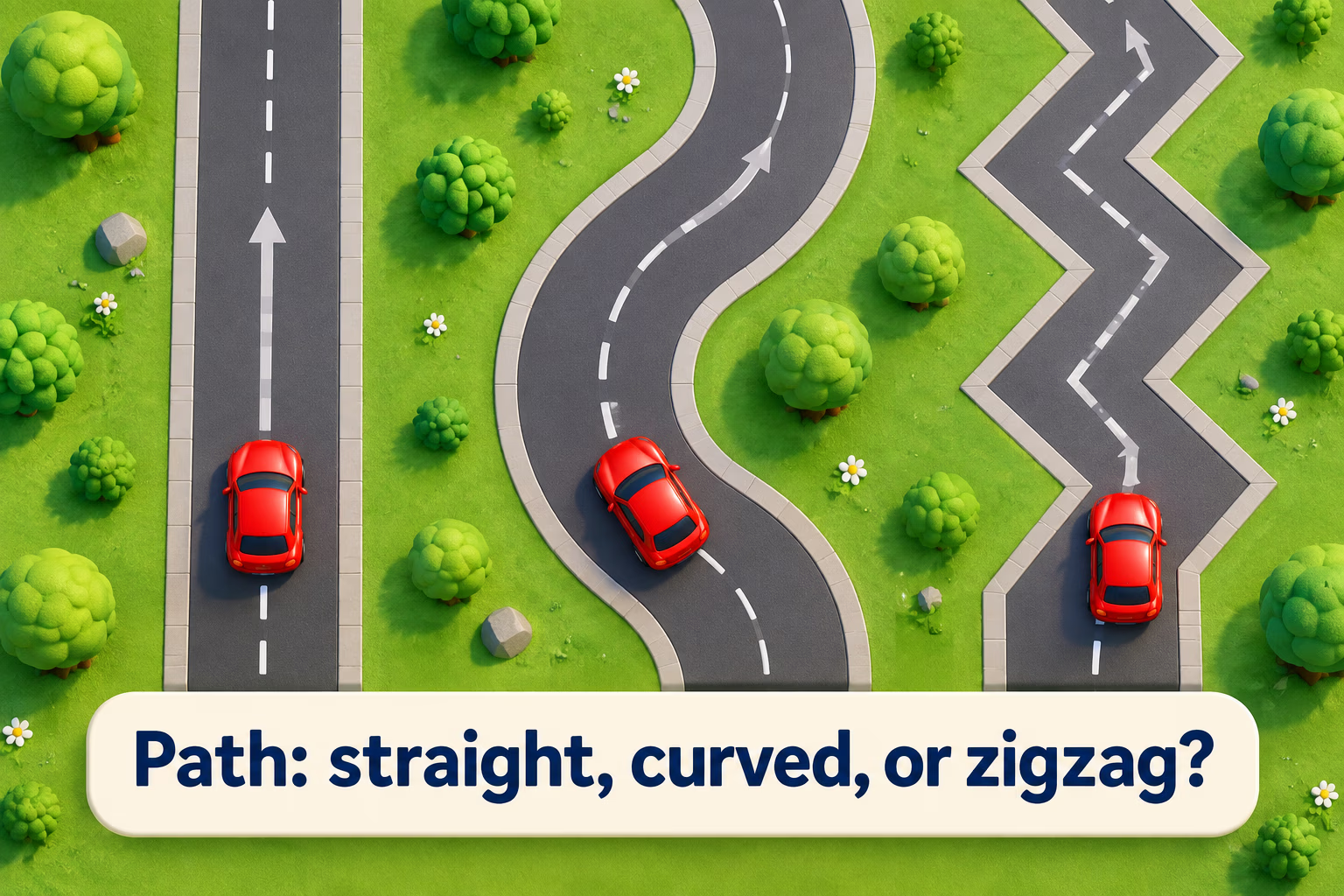
How do pace, path, and movement quality differ?
Pace answers “how fast?”; path answers “where or in what shape?”; quality answers “how does the action unfold?” They are separate observations, so combining one adjective from each group often creates a clearer picture than stacking near-synonyms. For example, “a slow, winding walk” names pace and route, while “a quick, jerky turn” contrasts speed with abrupt changes.
Not every word has one fixed category. Fluid may suggest smooth continuity, but in another context it can refer to a liquid. Dynamic can describe changing or energetic movement, yet it is broad; replace it with a visible detail when the reader needs a precise image.

Which adjectives fit people, animals, objects, and nature?
Match the word to the movement a subject can make. A dancer can make a graceful turn; a bird can make a swift dive; a toy car can follow a curved track; a branch can sway gently; and a river can flow steadily. The same adjective does not fit every subject equally well: nimble usually suggests quick, light movement, while lumbering suggests slow, heavy steps.
Use neutral, observable language when describing a person. Unsteady or stiff can be useful for a particular action, but they should not be treated as a diagnosis or a complete description of someone. A person’s movement may vary by activity, environment, fatigue, equipment, or preference. The CDC’s guidance on communicating with and about people with disabilities recommends respectful language and recognizes that wording preferences can differ; describe what happened without assuming why.

Are “quickly” and “graceful” both adjectives?
Graceful is an adjective: it can describe a noun, as in “a graceful movement.” Quickly is an adverb that describes how an action happens, as in “the rabbit hopped quickly.” Use quick before a noun (“a quick hop”) or after a linking verb (“the movement was quick”). This small distinction helps keep a vocabulary list grammatically accurate while still letting writers pair an adjective and an adverb when needed.
Movement itself is a noun. A phrase such as “adjectives for movement” means adjectives that describe motion or the thing moving; it does not make every movement word an adjective. Cambridge Grammar describes adjectives as qualities of people and things, while its adverb guidance explains that adverbs can modify verbs and actions.
How can you choose a precise movement word?
- Decide whether you are describing pace, path, continuity, or force.
- Name the subject and action: a leaf drifts, a wheel spins, and a person steps.
- Pick a word that matches what a reader could observe, then test it in a sentence.
- Replace a broad or judgmental word if a concrete detail would be clearer.
For instance, “the object moved dynamically” leaves the route and pace unclear. “The red ball rolled quickly down a curved ramp” gives the reader a subject, speed, action, and path. Pair sensory detail with a specific verb when an adjective alone cannot show how the motion changed.
Frequently asked questions
What are some adjectives for movement?
Common choices include swift, slow, smooth, jerky, winding, steady, gentle, and forceful. Pick by feature: swift describes pace, winding describes a route, and steady describes consistent motion. The best choice also fits the subject; a current may flow swiftly, while a dancer may turn smoothly.
What is the difference between movement and motion?
In ordinary writing, movement and motion often overlap: both can refer to a change in position or the act of moving. The surrounding context determines which sounds natural. “The movement of the branch” and “the motion of the branch” are both understandable, while technical fields may use more specialized definitions.
Can one sentence use several adjectives for movement?
Yes, when each word contributes a different detail. “A slow, winding current” combines pace and path; “a quick, smooth glide” combines pace and quality. Avoid piling up synonyms such as “swift, rapid, speedy movement” unless repetition serves a specific style.
The original examples and adjective lists follow as an archive. Some legacy examples mix adjectives with adverbs, verbs, or broad judgments; use the guidance above to select the grammatical form and meaning that fit your own sentence.
Have you ever struggled to find the right words to describe movement? Whether you’re writing a story, describing a dance performance, or simply trying to articulate how something moves, having a rich vocabulary of adjectives for movement can make all the difference. In this article, I’ll share with you a collection of descriptive words that will help you bring movement to life in your writing. From graceful and fluid to swift and jerky, these adjectives will add depth and vividness to your descriptions. So, let’s dive in and explore the world of adjectives for movement together!
When it comes to describing movement, it’s important to choose the right words that accurately capture the essence of what you’re trying to convey. Whether it’s the gentle sway of a tree branch in the wind or the powerful leap of a gymnast, the right adjectives can paint a vivid picture in the reader’s mind. In this article, I’ll provide you with a comprehensive list of adjectives for movement, along with examples to help you understand how to use them effectively. So, if you’re ready to take your writing to the next level and make your descriptions come alive, keep reading!
How to Describe Movement? – Different Scenarios
When it comes to describing movement, it’s important to choose the right adjectives that accurately convey the essence of what you’re trying to describe. By selecting the appropriate words, you can make your writing more vibrant and captivating. Let’s explore different scenarios and the adjectives that best describe movement in each one.
- Animals:
- People:
- Inanimate Objects:
- Natural Phenomena:
By incorporating these descriptive adjectives into your writing, you can paint a vivid picture of movement and bring your descriptions to life. Remember to choose words that accurately reflect the scenario and evoke the desired emotions.
And now, armed with this knowledge, you can enhance your writing with a rich vocabulary of adjectives for movement. Happy writing!
Note: Remember to refer back to the comprehensive list of adjectives for movement in the previous sections.
How to Describe movement? – Different Scenarios
Describing Words for movement in English
When it comes to teaching young children about movement, using the right adjectives can help bring their learning experience to life. In this section, I’ll share some examples of descriptive words for movement that are simple enough for kindergarten and preschool teachers to introduce to their students. These words will help children understand and describe different types of movement in an engaging way.
1. Quick
- The rabbit hopped quickly across the field.
- The cheetah ran quickly to catch its prey.
2. Slow
- The turtle moved slowly along the path.
- The snail crawled slowly on the ground.
3. Smooth
- The ball rolled smoothly down the hill.
- The ice skater glided smoothly across the rink.
4. Bumpy
- The car drove over the bumpy road.
- The train traveled on a bumpy track.
5. Wavy
- The flag waved in the wind.
- The ocean had wavy waves.
6. Zigzag
- The lightning flashed in a zigzag pattern.
- The bee flew in a zigzag path.
7. Curvy
- The snake slithered in a curvy line.
- The river flowed in a curvy path.
8. Straight
- The ruler is straight.
- The arrow flew in a straight line.
9. Twisting
- The dancer performed twisting moves.
- The road took us through twisting turns.
10. Hopping
- The kangaroo hopped on its powerful hind legs.
- The grasshopper was hopping in the garden.
11. Flying
- The bird flew high in the sky.
- The kite soared through the air.
12. Sliding
- The penguin slid on the ice.
- The children went sliding down the hill.
These are just a few examples of the many adjectives that can be used to describe movement. By incorporating these words into their teaching, kindergarten and preschool teachers can help children develop their vocabulary and foster a greater appreciation for the world around them. Remember to use these words in context to give children a clear understanding of how they relate to different types of movement.
Adjectives for movement
When it comes to describing movement, choosing the right adjectives is key. These words can help us paint vivid pictures and convey the energy and dynamics of different actions. In this section, I will provide examples of both positive and negative adjectives for movement, along with example sentences to help you understand how to use them effectively. Whether you are a kindergarten or preschool teacher looking to introduce these words to children or simply someone looking to enhance your writing, these descriptive words will come in handy.
Positive Adjectives for Movement
Positive adjectives are used to describe movement that is lively, energetic, and graceful. They convey a sense of excitement and enthusiasm. Here are twelve examples of positive adjectives for movement:
| Adjective | Example Sentence |
|---|---|
| Agile | The cheetah moved agilely through the grass. |
| Buoyant | The dancer’s movements were buoyant and light. |
| Sprightly | The children skipped and played sprightly. |
| Nimble | The gymnast performed nimble flips and twists. |
| Graceful | The ballerina’s movements were graceful as she twirled. |
| Energetic | The soccer player made an energetic sprint towards the goal. |
| Vibrant | The parade was filled with vibrant and colorful floats. |
| Lively | The party was full of lively dancing and laughter. |
| Agile | The squirrel moved agilely along the tree branches. |
| Zippy | The race car sped around the track with zippy movements. |
| Spirited | The horse galloped with spirited strides. |
| Dynamic | The dancer’s performance was dynamic and captivating. |
Negative Adjectives for Movement
On the other hand, negative adjectives describe movement that is slow, awkward, or clumsy. They convey a sense of heaviness or lack of coordination. Here are five examples of negative adjectives for movement:
| Adjective | Example Sentence |
|---|---|
| Sluggish | The turtle moved in a sluggish pace. |
| Clumsy | He made a clumsy attempt to catch the ball. |
| Stiff | The robot’s movements were stiff and jerky. |
| Lumbering | The elephant made lumbering steps across the field. |
| Awkward | She tripped and fell in an awkward manner. |
Now that you have a list of adjectives for movement, you can incorporate these words into your writing or teaching to create more engaging descriptions. Whether it’s capturing the agility of a cheetah or the gracefulness of a ballerina, these adjectives will bring your descriptions to life. So go ahead and experiment with these words to enhance your writing and captivate your readers.
Stay tuned for the next section where I will provide examples of descriptive adjectives for movement in animals, people, inanimate objects, and natural phenomena.
Synonyms and Antonyms with Example Sentences
Synonyms for movement
When it comes to describing movement, it’s important to have a variety of descriptive words to choose from. Here are some synonyms for movement that you can incorporate into your writing or teaching:
- Crawl: The baby crawled across the floor.
- Creep: The spider creeped along the wall.
- Glide: The skater glided gracefully across the ice.
- Sprint: The cheetah sprinted across the savannah.
- Skip: The child skipped joyfully down the street.
Antonyms for movement
Just as important as synonyms are antonyms, which are words that have opposite meanings. Here are some antonyms for movement that you can use to add contrast and variety to your descriptions:
- Still: The lake was so calm and still.
- Stationary: The bike was stationary, not going anywhere.
- Immobile: The statue stood immobile in the park.
- Motionless: The bird sat motionless on the branch.
- Static: The traffic jam was at a static standstill.
Remember, incorporating a mix of synonyms and antonyms into your writing or teaching can make your descriptions more engaging and dynamic. Use these words to paint vivid pictures and capture the essence of movement.
Conclusion
Choosing the right adjectives to describe movement is essential for creating vivid and engaging descriptions. Throughout this article, we have explored various synonyms and antonyms for movement, along with example sentences to illustrate their usage.
By incorporating a mix of these descriptive words into your writing or teaching, you can bring your descriptions to life and make them more dynamic. Whether you’re describing the graceful movements of a dancer or the swift motions of an athlete, selecting the appropriate adjectives will help your readers or students visualize the scene.
Remember, the key is to strike a balance between synonyms and antonyms. Synonyms can add depth and variety to your descriptions, while antonyms can create contrast and highlight the differences in movement.
So, next time you’re writing or teaching about movement, consider the impact that carefully chosen adjectives can have. By using the right words, you can captivate your audience and transport them into the world of your description.


