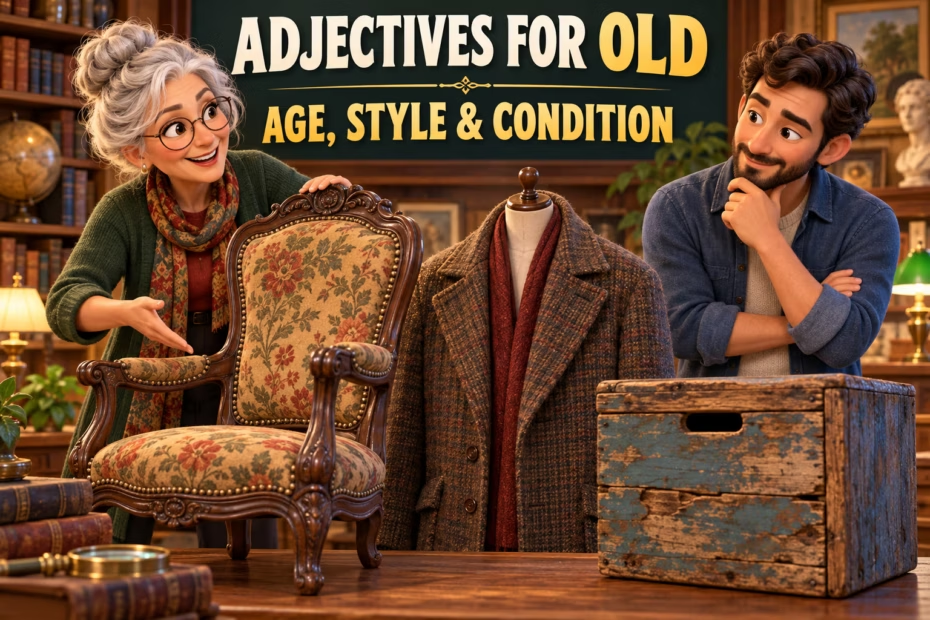
Quick answer: The best adjective for something old depends on what you mean: its period or style, its physical condition, or a person’s age or experience. Vintage points to a past style or period; decrepit describes very poor condition. Choose words for people with care and context.
- For objects, separate age or style from wear and condition.
- For people, a term such as “older adult” or “older person” is often more respectful than a broad label.
- Words such as wise and experienced describe qualities or skills, not age by themselves.
Choose an Adjective for the Context
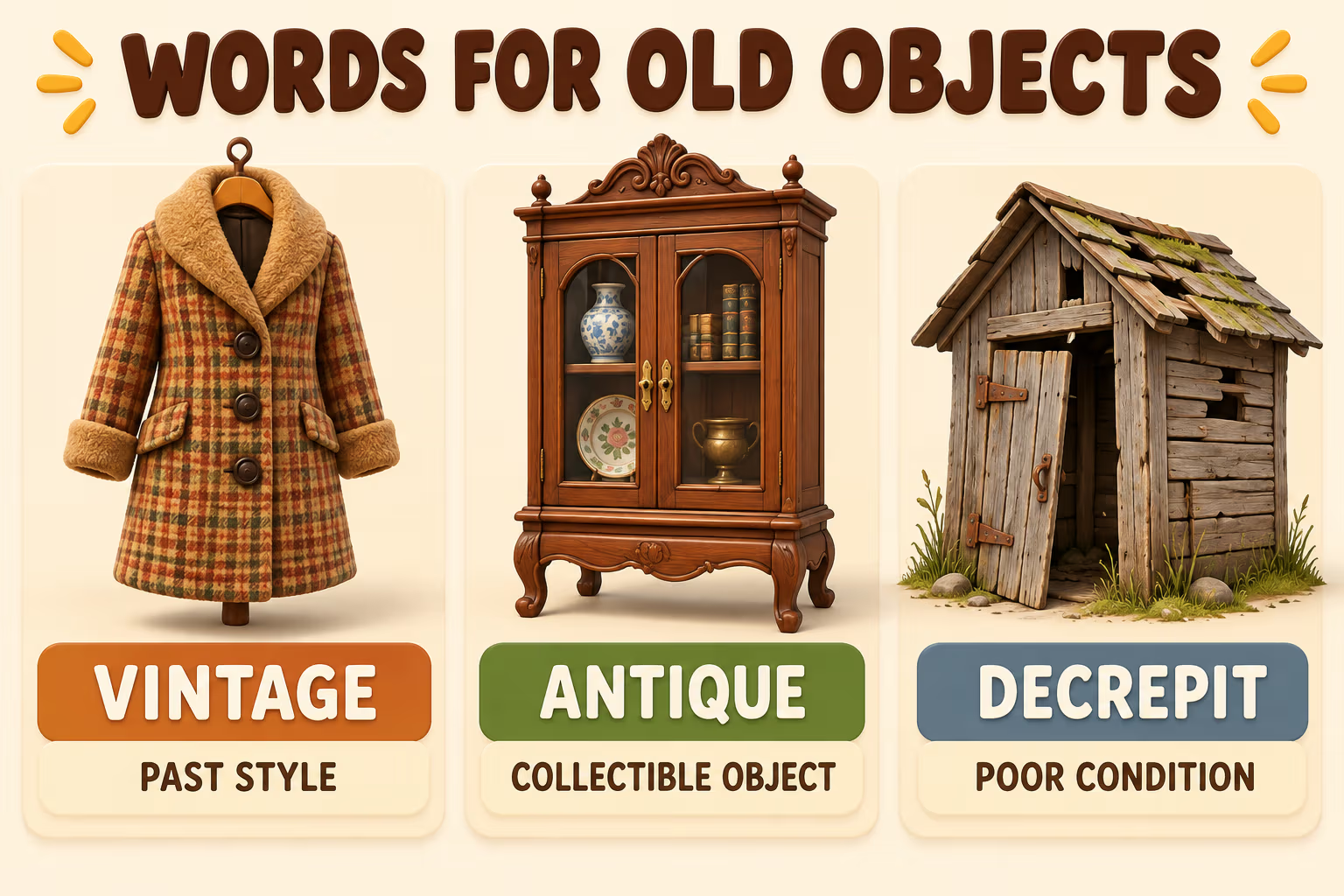
“Old” can refer to how long something has existed, a style from an earlier period, or the condition that comes with wear. These ideas overlap, but the adjectives are not interchangeable. Cambridge defines vintage in part as something from the past that is typical of its period; an antique is an earlier-period item valued for qualities such as age, rarity, or quality; and decrepit describes very bad condition. See the linked vintage, antique, and decrepit entries for definitions and usage.
| What you mean | Possible word | What it emphasizes | Example |
|---|---|---|---|
| Style or period | Vintage | A past era or a style typical of it. | She found a vintage coat from the 1970s. |
| Collectible object | Antique | An earlier-period item valued for qualities such as age, rarity, or craftsmanship. | They restored an antique cabinet. |
| Exposure over time | Weathered | Visible effects of weather or use; it does not automatically mean neglected. | The weathered fence showed years of sun and rain. |
| Wear from time or use | Time-worn | A marked or softened appearance from age or repeated use. | The time-worn steps led to the old harbor. |
| Poor physical condition | Dilapidated, crumbling, decrepit | Deterioration or disrepair, usually with a negative tone. | The decrepit shed needed structural repairs. |
| Skill gained through practice | Experienced, well-seasoned | Knowledge or skill from doing something; not a person’s age. | The experienced chef taught the new staff. |
| Age of a person | Older adult, older person | A person’s age, stated without assuming a particular ability or personality. | The program welcomes older adults from the neighborhood. |
| Judgment or knowledge | Wise | A quality of judgment or insight, not an automatic result of age. | Her wise advice drew on years of experience. |
Describing Older People Respectfully
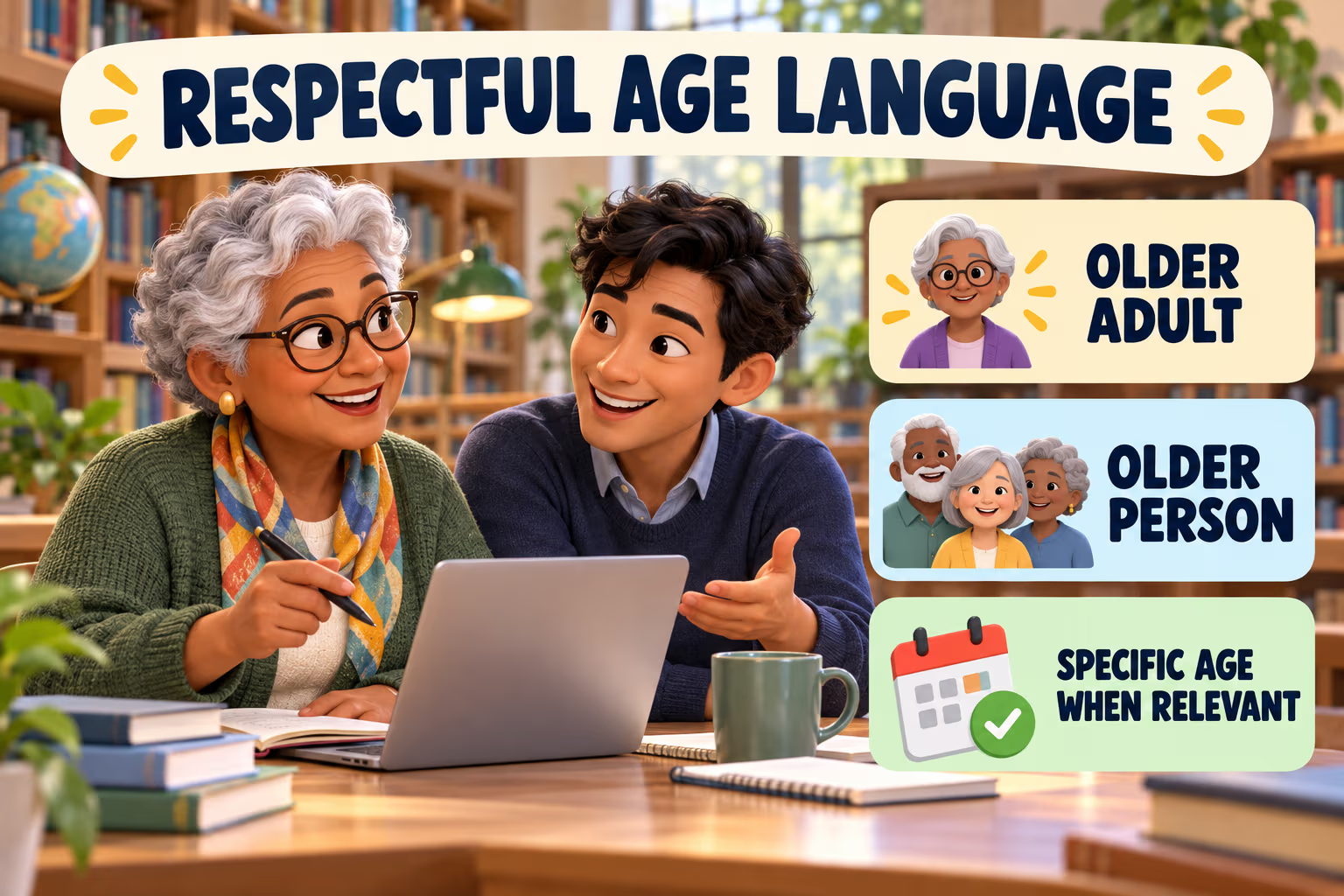
When the subject is a person, avoid treating age as a personality or ability. The American Psychological Association’s inclusive-language guide advises against labels such as “the elderly,” “the aged,” and “senior citizens,” which can make older adults sound like a separate group. The NIH Style Guide recommends specific wording such as “older adults,” “older people,” or an age range when the detail is relevant.
Preferences and context still matter. Use a person’s stated preference when you know it, and include an exact age or range only when it helps the reader understand the subject. “An older adult who restores furniture” is more precise than assuming that someone is wise, frail, experienced, or out of date because of age. See the APA Inclusive Language Guide and the NIH Style Guide’s age guidance for more detail.
Some source examples need a context check. Experienced usually describes someone who has gained knowledge or skill through practice, so “Grandma shared her experienced advice” sounds awkward; “Grandma shared advice shaped by experience” is clearer. Likewise, fragile describes a tendency to break or be damaged, not simply an object’s age. These distinctions help keep an adjective specific.
Synonyms and Antonyms Depend on the Meaning
There is no single opposite for old in every sentence. Choose a contrast that matches the sense: an object may be old versus new, a person may be older versus younger, and a design may be old-fashioned versus modern. Words such as vintage, antique, aged, and decrepit each add different information, so do not substitute them mechanically.
| Sense of “old” | Useful contrast | Example |
|---|---|---|
| Made or acquired earlier | New, recently made | The old chair was replaced by a new one. |
| Earlier in a person’s life stage | Younger | He is older than his sister. |
| Style from an earlier period | Modern, contemporary | The modern addition contrasts with the historic building. |
| In poor condition after age or use | Sound, intact, well-maintained | The weathered gate still works; the decrepit shed does not. |
For a wider life-stage vocabulary, continue to our guide to adjectives for age. Use the original list below as a vocabulary bank, then check the word’s target, tone, and meaning before choosing it.
When it comes to describing something or someone as old, there is a wide range of adjectives that can be used. These words not only convey the age of an object or person, but also add depth and character to our descriptions. In this article, I’ll be sharing with you some of the most commonly used adjectives for old, along with examples to help you understand their usage in context. From ancient to vintage, there are various adjectives that can be used to describe something as old. Each word carries its own unique connotation, allowing us to paint a vivid picture in the minds of our readers. Whether you’re describing an antique piece of furniture, a historical landmark, or a person with years of wisdom, these adjectives will help you capture the essence of age in your writing.How to Describe old? – Different Scenarios
When it comes to describing something or someone as old, there are many different scenarios where specific adjectives can be used. These adjectives not only convey the age of an object or person, but also add depth and character to descriptions. Let’s explore some different scenarios and the adjectives that can be used in each:- Ancient Artifacts
- Antique: It refers to objects that are over 100 years old and hold value due to their historical significance.
- Archaic: It suggests an object or style that is no longer in common use and belongs to an earlier time.
- Old Buildings
- Historic: This term implies a building’s association with a significant event or period in history.
- Victorian: It refers to buildings or architectural styles from the Victorian era, characterized by intricate details and ornate design.
- Aging People
- Elderly: It refers to someone who is advanced in age and may suggest a level of respect and honor.
- Wise: This adjective implies that the person has acquired a great deal of knowledge and experience through the years.
Describing Words for old in English
When it comes to describing something or someone as old, there are a variety of adjectives that can be used. These adjectives not only convey age but also add depth and character to our descriptions. In this section, I’ll share some common adjectives that can be used to describe old things or individuals. Let’s dive in!- Ancient
- Vintage
- Time-worn
- Weathered
- Well-seasoned
- Aged
- Dilapidated
- Crumbling
- Antique
- Decrepit
Adjectives for old
In this section, I will provide you with a list of adjectives that can be used to describe something or someone as old. These adjectives not only convey age but also add depth and character to descriptions. Let’s explore both positive and negative adjectives for old with example sentences.Positive Adjectives for Old
When describing something as old in a positive light, we can use these adjectives:- Ancient: The ancient artifact held great historical significance.
- Vintage: I found a beautiful vintage dress at the thrift store.
- Time-worn: The time-worn book held the stories of generations past.
- Weathered: The weathered barn stood strong despite its age.
- Well-seasoned: The well-seasoned chef prepared a delicious, old-fashioned meal.
- Aged: The aged wine had a rich and complex flavor.
- Experienced: Grandma shared her experienced advice on life.
- Classic: The classic car turned heads wherever it went.
- Antique: He collected antique furniture for its unique charm.
- Historic: The historic building was a symbol of our city’s past.
- Enduring: The enduring story captured the hearts of readers for decades.
- Storied: The storied mansion held tales of legendary parties.
Negative Adjectives for Old
On the other hand, when we want to emphasize the negative aspects of something being old, we can use these adjectives:- Dilapidated: The dilapidated house was in desperate need of repairs.
- Crumbling: The crumbling castle was a mere shadow of its former glory.
- Worn-out: The worn-out shoes were no longer suitable for running.
- Decrepit: The decrepit bridge was unsafe to cross.
- Fragile: The fragile antique vase required careful handling.
Synonyms and Antonyms with Example Sentences
Synonyms for Old
When it comes to describing something or someone as old, there are many synonyms that can convey the sense of age and history. Here are some examples:| Synonym | Definition | Example Sentence |
|---|---|---|
| Ancient | Very old | The book is filled with ancient wisdom. |
| Vintage | Old-fashioned, from a past era | My grandmother’s vintage dress looked stunning on her. |
| Time-worn | Worn out by time or use | The time-worn steps of the old house creaked with every step. |
| Weathered | Worn and aged due to exposure | The weathered ship had seen many storms in its long journey. |
| Well-seasoned | Experienced and skillful | The well-seasoned chef knew exactly how to blend the flavors. |
| Aged | Having reached a certain age | The aged wine had a rich, complex flavor. |
| Antique | Belonging to an earlier time | The antique furniture added a touch of elegance to the room. |
| Decrepit | In a state of disrepair | The decrepit building was in desperate need of renovation. |
Antonyms for Old
On the other hand, if you want to describe something as the opposite of old, there are also antonyms that can be used. Here are a few examples:| Antonym | Definition | Example Sentence |
|---|---|---|
| New | Recently made or created | I bought a new pair of shoes for the party. |
| Modern | Of or pertaining to recent times | The modern design of the building stood out in the city skyline. |
| Youthful | Having the qualities of youth | She has a youthful energy that is contagious. |
| Fresh | Newly made or obtained | The fresh bouquet of flowers brightened up the room. |
| Contemporary | Of the present time | The contemporary art exhibition showcased the work of local artists. |
Conclusion
In this article, we have explored a variety of adjectives that can be used to describe something or someone as old. By using these descriptive words, we can paint a vivid picture and bring depth to our descriptions. From ancient and vintage to time-worn and weathered, these adjectives not only convey age but also add character and richness to our language. We have also discussed the importance of choosing the right adjective to accurately capture the essence of what is being described. By selecting the appropriate adjective, we can evoke specific emotions and create a more engaging experience for our readers. Additionally, we have introduced antonyms for old, such as new, modern, youthful, fresh, and contemporary. These contrasting words provide a balance and allow us to further expand our vocabulary when describing age. The use of adjectives for old allows us to create more compelling and descriptive narratives. By incorporating these words into our writing, we can bring our descriptions to life and engage our readers on a deeper level.Frequently Asked Questions
What is a good adjective for an old object?
Choose the word that describes the feature you mean. Vintage can point to a past style or period, antique to an earlier-period collectible, and weathered to visible exposure or wear. If the object is in very poor condition, dilapidated or decrepit may fit, with a negative tone.
Are “vintage” and “antique” synonyms?
They overlap around things from the past, but they emphasize different ideas. Vintage often describes an item that reflects the style of its period; antique often describes an earlier-period item collected for qualities such as age, rarity, or quality. The right label depends on the object and the context.
What is a respectful way to describe an older person?
When age is relevant, terms such as “older adult” or “older person” are commonly recommended in APA and NIH style guidance. Avoid reducing a person to a group label, and do not infer ability, health, or personality from age. If you know the individual’s preferred wording, follow it.
Does “decrepit” just mean old?
No. Decrepit adds a strong judgment about very poor condition, often because of age, heavy use, or lack of care. An old building can still be sound and well-maintained. Use decrepit when the deterioration matters, and choose a neutral age word when it does not.
Is “experienced” another word for old?
No. Experienced describes someone who has knowledge or skill from doing something. A person may be experienced at any adult age, while an old object has no personal experience. To describe advice, say it is informed by experience; to describe a person, say “an experienced chef.”


