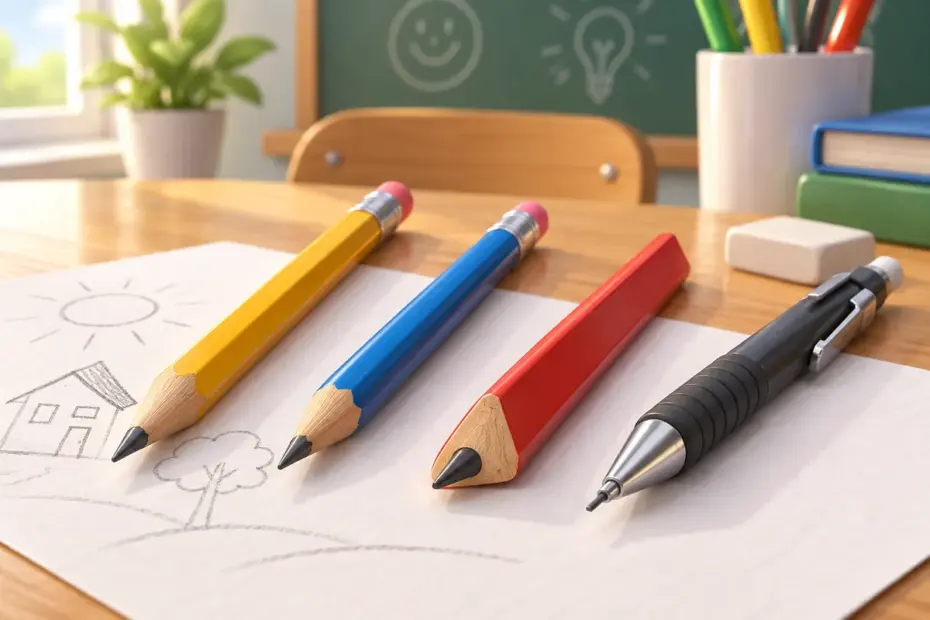
Adjectives for Pencil: 40 Descriptive Words
Adjectives for a pencil can describe its shape, surface, color, condition, or the mark it makes. Words such as hexagonal, glossy, stubby, yellow, and smudge-prone give readers different details; choose observable traits for factual descriptions and reserve opinion words for a clearly personal impression.
Key facts at a glance
- Shape adjectives include round, hexagonal, triangular, slender, and stubby.
- Surface words such as matte, glossy, smooth, and lacquered describe visible finish or feel.
- Soft and hard can refer to graphite grade or the mark a pencil makes; context matters.
- Most pencil cores called “lead” are graphite and clay, not the metal lead.
- Specific adjectives help readers picture a pencil more accurately than a string of synonyms.
What adjectives describe a pencil?
Pencil adjectives describe traits readers can see, feel, or infer from use: shape, size, finish, color, condition, and graphite behavior. A short pencil describes length; a hexagonal pencil describes its barrel; a blunt pencil describes its point. Pick words that match the detail you want to communicate.
The word lead is traditional shorthand for the writing core, but the U.S. Geological Survey notes that pencil “lead” contains graphite and clay, not metallic lead. If you describe the mark, use phrases such as dark graphite line or pale, erasable mark to avoid confusing the core with the metal.
Shape, size, and build adjectives
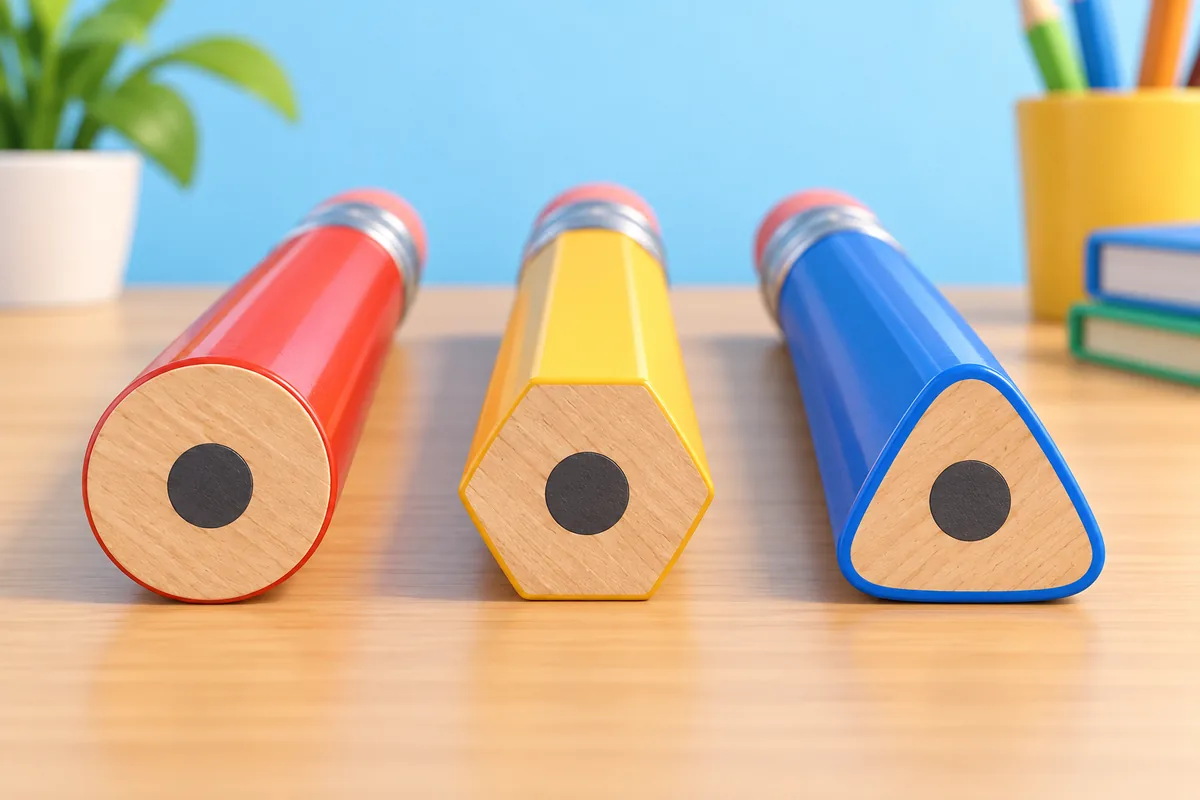
Useful form words include round, hexagonal, triangular, slender, thick, short, stubby, long, lightweight, and mechanical. “The triangular pencil rested comfortably between the student’s fingers” describes both shape and use; “a stubby pencil” suggests little length remains.
Some adjectives name construction rather than size. A wooden pencil has a wood casing; a mechanical pencil advances a replaceable lead through its holder. Manufacturer examples show that products may vary in shape and finish: one STABILO graphite model is hexagonal, made from wood, and has a matte surface. Do not assume every pencil shares those features.
Surface, color, and condition words
Surface adjectives include smooth, rough, glossy, matte, lacquered, and striped. Color words include yellow, red, blue, striped, bright, and muted. Condition words include new, worn, broken, sharpened, blunt, and eraserless.
Prefer details that are visible or testable. “The worn pencil had chipped paint near the eraser” is more informative than “The pencil looked bad.” If color matters, name it directly; if the surface has a finish, use glossy or matte instead of the less precise nice.
Writing feel and graphite adjectives
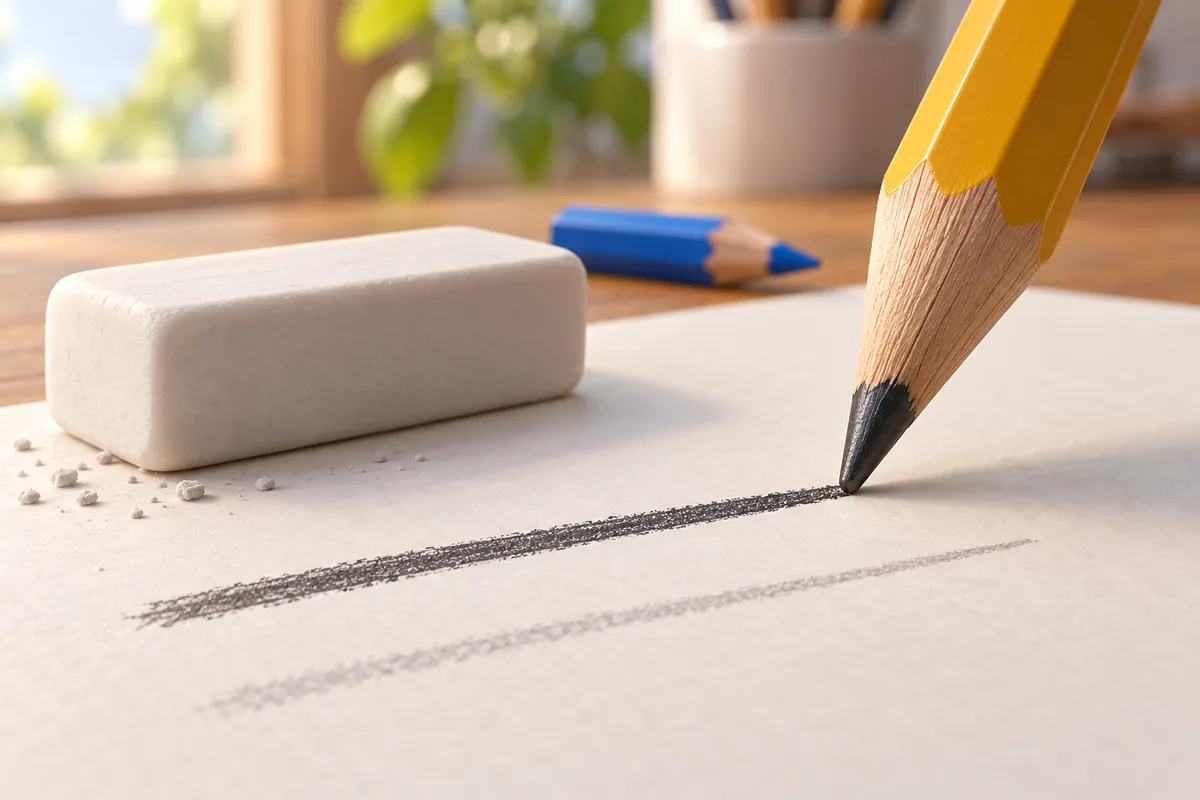
Words about writing behavior include smooth-writing, fine-point, dark-marking, light-marking, smudgy, erasable, and break-resistant. These describe a particular pencil or its marks, so they work best when grounded in an observation: “The 2B pencil made a darker line than the HB pencil on this paper.”
Pencil grades vary by manufacturer and system. Faber-Castell explains that graphite-and-clay proportions affect hardness, with H grades generally harder and B grades softer; exact grades are not fully standardized across brands. For precise writing, name the grade and maker rather than calling every dark-looking pencil simply “soft.”
How to choose the right pencil adjective
Start by deciding what the reader needs to picture. For a product description, include construction and grade: “a hexagonal HB wooden pencil with a matte finish.” For a story, choose one or two details that support the scene: “a chewed, blunt pencil rolled under the desk.” For an art review, describe the line or shading rather than only the pencil’s color.
Avoid adjective piles such as “nice, good, great, lovely.” They do not tell a reader what the object looks or feels like. Mix one measurable trait with one relevant impression: “The short, lightweight pencil fit the child’s hand.” If the adjective is subjective—such as elegant or charming—make clear whose judgment it represents.
Frequently asked questions
What are five adjectives for a pencil?
Five useful pencil adjectives are hexagonal, wooden, yellow, blunt, and smooth-writing. They describe different traits: shape, casing, color, point condition, and writing feel. Choose a word that matches the pencil rather than adding a detail you cannot observe directly in person.
What words describe a pencil’s shape?
Shape words for a pencil include round, hexagonal, triangular, slender, and thick. For example, “The triangular pencil rolled less easily across the desk” connects a specific shape with an observable result. Use stubby for a short pencil, not a short point.
Is pencil lead made of real lead?
No. A modern graphite pencil core is commonly called “lead,” but it is not the metal lead. The U.S. Geological Survey describes graphite and clay as materials found in a pencil; the blend and proportions affect how the core writes. Use graphite core in technical descriptions.
What adjectives describe how a pencil writes?
Words such as smooth-writing, fine-point, dark-marking, light-marking, smudgy, and erasable describe writing behavior. Results depend on grade, paper, and pressure, so compare pencils under similar conditions. A specific example is clearer than a broad claim such as “best” for your task.
Conclusion
Use adjectives for pencil examples to make the intended meaning or description specific, accurate, and easy for a reader to picture.
When it comes to describing a pencil, there are a plethora of adjectives that can capture its various characteristics. From the color and texture to its size and shape, these descriptive words help bring the humble pencil to life. In this article, I’ll be sharing a curated list of adjectives that can be used to describe pencils, along with examples to help you visualize their usage. So whether you’re a writer looking for the perfect words to describe your favorite pencil or simply curious about the different qualities of this essential tool, read on to discover the descriptive world of pencils.
A pencil can be more than just a writing instrument; it can be a work of art, a tool for creativity, and a symbol of precision. Each pencil possesses unique qualities that make it stand out from the rest. From the classic wooden pencil to the sleek mechanical ones, there’s an adjective to capture the essence of every type. In this article, I’ll be delving into the world of adjectives for pencils, exploring the various attributes that make them special. So whether you’re a student, artist, or simply someone who appreciates the beauty of a well-crafted pencil, get ready to dive into the fascinating world of pencil descriptions.
How to Describe pencil? – Different Scenarios
How to Describe a Pencil? – Different Scenarios
When it comes to describing a pencil, there are various scenarios in which different adjectives can be used. Here are some situations where you may need to describe a pencil in detail:
- Writing: Whether you’re a student working on an assignment, a writer crafting a story, or simply jotting down notes, you want a pencil that is reliable, smooth, and comfortable to hold. Consider using adjectives like:
- Drawing: Artists and creative individuals often rely on pencils for sketching, shading, and creating detailed artworks. When describing a pencil for drawing, consider using adjectives like:
- Coloring: Pencils are commonly used for coloring books and other artistic projects. When describing a pencil for coloring, consider using adjectives like:
In each of these scenarios, the right adjectives can help convey the specific qualities of a pencil that make it suitable for a particular task. Whether you’re looking for a reliable writing pencil, a versatile drawing pencil, or vibrant coloring pencils, there is a wide range of adjectives to choose from to describe your pencil accurately and vividly.
Describing Words for pencil in English
When it comes to describing pencils, there are a multitude of adjectives that can accurately capture their unique qualities. From the smoothness of the lead to the vibrancy of the colors, finding the right words can help convey the specific characteristics that make a pencil suitable for a particular task. In this section, I’ll provide examples of adjectives that can be used to describe pencils, whether they are used for writing, drawing, or coloring.
Describing Words for Writing Pencils
When it comes to writing, having the right pencil is essential for achieving neat and legible handwriting. Here are some adjectives that can be used to describe writing pencils:
- Reliable: A pencil that consistently produces clear and precise lines.
- Sharp: A pencil with a fine point that allows for accurate writing.
- Smooth: A pencil that glides effortlessly across the paper, making writing an enjoyable experience.
- Erasable: A pencil that can be easily erased without leaving smudges or marks.
Describing Words for Drawing Pencils
Drawing pencils require different qualities to bring creativity to life on the paper. Here are some adjectives that can be used to describe drawing pencils:
- Versatile: A pencil that can create varying levels of shading and depth in drawings.
- Bold: A pencil that produces strong and prominent lines, ideal for outlining or sketching.
- Blendable: A pencil that can be easily blended on the paper, allowing for smooth transitions and shading.
- Expressive: A pencil that enables the artist to convey emotion and detail in their artwork.
Describing Words for Coloring Pencils
Coloring pencils open up a whole new world of creativity. Here are some adjectives that can be used to describe coloring pencils:
- Vibrant: A colored pencil that produces rich, bright colors.
- Blendable: A pencil that can be seamlessly blended with other colors, creating a smooth and uniform appearance.
- Precise: A pencil that allows for detailed coloring, perfect for intricate designs.
- Long-lasting: A colored pencil that maintains its color intensity even after prolonged use.
Adjectives for pencil
When it comes to describing pencils, the right adjectives can make all the difference. Whether you are writing, drawing, or coloring, finding the perfect words to capture the unique qualities of a pencil is essential. In this section, I’ll share some positive and negative adjectives that can be used to describe pencils, along with example sentences to help you understand how to use them.
Positive Adjectives for Pencil with 12 Example Sentences
- Versatile: This pencil can be used for both writing and drawing.
- Smooth: The pencil glides effortlessly across the paper.
- Precise: The pencil allows for detailed and accurate lines.
- Reliable: This pencil never fails to deliver consistent results.
- Ergonomic: The pencil is designed for comfortable and easy control.
- Long-lasting: This pencil has a durable lead that withstands frequent use.
- Vibrant: The colored pencils produce vivid and vibrant hues.
- Blendable: These colored pencils can be easily blended together.
- Lightweight: The pencil is lightweight, making it easy to carry around.
- Sharpenable: The pencil can be sharpened to a fine point.
- Eco-friendly: This pencil is made from sustainable and recyclable materials.
- Affordable: These pencils offer great quality at an affordable price point.
- Dull: This pencil produces faint lines and needs to be sharpened.
- Scratchy: The lead of this pencil feels rough and scratchy on the paper.
- Smudgy: The pencil tends to smudge, making the drawing look messy.
- Fragile: This pencil is prone to breakage with minimal pressure.
- Unreliable: The pencil’s lead often breaks, causing interruptions in your work.
Remember, choosing the right adjectives can help you accurately convey the specific qualities of a pencil. By using descriptive words, you can effectively communicate the features and characteristics that make a pencil suitable for a particular task.
Next, we’ll explore some common adjectives used to describe the colors of pencils, providing even more insight into the world of pencils and their attributes.
Synonyms and Antonyms with Example Sentences
Synonyms for Pencil
Synonyms and Antonyms with Example Sentences
When it comes to describing pencils, there are various synonyms you can use to add depth to your descriptions. Here are some examples of synonyms for “pencil” that can help expand your vocabulary and make your writing more interesting:
| Synonym | Definition | Example Sentence |
|---|---|---|
| Writing utensil | An instrument used for writing or drawing | I picked up my writing utensil to jot down a quick note. |
| Graphite pencil | A pencil made with graphite, used for writing and drawing | She filled in the details of her sketch with a graphite pencil. |
| Lead pencil | A pencil made with lead or graphite that leaves a gray mark | I reached for a lead pencil to write my to-do list. |
| Sketching pencil | A pencil used for drawing or sketching | The artist used a sketching pencil to create precise lines in her artwork. |
| Mechanical pencil | A pencil with a thin replaceable lead that doesn’t require sharpening | My mechanical pencil broke, so I had to switch to a regular one. |
Using synonyms can make your writing more engaging and prevent repetition of the same word. Experiment with these synonyms to find the ones that best fit the description you want to convey.
Antonyms for Pencil
On the other hand, if you want to talk about the opposite qualities of a pencil, you can use antonyms. Antonyms are words that have opposite meanings. Here are some examples of antonyms for “pencil” that can help you contrast different attributes:
| Antonym | Definition | Example Sentence |
|---|---|---|
| Eraser | An object used to remove or correct mistakes made with a pencil | I carefully used the eraser to fix the smudges on my drawing. |
| Pen | A writing instrument with ink instead of graphite or lead | I switched from using a pencil to a pen for my final draft. |
| Marker | A writing tool that uses ink or paint to create bold lines | She grabbed a marker to highlight important information. |
| Paintbrush | A tool used for applying paint to a surface | The artist put down her pencil and picked up a paintbrush to add color to her artwork. |
| Chalk | A soft, white writing tool used on blackboards or sidewalks | The teacher wrote the math problem on the board with a piece of chalk. |
Using antonyms can help you create a contrast and highlight the differences between a pencil and other writing or drawing tools.
By utilizing synonyms and antonyms, you can enhance your descriptions of pencils and make your writing more vivid. Experiment with different words to find the ones that best capture the qualities you want to convey. Remember, the right words can make a significant difference in engaging your readers and making your writing more interesting.
Conclusion
Describing pencils with adjectives is a powerful tool that allows us to accurately convey their unique qualities. By carefully selecting the right adjectives, we can paint a vivid picture in the reader’s mind and make our writing more engaging. Throughout this article, we have explored the importance of using adjectives to describe pencils and have provided examples of positive and negative adjectives that can be used.
We have also discussed how adjectives can be used to describe the colors of pencils, adding further depth to our descriptions. Additionally, we have introduced the use of synonyms and antonyms to enhance our descriptions, allowing us to create contrast and capture the full range of qualities and characteristics that pencils possess.
The use of adjectives is an essential skill in writing, and when it comes to describing pencils, it can make all the difference. So, let’s continue to experiment with different words, capturing the qualities we want to convey and making our writing truly come alive.


