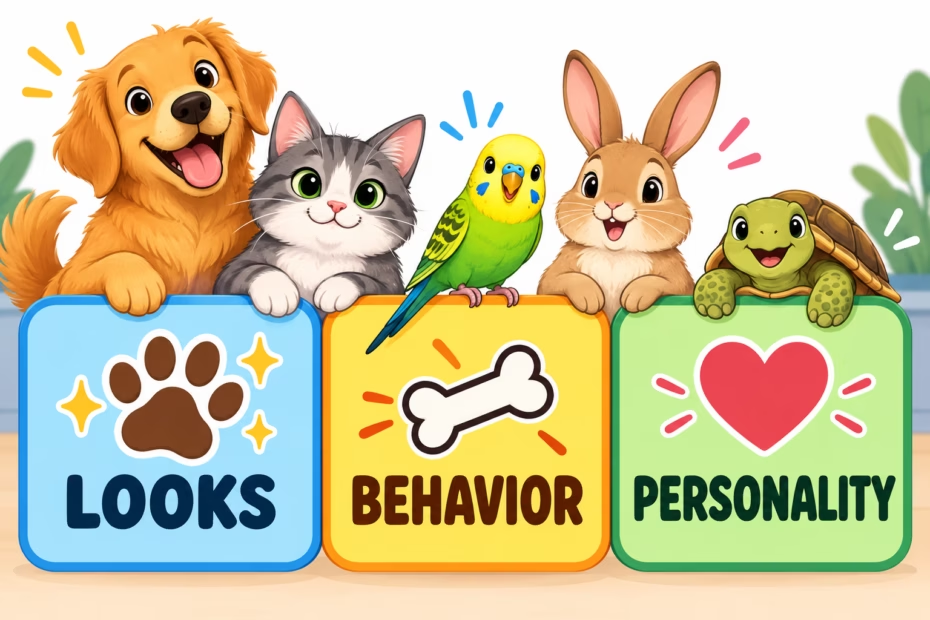
Adjectives for pets work best when they tell readers something specific about an animal’s appearance, observable behavior, or individual temperament. Choose a word that fits this pet and moment, then add an example: “Milo is a curious cat who watches every visitor from the windowsill.”
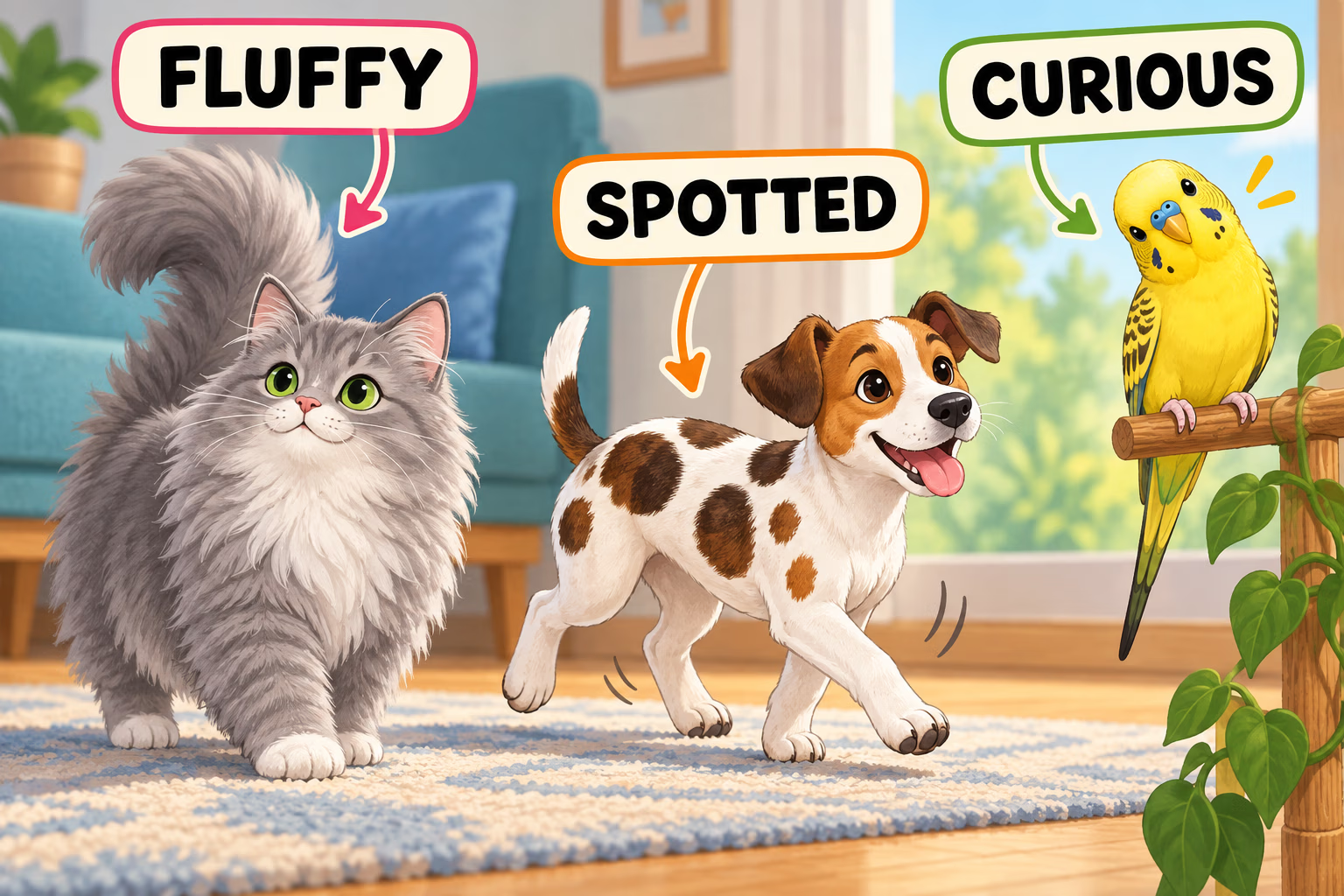
- Appearance: fluffy, spotted, small, long-haired.
- Observable behavior: playful, quiet, curious, energetic.
- Interaction or temperament: affectionate, cautious, sociable, independent.
- Make it precise: support a broad word with a concrete action or detail.
- Remember: no adjective describes every dog, cat, bird, or other pet.
How do you choose an accurate adjective for a pet?
Start with what you can see or reliably know, rather than guessing what an animal feels. “The dog brings the ball back three times” gives evidence for playful; “the dog is playful” is a concise interpretation. If you are describing an unfamiliar pet, prefer observable details such as small, curly-coated, or quiet over a confident personality label.
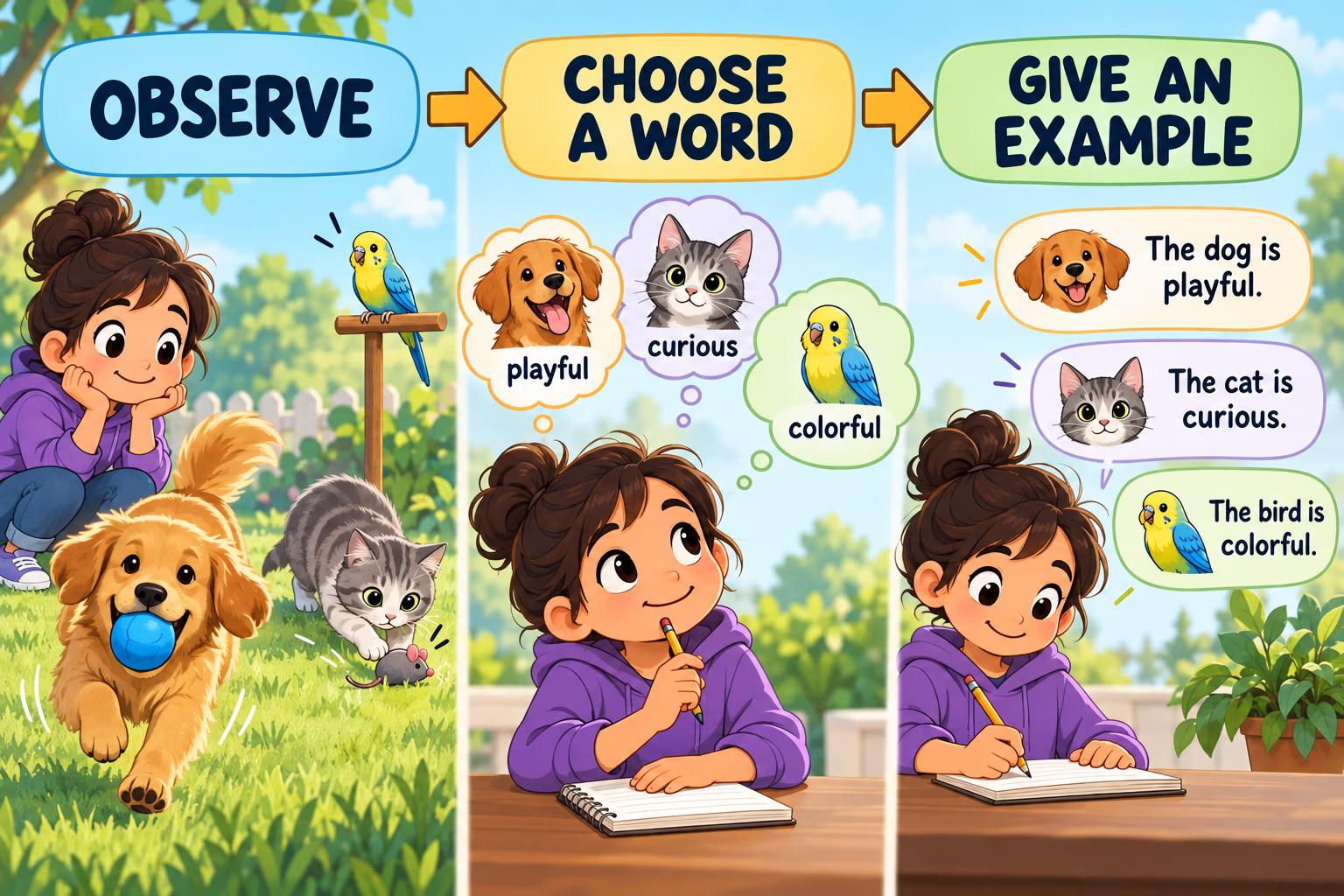
- Observe one detail: note a feature, action, or interaction.
- Choose a matching adjective: use fluffy for a thick soft-looking coat, curious for active investigation, or gentle for careful behavior in the example you observed.
- Check the context: say when or where the trait appears if it changes by situation.
- Give evidence: add an action, feature, or short example that helps a reader picture the animal.
For example, “The cautious rabbit stayed near its shelter when visitors arrived” is more informative than “The rabbit is shy.” The first sentence reports an observable response in a particular setting; it does not claim the rabbit behaves that way everywhere.
What kinds of pet adjectives can you use?
Most useful pet descriptions draw from three groups: physical adjectives, behavior words, and personality or relationship words. A sentence can combine them, but one or two well-chosen adjectives are usually clearer than a string of near-synonyms.
| What you describe | Possible adjectives | Example |
|---|---|---|
| Appearance | fluffy, spotted, sleek, small, gray | “A small gray rabbit sat beside the gate.” |
| Activity or action | playful, energetic, quiet, curious, vocal | “The energetic puppy chased a rolling toy.” |
| Interaction | affectionate, sociable, cautious, independent | “The cautious cat watched from a safe distance.” |
| Sound or movement | melodious, chatty, graceful, quick, steady | “The chatty parakeet chirped when its owner entered.” |
These are possible descriptions, not fixed species traits. A quiet bird can still be curious, and an affectionate cat may prefer brief contact. Combine categories when it helps: “The spotted dog is energetic outdoors but calm while resting at home.”
Which adjectives fit dogs, cats, birds, and small pets?
Use the same basic method for any species: choose words that match the particular animal, not a stereotype about its kind. The examples below are a word bank; each adjective should still fit the pet you are describing.
- Dogs: playful, attentive, loyal, energetic, gentle, vocal, curious, patient, cautious, or fluffy. Example: “Our attentive dog waits by the door when she hears the leash.”
- Cats: curious, independent, affectionate, cautious, quiet, graceful, playful, observant, vocal, or sleek. Example: “The observant cat watches the birds from a sunny window.”
- Birds: colorful, vocal, active, curious, nimble, quiet, observant, or melodious. Example: “The colorful parakeet explores the new perch.”
- Rabbits and other small mammals: soft, quick, cautious, active, curious, gentle, or calm. Example: “The curious rabbit nudges the cardboard tunnel.”
- Fish and reptiles: patterned, striped, speckled, slow-moving, quick, bright, or still. Example: “The striped fish glides past the plants.”
Some words are easier to verify than others. Spotted and long-haired describe visible features; loyal and stubborn interpret a relationship or action. When precision matters, pair the interpretation with a concrete example.
How can you describe a pet without guessing its feelings?
Separate an observation from an interpretation. “The cat hid under the chair when the vacuum started” records an action; calling the cat fearful is an interpretation that may be reasonable but cannot be confirmed from one detail alone. Context matters, and animal behavior can be subtle: the ASPCA notes that reading a dog’s body language helps people respond safely, while its cat guidance explains that feline body language can be harder to interpret.
For a school description or short profile, use action-based wording: “The new dog backed away when the doorbell rang” or “The cat approached after the room became quiet.” If an animal shows a sudden or persistent behavior change, an adjective list is not a health assessment; a veterinarian can evaluate possible causes. Cornell’s Feline Health Center, for example, notes that changes in activity or sociability can have different explanations and may warrant attention.
Also avoid turning a moment into a permanent label. A pet may be quiet during a car ride and playful at home. Phrases such as “often,” “during play,” or “with familiar people” make the description fairer and more useful.
How do you use pet adjectives in a sentence?
Put an adjective before a noun or after a linking verb such as be, seem, or look: “a gentle rabbit,” “the rabbit is gentle,” or “the rabbit seems curious.” Cambridge Grammar describes these as common adjective positions. Add a short detail to show what you mean.
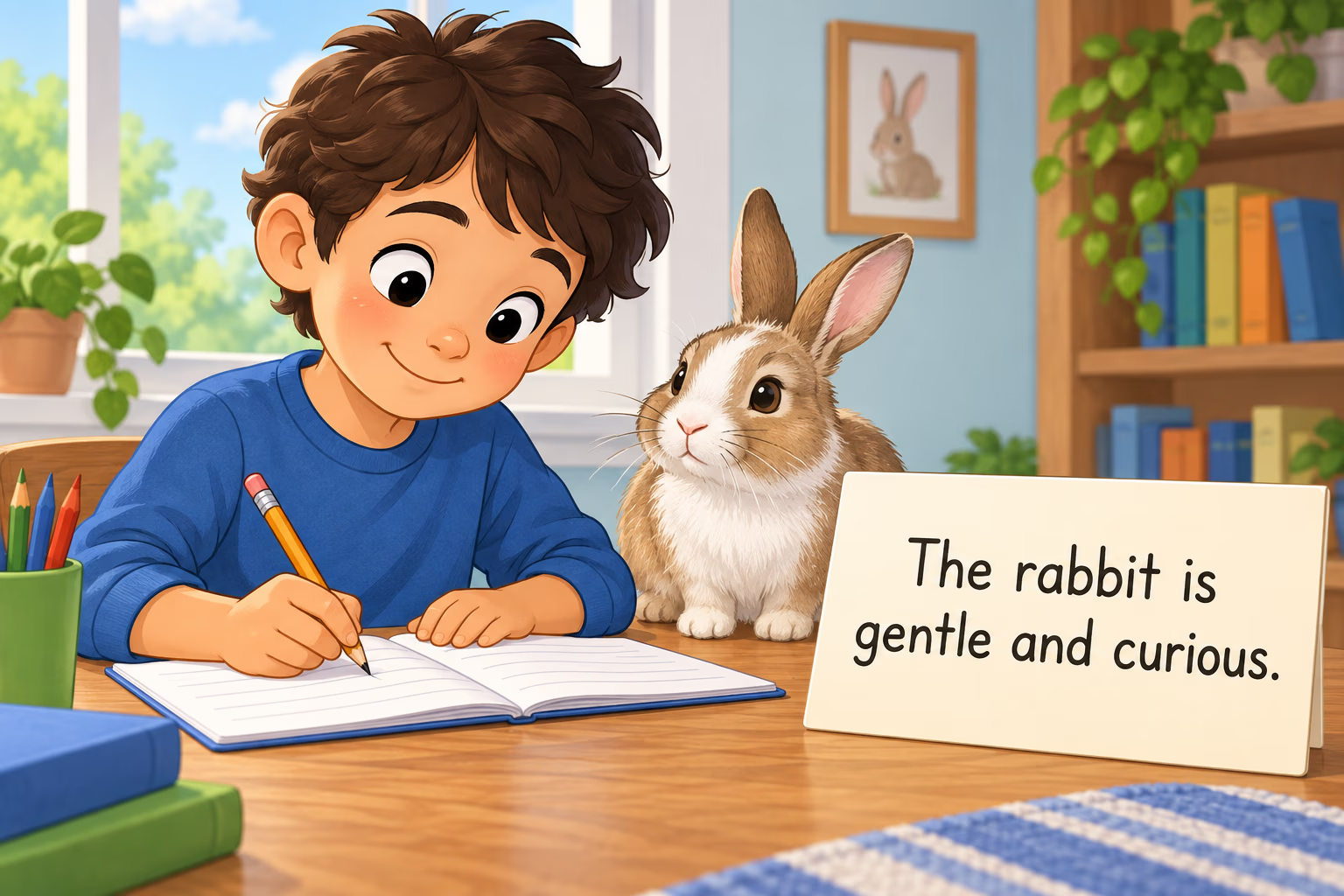
- Adjective + noun: “The fluffy kitten curled up in a basket.”
- Linking verb + adjective: “The parakeet is vocal in the morning.”
- Observation + adjective: “She is curious, sniffing each box as it arrives.”
- Two adjectives: “The small, spotted dog waited patiently.”
- Comparison: “After a walk, the puppy is calmer than before.”
When several adjectives come before one noun, English often places opinion words before more factual descriptors, but long adjective strings are uncommon. “A lovely small brown dog” is possible; “a lovely small brown friendly energetic dog” is harder to read. Cambridge’s adjective-order guide gives the usual sequence, while reminding writers that the exact combination depends on meaning.
Positive and negative pet adjectives: choose with care
Positive words such as affectionate, playful, gentle, and curious can make a description warm. Words such as noisy, destructive, aloof, or stubborn may communicate a challenge, but they can also sound judgmental or vague. Describe the action when possible: “barks when the delivery truck stops” tells more than “noisy.”
Use labels like aggressive cautiously. A single growl, retreat, or swat does not establish a pet’s usual temperament or explain why it acted that way. In a personal story, report what happened and the situation; in a safety concern, create space and get guidance from an appropriate animal-care professional.
Common questions about adjectives for pets
What are good adjectives for a pet?
Good adjectives depend on the pet and the detail you want to communicate. Fluffy, spotted, and small describe appearance; playful, quiet, and curious describe behavior or a pattern. Add an example so the reader understands why the word fits.
What are five positive adjectives for pets?
Five positive options are affectionate, playful, gentle, curious, and loyal. They are not automatic descriptions of every animal. Choose a word only when it fits the pet and situation you have observed.
How do you describe a pet’s appearance?
Name observable features such as size, coat, color, pattern, or movement: “a small, long-haired white cat” or “a brown rabbit with upright ears.” Use neutral, respectful language and avoid guessing age, breed, or health from appearance alone.
Can I use two adjectives before pet?
Yes. Write “a friendly, energetic dog” or “a quiet gray cat.” When several adjectives appear before a noun, put them in an order that sounds natural and remove any word that repeats the same idea. The adjective-order pattern is a guide, not a reason to overcrowd a sentence.
What is the difference between a behavior word and a personality word?
A behavior word can describe an action or repeated pattern, such as vocal or playful. A personality word, such as independent or affectionate, summarizes a broader impression. Because behavior changes with context, examples make both kinds more precise.
Sources and further reading
- Cambridge Dictionary Grammar: Adjectives: order — common order for multiple adjectives and coordination.
- Cambridge Dictionary Grammar: Adjectives: forms — adjective function, inflection, and common forms.
- ASPCA: Dog Bite Prevention — reading dog body language and safe interaction.
- Cornell Feline Health Center: Choosing and Caring for Your New Cat — individual temperament and care context.
- Cornell Feline Health Center: Feline Behavior Problems — behavior depends on causes and circumstances.
- ASPCA: Aggression in Cats — feline body language can be subtle and context-sensitive.
Original wording and examples
Note on the original article: The material below is retained from the earlier version. Its adjective choices and sample behaviors are illustrative, not universal traits of a species or a diagnosis of an animal’s feelings. Prefer a specific observation when you do not know a pet well, and remember that a single behavior may depend on its setting.

Hey there pet lovers! Are you looking for the perfect words to describe your furry friends? Well, look no further! In this article, I’ll be sharing a list of adjectives that will help you capture the unique qualities and characteristics of your beloved pets. Whether you have a playful pup, a cuddly kitten, or a talkative parrot, these adjectives will bring their personalities to life in your descriptions. So, let’s dive in and discover some pawsome adjectives for our furry, feathery, and scaly companions!
How to Describe pets? – Different Scenarios
When it comes to describing pets, it’s important to use adjectives that capture their unique qualities and characteristics. Whether you’re a pet owner or a preschool teacher teaching kids about pets, here are some tips on how to describe pets in different scenarios:
- Physical Appearance: Describing pets in terms of their physical appearance can help paint a vivid picture in the reader’s mind. Use adjectives that describe their size, color, and features. For example:
- Personality Traits: Pets have unique personalities, and describing them in terms of their personality traits can help bring them to life. Use adjectives that describe their behavior, temperament, and interaction with humans. For example:
- Interactions with Others: Describing how pets interact with other pets or humans is another way to provide a comprehensive description. Use adjectives that depict their behavior in social settings. For example:
Describing Words for pets in English
When it comes to describing pets, there are countless adjectives that can capture their unique characteristics and qualities. Whether it’s their physical appearance, personality traits, or how they interact with others, using descriptive words can bring your descriptions to life. In this section, I’ll provide you with a range of adjectives for different types of pets, along with examples to help you better describe them.
Adjectives for Dogs
Dogs are known for their loyalty, playfulness, and diverse breeds. Here are some adjectives you can use to describe these furry friends:
- Energetic: Dogs are often full of energy, ready for playtime and adventures.
- Loyal: They are known for their unwavering devotion to their owners.
- Affectionate: Dogs are often loving and demonstrate their affection through kisses and cuddles.
- Intelligent: Many dog breeds are highly intelligent and can be trained to perform various tasks.
- Playful: Dogs are naturally playful creatures, always ready for a game of fetch or a run in the park.
Adjectives for Cats
Cats have a mysterious and independent nature that sets them apart from other pets. Here are some adjectives to capture their unique qualities:
- Curious: Cats are known for their curiosity and love to explore their surroundings.
- Graceful: They move with elegance and are known for their graceful leaps and jumps.
- Independent: Cats are often self-reliant and enjoy time alone.
- Gentle: Many cats have a gentle nature, especially when they’re being affectionate.
- Adaptable: Cats are highly adaptable creatures, making them suitable for various living situations.
Adjectives for Birds
Birds bring a sense of beauty and liveliness to any environment. Here are some adjectives to help you describe these fascinating creatures:
- Colorful: Birds come in a wide range of vibrant colors, making them visually stunning.
- Melodious: Many birds have beautiful songs that fill the air with melodious tunes.
- Graceful: Birds, especially those in flight, showcase graceful movements.
- Chatty: Birds are known for their ability to make a variety of sounds and communicate with others.
- Inquisitive: Birds have a natural curiosity and are often intrigued by their surroundings.
Remember, when describing pets, think about their appearance, behavior, and unique traits.
Adjectives for pets
Pets come in all shapes, sizes, and personalities. As an experienced pet owner, I understand the importance of finding the right words to describe our furry friends. In this section, I will provide you with a range of adjectives that can capture the essence of your pets. Whether you have a dog, a cat, or a bird, these adjectives will help you describe them accurately and vividly.
Positive Adjectives for Pets with 12 Example Sentences
Adjectives play a crucial role in describing pets’ physical appearance, behavior, and unique traits. Here are twelve positive adjectives that will paint a clear picture of your beloved pet:
| Adjective | Definition | Example Sentence |
|---|---|---|
| Playful | Full of energy and enjoyment | My dog is playful, always chasing his tail with excitement. |
| Affectionate | Showing fondness or love | My cat is incredibly affectionate, always curling up on my lap for a cuddle. |
| Intelligent | Quick to understand and learn | My bird is remarkably intelligent, learning new tricks in no time. |
| Loyal | Devoted and faithful | My dog is incredibly loyal, always by my side through thick and thin. |
| Cuddly | Enjoying or seeking affectionate embrace | My cat is irresistibly cuddly, always snuggling up against my cheek. |
| Energetic | Full of vitality and enthusiasm | My dog is highly energetic, always ready for a long run in the park. |
| Graceful | Having beauty of movement or form | My bird is incredibly graceful, effortlessly gliding through the air. |
| Friendly | Kind and sociable | My cat is extremely friendly, always welcoming guests with a purr. |
| Brave | Showing courage and fearlessness | My dog is exceptionally brave, never backing down in the face of danger. |
| Gentle | Having a mild or kind nature | My pet bird is wonderfully gentle, hopping onto my finger with care. |
| Curious | Eager to learn and explore | My cat is endlessly curious, always investigating every nook and cranny. |
| Talkative | Fond of or given to talking | My bird is brilliantly talkative, mimicking phrases and melodies. |
Negative Adjectives for Pets with 5 Example Sentences
While our pets bring us endless joy, we also need to acknowledge their less-than-ideal traits. Here are five negative adjectives to describe certain behaviors or characteristics:
| Adjective | Definition | Example Sentence |
|---|---|---|
| Stubborn | Unwilling to change or comply | My dog can be stubborn, often refusing to follow commands. |
| Aloof | Distant or uninvolved | My cat can be aloof, occasionally preferring solitude over attention. |
| Noisy | Making a lot of noise | My bird can be noisy, especially during his morning serenades. |
| Destructive | Causing damage or destruction | My pet dog can be destructive, chewing on furniture when left alone. |
| Moody | Subject to unpredictable changes in mood | My pet cat can be moody, sometimes demanding affection one moment and swatting at my hand the next. |
Synonyms and Antonyms with Example Sentences
Synonyms for pets
When it comes to describing pets, using a variety of adjectives can make your writing more engaging and interesting. Here are some synonyms for common pet traits:
- Lively: full of energy, active
- Energetic: lively, spirited
- Vibrant: full of life, animated
- Sprightly: lively, energetic
- Animated: full of energy, lively
For example, instead of saying “My dog is playful,” you can say “My dog is lively and always ready to play.”
Antonyms for pets
Sometimes, it’s also helpful to describe pets by using antonyms, which are words that have opposite meanings. Here are some antonyms for common pet traits:
- Calm: peaceful, tranquil
- Serene: calm, composed
- Relaxed: calm, laid-back
- Mellow: calm, easygoing
- Soothing: calming, pacifying
For instance, instead of saying “My cat is always playful,” you can say “My cat is usually calm and relaxed.”
Using synonyms and antonyms can add depth and variety to your descriptions of pets. It allows you to paint a more precise picture and capture different aspects of their personalities. Remember to choose words that best reflect the unique qualities of the pets you are describing.
Conclusion
Describing pets can be a fun and creative way to share their unique qualities with others. By using adjectives, we can paint a vivid picture of their physical appearance, showcase their personality traits, and highlight their interactions with both humans and other animals. Throughout this article, I’ve provided a range of adjectives specifically tailored for dogs, cats, and birds, along with examples to inspire your pet descriptions.
In addition to using adjectives, I’ve also introduced the concept of synonyms and antonyms to add depth and variety to your pet descriptions. By incorporating different words with similar or contrasting meanings, you can further enhance the richness of your descriptions and capture the essence of your furry or feathered friend.
Remember, when describing your pets, choose words that truly reflect their individuality and charm. Whether it’s their playful nature, loyal companionship, or unique physical features, adjectives allow us to bring their stories to life. So go ahead, get creative, and let your pets shine through the power of words.


