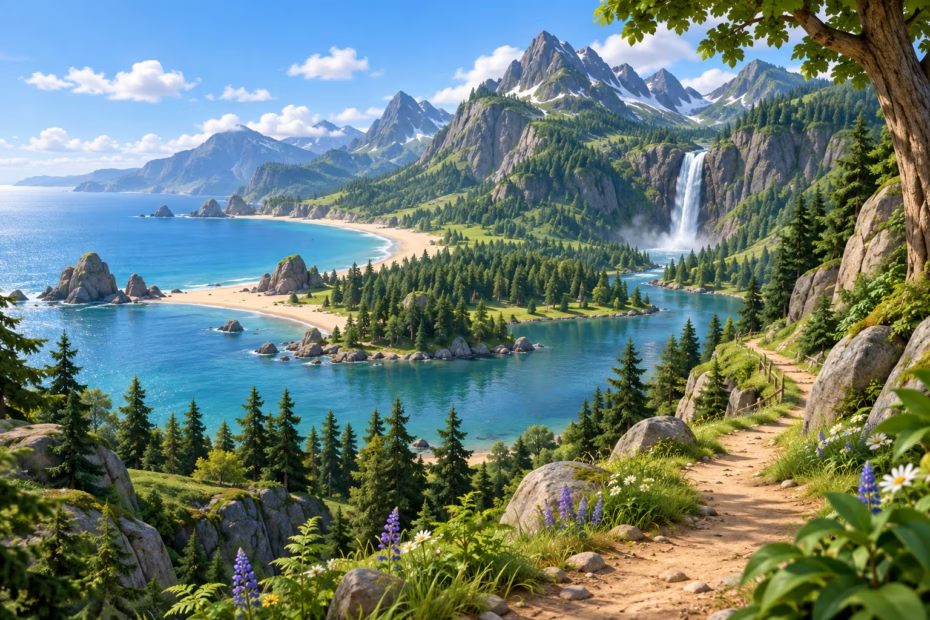
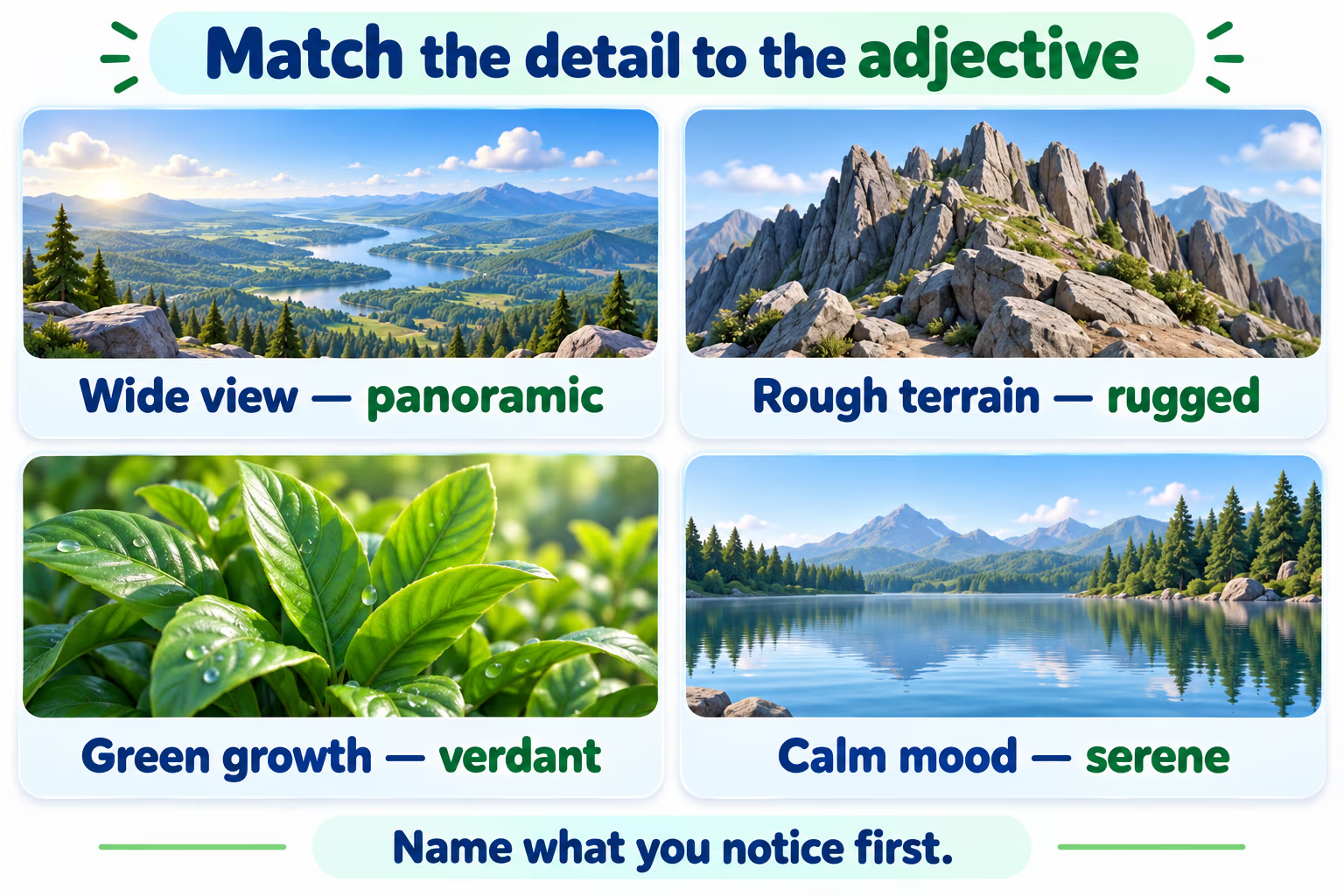
Adjectives for scenery describe a landscape’s appearance, mood, scale, texture, or atmosphere. Choose a word that matches a visible feature: panoramic for a wide view, rugged for uneven terrain, verdant for green growing plants, or serene for calm. Concrete details help a reader picture the scene more clearly than a stack of broad praise words.
Key Facts: Adjectives for Scenery
- Scenery is a noun that can mean a picturesque view or landscape.
- Scenic is an adjective relating to natural scenery, as in “a scenic route.”
- Panoramic describes a full or wide view; rugged describes rough or uneven terrain.
- Verdant means green with growing plants, while serene emphasizes calm or quiet.
- Barren can describe land producing little or no vegetation; its tone depends on the context.
- Purdue OWL’s descriptive-writing guidance recommends vivid, precise language and details that appeal to the senses.
When it comes to describing the beauty of nature, words often fall short. From breathtaking mountain ranges to serene beaches, the scenery around us is a constant source of inspiration and awe. As a writer, finding the right adjectives to capture the essence of these landscapes can be a challenge. That’s why I’ve compiled a list of descriptive words that will help you bring the scenery to life in your writing. Whether you’re describing a picturesque sunset or a lush forest, these adjectives will add depth and vividness to your descriptions. So, let’s dive in and explore the world of adjectives for scenery, with plenty of examples along the way.
Picture yourself standing on a cliff, overlooking a vast expanse of rolling green hills. How would you describe the scenery before you? Majestic? Serene? Breathtaking? These are just a few of the adjectives that can help you paint a vivid picture in the reader’s mind. In this article, I’ll be sharing a wide range of adjectives that are perfect for describing different types of scenery. Whether you’re writing a travel article, a poem, or a novel, having a diverse vocabulary of descriptive words at your disposal is essential. So, get ready to enhance your writing with these powerful adjectives for scenery.
How do you choose the right adjective for scenery?
Start with the feature a reader should notice, then choose the adjective that names it. A broad horizon can be panoramic, an uneven ridge rugged, thick green growth verdant, and an undisturbed lake serene; these words describe different qualities rather than ranking a place from good to bad.
- Name the subject: identify the coast, ridge, forest, waterfall, sky, or path.
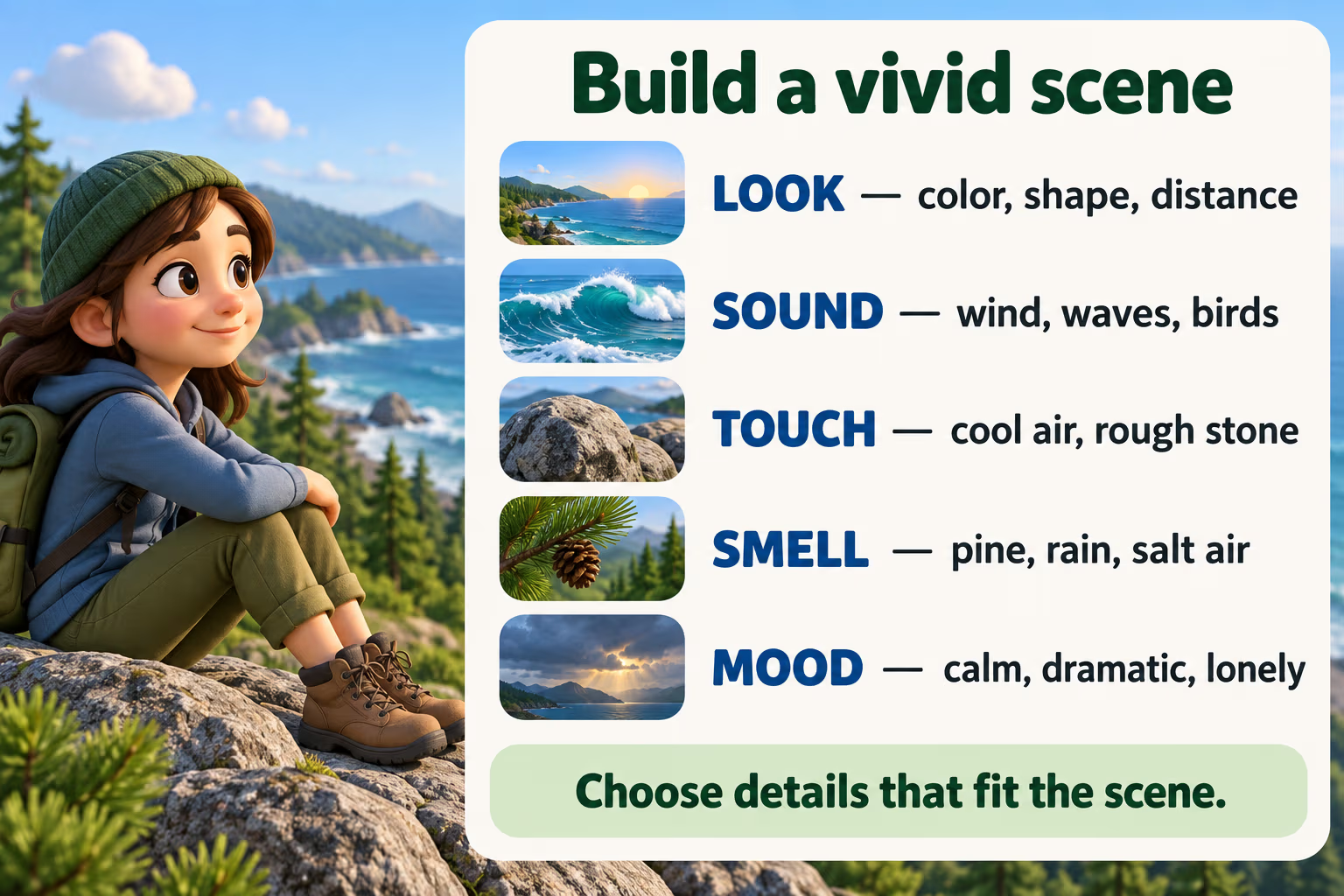
- Notice one observable detail: consider shape, color, distance, vegetation, weather, sound, or texture.
- Choose a precise word: use panoramic for a wide view, misty when mist obscures the scene, or rugged for rough landforms.
- Check the mood: serene and idyllic suggest calm or charm; dreary and desolate create a bleaker impression.
- Read the sentence aloud: keep the adjective only if it adds a detail the noun and surrounding sentence do not already show.
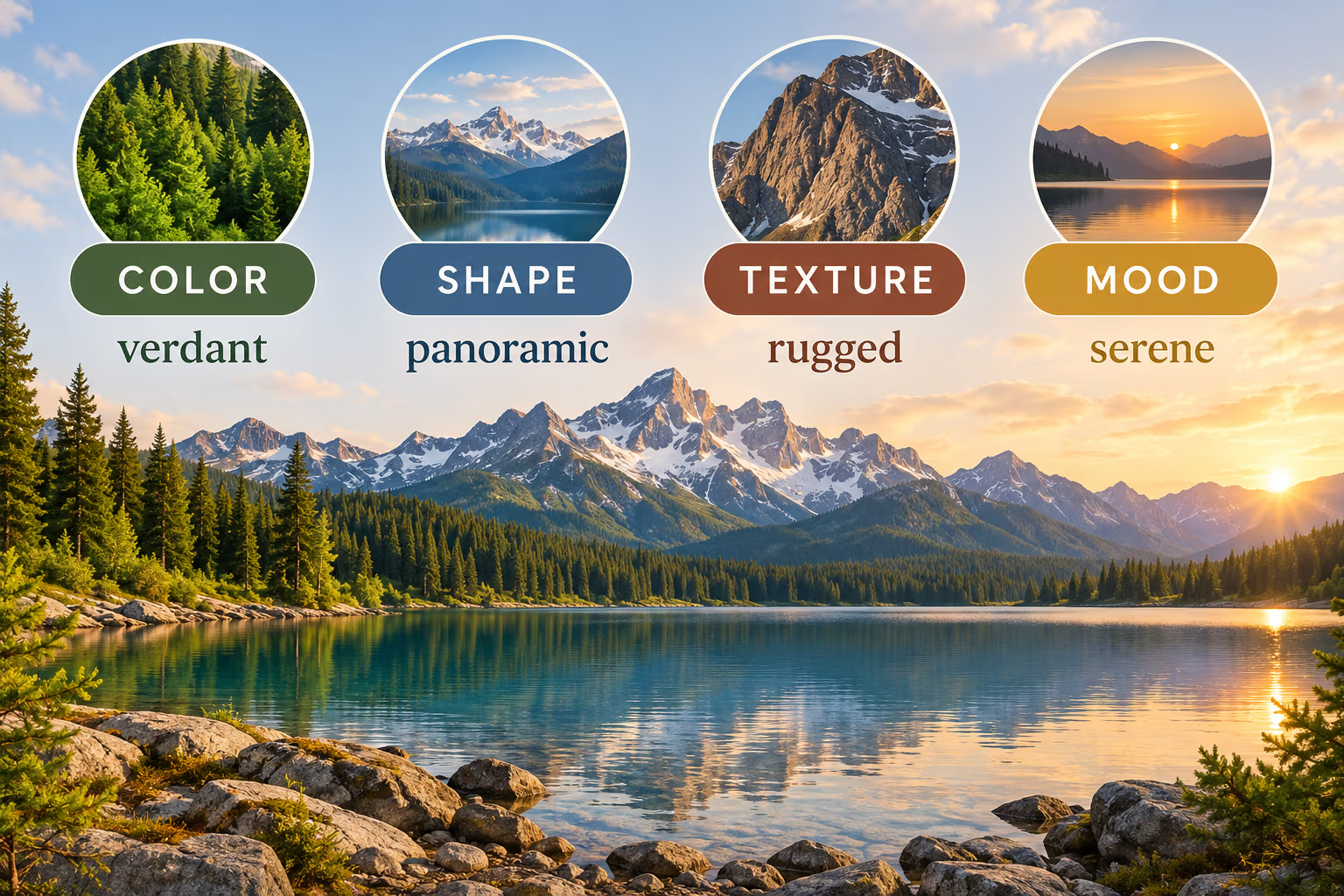
Compare “The view was beautiful” with “A panoramic bay opened below the rugged ridge.” The second sentence names breadth and terrain instead of relying on a general judgment. For more landform-specific examples, see our guide to adjectives for landscapes; for words that name a setting’s mood, see adjectives for atmosphere.
Concrete sensory details give an adjective evidence. Purdue OWL advises writers to consider what a scene looks, sounds, smells, or feels like, then select clear language that fits the intended impression.
How to Describe scenery? – Different Scenarios
When it comes to describing scenery, it’s important to have a diverse vocabulary that allows you to paint a vivid picture in the reader’s mind. In this section, I’ll provide you with examples of how to describe different scenarios in nature.
Beaches
Beaches are a popular destination for many people, and they offer a wide range of scenery to capture with words. Here are some adjectives that can bring a beach scene to life:
- Sandy: The soft, golden sand feels warm between my toes.
- Breezy: The gentle sea breeze rustles through the palm trees.
- Sparkling: The sun’s rays dance on the sparkling water.
- Tropical: Palm trees sway in the tropical paradise.
Mountains
Mountain landscapes are awe-inspiring and majestic. When describing mountains, consider using the following adjectives:
- Snow-capped: The snow-capped peaks glisten in the sunlight.
- Majestic: Towering mountains stand tall against the clear blue sky.
- Serene: The tranquil mountain lake reflects the peaks in perfect harmony.
- Misty: A blanket of mist veils the rugged mountain ranges.
Forests
Forests are enchanting and full of life. Use these adjectives to describe the beauty of a forest:
- Lush: The lush green foliage creates a magical canopy overhead.
- Whispering: The leaves rustle and whisper secrets in the breeze.
- Mysterious: Sunlight filters through the dense branches, creating an air of mystery.
- Ancient: The towering trees have witnessed centuries of history.
Waterfalls
Waterfalls are nature’s masterpiece, with their cascading waters and mesmerizing power. Try these adjectives to describe a waterfall:
- Gushing: The water gushes down the rocky cliff with thunderous force.
- Graceful: The waterfall gracefully plunges into the crystal-clear pool below.
- Majestic: The powerful cascade creates a magnificent display of nature’s force.
- Spray: Fine mist rises from the base of the waterfall, refreshing everything around.
Remember, when describing scenery, be sure to mix and match your adjectives to create a vivid and captivating description. Use your imagination to transport the reader to the scene and let them experience the beauty of nature through your words.
Are “spray” and “serenading” adjectives here?
Two labels in the original examples call attention to word form. Spray is a noun in the waterfall list: it names the fine water droplets thrown up by a waterfall. The example sentence correctly describes those droplets as mist, but an adjective such as misty, cascading, or forceful is a direct modifier for the waterfall. In the forest list, “Serenading” labels an example whose sentence uses serenaded as a verb; the line can still show sound, but it does not demonstrate that label as an adjective. Existing examples remain below.
Describing Words for scenery in English
When it comes to describing beautiful scenery in English, having a diverse vocabulary is essential. It allows us to paint a vivid picture with words and transport our readers to stunning landscapes, whether it’s a serene beach or a majestic mountain range.
Below, I have gathered a collection of descriptive adjectives that will bring your scenery descriptions to life. Remember, combining these words and phrases can create even more immersive and captivating descriptions.
Words to Describe Beach Scenes:
- Breathtaking: The beach view was absolutely breathtaking, with its crystal-clear turquoise waters and powdery white sand.
- Serene: As I walked along the shore, I couldn’t help but be captivated by the serene beauty of the beach, with its gentle waves and peaceful atmosphere.
- Sun-kissed: The beach was a sun-kissed paradise, with golden rays illuminating the sparkling waters and casting a warm glow on the sandy shore.
- Secluded: Tucked away in a secret cove, the beach was a secluded oasis, offering solitude and a sense of tranquility amidst nature’s beauty.
Descriptive Words for Mountain Landscapes:
- Majestic: Standing at the summit, I was in awe of the mountain’s majestic presence, with its towering peaks and breathtaking vistas stretching as far as the eye could see.
- Rugged: The mountain range was rugged and untamed, with jagged cliffs and steep slopes that showcased the raw beauty of nature.
- Misty: As the morning mist gently rolled over the mountains, the landscape took on a mystical aura, creating an enchanting scene.
- Snow-capped: The peaks of the mountains were covered in a pristine blanket of snow, their white tops contrasting against the deep blue sky.
- Enchanting: The forest was enchanting, with its lush green canopy and sunlight filtering through the leaves, casting a magical glow on the forest floor.
- Serenading: In the heart of the forest, the gentle rustling of leaves and the melodic songs of birds serenaded me, creating a tranquil and soothing ambiance.
- Mossy: The forest floor was covered in a soft, mossy carpet, adding a touch of emerald green to the vibrant tapestry of nature.
Which adjective fits the view, terrain, or mood?
Use the feature in the middle column to choose among similar-sounding descriptions. Dictionary definitions show where each word is useful; the examples are original sentences for this guide.
| Adjective | What it emphasizes | Example |
|---|---|---|
| Panoramic | A full or wide view | The panoramic overlook revealed the entire bay. |
| Picturesque | A picture-like, charming, or quaint appearance | A picturesque harbor curved around the old stone quay. |
| Rugged | Rough, uneven terrain | A rugged ridge broke the line of the horizon. |
| Verdant | Green with growing plants | Verdant ferns edged the shaded stream. |
| Serene | Calm, unruffled, or quiet | A serene lake held a still reflection of the peaks. |
| Tranquil | Free from disturbance or turmoil | The tranquil cove was quiet before sunrise. |
| Misty | Obscured by or marked by mist | Misty cliffs faded into the distant sky. |
| Secluded | Screened or hidden from view | A secluded cove lay beyond the tree-lined path. |
| Idyllic | Pleasing or picturesque in natural simplicity | An idyllic meadow opened beyond the pines. |
| Barren | Producing little or no vegetation; sometimes arid | Barren rock left only scattered grass on the slope. |
| Desolate | Deserted, neglected, or lifeless; often bleak in tone | A desolate station stood alone beside the salt flat. |
| Dreary | Gloomy or lacking cheer and interest | A dreary gray sky muted the coast. |
Serene and tranquil both suggest quiet, but tranquil can stress deep quiet or freedom from disturbance; choose the one that fits the scene. Panoramic describes the scope of a view, while picturesque emphasizes a picture-like or charming quality. A scene can be panoramic without feeling picturesque.
Most adjectives in this guide work before a noun (“a panoramic view”) or after a linking verb (“the view looks panoramic”). Cambridge Grammar describes these as attributive and predicative functions of adjective phrases; use the pattern that sounds natural with the particular word.
Adjectives for scenery
When it comes to describing scenery, having a diverse range of descriptive words can really bring the natural beauty to life. Whether it’s a serene beach, a majestic mountain landscape, or a lush forest, the right adjectives can transport the reader to the scene. In this section, I’ll share some positive and negative adjectives that can be used to describe different types of scenery, along with example sentences to help you understand their usage.
Positive Adjectives for Scenery
- Breathtaking: The view from the mountaintop was absolutely breathtaking.
- Picturesque: The small, picturesque village was nestled in the valley.
- Idyllic: The idyllic beach was untouched and pristine.
- Majestic: The majestic waterfall cascaded down the rocks.
- Tranquil: The tranquil lake reflected the colors of the sunset.
- Enchanting: The enchanting forest was filled with ancient trees.
- Spectacular: The sunset over the ocean was a spectacular sight.
- Serene: The serene meadow was covered in wildflowers.
- Panoramic: The panoramic view of the valley stretched for miles.
- Lush: The lush green landscape was a sight to behold.
- Captivating: The captivating sunrise painted the sky with vibrant colors.
- Peaceful: The peaceful countryside was a haven of tranquility.
- Barren: The barren desert stretched as far as the eye could see.
- Gloomy: The gloomy forest was shrouded in mist.
- Dreary: The dreary, gray sky matched the lifeless landscape.
- Desolate: The desolate wasteland was devoid of any signs of life.
- Eerie: The eerie silence in the abandoned town sent shivers down my spine.
Remember, the key is to use adjectives that accurately capture the essence of the scenery you are trying to describe. By mixing and matching these adjectives, you can create vivid and captivating descriptions that truly transport the reader to the scene.
Now that we have explored positive and negative adjectives for scenery, let’s move on to the next section where we will delve into adjectives for waterfalls and forests.
Context note: The existing “Positive Adjectives for Scenery” list includes barren. Merriam-Webster defines the landscape sense as producing little or no vegetation, and also records senses involving poor productivity or lack of charm. The word can be a neutral physical description or create a stark mood, so it is not automatically positive or negative. Describe the visible conditions and let context establish the feeling.
Synonyms and Antonyms with Example Sentences
Synonyms for scenery
When it comes to describing the beauty of nature, it’s important to have a diverse vocabulary. Here are some synonyms for scenery that can help bring your descriptions to life:
| Synonym | Definition | Example Sentence |
|---|---|---|
| Landscape | The visible features of an area of land | The landscape was breathtakingly beautiful. |
| View | What can be seen or considered in a particular direction | The view from the mountaintop was incredible. |
| Panorama | An unbroken view of the whole surrounding area | The panorama of the beach stretched for miles. |
| Vistas | A pleasing view | The vistas in the valley were breathtaking. |
| Scenic | Visually attractive | I enjoyed the scenic drive through the countryside. |
| Outlook | A particular point of view or attitude | Their outlook on nature was awe-inspiring. |
Word-class note: The original synonym table mixes nouns with adjectives. Scenery, landscape, view, panorama, vista, and outlook are nouns in the listed senses; scenic is an adjective, as in “a scenic route.” Panoramic is an adjective too. A panorama is a full or wide view, while a vista is a distant view through or along an opening. Outlook often means a point of view or attitude, so it is not a direct substitute for a visible landscape in every sentence.
Usage note: The retained rows are useful contrasts, but “antonyms for scenery” is not a precise grammatical category. Scenery is a noun for a view or landscape; antonyms are words with opposite meanings, while the listed items describe different qualities or conditions. Barren and dreary are adjectives; blight and desolation are nouns. Use a contrast tied to the feature: verdant versus barren for vegetation, or serene versus dreary for mood. Plain may describe a flat area of land or something simple; it does not always mean unattractive.
Antonyms for scenery
In addition to synonyms, using antonyms can provide a contrast and variety to your descriptions. Here are some antonyms for scenery:
| Antonym | Definition | Example Sentence |
|---|---|---|
| Blight | The state or result of being spoiled or damaged | The blight on the landscape was disheartening. |
| Desolation | A state of complete emptiness or destruction | The desolation of the abandoned building was haunting. |
| Barren | Lacking vegetation or fertility | The barren desert landscape was unforgiving. |
| Dreary | Dull, bleak, and lifeless | The dreary winter scene was devoid of color. |
| Plain | An area of flat land, usually lacking vegetation | The plain landscape was vast and featureless. |
| Darkness | The absence of light and brightness | The darkness of the night sky was mesmerizing. |
By incorporating a wide range of synonyms and antonyms in your descriptions, you can captivate your readers and paint a vivid picture of the natural world. Remember to choose words that accurately capture the essence of each scene, making your writing more engaging and enjoyable.
Conclusion
Expanding our vocabulary is essential when it comes to describing the beauty of nature. Throughout this article, I have provided examples of adjectives that can be used to vividly depict various scenic landscapes. From the serene beaches to the majestic mountains, the lush forests to the cascading waterfalls, there are countless words that can bring these scenes to life.
By incorporating a diverse range of descriptive words, we are able to capture the essence of each scene and transport our readers to these breathtaking locations. The power of language lies in its ability to paint a vivid picture in our minds, and by choosing the right adjectives, we can create a sensory experience that leaves a lasting impact.
So next time you find yourself in awe of the natural world, remember to explore the vast array of adjectives available to you. Whether it’s the gentle lapping of waves on the shore or the towering peaks that touch the sky, there’s an adjective out there waiting to perfectly capture the beauty of the scenery. Let your words be the brushstrokes that bring these landscapes to life.
Frequently Asked Questions About Adjectives for Scenery
What is a good adjective for a wide scenery view?
Panoramic is a good choice when the view is full or wide, such as a broad bay seen from a ridge. Use vista for the distant view itself, because vista is a noun. A sentence can say “a panoramic vista,” combining the adjective and noun without treating them as interchangeable.
What is the difference between scenery and scenic?
Scenery is a noun for a view or landscape; scenic is an adjective relating to natural scenery. Write “The scenery was dramatic” or “We followed a scenic route.” Panoramic is another adjective: “a panoramic view.” Choosing the correct word class makes the sentence clear and grammatical.
Which adjective describes a green landscape?
Verdant describes something green with growing plants, so it fits a field, forest, or meadow. Lush often emphasizes abundant growth or fullness. Use verdant when green vegetation is the visible feature and lush when the scene looks richly grown or dense.
How can sensory details improve a scenery description?
Sensory details show readers what a place looks, sounds, smells, or feels like, giving an adjective a concrete basis. Instead of saying only “the forest was beautiful,” name the wet pine scent, soft moss, or wind in the canopy. Purdue OWL’s descriptive-writing guidance recommends precise, vivid wording and attention to the senses.
Are barren and desolate antonyms of scenery?
No. Barren and desolate are adjectives describing land or conditions, while scenery is a noun. Barren can mean producing little vegetation; desolate can suggest a deserted, neglected, or lifeless place. They contrast with particular qualities such as verdant growth or lively activity, not with scenery itself.


