
Quick guide: adjectives for scientists
Useful adjectives for scientists describe a visible quality of their work, such as being curious, observant, methodical, analytical, meticulous, persistent, collaborative, or resourceful. Choose a word that fits the evidence and the tone: “methodical” suits a careful process, while “meticulous” emphasizes close attention to detail.
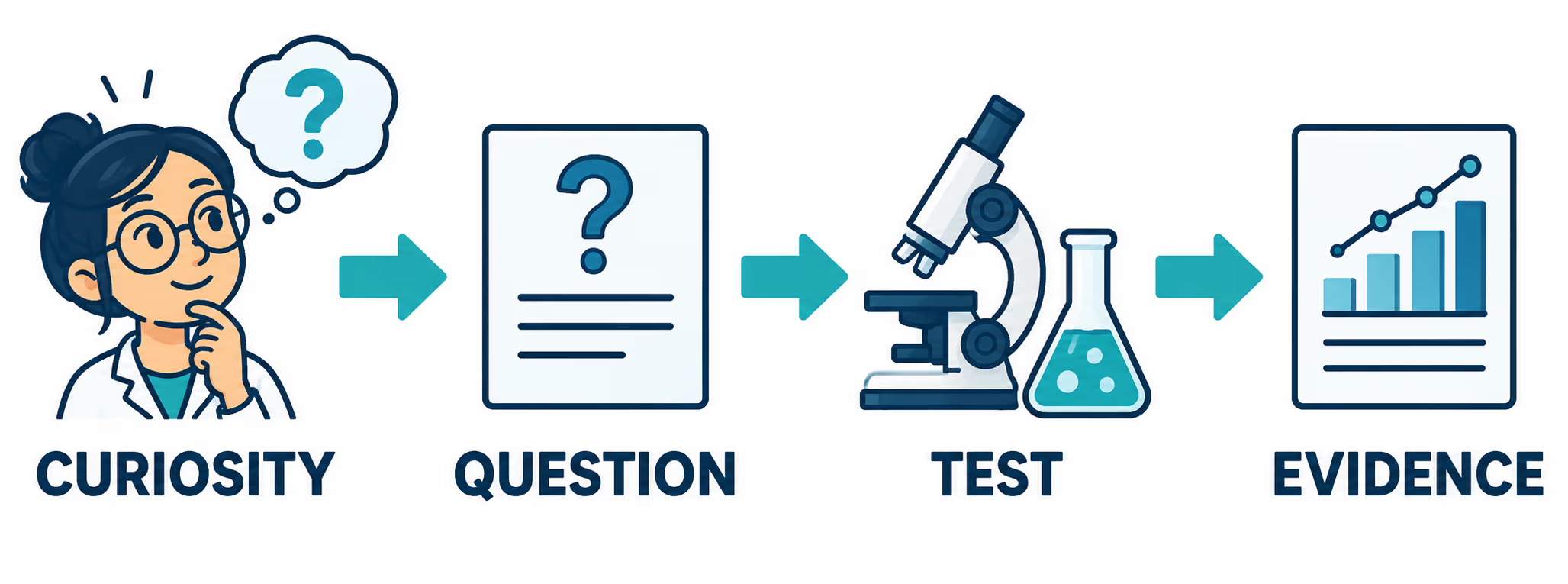
For a fair description, explain what the scientist did instead of treating one adjective as a complete personality profile. For example: “Dr. Chen was observant, noticing a small change in the control sample,” gives readers a concrete reason for the word.


12 useful adjectives to describe a scientist
These words work in a school assignment, biography, report, or character description. The example sentences are original and show the adjective in context.
- Curious — eager to learn how something works. The curious ecologist asked why the insects appeared only after rain.
- Inquisitive — actively asking questions and seeking information. An inquisitive student compared the two samples before drawing a conclusion.
- Observant — quick to notice relevant details. The observant astronomer recorded a faint change in the star’s brightness.
- Analytical — able to examine information carefully and identify patterns or relationships. Her analytical report separated measured results from possible explanations.
- Methodical — working in an ordered, systematic way. The methodical team followed the same steps for every trial.
- Meticulous — paying close attention to small details. He kept meticulous notes about the temperature at each reading.
- Patient — willing to continue carefully when an investigation takes time. The patient researcher repeated the observations over several weeks.
- Persistent — continuing to work through setbacks or unanswered questions. Persistent testing helped the group find why its first result could not be repeated.
- Resourceful — finding practical ways to solve a problem with available tools or information. The resourceful field scientist repaired the sample holder with materials from the kit.
- Creative — developing original ideas or approaches. The creative engineer designed a simpler way to measure the vibration.
- Collaborative — working constructively with other people. The collaborative researchers combined their field observations and lab analysis.
- Open-minded — willing to reconsider an explanation when new evidence calls for it. The open-minded scientist revised the hypothesis after the second set of results.
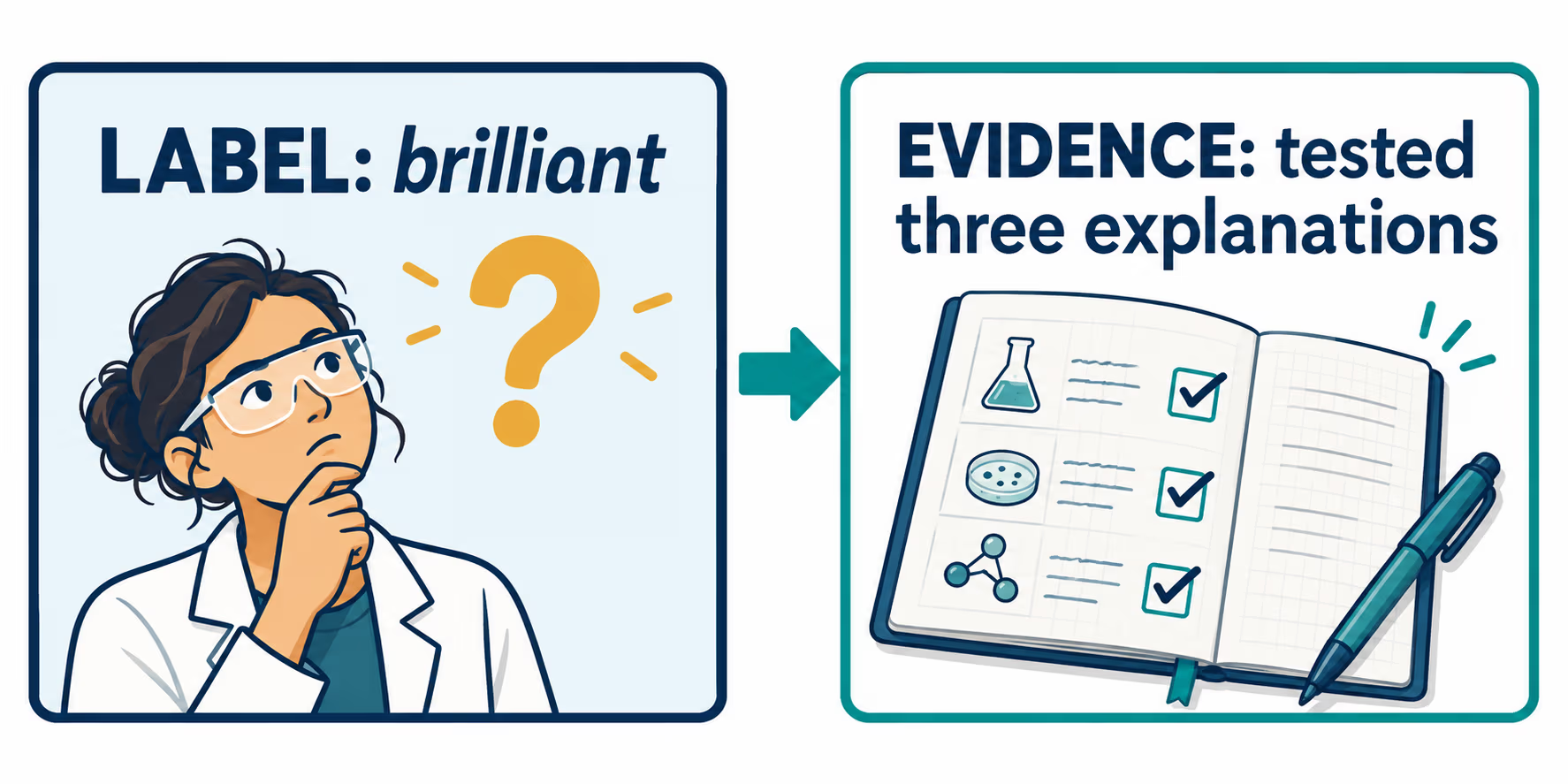
“Groundbreaking” is useful when the work itself makes a major contribution, but it is a strong claim: use it only when the significance is established. “Brilliant” and “genius” express admiration, yet they say less about the method or evidence. A concrete description is usually more informative.
Choosing the right adjective for your sentence
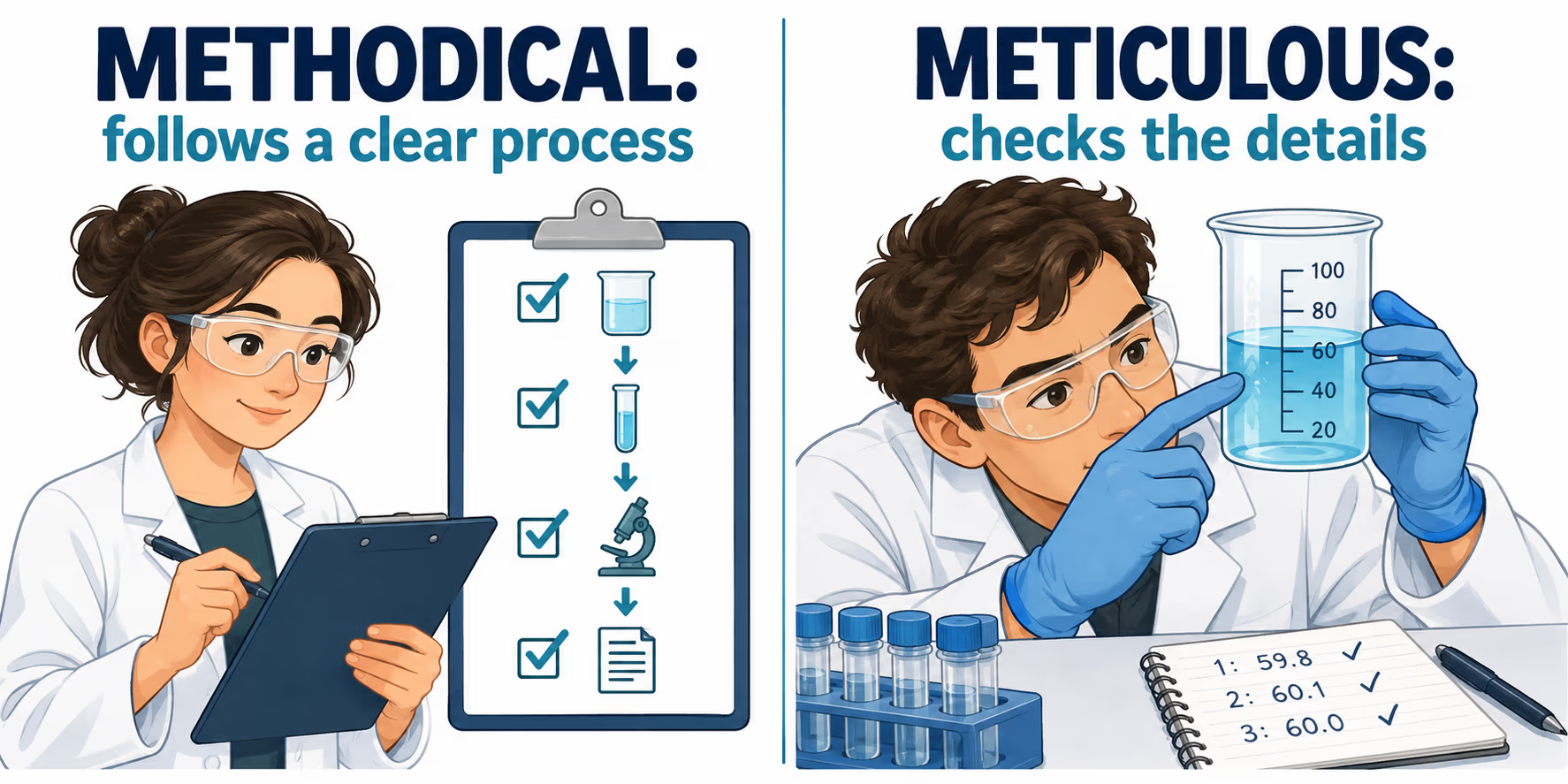
Match the adjective to the action you can point to. Curious or inquisitive describes the questions someone asks. Observant describes noticing something. Analytical emphasizes interpreting data. Methodical focuses on an organized process; meticulous focuses on the details. The two overlap, but they are not interchangeable: a scientist may work methodically without recording every detail meticulously, or vice versa.
Cambridge Dictionary defines methodical in terms of doing things in an ordered, careful way and meticulous as being very careful about every detail. Those distinctions make them especially useful when revising a sentence that otherwise relies on a broad label. Cambridge Dictionary: methodical; Cambridge Dictionary: meticulous.
| What you observed | Adjective to consider | Example sentence |
|---|---|---|
| Asked a precise question and sought answers | Curious, inquisitive | The inquisitive botanist asked what changed after the first frost. |
| Noticed a detail other people missed | Observant | An observant technician spotted a crack in the sample vial. |
| Followed a consistent sequence | Methodical | The methodical team checked each instrument before collecting data. |
| Checked records and measurements closely | Meticulous | Her meticulous notes made it possible to compare each trial. |
| Compared evidence and weighed explanations | Analytical | The analytical researcher tested whether the pattern held across sites. |
| Worked through practical limits | Resourceful | The resourceful team adapted its field setup to the weather. |
| Shared work, ideas, or expertise | Collaborative | The collaborative group combined data collected by three laboratories. |
| Changed a claim after stronger evidence appeared | Open-minded | The open-minded author updated the explanation when later tests disagreed. |
Describe scientific work without stereotyping
Scientists do not all work at laboratory benches or follow one identical routine. They may observe wildlife, build models, analyze archives, run clinical studies, conduct interviews, make measurements, or combine several approaches. Pick adjectives that fit the person, discipline, and specific task rather than implying every scientist has the same temperament.
Adjectives can also carry judgment. “Careless,” “arrogant,” or “dogmatic” may be appropriate in a fictional characterization or a documented critique, but they can sound unfair when they are not supported by examples. Describe the behavior and its effect: “The report omitted two conflicting measurements” is more precise than “the scientist was careless.” Likewise, describe a disagreement with the reasoning or evidence rather than assigning a negative label to the person.
For factual writing, distinguish a result from an interpretation. The National Academies explains that scientific understanding can change with new evidence and that stronger conclusions draw on a broader body of research. NASA’s science education material also emphasizes questions, observation, testing, and revising explanations. This makes open-minded, analytical, and collaborative especially useful when you can connect them to specific actions—not as automatic praise for every researcher. National Academies: Decoding Science; NASA: The Nature of Science.
Example paragraphs
For a school report
“The observant and methodical marine biologist recorded water conditions at each site, then compared the measurements. Her analytical approach helped the class see why one sample did not tell the whole story.”
For a biography or article
“The collaborative research team brought together field notes and laboratory results. When later measurements challenged its first explanation, the group remained open-minded and described how the evidence changed its conclusion.”
For a fictional scientist
“Mara was resourceful when a storm cut off the observatory’s usual data feed. Her persistent search for another source revealed that the strange reading came from a sensor fault, not the comet she had hoped to discover.”
Frequently asked questions
What are positive adjectives for a scientist?
Curious, observant, analytical, methodical, meticulous, persistent, resourceful, creative, collaborative, and open-minded are positive options when they accurately describe the person’s work.
What is the difference between methodical and meticulous?
Methodical emphasizes an ordered way of working. Meticulous emphasizes close attention to detail. A scientist can be one, the other, or both.
How can I describe a scientist in one sentence?
Name a specific action and connect it to one fitting adjective: “The observant researcher noticed that the control sample changed before the treated sample.”
Should I use negative adjectives to describe a scientist?
Use words such as careless or dogmatic only when the tone and evidence support that judgment. In reports, it is usually clearer to describe the action, the evidence, and its effect.
Sources for the usage notes
- Cambridge Dictionary, “methodical”
- Cambridge Dictionary, “meticulous”
- National Academies of Sciences, Engineering, and Medicine, “Decoding Science”
- NASA Science, “The Nature of Science”
As a scientist, I know firsthand the importance of precise and descriptive language in the field. Adjectives play a vital role in conveying the characteristics, qualities, and abilities of scientists. In this article, I’ll be exploring a range of adjectives that can be used to describe scientists, along with examples to illustrate their usage.
Scientists are not just intelligent, but they are also curious, inquisitive, and relentless in their pursuit of knowledge. They are analytical, logical, and methodical in their approach to problem-solving. From astute astronomers to meticulous microbiologists, the adjectives used to describe scientists are as diverse as the fields they specialize in. In this article, I’ll delve into a variety of adjectives that capture the essence of different types of scientists, providing you with a comprehensive resource to enhance your descriptions and understanding of the scientific world.
Whether you’re a writer looking to add depth to your characters or a student eager to expand your scientific vocabulary, this article will equip you with a wide array of adjectives to accurately portray scientists. So, let’s dive into the fascinating world of adjectives for scientists and discover the power of descriptive language in capturing the essence of these brilliant minds.
How to Describe scientists? – Different Scenarios
When it comes to describing scientists, there are various scenarios in which you may need to articulate their qualities and characteristics. Whether you’re writing an article, teaching a class, or simply explaining the concept of science to kids, using precise and descriptive language can make all the difference. Here are some different scenarios and adjectives to help you effectively describe scientists:
1. In a Classroom Setting:
- Resourceful: Scientists are skilled at finding information and utilizing various tools and materials.
- Observant: They have a keen eye for detail and notice things that others might overlook.
- Creative: Scientists often think outside the box and find innovative solutions to problems.
- Patient: They understand the need for careful observation and experimentation, even when results may take time.
- Collaborative: Scientists often work in teams, sharing ideas and knowledge with each other.
2. In an Article about Scientific Discoveries:
- Groundbreaking: Scientists push the boundaries of knowledge and make significant advancements in their field.
- Methodical: They follow a systematic approach, conducting experiments and collecting data to arrive at reliable conclusions.
- Inquisitive: Scientists have a natural curiosity, constantly seeking answers and exploring new possibilities.
- Meticulous: They pay great attention to detail and take care in ensuring their experiments are precise and accurate.
- Persistent: Scientists don’t give up easily; they persevere in the face of challenges and setbacks.
- Engaging: Scientists know how to captivate their audience, presenting complex concepts in an understandable way.
- Enthusiastic: They demonstrate a passion for their work, igniting excitement and interest in others.
- Informative: Scientists provide clear explanations and use visuals to enhance understanding.
- Eloquent: They have excellent communication skills, articulating their ideas with clarity and confidence.
- Inspiring: Scientists motivate others to pursue scientific exploration and discovery.
As you can see, describing scientists in different scenarios requires considering their unique qualities and adapting your language accordingly. By using these adjectives and examples, you can effectively convey the diverse attributes and abilities of scientists in a way that engages and informs your audience.
Remember, using precise and descriptive language adds depth and understanding to our appreciation of scientists and their contributions to the scientific world.
Describing Words for scientists in English
When it comes to describing scientists, precise and descriptive language can help us paint a vivid picture of their work and qualities. I’ll provide you with a list of adjectives that can be used to describe scientists, along with examples to help you understand each word’s meaning.
- Resourceful: Scientists are known for their ability to find creative solutions to problems. They have a knack for using the resources at hand to overcome obstacles. For example, a resourceful scientist might use everyday materials to create an experiment.
- Observant: Scientists possess keen powers of observation. They carefully study the world around them and pay attention to even the smallest details. An observant scientist might notice a pattern that others might miss.
- Creative: Creativity is a valuable trait among scientists. They often think outside the box and come up with innovative ideas and approaches. A creative scientist might devise a new method for conducting research.
- Patient: Scientific research requires patience, as discoveries don’t happen overnight. Scientists understand the value of perseverance and are willing to wait for results. A patient scientist might spend years studying a phenomenon before reaching a breakthrough.
- Collaborative: Collaboration is key in the scientific community. Scientists often work together, share ideas, and build upon each other’s findings. A collaborative scientist might join forces with others to conduct a complex experiment.
- Groundbreaking: Some scientists make groundbreaking discoveries that revolutionize their field. These discoveries have a significant impact on our understanding of the world. Examples include Thomas Edison’s invention of the light bulb or Albert Einstein’s theory of relativity.
- Methodical: Scientists follow a systematic and methodical approach to their work. They carefully plan experiments, collect data, and analyze the results. A methodical scientist would conduct each step of the scientific process in a structured manner.
- Inquisitive: Curiosity drives scientists to explore and ask questions. They are constantly seeking new knowledge and striving to understand the unknown. An inquisitive scientist might conduct research to uncover the mysteries of the universe.
- Meticulous: A meticulous scientist pays great attention to detail and ensures accuracy in their work. They meticulously record data, conduct thorough experiments, and analyze every aspect of their research.
- Persistent: Persistence is crucial in scientific inquiry. Scientists face challenges and setbacks but remain determined to find answers. A persistent scientist would not give up easily, even when faced with obstacles.
Adjectives for scientists
As an expert blogger with years of experience writing high-quality articles, I understand the importance of using precise and descriptive language when describing scientists. In this section, I will provide you with a list of adjectives that can be used to describe scientists in various scenarios. These adjectives will help you convey the unique qualities and contributions of scientists in a clear and engaging manner. Let’s dive in!
Positive Adjectives for Scientists
When it comes to describing scientists in a positive light, there are several adjectives that come to mind. Here are twelve examples of adjectives that capture the essence of a scientist:
- Resourceful: Scientists are known for their ability to find creative solutions to problems.
- Observant: Scientists have a keen eye for detail and can notice even the smallest of changes.
- Creative: Scientists often think outside the box and come up with innovative ideas.
- Patient: Patience is a virtue in the scientific world, as experiments and research can take time.
- Collaborative: Scientists frequently work together, pooling their knowledge and skills.
- Groundbreaking: Scientists are at the forefront of new discoveries and breakthroughs.
- Methodical: Scientists follow a systematic approach to their work, ensuring accuracy and reliability.
- Inquisitive: Curiosity drives scientists to explore and seek answers to complex questions.
- Meticulous: Scientists pay great attention to detail, leaving no stone unturned in their research.
- Persistent: Scientists are determined individuals who persevere in the face of challenges.
- Inventive: Scientists have a knack for inventing new instruments and techniques.
- Analytical: Scientists are skilled at analyzing data and drawing meaningful conclusions.
These adjectives paint a vivid picture of scientists and their remarkable attributes.
Negative Adjectives for Scientists
While scientists are often praised for their positive qualities, it is important to recognize that they, like everyone else, have their flaws. Here are five examples of negative adjectives that can be used to describe scientists:
- Arrogant: Sometimes, scientists can come across as overly confident or dismissive of others’ ideas.
- Tunnel-visioned: Scientists may become so focused on their own research that they neglect other perspectives.
- Impatient: Despite the importance of patience, some scientists can be impatient when it comes to obtaining results.
- Careless: Occasional mistakes or oversights can happen in the scientific process.
- Dogmatic: In rare cases, scientists may be unwilling to consider alternate theories or approaches.
It is essential to remember that these negative adjectives are not representative of all scientists, but merely describe common human traits that can occasionally be observed in scientific communities.
Using precise and descriptive language when describing scientists helps enhance the understanding and appreciation of their contributions to the scientific world. The adjectives provided in this section capture both the positive and negative aspects of scientists, painting a well-rounded picture of their work and character.
Synonyms and Antonyms with Example Sentences
Synonyms for Scientists
When it comes to describing scientists, there are several synonyms that capture their unique qualities and contributions. Take a look at the following list:
- Resourceful: Scientists are innovative problem solvers who can find creative solutions.
- Observant: Scientists are keen observers, noticing even the smallest details in their experiments.
- Creative: Scientists are imaginative thinkers, constantly coming up with new ideas and hypotheses.
- Patient: Scientists are tolerant and understand that experiments take time to yield results.
- Collaborative: Scientists are team players, working together to achieve greater scientific advancements.
- Groundbreaking: Scientists are pioneering individuals who make significant breakthroughs in their fields.
- Methodical: Scientists are systematic and follow a step-by-step approach in their research.
- Inquisitive: Scientists are curious individuals, always asking questions and seeking knowledge.
- Meticulous: Scientists are meticulous in their attention to detail, ensuring accuracy in their findings.
- Persistent: Scientists are tenacious in their pursuit of answers, never giving up easily.
- Inventive: Scientists are imaginative inventors, constantly developing new tools and technologies.
- Analytical: Scientists are logical thinkers who analyze information to draw conclusions.
Antonyms for Scientists
It’s important to acknowledge that scientists, like everyone else, also have flaws. Here are some antonyms that can be used to describe scientists:
- Arrogant: Some scientists can be overconfident and dismissive of ideas that challenge their own.
- Tunnel-visioned: At times, scientists can become narrow-minded, focusing solely on their specific area of research.
- Impatient: While patience is often a virtue for scientists, some individuals can be impatient when waiting for results or progress.
- Careless: Although scientists strive for accuracy, there are instances when they might overlook important details and become careless.
- Dogmatic: Some scientists can be stubborn and unwilling to consider alternative viewpoints or evidence.
Keep in mind that these adjectives should be used sparingly and thoughtfully to provide a balanced description of scientists. Each scientist is unique, so it’s essential to approach the description with an open mind.
Conclusion
Describing scientists using precise and descriptive language is crucial in capturing their unique qualities and contributions. Throughout this article, I have provided a comprehensive list of positive adjectives that aptly describe scientists, such as resourceful, observant, creative, patient, collaborative, groundbreaking, methodical, inquisitive, meticulous, persistent, inventive, and analytical. On the other hand, I have also highlighted negative adjectives that can be used to describe scientists’ flaws, including arrogant, tunnel-visioned, impatient, careless, and dogmatic.
By using these adjectives sparingly and thoughtfully, we can provide a balanced description of scientists, recognizing both their positive and negative qualities. It is important to remember that each scientist is unique, and no single adjective can fully encapsulate their entire persona.
Using precise and descriptive language not only enhances our understanding of scientists, but also fosters a greater appreciation for their contributions to the scientific world. It allows us to recognize their resourcefulness, creativity, and perseverance, while acknowledging their imperfections. Let us continue to celebrate scientists by accurately describing their remarkable qualities.


