As a skincare enthusiast, I understand the importance of finding the right words to describe our skin. Whether it’s glowing, radiant, or flawless, adjectives play a crucial role in expressing the qualities of our skin. In this article, I’ll be sharing a comprehensive list of adjectives for skin, accompanied by real-life examples to help you better understand and appreciate the beauty of your own skin.
From smooth and supple to blemish-free and youthful, we’ll explore a wide range of adjectives that can accurately depict the various characteristics of our skin. Understanding these adjectives not only allows us to communicate our skincare concerns effectively but also helps us appreciate the unique qualities of our skin. So, whether you’re looking to describe your skin in a conversation or searching for the perfect words to capture its essence in a poem or a piece of writing, this article will provide you with a wealth of adjectives to choose from.
Get ready to dive into the world of adjectives for skin and discover new ways to celebrate and describe your skin’s beauty. Let’s explore the power of words and how they can elevate our understanding and appreciation of the largest organ of our body – our skin.
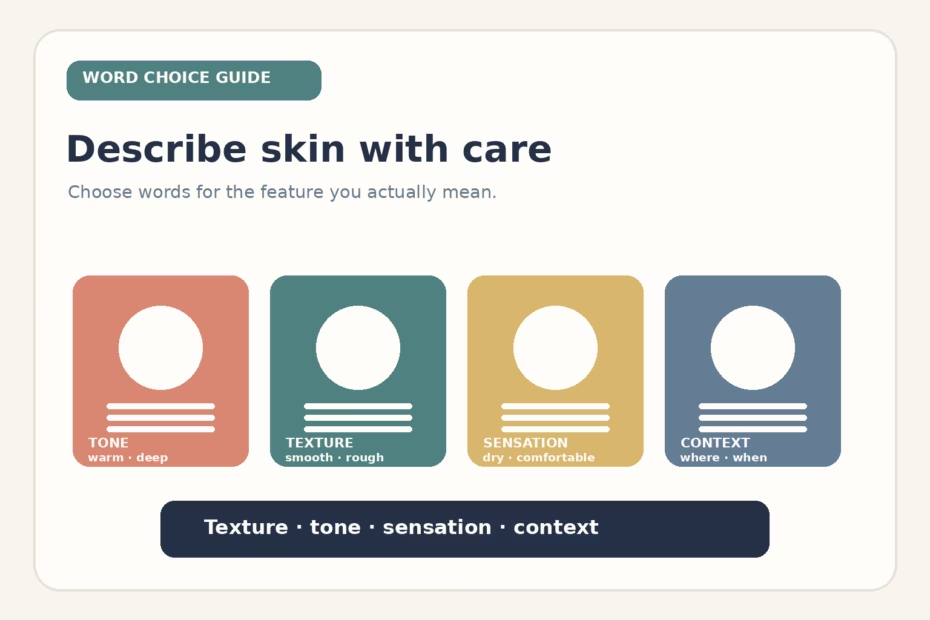
Quick answer: Useful adjectives for skin describe a specific feature: smooth or rough for texture, even or freckled for visible appearance, and dry or comfortable for a reported sensation. Add the location and situation when they matter, and treat words such as “flawless” or “perfect” as personal opinions rather than universal standards.

How to Describe skin? – Different Scenarios
How to Describe Skin? – Different Scenarios
When it comes to describing skin, finding the right words can make all the difference. Whether you are discussing your own skin or talking about someone else’s, using descriptive adjectives can help paint a picture of its qualities and characteristics. In different scenarios, we may need to describe skin for various reasons – whether it’s discussing skincare concerns, complimenting someone’s complexion, or simply expressing appreciation for our own skin’s unique beauty. Here are a few different scenarios in which describing skin can be helpful:
1. Skincare Concerns:
Understanding how to describe our skin can be particularly valuable when discussing skincare concerns. For example, if you’re experiencing dryness, you might say “My skin feels tight and rough.” Alternatively, oily skin can be described as “My skin looks shiny and feels greasy.” By using adjectives to describe our skin’s condition, we can effectively communicate our concerns to dermatologists or skincare professionals.
2. Complimenting Someone’s Complexion:
Describing someone else’s skin in a positive way can be a great way to pay them a compliment. For instance, you might say “Your skin looks radiant and glowing” to express admiration. If you notice someone with smooth and flawless skin, you could say “Your complexion is perfect.” Using adjectives to describe someone’s skin can make them feel appreciated and boost their confidence.
3. Appreciating Your Own Skin:
Describing our own skin with positive adjectives can help us appreciate its unique beauty. For instance, you might say “I love how soft and supple my skin feels” or “My skin has a natural and healthy glow.” By recognizing and acknowledging the positive qualities of our skin, we can cultivate a sense of self-acceptance and confidence.
In each scenario, finding the right words to describe skin can enhance our communication, relationships, and self-perception. By utilizing descriptive adjectives, we can accurately convey our skincare concerns, compliment others on their complexion, and appreciate the qualities of our own skin. So, the next time you think about your skin or encounter a conversation about it, don’t hesitate to use some of these adjectives to express its beauty and uniqueness.
Describing Words for skin in English
When it comes to describing skin, using the right adjectives is essential in effectively communicating its condition, appearance, and texture. Whether we’re discussing skincare concerns, complimenting someone’s complexion, or appreciating our own skin, descriptive words play a significant role in conveying our thoughts and emotions. Here are some adjectives that can help us describe skin:
- Radiant: Radiant skin is characterized by a natural, healthy glow. It appears luminous, bright, and full of life. This adjective is often used to compliment someone’s complexion, indicating that their skin is vibrant and beautiful.
- Smooth: Smooth skin is free from bumps, rough patches, or any uneven texture. It feels velvety and soft to the touch. When describing skin as smooth, it implies a well-maintained and well-hydrated complexion.
- Clear: Clear skin is devoid of blemishes, such as acne, pimples, or scars. It has an even tone and a consistent texture. Describing skin as clear indicates that it is healthy, flawless, and free from any visible imperfections.
- Glowing: Glowing skin emits a natural radiance from within. It has a healthy sheen and appears lit from within. This adjective is often used to describe skin that is well-nourished, hydrated, and reflects a youthful and vibrant appearance.
- Plump: Plump skin is well-hydrated, supple, and firm. It has a youthful volume and bounce. Describing skin as plump suggests that it is well-moisturized, giving it a healthy and youthful look.
- Elastic: Elastic skin is resilient, flexible, and able to stretch and return to its original state. It shows minimal signs of sagging or wrinkles. Describing skin as elastic indicates its strength and ability to maintain its shape.
- Toned: Toned skin is firm, tight, and well-defined. It has good muscle tone and appears sculpted. This adjective is often used to describe fit individuals whose skin reflects their physical fitness and health.
- Even: Even skin has a consistent color and texture. It lacks any blotchiness or discoloration. Describing skin as even suggests a balanced and uniform appearance.
Adjectives for skin
Adjectives for Skin
Positive Adjectives for Skin
Having beautiful, healthy-looking skin is something that many of us desire. Describing our skin using positive adjectives can help convey its condition, appearance, and texture. Here are some positive adjectives you can use to describe skin, along with example sentences:
| Adjective | Example Sentence |
|---|---|
| Radiant | Her skin looked radiant after using a moisturizing cream. |
| Smooth | His skin felt incredibly smooth to the touch. |
| Clear | She had clear skin with no blemishes or imperfections. |
| Glowing | His skin had a natural, healthy glow. |
| Plump | Her cheeks looked plump and youthful. |
| Elastic | The elasticity of her skin made her look younger. |
| Toned | He had well-toned skin that looked firm and tight. |
| Even | Her skin tone was even and without any discoloration. |
Negative Adjectives for Skin
While we strive for healthy-looking skin, there are times when we may need to describe certain skin concerns. Here are some negative adjectives you can use to describe skin, along with example sentences:
| Adjective | Example Sentence |
|---|---|
| Blemished | Her skin was blemished with acne scars. |
| Rough | His skin felt rough and dry due to the cold weather. |
| Uneven | She had uneven skin tone with patches of discoloration. |
| Dull | His skin appeared dull and lacked radiance. |
| Wrinkled | Her skin was wrinkled due to years of sun exposure. |
Using these adjectives can help you effectively communicate when discussing skin condition or complimenting someone on their complexion. The power of using descriptive words allows us to enhance communication, build relationships, and positively impact our self-perception when it comes to describing our skin.
Next, let’s explore how these adjectives can be used in different situations and why they are important in skincare conversations.
Synonyms and Antonyms with Example Sentences
Synonyms for skin
Synonyms and Antonyms with Example Sentences
When it comes to describing the condition, appearance, and texture of our skin, using a diverse range of adjectives can help us effectively communicate and express ourselves. Here are some synonyms that can be used to describe different aspects of our skin:
| Synonym | Definition | Example Sentence |
|---|---|---|
| Radiant | Glowing and full of energy | Her skin looked radiant in the sunlight. |
| Smooth | Even and free of bumps or roughness | His skin felt smooth to the touch. |
| Clear | Free from blemishes or imperfections | She had clear skin that glowed naturally. |
| Glowing | Shining and healthy-looking | After her workout, her skin was glowing. |
| Plump | Full and well-hydrated | The moisturizer made her skin look plump. |
| Elastic | Firm and able to stretch without losing its shape | With proper care, skin can remain elastic. |
| Toned | Firm and well-defined | Regular exercise can help tone the skin. |
| Even | Uniform and consistent | A good skincare routine leads to even skin. |
Antonyms for skin
On the other hand, there are also words that can be used to describe skin concerns or imperfections. These antonyms can help us highlight areas that may require attention or improvement:
| Antonym | Definition | Example Sentence |
|---|---|---|
| Blemished | Marked or marred by imperfections or discoloration | Her skin had blemishes from the acne. |
| Rough | Uneven or coarse in texture | His skin felt rough and dry. |
| Uneven | Not smooth or consistent | The scars on her face made her skin uneven. |
| Dull | Lacking brightness or radiance | Stress can make the skin look dull. |
| Wrinkled | Marked by lines or creases, typically from aging or sun damage | Her skin had become wrinkled over time. |
Using these adjectives can help us accurately describe and communicate our experiences with our skin. Whether we want to express its positive attributes or address any concerns, having a wide range of words at our disposal enables us to better engage in skincare conversations. With these synonyms and antonyms, we can enhance our ability to express our thoughts and feelings about our skin.
How to choose adjectives for skin
Begin by deciding what you mean to describe: visible tone, surface texture, a sensation someone reports, or a particular condition. Mixing those ideas can make a sentence unclear. For example, smooth describes texture, deep can describe a tone, and itchy describes a sensation. A person may use more than one word, but each should add a distinct detail.
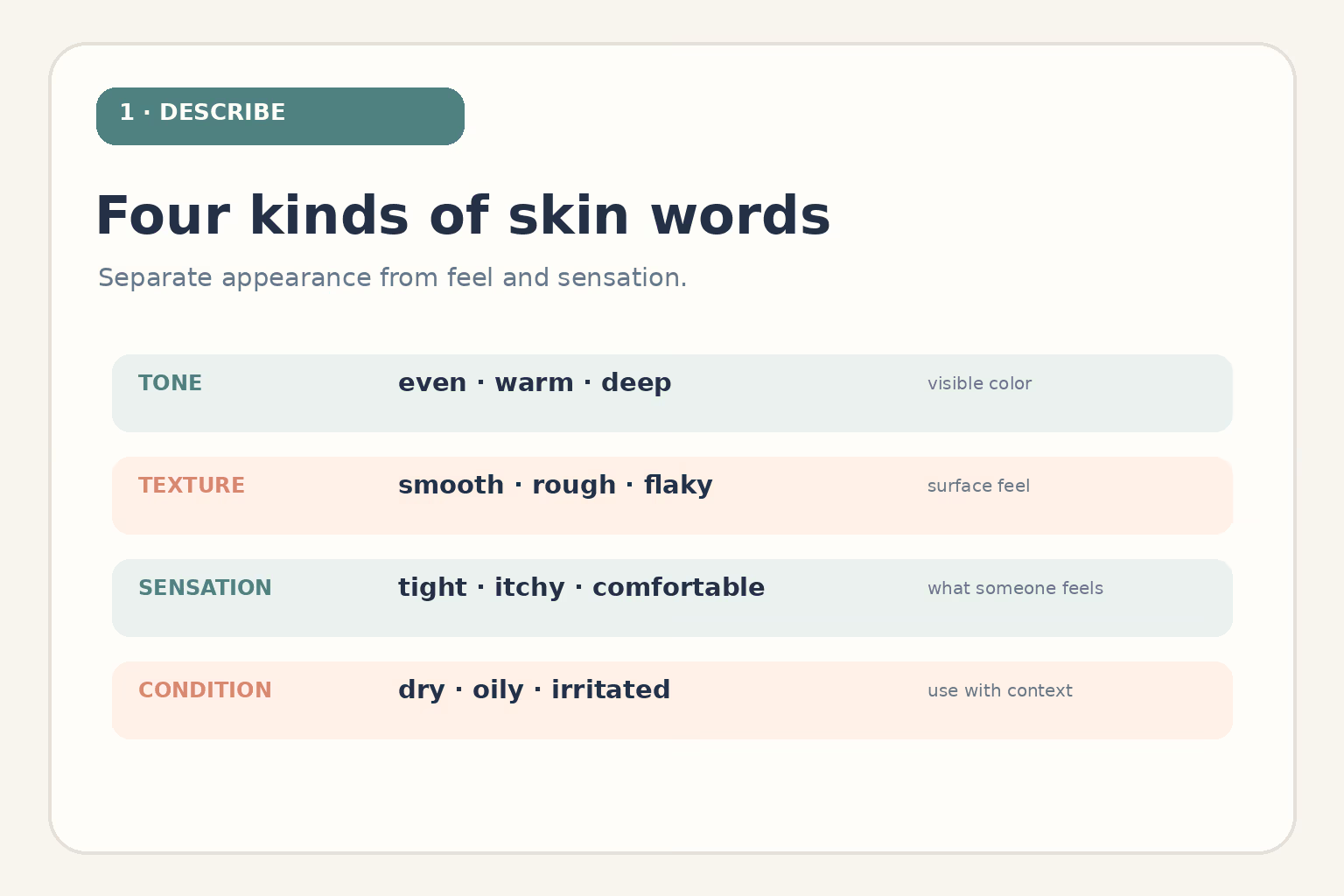
| What you are describing | Possible adjectives | Example |
|---|---|---|
| Texture | smooth, rough, soft, flaky | “The skin on my hands feels rough after gardening.” |
| Visible appearance | even, freckled, shiny, dewy | “Her cheeks looked dewy in the afternoon light.” |
| Tone | light, medium, deep, warm | “The portrait uses warm tones and soft lighting.” |
| Sensation | tight, itchy, tender, comfortable | “My skin feels tight after the long swim.” |
| Condition or concern | dry, oily, irritated, sensitive | “They described the area as dry and sensitive.” |
Pair the adjective with an observable detail
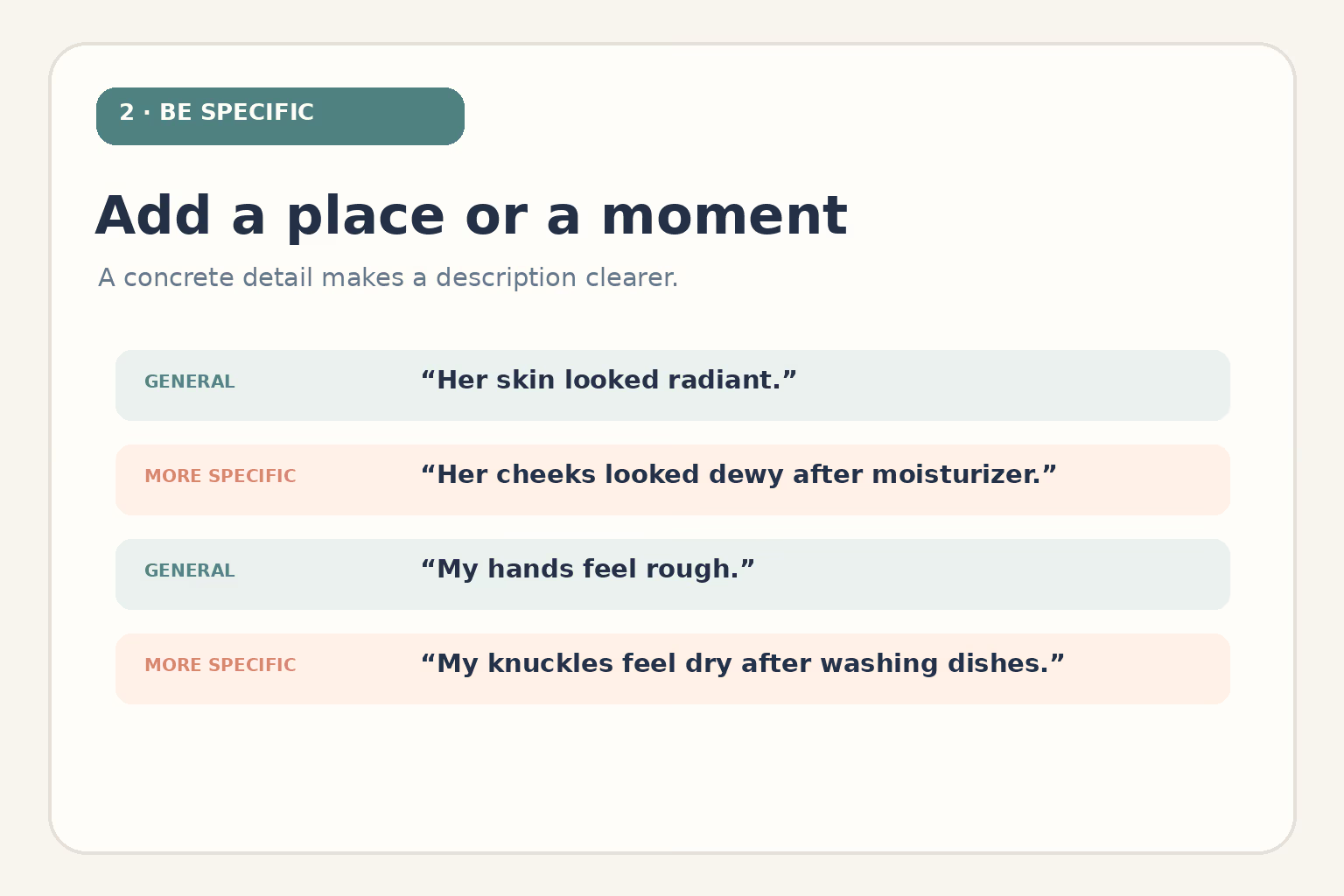
A broad adjective can be useful in a compliment or a creative description. For clearer communication, add what you noticed and where. “Her skin looked radiant” gives an overall impression; “her cheeks looked dewy after the moisturizer” names an appearance and context. For a sensation, make clear whose experience it is: “My forehead feels tight,” or “They said the area was itchy.” This keeps an observation separate from an assumption about what caused it.
Describe color with awareness of skin tone
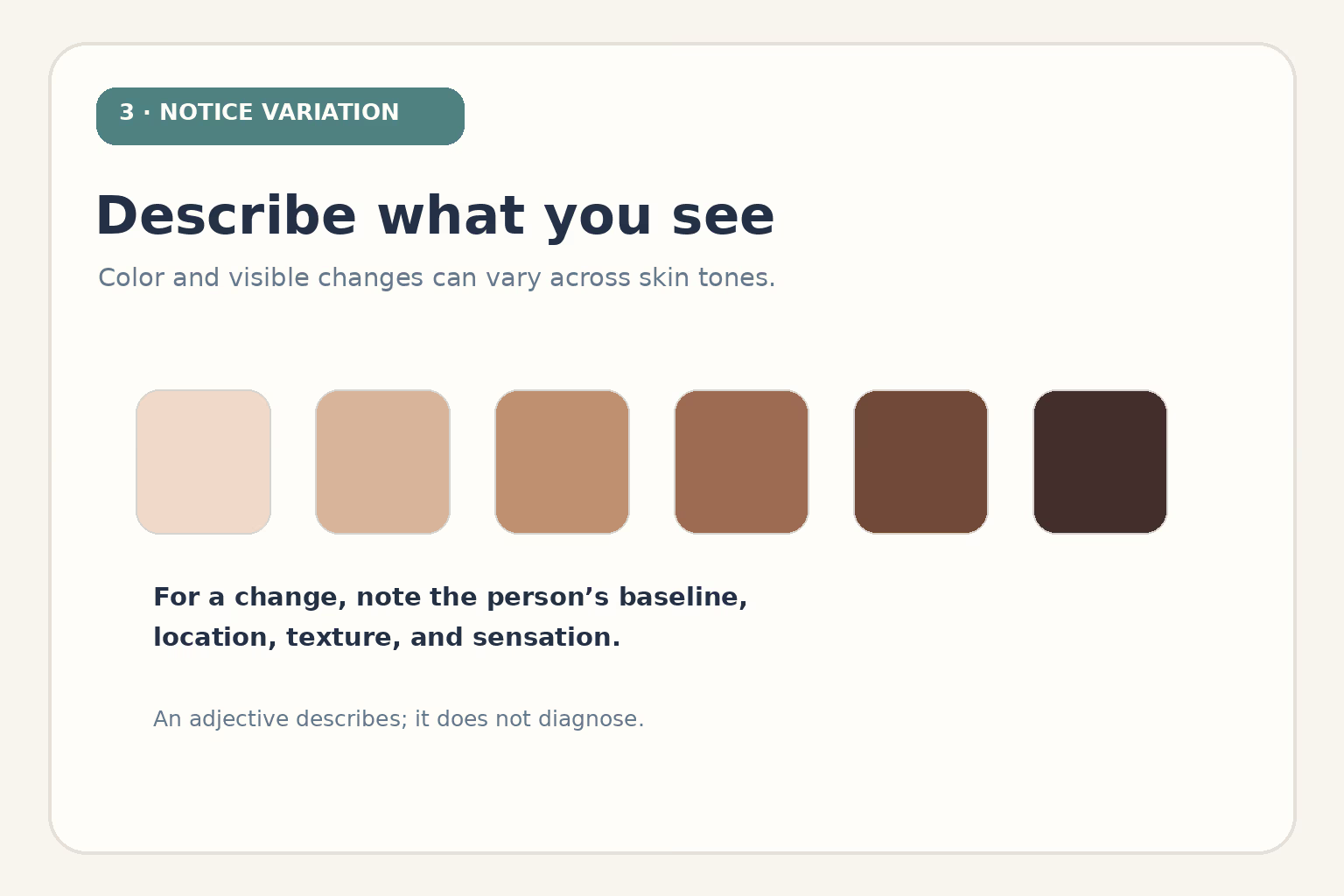
Visible color changes do not look identical on every skin tone. The American Academy of Dermatology notes that rosacea may appear red on lighter skin and brown or violet on darker skin; the NHS describes contact dermatitis as red on lighter skin and potentially dark brown, purple, or gray on darker skin. When describing a change, note the person’s usual appearance, location, texture, and any sensation they report. A color adjective by itself cannot identify a cause or diagnose a condition.
Use evaluative words thoughtfully
Words such as flawless, perfect, youthful, and blemished express a judgment as well as a description. They may fit a quoted opinion or a particular style of writing, but skin naturally varies in tone, pores, freckles, lines, and texture. These features are not a simple measure of health or beauty. If a detail matters, describe it specifically—such as “a few visible freckles” or “dry patches around the knuckles”—instead of turning it into a label for the person.
Skin descriptors are not literal synonyms or antonyms for “skin”
Words such as radiant, smooth, and rough describe skin; they do not replace the noun skin. Some pairs contrast one feature, such as smooth and rough for texture, while others describe separate qualities. Use “descriptor” for these words and reserve “synonym” or “antonym” for words with a closer same-or-opposite meaning.
Frequently asked questions
What are positive adjectives for skin?
Soft, smooth, comfortable, even, and radiant can work positively, depending on context. “Positive” is a point of view: choose a word that names the feature you mean rather than implying that one appearance is the standard for everyone.
How can I describe skin texture?
Words such as smooth, rough, soft, coarse, and flaky refer to texture. If accuracy matters, identify the location and whether the word describes what you see or what someone feels.
How do you describe a skin concern without diagnosing it?
Stick to the observed detail and the person’s own report: where it is, how it looks or feels, and when it appeared. An adjective can describe an appearance or sensation, but it cannot explain the cause of a skin change.
Are “clear” and “flawless” objective descriptions?
They are often evaluative or broad. For a more specific description, name the visible feature—such as an even tone, freckles, or a few visible spots—and avoid treating normal skin texture or variation as a flaw.
Conclusion
Descriptive adjectives play a crucial role in effectively expressing the condition, appearance, and texture of our skin. By using positive adjectives like radiant, smooth, clear, glowing, plump, elastic, toned, and even, we can vividly convey the beauty and health of our skin. On the other hand, negative adjectives such as blemished, rough, uneven, dull, and wrinkled help us address specific skin concerns.
By incorporating these adjectives into our vocabulary, we can enhance our communication skills, build stronger connections, and positively influence our self-perception when discussing our skin. These words empower us to accurately describe and communicate our experiences, allowing others to better understand and empathize with our skincare journey.
To further expand our skin vocabulary, the next section explores synonyms and antonyms for skin, along with example sentences for each adjective. This comprehensive resource will enable us to express ourselves with precision and clarity, ensuring that our descriptions of our skin are accurate and impactful.
By harnessing the power of descriptive adjectives, we can effectively communicate the unique qualities of our skin, fostering a deeper understanding and appreciation for the diverse range of skin experiences.


