Adjectives for small describe relative size, but the right word depends on the noun and the point you mean: tiny and minuscule mark degree, compact describes little occupied space, short names height, and meager describes an inadequate amount. “Small” has no universal cutoff, so add a comparison when precision matters and avoid using petite or microscopic as general substitutes.
How to Choose an Adjective for Small
“Small” is a gradable adjective: it can be intensified (“very small”) or compared (“smaller than the sample”). What counts as small depends on the object, purpose, and comparison group, so avoid inventing a universal size threshold. Cambridge Grammar uses small as an example of an adjective that takes different degrees, and its comparison guide explains how comparative forms relate items within a comparison set (Cambridge Grammar: adjectives; comparative and superlative adjectives).
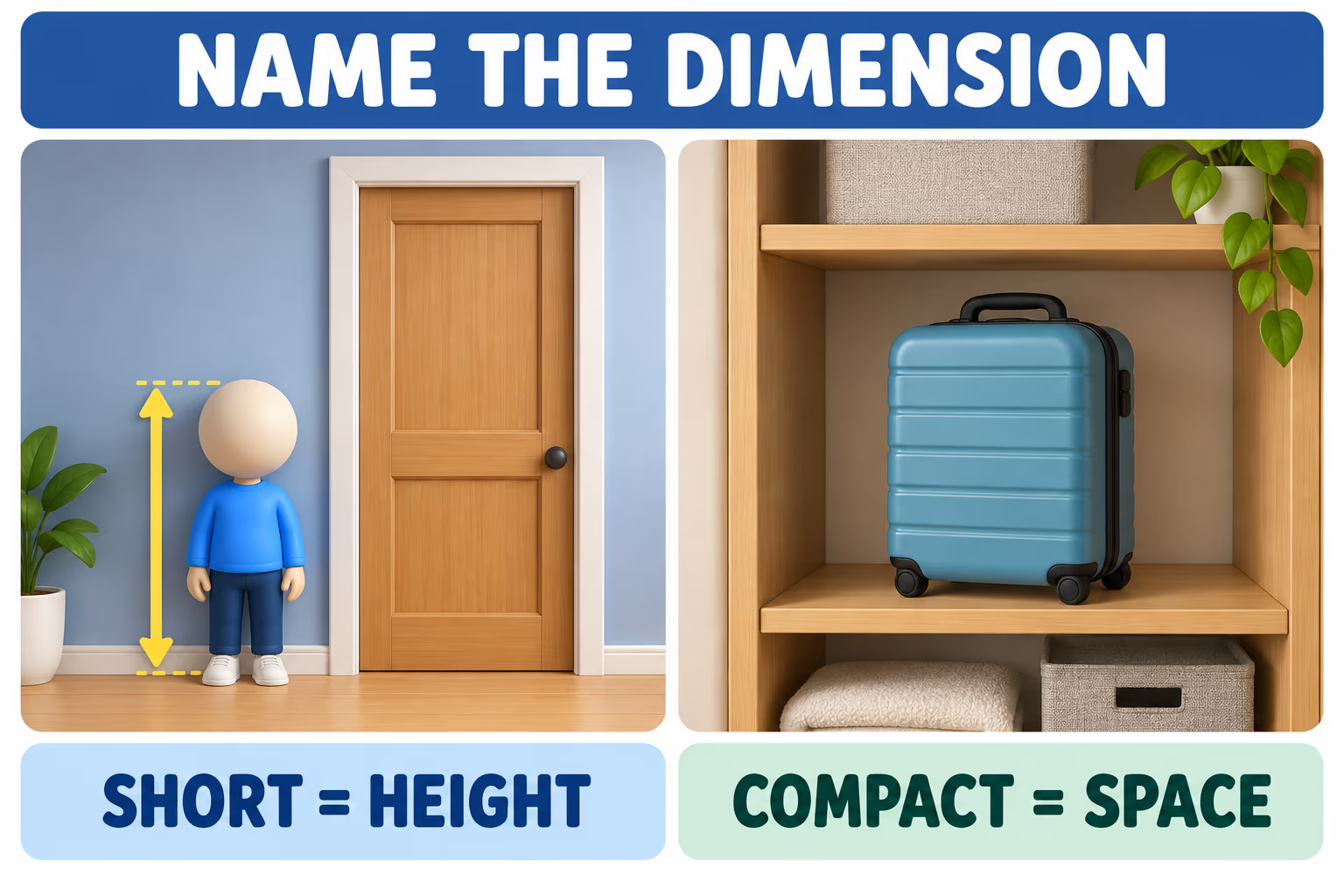
- Name the dimension. Use short for height or length, narrow for width, and low for height, level, or amount when that is the intended measure. “A narrow shelf” tells readers more than “a small shelf.”
- Separate size from space. Compact fits a design or arrangement that occupies little space: a compact camera, compact car, or compact layout. It does not automatically mean slender or petite when describing a person.
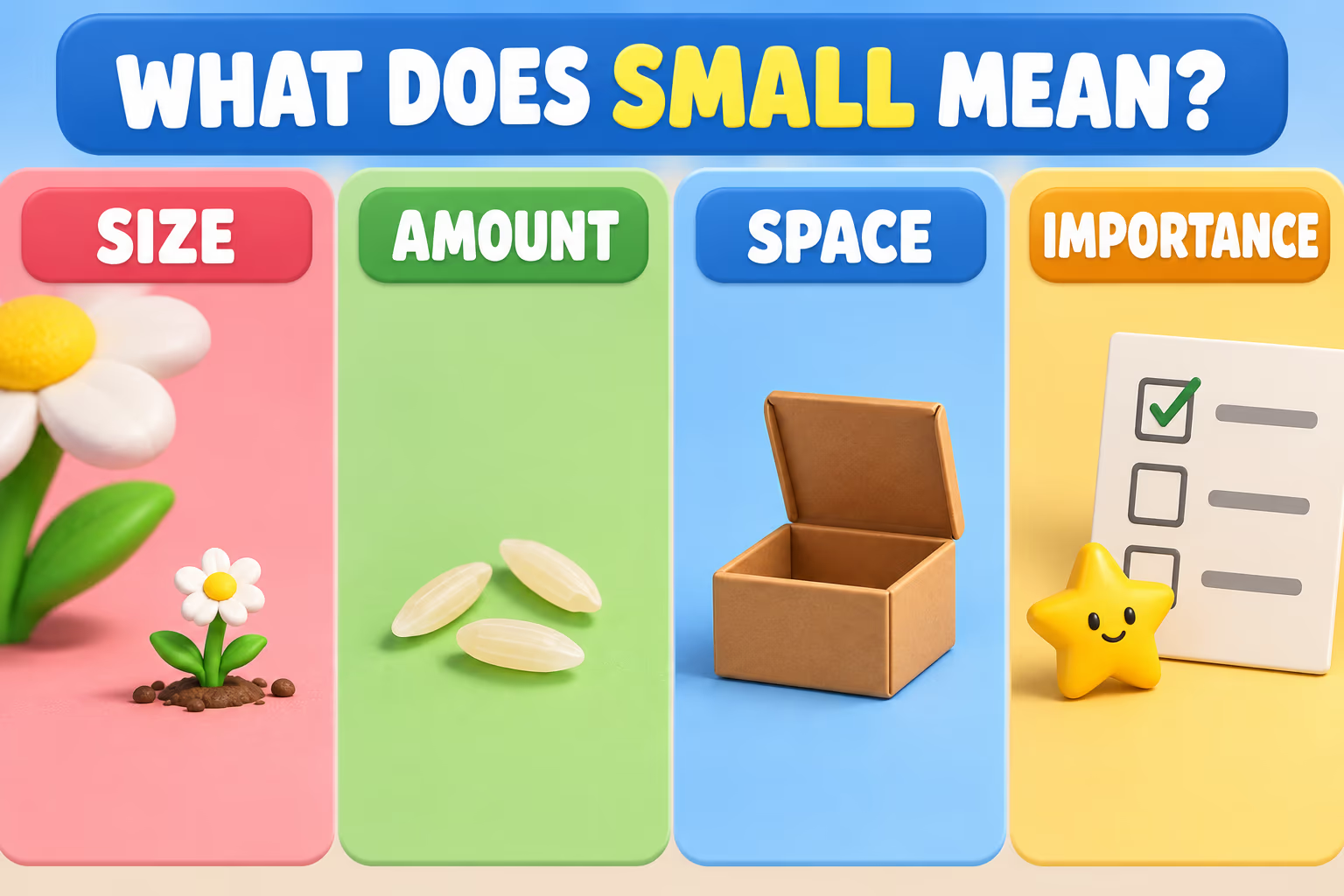
- Separate size from quantity. Meager (US spelling: meager) describes an amount that is very small or not enough. Limited can describe a small amount or number, such as limited time or limited resources. Neither gives a physical measurement by itself.
- Match the degree and tone. Tiny, minuscule, and diminutive emphasize very small size; dainty adds delicacy; Lilliputian sounds literary or playful. Choose the one that fits the object and the voice.
- Describe people with care. If height is relevant, say shorter or give a comparison. Petite is commonly used for women/girls and clothing sizes for shorter or smaller women, so it is not a neutral all-purpose synonym for an object or every person.
Adjectives for Small: Quick Comparison
Use this table to choose a word by meaning, not by an assumed ladder from “small” to “smallest.” The same object can be small in one dimension and not another; a compact design can save space without being the shortest or lightest option.
| Word | What it emphasizes | Useful example | Usage check |
|---|---|---|---|
| small | General size relative to a comparison | a small mug beside a large one | State the comparison when precision matters. |
| little | Small size or amount; often conversational | a little garden behind the house | Meaning depends on the noun and sentence. |
| tiny | Extremely small size or amount | a tiny seed on the table | Does not establish a measurement. |
| minuscule | Extremely small; often more formal in tone | a minuscule print label | Not automatically smaller than tiny. |
| miniature | A small version or copy; also very small | a miniature model of a bridge | Often suggests a deliberately scaled-down version. |
| compact | Neatly arranged or using little space | a compact camera in a small bag | Emphasizes footprint or arrangement, not body type. |
| petite | Small stature or a clothing size for shorter women | a petite-size jacket | People/clothing usage is more idiomatic than an object such as a jewelry box. |
| short | Limited height or length | a short handle on a travel cup | Names one dimension; it need not mean narrow or low in volume. |
| microscopic | So small it can be seen only with a microscope, in the literal sense | microscopic algae in a sample | Use figuratively only when the exaggeration is intentional. |
| diminutive | Very or unusually small | a diminutive brass key | Can sound affectionate or belittling depending on context. |
| dainty | Small and delicate, sometimes with careful movement | dainty pastry shells | It adds delicacy, not size alone. |
| Lilliputian | Extremely small, with a literary or whimsical effect | a Lilliputian toy village | Use when the allusion or playful tone fits. |
| meager / limited | An amount, supply, choice, or number that is too small or restricted | a meager allowance; limited seating | These describe quantity or sufficiency, not an object’s dimensions. |
| cramped / confining | A space or experience that feels restrictive | a cramped booth; a confining room | Describes restricted room or the effect it has. |
Usage Notes for Common Small Adjectives
Tiny and minuscule overlap
Tiny and minuscule both mean extremely small. Cambridge’s entries do not set a fixed scale in which one must always be smaller than the other (tiny; minuscule). Choose by tone and sentence rhythm: “tiny grains” is plain and familiar; “a minuscule amount” sounds more formal. If an exact difference matters, supply a measurement rather than relying on the word alone.
Compact, petite, and miniature are not interchangeable
Compact describes parts arranged closely or something designed to use little space, as in a compact camera or office (Cambridge Dictionary: compact). Petite usually describes a woman/girl or a clothing size made for small women; the dictionary’s British entry marks the body description as approving, and the American entry also notes smaller-than-average height (petite). Miniature commonly means a small copy or version, as in a miniature landmark. The phrase “petite jewelry box” can be understood, but tiny or compact is clearer for an object.
Use microscopic literally when accuracy matters
In its scientific sense, microscopic means very small and only visible with a microscope (Cambridge Dictionary: microscopic). “A microscopic organism” works when that condition is true. “A microscopic apartment” is a figurative exaggeration; in practical description, use “very small,” “cramped,” or give the floor area. Avoid stacking an extreme word with an intensifier if the result sounds redundant.
Short, narrow, low, and light name different dimensions
Replace a general size word only when the dimension is clear: a short ladder has limited length or height; a narrow path has little width; a low shelf is not high; and a light object has little mass. “Small” can describe overall scale, but it does not tell readers which measurement changed. For more vocabulary about stature, see our guides to adjectives for height and adjectives for short.
Teacup is an informal label, not a recognized breed category
In dog descriptions, teacup is an informal label for a dog smaller than average, not an official breed adjective. The Royal Kennel Club says it does not recognize teacup breeds and does not record dogs as teacup in its register. When accuracy matters, name the recognized breed and describe the dog’s actual size rather than presenting “teacup” as a breed (Royal Kennel Club guidance). For more animal-description terms, see our adjectives for animals guide.
“Positive” and “negative” depend on what the word evaluates
A word can describe size, quantity, importance, or an effect—and those meanings should not be collapsed into one positive/negative scale. Trivial and insignificant usually judge importance or value, not physical dimensions (trivial; insignificant). Meager says an amount is very small or insufficient (meager/meagre). Confining describes a restrictive experience. By contrast, nimble describes agility and charming describes an appealing quality; neither is a size synonym. Tone depends on the sentence and the person or thing being described.
Lilliputian is a literary choice
Lilliputian alludes to Lilliput in Jonathan Swift’s Gulliver’s Travels. In the novel, the inhabitants are described as under six inches tall, making the allusion a vivid way to suggest extreme smallness. The adjective can add a playful or literary flavor, but it may sound ornate in straightforward instructions. For plain prose, tiny, miniature, or a measurement is usually easier to understand (Project Gutenberg text of Gulliver’s Travels).
Which Adjective Should You Choose?
- For a neutral description: use small and add a comparison, such as “small for this model” or “smaller than the first sample.”
- For a specific measurement: choose short, narrow, or low to identify the dimension instead of making readers guess.
- For a space-saving design: choose compact, especially when the item is arranged efficiently or fits in a limited space.
- For an insufficient amount: choose meager or limited and name the quantity or resource that falls short.
- For a tiny model or playful image: choose miniature for a scaled copy or Lilliputian for a deliberate literary effect.
For size words at the opposite end of the scale, compare these choices with our guide to adjectives for big. When describing an actual person, use the dimension that matters and avoid treating body size as a judgment of character or ability.
Frequently Asked Questions About Adjectives for Small
Is minuscule smaller than tiny?
Not by a fixed dictionary scale. Cambridge defines both tiny and minuscule as extremely small, but does not require minuscule to be smaller in every context. Writers often choose minuscule for a more formal tone. If readers need an exact distinction, use a number or comparison rather than relying on the synonym.
What is the difference between small and compact?
Small describes general size relative to a reference. Compact emphasizes a neat arrangement or design that uses little space, such as a compact camera or layout. An object may be compact without being the shortest, narrowest, or lightest version, so use the word that matches the feature you mean.
Can petite describe an object?
It can be understood figuratively, but petite is most idiomatic for a woman/girl or a clothing size designed for shorter or smaller women. For a jewelry box, camera, or animal, small, tiny, or compact usually communicates the intended feature more clearly and avoids implying a person-related sense.
Does microscopic always mean visible only through a microscope?
That is the literal scientific meaning: microscopic things are so small they can be seen only with a microscope. In everyday speech, people also use the word figuratively for something extremely small, as in “a microscopic room.” In technical or practical writing, state the measurement or use “very small” unless microscope visibility is accurate.
Is teacup an official adjective for a dog breed?
No. “Teacup” is an informal label for a dog smaller than average, not a recognized breed category. The Royal Kennel Club states that it recognizes no teacup breeds. For clear writing, name the dog’s actual breed and describe its size separately instead of presenting “teacup” as an official breed name.
Are trivial and insignificant synonyms for small?
They can refer to something small in importance or value, but they are not neutral substitutes for physical size. A trivial disagreement is not necessarily physically small; an insignificant difference may be small enough not to matter. For an object’s dimensions, choose a measurement word such as short, narrow, or tiny.
Source and Preservation Note
The usage guidance above applies current dictionary and institutional definitions. The original published examples, 22 list items, six tables, conclusion, and all other source HTML follow unchanged below for preservation. Where the original text claims that minuscule is always smaller than tiny, uses petite broadly for objects, treats microscopic as ordinary smallness, or labels importance words as size words, use the clarifications above.
When it comes to describing something small, the English language offers a plethora of adjectives that can capture the essence of its size. From tiny and minuscule to petite and compact, these words paint a vivid picture in our minds. In this article, I’ll be exploring a variety of adjectives that can be used to describe small objects, animals, and even people. So, whether you’re looking to add some flair to your writing or simply expand your vocabulary, get ready to delve into the world of adjectives for small!
One of the most commonly used adjectives for small is “tiny.” This word conveys a sense of extreme smallness and is often used to describe objects or creatures that are significantly smaller than average. For example, you might say, “The newborn kitten was so tiny, it could fit in the palm of my hand.” Another adjective that can be used to describe smallness is “minuscule.” This word suggests an even smaller size than tiny and is perfect for emphasizing the minute nature of something. For instance, you could say, “The minuscule grains of sand sparkled in the sunlight.”
In addition to objects and animals, adjectives for small can also be used to describe people. One such adjective is “petite.” This word is commonly used to describe someone who is small and slender in stature. For example, you might say, “She was a petite woman with delicate features.” Another adjective that can be used to describe a small person is “compact.” This word suggests a small and well-proportioned physique. For instance, you could say, “He had a compact build that made him agile and nimble.”
How to Describe small? – Different Scenarios
When it comes to describing small things, the English language offers a multitude of adjectives that can be used in various scenarios. Whether you’re describing objects, animals, or people, there are plenty of descriptive words to capture the essence of smallness. Let’s explore different scenarios and the adjectives that can be used in each one:
1. Describing Small Objects
Small objects come in all shapes and forms, and there are several adjectives you can use to describe them. Here are a few examples:
| Adjective | Definition | Example |
|---|---|---|
| Tiny | Extremely small in size or amount | The tiny pebble on the beach |
| Minuscule | Extremely small, tiny | The minuscule ant crawling on the ground |
| Compact | Occupying little space | The compact car parked in the driveway |
| Petite | Small and delicate | The petite jewelry box on the dresser |
| Lilliputian | Extremely small or miniature | The lilliputian toy figurine on the shelf |
2. Describing Small Animals
Animals, both wild and domestic, can also be described using adjectives that highlight their small size. Here are a few examples:
| Adjective | Definition | Example |
|---|---|---|
| Diminutive | Extremely or unusually small | The diminutive hummingbird fluttering in the garden |
| Pint-sized | Very small, tiny | The pint-sized puppy playing in the park |
| Microscopic | So small as to be visible only with a microscope | The microscopic organism in the pond water |
| Dainty | Small and delicate, often used to describe small pets or birds | The dainty butterfly landing on the flower |
| Teacup | Describing small dog breeds or animals | The teacup poodle curled up on the couch |
| Adjective | Definition | Example |
|---|---|---|
| Short | Having a small vertical extent | The short boy reaching for the |
Describing Words for small in English
When it comes to describing small objects, animals, or even people, the English language offers a plethora of adjectives that can help us paint a vivid picture. Here are some descriptive words for small that you can add to your vocabulary:
- Tiny: This word is often used to describe something extremely small in size. It conveys a sense of delicacy and fragility. For example, “The tiny flower bloomed in the garden.”
- Minuscule: Use this word when you want to emphasize that something is even smaller than tiny. It adds a touch of awe and wonder to your description. For instance, “The minuscule ants crawled along the path.”
- Compact: This adjective is perfect for describing small objects that are neatly and efficiently designed. It implies efficiency and functionality. For instance, “The compact laptop fit perfectly into my bag.”
- Petite: This word is commonly used to describe small and dainty people, particularly women. It suggests grace and elegance in a diminutive size. For example, “She wore a petite dress that accentuated her figure.”
- Lilliputian: Derived from Jonathan Swift’s “Gulliver’s Travels,” this adjective refers to something tiny or miniature. It adds a whimsical and literary touch to your description. For example, “The lilliputian houses lined the toy village.”
Remember, incorporating diverse and colorful vocabulary can make your writing more engaging and captivating. By using these adjectives, you can effectively describe small objects, animals, or people in a precise and imaginative manner.
| Adjective | Definition |
|---|---|
| Tiny | Extremely small in size. |
| Minuscule | Even smaller than tiny, conveying a sense of awe and wonder. |
| Compact | Neatly and efficiently designed, implying efficiency and functionality. |
| Petite | Describing small and dainty people, particularly women. Suggesting grace and elegance in a diminutive size. |
| Lilliputian | Referring to something tiny or miniature, adding a whimsical and literary touch to your description. |
Adjectives for small
Positive Adjectives for small with 12 Example Sentences
When it comes to describing small objects, animals, or people, there are a plethora of positive adjectives that can be used. Here are 12 examples of positive adjectives for small, along with example sentences to illustrate their usage:
- Tiny: The baby turtle was so tiny that it could fit in the palm of my hand.
- Minuscule: The ants were carrying the food crumb with their minuscule strength.
- Compact: The new smartphone is not only sleek, but also compact, making it easy to carry around.
- Petite: The ballet dancer had a petite frame, which made her movements look even more graceful.
- Lilliputian: The dollhouse was filled with lilliputian furniture, each piece intricate and delicate.
- Diminutive: The puppy had a diminutive size, but its personality was larger than life.
- Pint-sized: The toddler was incredibly adorable with his pint-sized cowboy hat.
- Microscopic: Under the microscope, we discovered a microscopic world of organisms.
- Dainty: The bakery was filled with an array of dainty pastries, each one a work of art.
- Teacup: The teacup chihuahua was pampered and adored by its owner.
- Nimble: The gymnast performed a series of nimble flips and twists effortlessly.
- Charming: The small cottage in the countryside had a charming garden, filled with colorful flowers.
Negative Adjectives for small with 5 example sentences
While there are many positive adjectives to describe small things, there are also negative adjectives that can be used in certain contexts. Here are 5 examples of negative adjectives for small, along with example sentences to provide a better understanding:
- Insignificant: The contribution made by the small company was seen as insignificant compared to the larger corporations.
- Trivial: The disagreement between the friends seemed trivial in the grand scheme of things.
- Limited: The small budget set a limited scope for the project, making it challenging to achieve all the desired outcomes.
- Confining: The cramped quarters of the small apartment felt confining and suffocating.
- Meager: The small portion of food on the plate was meager and left me feeling unsatisfied.
When it comes to describing small objects, animals, or people, there is a wide range of adjectives to choose from. From positive adjectives highlighting their charm and beauty, to negative adjectives indicating limitations or insignificance, these words can add depth and precision to our descriptions.
Synonyms and Antonyms with Example Sentences
Synonyms for small
When it comes to describing small objects, animals, or people, there are several synonyms that can be used to add variety and richness to your writing. Here are some alternative words you can use instead of “small,” along with example sentences to help you understand their usage:
| Synonym | Example Sentence |
|---|---|
| Tiny | I found a tiny bird’s nest in the tree. |
| Little | The puppy was so little that it fit in the palm of my hand. |
| Miniature | She collects miniature figurines of famous landmarks. |
| Petite | My sister is petite and can wear clothes from the kids’ section. |
| Compact | The compact car easily fits into tight parking spaces. |
Using these synonyms allows you to paint a more vivid picture in your writing and captivate your readers with your diverse vocabulary.
Antonyms for small
While there are many positive adjectives that can be used to describe small things, there are also antonyms that can be used in certain contexts to convey the opposite meaning. Here are some antonyms for “small,” along with example sentences to illustrate their usage:
| Antonym | Example Sentence |
|---|---|
| Large | The elephant is much larger than the mouse. |
| Big | I bought a big box of chocolates for my mom’s birthday. |
| Giant | The sunflower in our garden is a giant compared to the other flowers. |
| Huge | The mansion had a huge backyard with a swimming pool. |
| Spacious | The living room felt spacious with its high ceilings and open layout. |
By using antonyms, you can create contrast and emphasize the size difference between objects, animals, or people in your writing.
Remember, incorporating synonyms and antonyms effectively will enhance your writing and engage your readers, allowing them to visualize and experience your descriptions more vividly.
Conclusion
By exploring a range of adjectives for small objects, animals, and people, we have expanded our vocabulary and gained valuable insights into enhancing our writing. Throughout this article, we have discovered a plethora of synonyms for “small,” each with its own unique nuance and usage. These adjectives, when incorporated into our writing, can bring depth and richness to our descriptions.
Additionally, we have explored the power of antonyms for “small” and how they can be used to create contrast and emphasize the opposite meaning. By incorporating these antonyms into our writing, we can create a more dynamic and engaging narrative.
Expanding our vocabulary and utilizing synonyms and antonyms not only enhances our writing but also allows us to paint vivid pictures with words. By choosing the right adjectives, we can evoke emotions, create imagery, and captivate our readers.
So, whether we are describing the delicate petals of a flower, the diminutive size of an insect, or the slight frame of a person, the adjectives we choose can make all the difference. Let us continue to explore the vast world of adjectives and enrich our writing with their power.


