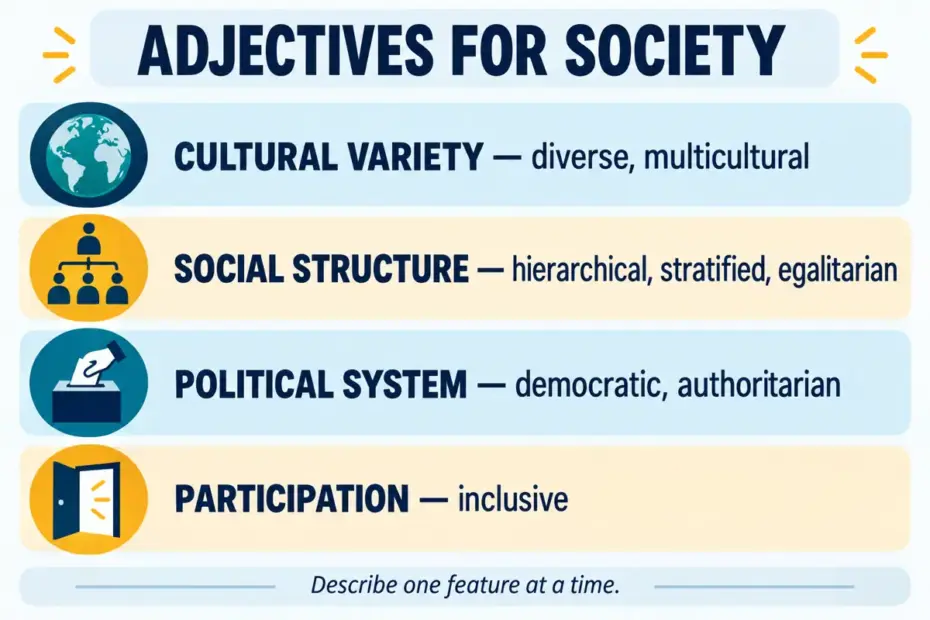
Adjectives for Society: Choose a Precise Description
Society is a noun for an organized group of people or the people living within a country or community. An adjective can describe one feature of that group—its cultural variety, social structure, political system, or access to participation. The clearest word depends on which feature you mean and what evidence supports it.
Correction to the lists below: community, civilization, culture, and human race are nouns related to society, not interchangeable adjectives. Isolation, solitude, loneliness, individualism, and self-reliance are not direct antonyms of society; they name different conditions or ideas. This guide separates the adjective from related nouns and clarifies what common society descriptors mean.
Adjectives for cultural variety
- Diverse means made up of many different kinds of people or things. Name the kind of variety if it matters: “The city has a culturally diverse population.”
- Multicultural describes a society or group that includes people with different cultural customs or beliefs: “The multicultural neighborhood hosts festivals organized by several cultural associations.”
- Pluralistic emphasizes different kinds of people, beliefs, opinions, or needs within a society: “A pluralistic society allows people with different beliefs to express them.”
Diverse is broad: it can refer to cultures, opinions, languages, or other differences. Multicultural focuses on multiple cultures. Neither word by itself tells readers whether members have equal influence or participate on equal terms. See Cambridge Dictionary on diverse, multicultural, and pluralist / pluralistic.
Adjectives for social structure
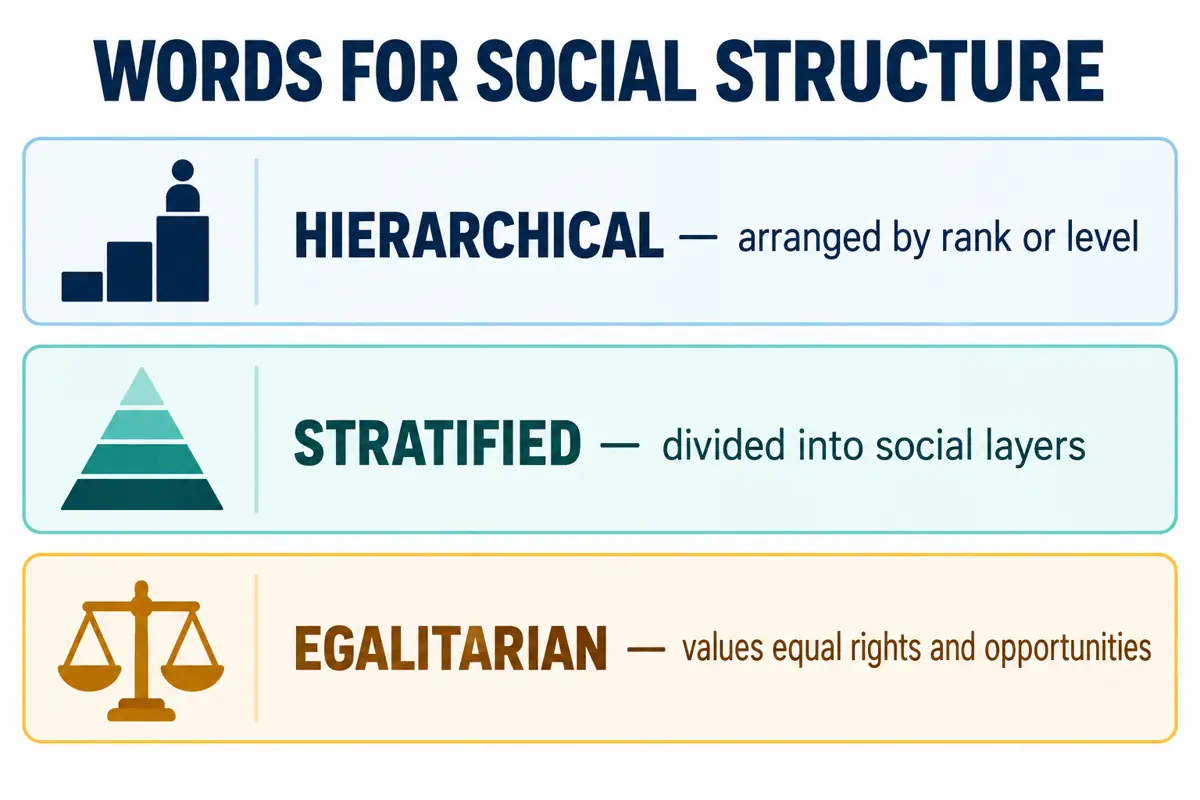
- Hierarchical describes an arrangement with ranks or levels of importance: “The report describes a hierarchical decision-making structure.”
- Stratified describes distinct social layers or groups: “The study examines a stratified society in which access to land differs by class.”
- Egalitarian describes a belief or arrangement that values equal importance, rights, or opportunities: “The organization describes its membership rules as egalitarian.”
Hierarchical points to ranked relationships; stratified often points to separate social layers; egalitarian expresses an equality-oriented principle or ideal. Use the word that matches the feature being discussed, and do not treat an ideal as proof that outcomes are equal. Cambridge Dictionary explains hierarchical, stratified, and egalitarian.
Adjectives for a political system
- Democratic relates to democracy, in which people hold power directly or choose representatives through elections: “The constitution establishes a democratic system with elected representatives.”
- Authoritarian describes a system or ruler that demands obedience and limits people’s freedom to act: “The historian describes the government as authoritarian because it restricts opposition and controls public debate.”
These words describe political arrangements, not every quality of the people who live under them. A political system can have elections and still need to be assessed on other features; explain the specific institution, rule, or evidence behind a broad label. Cambridge Dictionary defines democratic and authoritarian.
Adjectives for participation and social relations
- Inclusive describes a group or society that works to include different kinds of people and treat them fairly: “The town revised its meeting process to make public consultation more inclusive.”
- Divided describes a group split by disagreement or conflict: “The debate left the council divided over the proposed policy.”
- Harmonious suggests a peaceful or cooperative relationship: “The groups reached a harmonious working agreement after setting shared rules.”
- Unequal describes conditions or access that are not equal: “The report found unequal access to public transit across the districts it studied.”
These words need context. A society can be culturally diverse and still be unequal; disagreement does not mean that every relationship is hostile; and “harmonious” should not be used to imply that all members agree. Cambridge describes an inclusive group as one that tries to include different people and treat them fairly.
Related nouns are not always adjectives
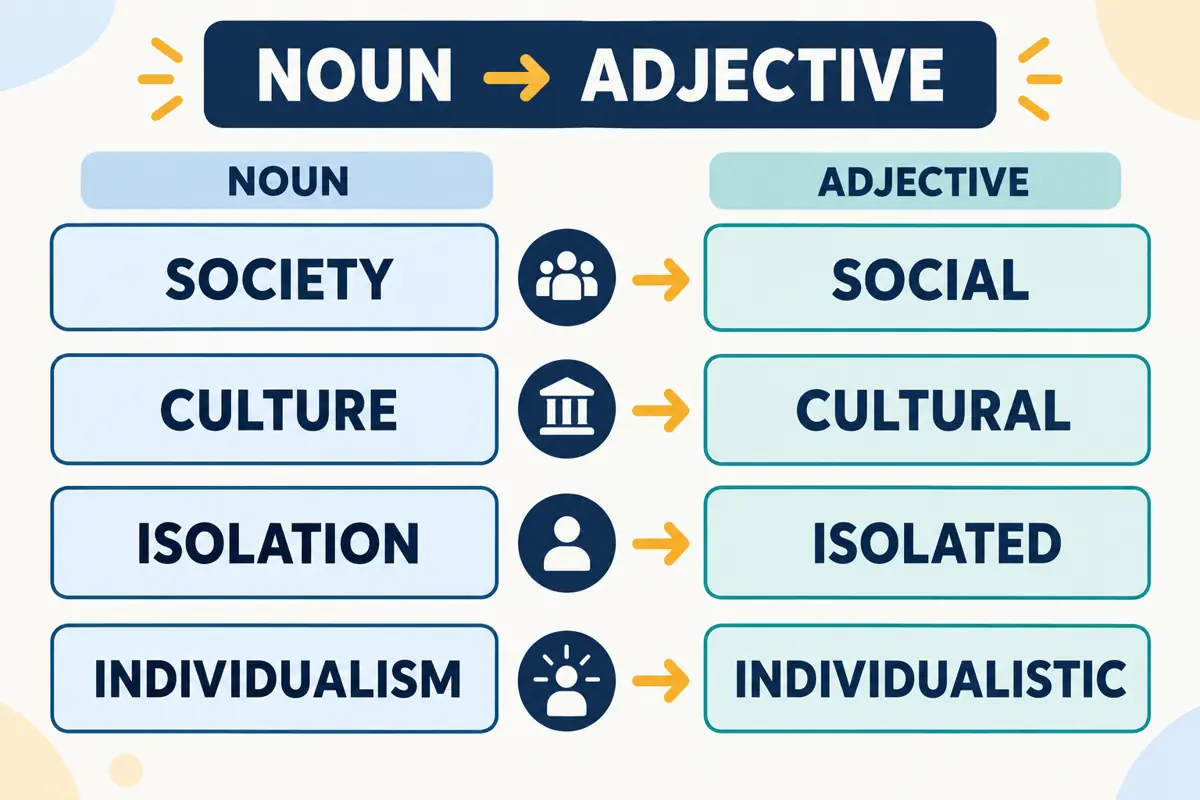
Some related words change form when they describe something. Use the adjective that fits the sentence rather than placing a related noun in an adjective list:
| Related noun | Adjective | Example |
|---|---|---|
| society | social | The report examines social conditions in three regions. |
| culture | cultural | The museum documents cultural traditions from the area. |
| community | communal | Residents maintain a communal garden. |
| isolation | isolated | The isolated settlement is several hours from the nearest city. |
| individualism | individualistic | The essay compares individualistic and collective approaches to public services. |
The adjective social means related to society or relationships; it is not a direct synonym for society. Likewise, isolated describes separation, while individualistic describes an emphasis on the individual. Cambridge lists individualism as a noun and individualistic as an adjective.
Quick word-choice check
- To discuss cultural composition, choose diverse or multicultural and say which kinds of difference you mean.
- To discuss ranks or social layers, choose hierarchical or stratified.
- To describe an equality-oriented principle, choose egalitarian; support claims about actual equality with specific evidence.
- To describe a government, choose democratic or authoritarian only when that political feature is relevant and supported.
- To describe access or participation, inclusive may fit; name the practice that includes people.
Writing tip: identify the feature, give a concrete example, and then choose the adjective. These words describe different dimensions of society; they are not a simple list of positive and negative opposites.
Frequently asked questions
Is “community” an adjective for society?
No. Community is a noun for a group of people or a shared place or interest. You can use the adjective communal for something shared by a group, or community-based for an activity organized around a community.
Is “individualism” the opposite of society?
No. Individualism is a noun for an idea that emphasizes individual freedom or action. It can be discussed as one feature of a society. Individualistic is the adjective form.
Can the same society be both diverse and unequal?
Yes. Diverse describes variety; unequal describes differences in conditions or access. One word does not determine the other, so describe each feature separately.
Society is a complex and ever-evolving entity that shapes our lives in countless ways. From the way we interact with others to the values we hold dear, society plays a crucial role in defining who we are as individuals. But how do we describe this vast and intricate network of human relationships? In this article, I’ll explore a range of adjectives that capture the essence of society, offering vivid and insightful descriptions along the way.
Whether we’re examining the dynamics of a bustling metropolis or the close-knit bonds of a small community, adjectives provide us with a powerful tool to delve into the intricacies of society. From “diverse” and “inclusive” to “hierarchical” and “egalitarian,” these adjectives paint a vivid picture of the social fabric that surrounds us. With each example, we’ll uncover the nuances and complexities that make society such a fascinating subject of study.
So, join me as we embark on a journey through the world of adjectives for society. Prepare to be captivated by the rich tapestry of words that illuminate the diverse and ever-changing nature of human interaction. Let’s dive in and discover the power of language in describing the intricate web of relationships that make up our society.
How to Describe society? – Different Scenarios
When it comes to describing society, there are various scenarios that can help us understand the dynamics and characteristics of the communities we live in. Let’s explore some of these scenarios and the adjectives that best describe them:
- Cultural Diversity: One important aspect of society is its cultural diversity. It refers to the wide array of cultures, traditions, and customs that coexist within a community. Some adjectives that describe a diverse society include:
- Social Hierarchies: Another aspect of society is the presence of social hierarchies, which refer to the unequal distribution of power, wealth, and resources. Some adjectives that describe societies with social hierarchies include:
- Political System: The political system of a society plays a pivotal role in shaping its characteristics. Here are some adjectives that can describe different political scenarios:
Describing Words for society in English
As an expert blogger, I’ve had the opportunity to explore the different adjectives that can be used to describe society. Understanding these descriptive words is important in accurately portraying and understanding the dynamics of a community. In this section, I’ll share some common adjectives that can be used to describe society in English.
Multicultural:
One important aspect of society is its cultural diversity. A multicultural society is one that consists of people from different cultural backgrounds, ethnicities, and nationalities. It celebrates and appreciates the richness and variety of cultures that exist within it. Some adjectives to describe a multicultural society include:
- Diverse
- Cosmopolitan
- Inclusive
- Harmonious
For example, a multicultural society is one where people of different races, languages, and religions live and work together harmoniously.
Stratified:
Societies often have social hierarchies, where individuals or groups are ranked based on their socioeconomic status, power, or privilege. A stratified society is one with these distinct social classes or levels. Here are some adjectives that can be used to describe a stratified society:
- Hierarchical
- Unequal
- Class-based
- Elitist
For instance, a stratified society may have a stark divide between the wealthy upper class and the lower-income working class.
Democratic:
The political system of a society greatly influences its character and functioning. A democratic society is one where power is vested in the people, who can participate in decision-making through free and fair elections. Some adjectives that best describe a democratic society include:
- Egalitarian
- Free
- Participatory
- Transparent
In a democratic society, people have the right to express their opinions freely and contribute to the shaping of policies and legislation.
Authoritarian:
On the other end of the political spectrum, we have authoritarian societies. In an authoritarian society, power is concentrated in the hands of a single person or a small group, and individual freedoms and civil liberties may be restricted. Here are some adjectives that can be used to describe an authoritarian society:
- Oppressive
- Dictatorial
- Repressive
- Censored
In an authoritarian society, the government tightly controls the media and limits citizens’ ability to criticize or challenge those in power.
Adjectives for society
Positive Adjectives for Society
In describing society, we often use adjectives to paint a picture of how people interact and live together. Here are some positive adjectives that can be used to describe society, along with example sentences demonstrating their usage:
- Inclusive: A society that welcomes and embraces people from all backgrounds. An inclusive society values diversity and ensures equal opportunities for everyone.
- Harmonious: A society where people coexist peacefully and without conflict. A harmonious society fosters unity and understanding among its members.
- Progressive: A society that actively promotes change and improvement. A progressive society values innovation and forward-thinking.
- Empathetic: A society that shows understanding and compassion towards others. An empathetic society supports and cares for those in need.
- Tolerant: A society that respects and accepts differences in opinions, beliefs, and lifestyles. A tolerant society values diversity and promotes mutual respect.
- Resilient: A society that can bounce back from challenges and adversity. A resilient society demonstrates strength and determination in the face of difficulties.
- Thriving: A society that is growing and flourishing in various aspects. A thriving society has a strong economy and a high quality of life for its citizens.
- Innovative: A society that encourages creativity and embraces new ideas. An innovative society fosters a culture of problem-solving and continuous improvement.
- Egalitarian: A society that strives for equality and fairness. An egalitarian society ensures that everyone has an equal chance to succeed.
- Generous: A society that is supportive and generous towards its members. A generous society provides assistance and opportunities to those in need.
- Democratic: A society where power is vested in the people and decisions are made through a fair and transparent process. A democratic society values citizen participation and protects individual rights.
- Educated: A society that prioritizes knowledge and invests in education. An educated society values learning and promotes intellectual growth.
Negative Adjectives for Society
While it’s important to highlight the positive aspects of society, it’s also crucial to acknowledge its negative aspects. Here are some negative adjectives that can be used to describe society, along with example sentences illustrating their usage:
- Divided: A society that is split or fragmented due to differences in opinions, beliefs, or interests. A divided society finds it challenging to reach consensus and achieve unity.
- Corrupt: A society that is characterized by dishonesty, bribery, and the misuse of power for personal gain. A corrupt society undermines trust and hampers progress.
- Stratified: A society with distinct social classes or hierarchies, where resources and opportunities are unevenly distributed. A stratified society perpetuates inequality and limits social mobility.
- Discriminatory: A society that shows prejudice or bias towards certain individuals or groups. A discriminatory society denies equal rights and opportunities based on factors such as race, gender, or religion.
- Authoritarian: A society where power is concentrated in the hands of a few individuals or a single governing authority. An authoritarian society restricts individual freedoms and suppresses dissent.
Remember, society is complex and can’t be simply defined by a single adjective. These adjectives serve as tools to help us better understand and discuss the characteristics of different types of societies.
Synonyms and Antonyms with Example Sentences
Synonyms for Society
When it comes to describing society, there are several synonyms that can help us paint a clearer picture. Here are some adjectives that can be used interchangeably with “society,” along with example sentences:
| Adjective | Example Sentence |
|---|---|
| Community | I take pride in being part of a vibrant community that values diversity. |
| Civilization | Our ancestors worked hard to build a civilization that we can enjoy today. |
| Culture | The rich culture of this country is evident in its art, music, and traditions. |
| Collective | It’s important for us to consider the needs of the collective rather than just our own. |
| Human race | We must work together to address the challenges that the human race faces today. |
Antonyms for Society
On the other hand, when we discuss the opposite qualities of society, we can use antonyms to help convey a different perspective. Here are some adjectives that represent the antonyms of “society,” along with example sentences:
| Adjective | Example Sentence |
|---|---|
| Isolation | The hermit preferred a life of isolation, away from the hustle and bustle of society. |
| Solitude | Some people seek solitude to find peace and introspection. |
| Loneliness | Loneliness can be a challenging emotion to overcome, especially in a crowded world. |
| Individualism | In a society that values individualism, one’s personal goals take precedence over collective goals. |
| Self-reliance | The philosophy of self-reliance promotes independence and individual responsibility. |
Remember, society is a complex construct that cannot be fully described by a single adjective. However, these synonyms and antonyms provide us with a deeper understanding of the different aspects and perspectives of society.
Now that we have explored the various adjectives that can describe society, let’s move on to examining the impact of these adjectives on social dynamics and how they shape our communities.
Conclusion
Throughout this article, I have delved into the realm of adjectives that can be used to describe society. From synonyms like community, civilization, culture, collective, and human race, to antonyms such as isolation, solitude, loneliness, individualism, and self-reliance, we have explored the diverse range of words that can help paint a vivid picture of society.
It is important to note that society is a multifaceted construct that cannot be encapsulated by a single adjective. However, by understanding the different aspects and perspectives of society through these adjectives, we gain a deeper comprehension of its complexities.
As we move forward, the impact of these adjectives on social dynamics and how they shape our communities will be the next topic of discussion. By examining the influence of these descriptive words, we can gain valuable insights into the functioning and evolution of society.
The adjectives we use to describe society provide us with a nuanced understanding of its various facets. By exploring these words, we can better appreciate the intricacies of the world we live in and work towards creating a more inclusive and harmonious society.


