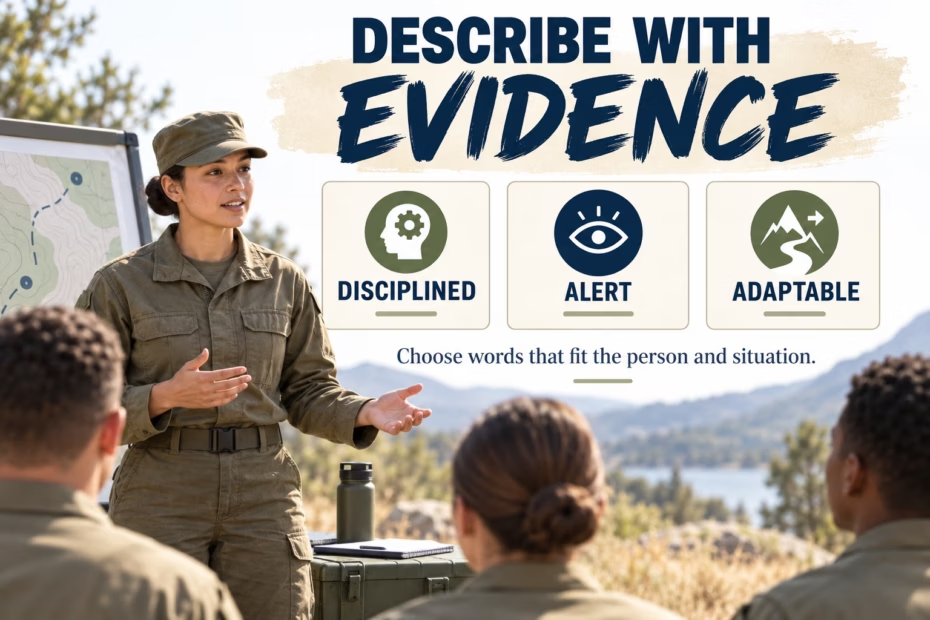
Use soldier adjectives to describe a person’s conduct, appearance, skills, or experience with enough context to make the word fair. Disciplined, alert, and adaptable describe different qualities; a precise sentence names the action that supports the choice. A uniform or military role alone does not prove what someone is like.
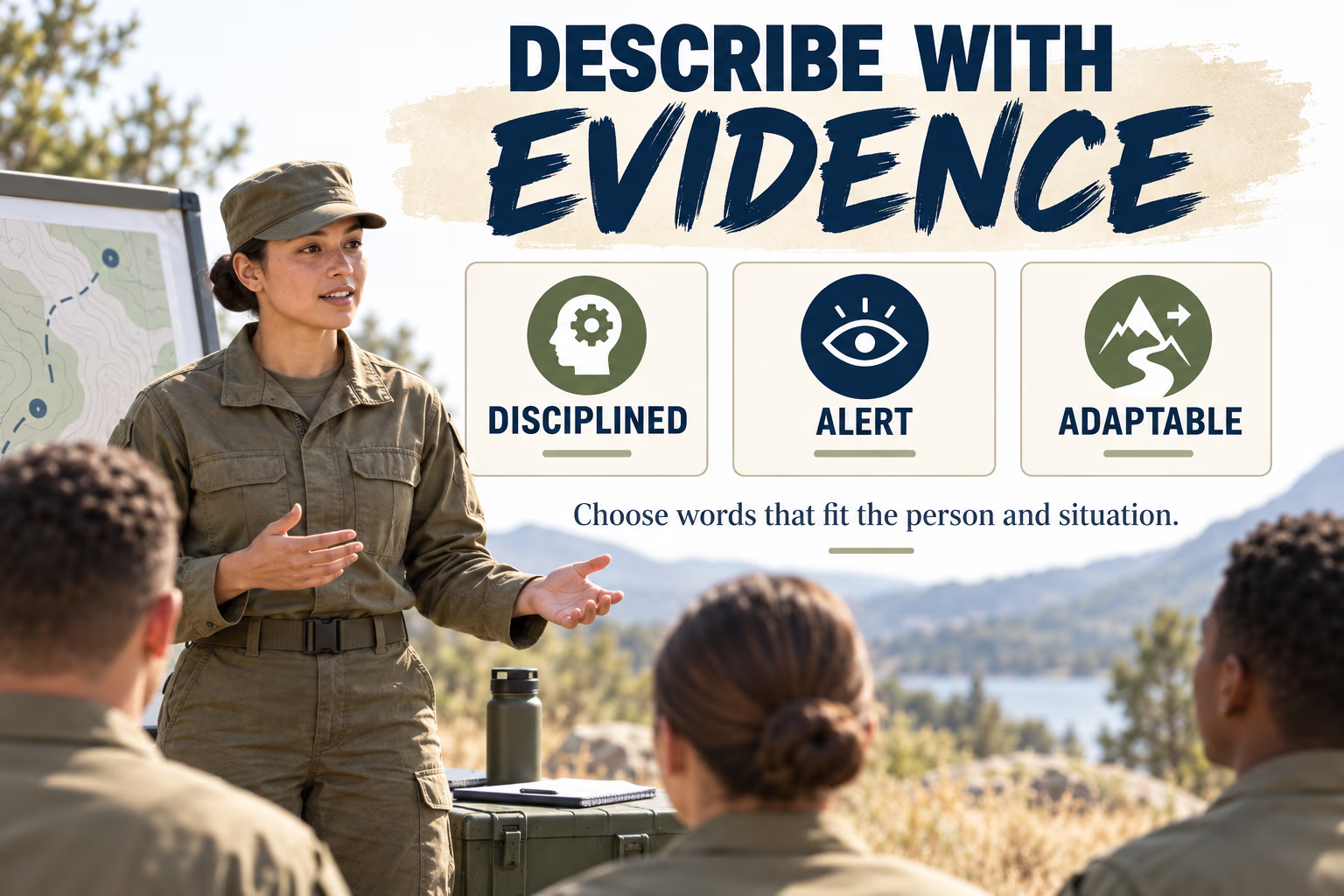
Quick list: adjectives for soldiers
These words fit several common writing needs. Choose one or two that match what a reader can see or what the story establishes.
- Conduct: disciplined, dependable, cooperative, conscientious, respectful, steady, loyal, dutiful, considerate, trustworthy
- Attention: alert, observant, attentive, vigilant, watchful, perceptive, focused, discerning, mindful, responsive
- Adaptation: adaptable, resourceful, flexible, inventive, composed, resilient, agile, versatile, pragmatic, determined
- Skill and preparation: trained, capable, experienced, precise, methodical, proficient, skilled, knowledgeable, practiced, qualified
- Bearing and condition: composed, confident, professional, reserved, weary, mud-stained, calm, formal, exhausted, unruffled
- Story-specific evaluation: courageous, heroic, reckless, battle-worn, battle-tested, resolute, daring, brave, bold, battle-scarred
The last group carries interpretation or a claim about a person’s history. Support those choices with an event, a quotation, a source, or a clearly fictional point of view.
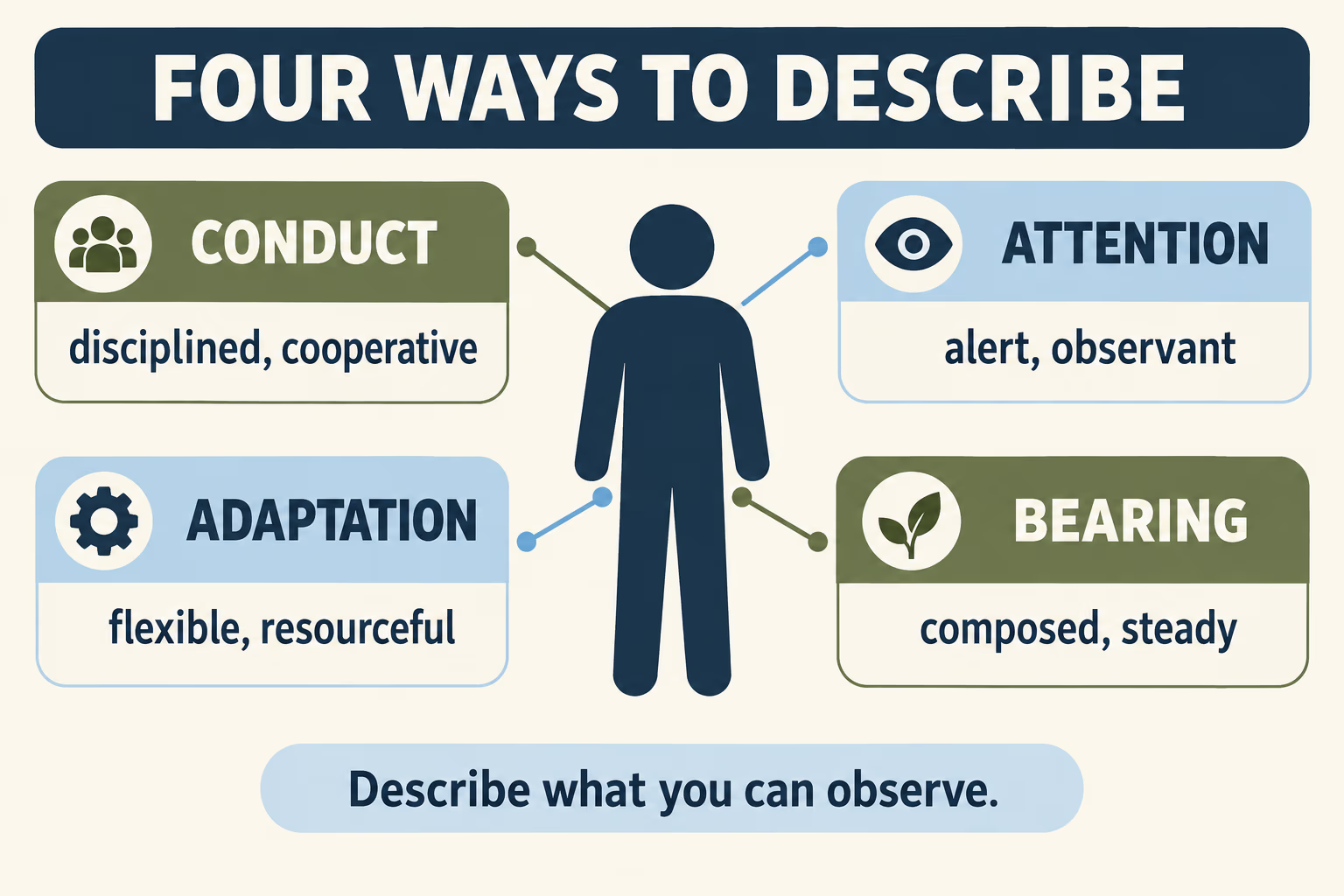
What kinds of qualities can soldier adjectives describe?
Soldier adjectives work best when their category is clear: conduct, attention, adaptation, bearing, or specialized skill. The categories overlap in real life, but separating them helps prevent a writer from treating one observed action as proof of a person’s entire character.
| Quality | Useful adjectives | Concrete example |
|---|---|---|
| Conduct | disciplined, dependable, cooperative | The dependable medic checked the supply list before the team left. |
| Attention | alert, observant, attentive | The observant sentry noticed a change in the weather and reported it. |
| Adaptation | adaptable, resourceful, flexible | The resourceful crew found a safe alternate route after a road closure. |
| Bearing | composed, confident, weary | The weary officer paused for water after the long exercise. |
| Skill | trained, methodical, proficient | The trained technician followed the maintenance checklist step by step. |
Context matters: quiet might mean calm, focused, tired, or simply not speaking. Add the surrounding action instead of expecting one adjective to explain everything.
How do you choose a precise adjective?
Start with the evidence, then choose the narrowest word that accurately names it. For example, “checked every item against the list” supports methodical more directly than it supports a sweeping judgment such as fearless.
- Identify the detail. Is the sentence about behavior, attention, appearance, training, or a reaction?
- Choose the matching word. Use vigilant for sustained watchfulness, precise for accuracy, and adaptable for adjusting to changed conditions.
- Add the situation. Name what the person did, what changed, or what task was involved.
- Check for overstatement. Replace an absolute label with an observable detail when the evidence is limited.
A helpful test: could a reader point to the action or detail that makes the adjective plausible? If not, revise the sentence or label the opinion as the narrator’s view.
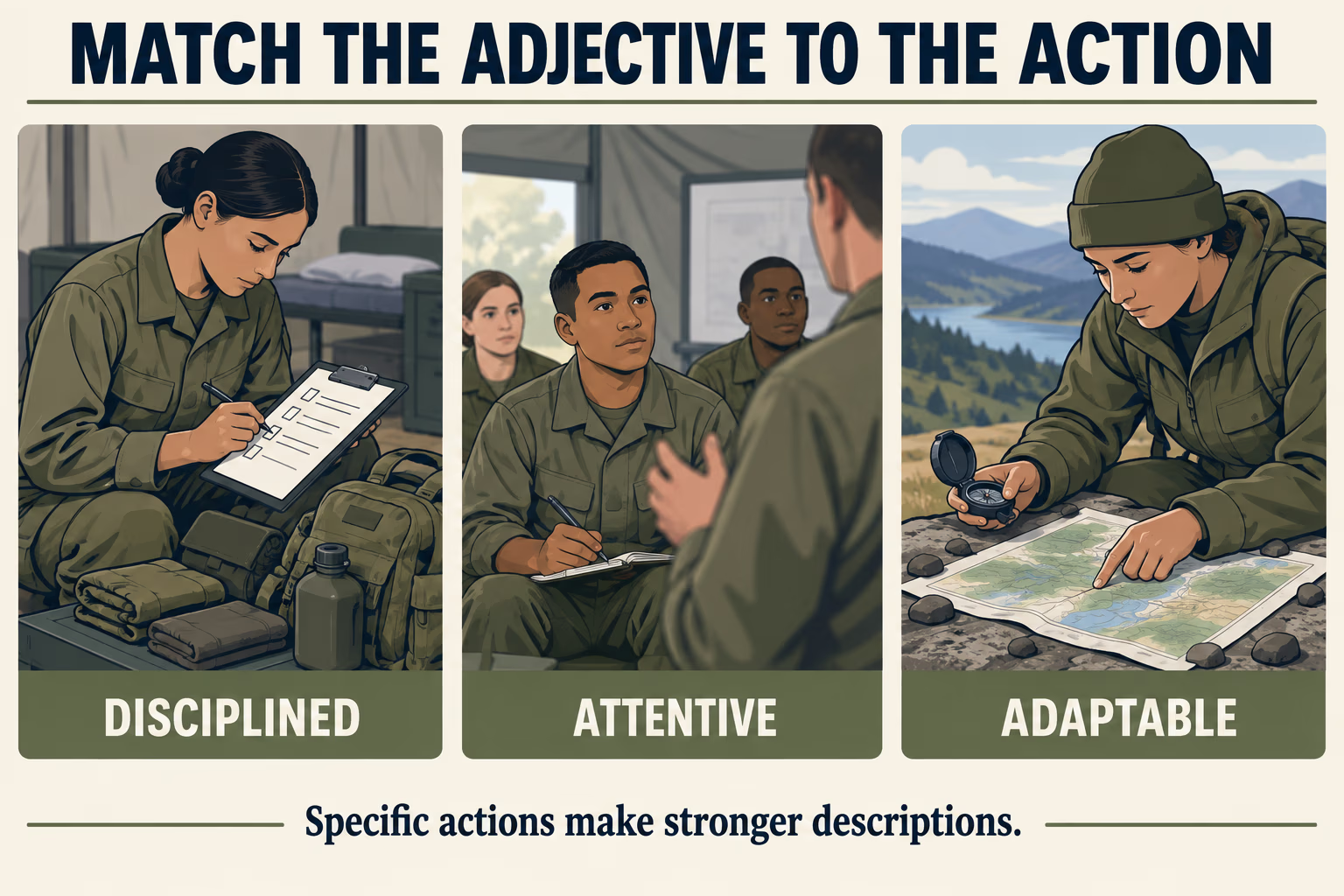
Soldier adjectives with meanings and examples
Similar words can carry different implications. The examples below keep each adjective tied to a particular action or situation.
| Adjective | Meaning | Example sentence |
|---|---|---|
| Disciplined | Following an agreed standard or practice consistently | The disciplined team completed its equipment check before departure. |
| Dependable | Reliable when others count on you | Her dependable partner delivered the requested update on time. |
| Vigilant | Remaining watchful for possible danger or change | The vigilant crew noticed that visibility had dropped. |
| Resourceful | Finding practical ways to solve a problem | The resourceful group used the supplies already on hand. |
| Adaptable | Able to adjust when circumstances change | The adaptable unit revised its schedule when transport was delayed. |
| Composed | Calm in manner, especially under pressure | The composed instructor explained the next step clearly. |
| Methodical | Working in an orderly, step-by-step way | The methodical mechanic recorded each inspection result. |
| Resilient | Able to recover or continue after difficulty | The resilient team regrouped after the training exercise was interrupted. |
| Proficient | Skilled through training or practice | The proficient translator conveyed the briefing accurately. |
| Weary | Tired, often after effort or a long period of activity | The weary soldiers rested after the overnight exercise. |
Are words like “brave” and “heroic” objective?
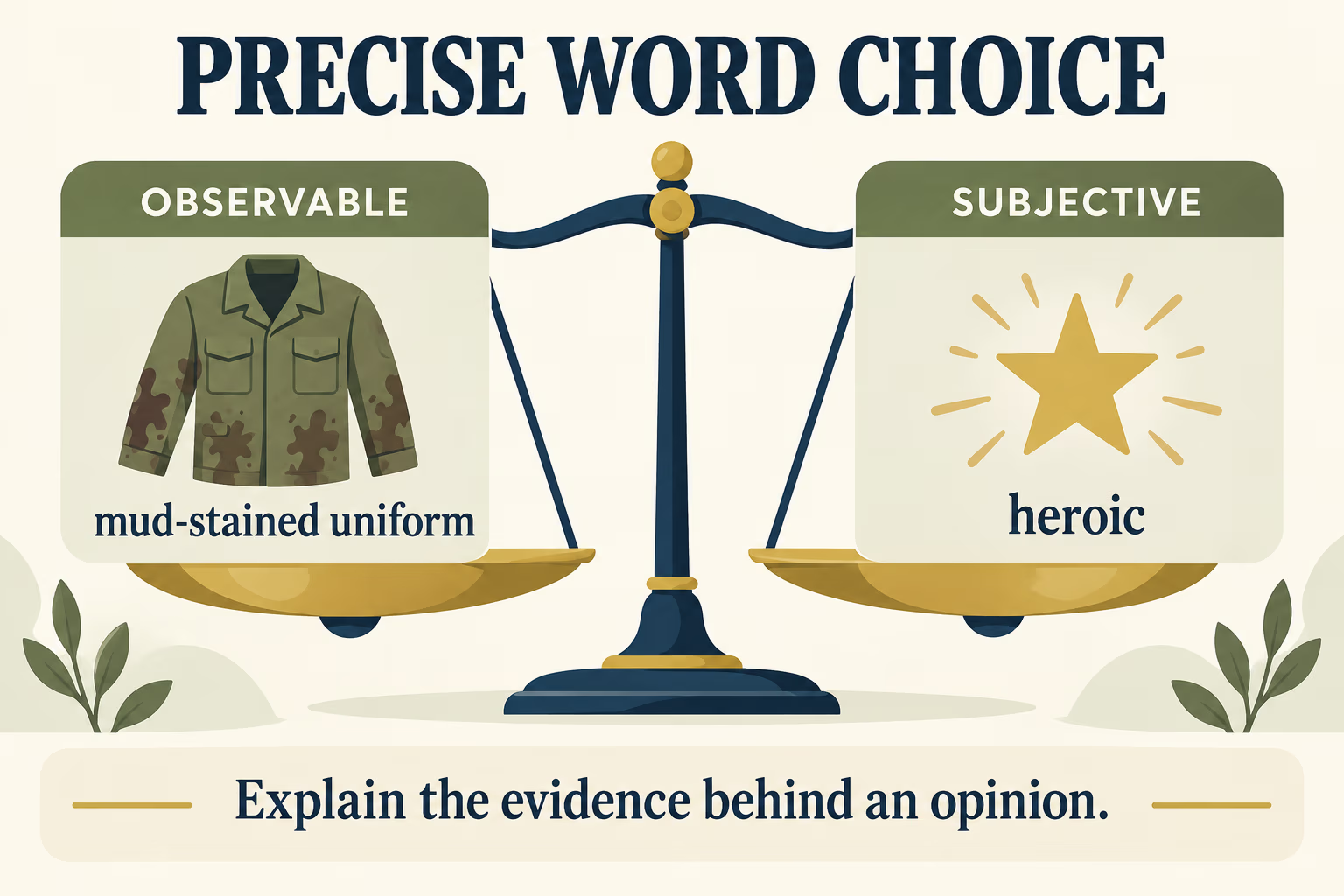
Usually, brave and heroic are evaluations, not neutral descriptions. They may suit a character’s perspective or a well-supported account of a specific act, but they do not follow automatically from serving in the military or taking part in an event.
Likewise, fearless makes a strong claim about a person’s inner state that an observer may not know. For factual writing, describe the decision or action—“continued assisting the evacuation despite the danger”—and let readers understand why someone calls it courageous. This keeps the description vivid without presenting an interpretation as a measurable trait.
Which adjectives fit different writing situations?
| Writing purpose | Word choices | What to include |
|---|---|---|
| Fiction scene | mud-stained, watchful, exhausted, resolute | A visible detail, action, and point of view |
| Formal profile | trained, experienced, methodical, proficient | Verified qualifications or specific responsibilities |
| Classroom vocabulary | brave, calm, helpful, careful | A simple sentence showing what the person does |
| News or history | injured, decorated, deployed, veteran | Accurate facts and attribution; not every word is an adjective |
| Personal tribute | generous, steady, thoughtful, courageous | A remembered example that explains the praise |
Some terms in military writing describe status or events rather than adjectives. Veteran is commonly a noun or modifier, deployed is a participle, and decorated refers to receiving an award. Use them only when the fact is established.
Respectful and accurate word choice
Military service includes people with different jobs, backgrounds, temperaments, and experiences. Avoid treating soldier as a synonym for man, assuming every soldier has combat experience, or assigning a personality trait based on nationality, rank, uniform, or appearance. When describing a real person, use the person’s name, pronouns, role, and verified details as appropriate.
Army leadership doctrine offers one example of how an institution organizes qualities: its ADP 6-22 discusses leader attributes under character, presence, and intellect, including concepts such as discipline, resilience, judgment, empathy, and mental agility. That framework is useful vocabulary context, not a universal scorecard for all soldiers. A quality may be developed, situational, and known only through specific evidence.
Frequently asked questions about soldier adjectives
What is a positive adjective for a soldier?
Dependable is a useful positive adjective when a soldier follows through on a responsibility. Other choices include disciplined, resourceful, and cooperative. For a specific, convincing sentence, pair the word with an action that demonstrates it.
What is a good adjective for a soldier who adapts quickly?
Adaptable describes someone who adjusts to changing circumstances. Resourceful emphasizes finding a practical solution, while flexible highlights willingness to change a plan. Choose based on what the person actually did.
How can I describe a soldier in a story?
Combine one observable detail with an action and a word that reflects the viewpoint. For example: “The rain-soaked, attentive radio operator repeated the coordinates before passing them on.” This sentence shows appearance and conduct without relying on a string of broad labels.
Is “battle-hardened” a neutral description?
No. Battle-hardened suggests experience in combat and an effect on a person’s character, so it may overstate what is known. In factual writing, verify combat history and explain the source; in fiction, use it only when that implication is intended.
What is the difference between “disciplined” and “obedient”?
Disciplined often describes consistent self-control or adherence to standards. Obedient focuses on following another person’s instructions. Neither word alone tells a reader whether the decision was thoughtful, ethical, or appropriate to the situation.

As a military enthusiast, I’ve always been fascinated by the bravery and dedication of soldiers. They are the true heroes who sacrifice so much to protect our freedom and ensure our safety. In this article, I’ll be exploring a variety of adjectives that can be used to describe soldiers, capturing the essence of their incredible qualities and characteristics. From courageous and resilient to disciplined and selfless, these adjectives paint a vivid picture of the remarkable individuals who serve in the armed forces.
When we think of soldiers, words like brave and heroic often come to mind. But there is so much more to these remarkable individuals than meets the eye. They possess a unique blend of physical and mental strength, unwavering determination, and an unwavering commitment to their mission. In this article, I’ll be sharing a collection of descriptive adjectives that truly capture the essence of soldiers and their extraordinary qualities. Whether you’re writing a tribute, crafting a character in a story, or simply want to express your admiration, these adjectives will help you paint a vivid and accurate picture of the remarkable men and women who serve in the military.
How to Describe soldiers? – Different Scenarios
When it comes to describing soldiers, there are various scenarios that we can consider. Each scenario presents a different aspect of their admirable qualities and characteristics. Let’s explore some effective ways to describe soldiers in different contexts:
1. Courage in Battle
- In the heat of battle, soldiers display fearlessness and bravery.
- Their resolute determination and unwavering courage shine through.
Examples:
Words to Describe Soldiers’ Courage in Battle
- Fearlessness
- Bravery
- Determination
- Courage
2. Discipline and Dedication
- Soldiers exhibit discipline and dedication to their duty.
- Their commitment and focused mindset are unparalleled.
Examples:
Words to Describe Soldiers’ Discipline and Dedication
- Discipline
- Dedication
- Commitment
- Focus
3. Resilience and Adaptability
- Soldiers demonstrate resilience even in the face of adversity.
- They possess the ability to adapt quickly to changing circumstances.
Examples:
Words to Describe Soldiers’ Resilience and Adaptability
- Resilience
- Adaptability
- Flexibility
- Versatility
4. Selflessness and Sacrifice
- Soldiers embody selflessness and willingly make sacrifices.
- They prioritize the safety and well-being of others above their own.
Examples:
Words to Describe Soldiers’ Selflessness and Sacrifice
- Selflessness
- Sacrifice
- Heroism
- Altruism
5. Leadership and Camaraderie
- Soldiers exhibit strong leadership skills and foster a sense of camaraderie among their comrades.
- They inspire and motivate others with their actions and support.
Examples:
Words to Describe Soldiers’ Leadership and Camaraderie
- Leadership
- Camaraderie
- Unity
- Teamwork
Describing Words for soldiers in English
When we think of soldiers, we often imagine individuals who possess a unique set of qualities that make them truly exceptional. Here are some describing words that capture the essence of soldiers:
1. Courageous
Soldiers are known for their unwavering courage in the face of danger. Whether it’s facing enemy fire on the battlefield or standing up for what is right, soldiers display exceptional bravery.
2. Disciplined
Discipline is a cornerstone of a soldier’s character. Soldiers adhere to strict rules and regulations, exhibiting self-control and a strong sense of responsibility.
3. Resilient
Soldiers possess remarkable resilience, able to bounce back in the face of adversity. They endure challenging conditions and continue to push forward, never giving up on their goals.
4. Selfless
Selflessness is a defining trait of soldiers. They put the needs of others before their own, showing true acts of heroism and sacrifice on a daily basis.
5. Adaptable
Soldiers must be adaptable to navigate through ever-changing scenarios. They quickly adjust to new environments and circumstances, demonstrating a high level of flexibility and resourcefulness.
6. Leadership and Camaraderie
Soldiers are not only capable of leading others, but they also foster a strong sense of camaraderie within their units. They work cohesively as a team, providing support and motivation to their fellow soldiers.
These words only scratch the surface of the incredible qualities that soldiers possess. They embody strength, determination, and dedication, serving as an inspiration to us all.
| Describing Words | Examples |
|---|---|
| Courageous | Charging fearlessly into battle |
| Disciplined | Following orders with precision and focus |
| Resilient | Enduring hardships and setbacks without faltering |
| Selfless | Putting the lives of others before their own |
| Adaptable |
Adjectives for soldiers
Positive Adjectives for Soldiers
Soldiers possess a multitude of positive qualities that make them exemplary individuals. Here are some adjectives to describe soldiers, along with example sentences that highlight their admirable characteristics:
| Adjective | Example Sentence |
|---|---|
| Courageous | Soldiers show their courageous nature by bravely facing danger on the battlefield. |
| Disciplined | A soldier’s disciplined mindset helps them follow orders and adhere to strict military regulations. |
| Resilient | In the face of adversity, soldiers exhibit resilient traits, bouncing back from setbacks and persevering. |
| Selfless | Soldiers prioritize the well-being of others, demonstrating selfless acts of service on and off the battlefield. |
| Adaptable | Soldiers possess the ability to adapt quickly to changing circumstances and environments, making them versatile in various situations. |
| Committed | Soldiers exhibit commitment to their duty and country, displaying unwavering dedication to their mission. |
| Resourceful | With limited resources, soldiers exemplify resourcefulness by finding creative solutions to overcome challenges. |
| Empathetic | Soldiers show empathy towards their comrades, offering support and understanding during difficult times. |
| Loyal | Soldiers are known for their loyalty, standing by their unit and their country, even in the face of adversity. |
| Skilled | Soldiers’ skills and expertise make them highly proficient in their roles, ensuring success in their missions. |
| Patriotic | Soldiers embody patriotism, proudly serving their nation and upholding its values. |
| Inspiring | Soldiers serve as inspiring role models, motivating others through their actions and dedication. |
Negative Adjectives for Soldiers
While soldiers are seen as admirable individuals, it’s important to acknowledge that they, like anyone else, can possess negative traits as well. Here are a few adjectives that describe negative aspects related to soldiers, with example sentences:
| Adjective | Example Sentence |
|---|---|
| Reckless | Occasionally, soldiers may make reckless decisions in the line of duty, risking their own safety and that of others. |
| Arrogant | Some soldiers may demonstrate an arrogant attitude, believing they are superior to others due to their military status. |
| Insubordinate | Instances of insubordination can be observed when soldiers refuse to follow orders or disrespect their superior officers. |
| Disloyal | While rare, there may be cases where soldiers betray the trust and commitment expected of them, displaying disloyal behavior. |
| Impulsive | At times, soldiers may act impulsively, making hasty decisions without fully considering the consequences. |
It’s important to remember that these negative traits are not representative of all soldiers, but rather exceptions to the norm. Soldiers, like any other individuals, are complex beings with both positive and negative aspects. However, their remarkable qualities and dedication to serving their country should be celebrated and acknowledged.
Please note: This article is written with the aim of providing descriptive adjectives for soldiers and is not intended to pass any judgment or generalize the behavior of all soldiers.
Synonyms and Antonyms with Example Sentences
Synonyms for soldiers
When describing soldiers, there are various synonyms that can be used to convey their admirable qualities and characteristics. Here are some synonymous words that capture the essence of what it means to be a soldier:
- Warrior: A warrior is a brave and skilled fighter who embodies the spirit of battle. Example sentence: “The courageous warriors charged into the enemy lines fearlessly.”
- Defender: A defender is someone who protects and safeguards others. Example sentence: “The determined defenders stood their ground, ensuring the safety of their comrades.”
- Hero: A hero is an exceptional individual who displays bravery and selflessness in the face of danger. Example sentence: “The heroic soldiers risked their lives to rescue civilians trapped in the warzone.”
- Protector: A protector is someone who shields and looks after others, ensuring their welfare and safety. Example sentence: “The dedicated protectors formed a line, shielding their fellow soldiers from enemy fire.”
- Guardian: A guardian is a vigilant and watchful presence, always ready to defend and protect. Example sentence: “The loyal guardians stood watch throughout the night, keeping the camp secure.”
Antonyms for soldiers
While soldiers are often associated with positive qualities and characteristics, it is important to acknowledge that not all individuals possess these traits. Here are some antonyms, or opposites, that describe the opposite of what it means to be a soldier:
- Coward: A coward is someone who lacks courage and is afraid to face danger or take risks. Example sentence: “The coward retreated in fear, leaving his fellow soldiers to face the enemy alone.”
- Deserter: A deserter is someone who abandons their post or duty, betraying their fellow soldiers. Example sentence: “The deserter left his comrades behind, shirking his responsibility in the heat of battle.”
- Traitor: A traitor is someone who betrays their own side, working against their own allies or country. Example sentence: “The traitor leaked sensitive information to the enemy, compromising the safety of his fellow soldiers.”
- Weakling: A weakling is someone who lacks physical or mental strength, unable to withstand challenging situations. Example sentence: “The weakling crumbled under pressure, unable to persevere in the face of adversity.”
- Individualist: An individualist is someone who prioritizes their own interests over the collective goals of the team or unit. Example sentence: “The individualist only cared about personal success, showing little regard for the well-being of his fellow soldiers.”
It is important to note that while these antonyms exist, they are not representative of the majority of soldiers who exhibit courage, dedication, and selflessness in their service.
Conclusion
In this article, we have explored the qualities and characteristics that define soldiers. From courage and discipline to resilience and adaptability, soldiers possess a unique blend of physical and mental strength that enables them to face danger, adhere to strict rules, and bounce back from adversity. Their selflessness and sacrifice, along with their leadership and camaraderie, further highlight their admirable qualities.
The list of adjectives provided in this article only scratches the surface of the incredible qualities that soldiers possess. They embody strength, determination, and dedication, serving as an inspiration to us all. While negative adjectives can also describe soldiers, it is important to remember that these traits are not representative of all soldiers.
Soldiers deserve our utmost respect and gratitude for their unwavering commitment to protecting and serving their country. They are the embodiment of bravery, sacrifice, and loyalty, and their contributions should never be overlooked. Let us honor and appreciate the soldiers who selflessly dedicate their lives to ensuring our safety and freedom.


