How to choose the right adjectives for a teddy bear
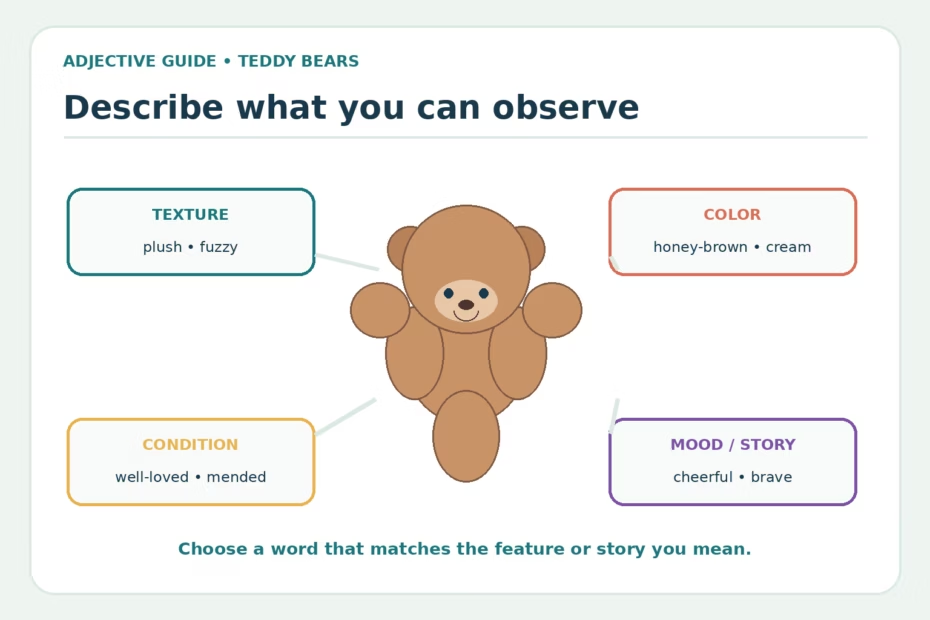
The most useful adjective depends on what you want a reader to picture. Start with a real or imagined detail—how the bear feels, what it looks like, its condition, or the role it plays in a story—then choose a word that names that detail. Soft points to touch, striped to a visible pattern, and well-loved to a bear that shows signs of frequent affection or use. A focused description is usually clearer than a long string of loosely related praise words.

| What you are describing | Useful adjectives | Example |
|---|---|---|
| Texture or touch | soft, plush, fuzzy, silky, scratchy | “The plush bear has a smooth satin bow.” |
| Size and shape | tiny, oversized, round, squat, long-limbed | “A tiny, round bear fit in the gift bag.” |
| Color and pattern | cream-colored, russet, spotted, striped, patchwork | “Its patchwork paws used three different fabrics.” |
| Condition | new, clean, faded, mended, worn | “The faded ribbon showed its age.” |
| Appearance or style | classic, handmade, vintage, realistic, whimsical | “The handmade bear had an embroidered smile.” |
| Character in a story | cheerful, shy, curious, brave, grumpy | “The curious bear peeked into the toy box.” |
These categories are a planning aid, not rigid grammatical labels: some words can describe more than one quality, and a word’s fit depends on context. In a product description, readers may need concrete details such as dimensions, material, or care instructions. In a story, a writer can give a bear a personality through actions and dialogue. Avoid treating an invented personality as a physical fact.
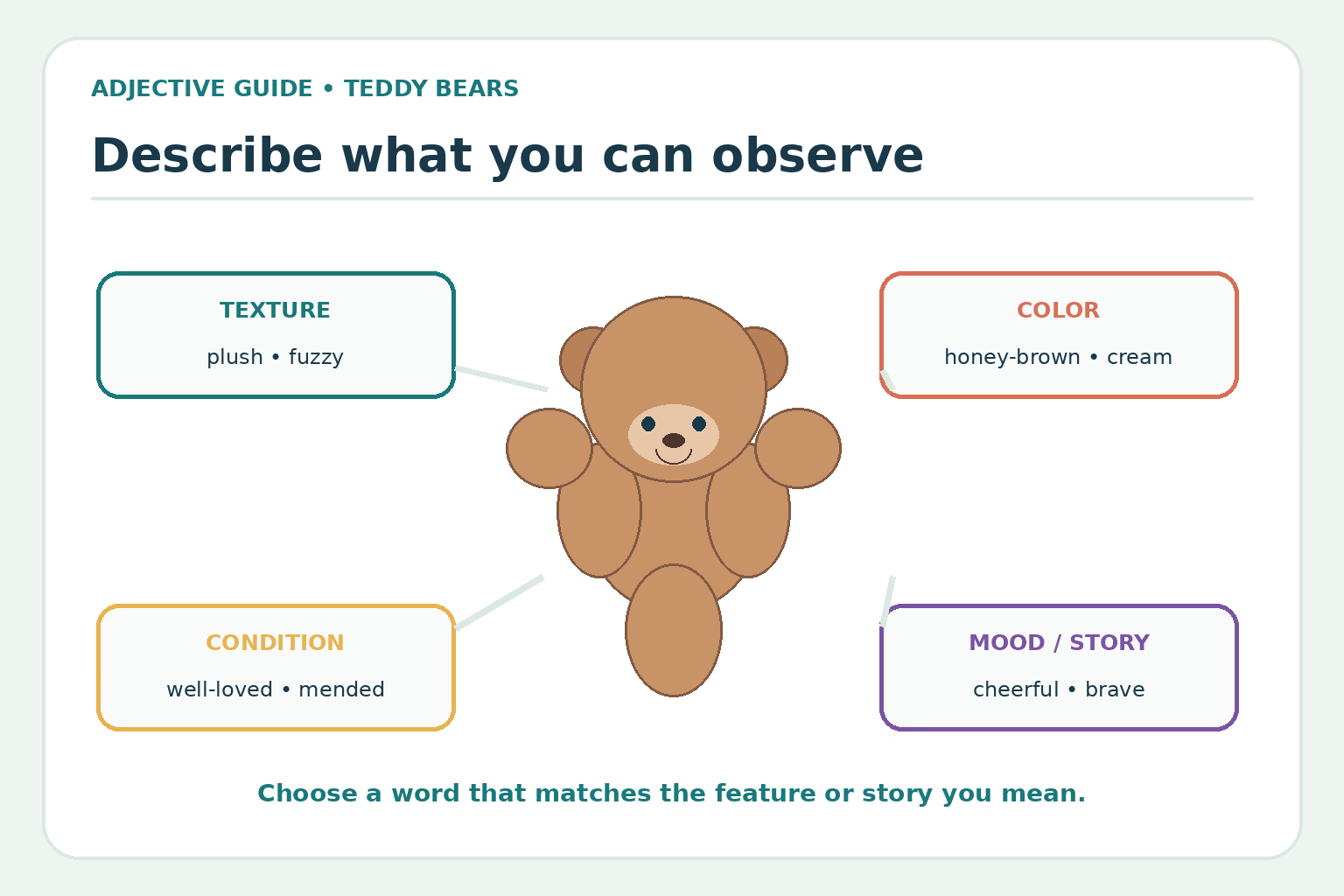
Texture, appearance, and condition are not interchangeable
Several common adjectives seem similar but help readers imagine different things. Soft tells how a surface feels; fluffy suggests a light, fuzzy surface or filling; plush can describe a soft feel or a dense, velvety textile. Cuddly describes something that seems pleasant to hold close. These words can overlap, but they do not make identical claims. A bear can look fluffy without being especially soft, for example.
Condition words describe the toy’s present state. Worn suggests use or age, while faded points to color that has lost intensity. Patched means a piece has been mended with a patch; it does not by itself say whether the bear is old or poorly made. Choose the word supported by what you can see or feel, and use more than one when each adds a different detail.
Adjective examples in useful sentence patterns
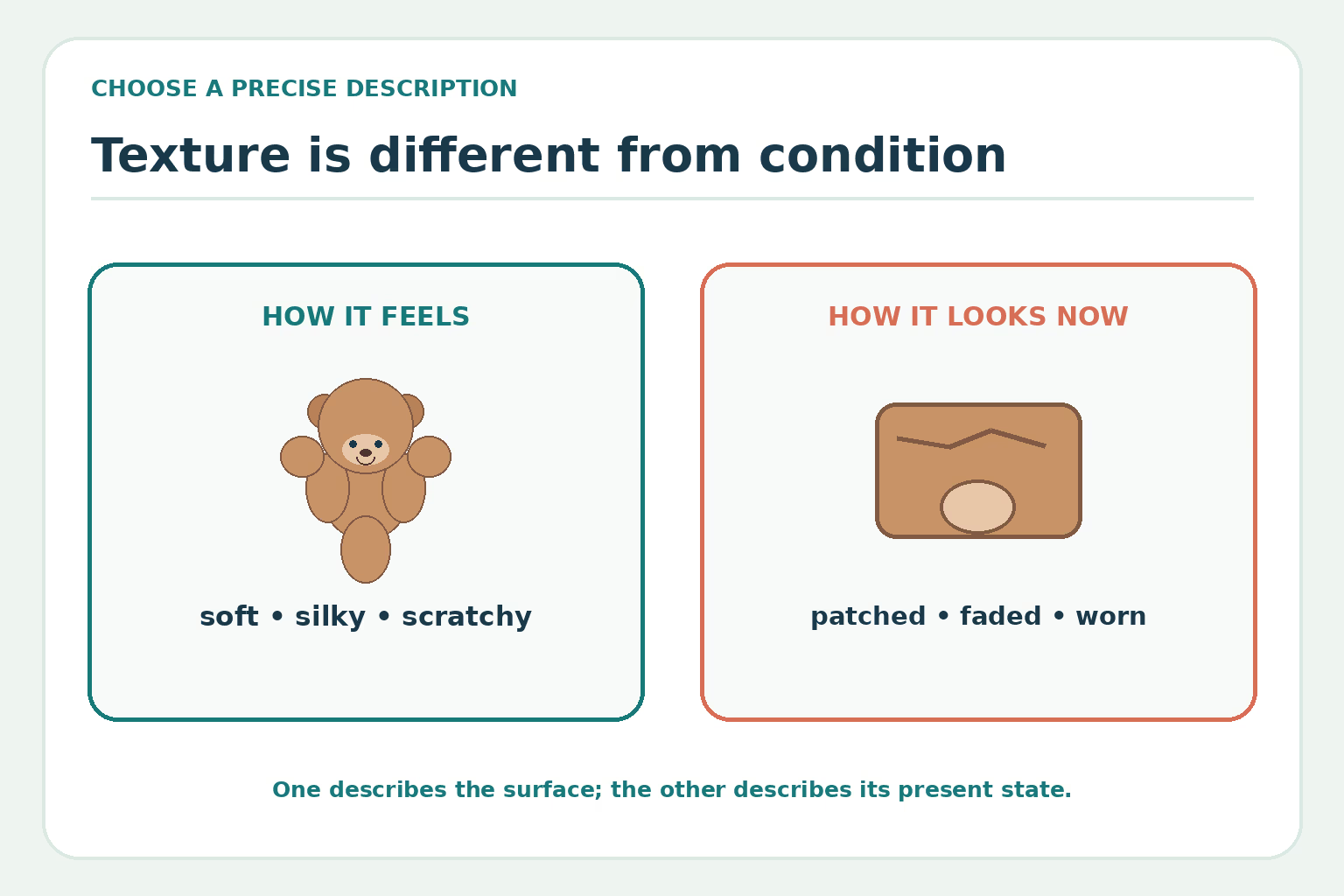
An adjective can come before a noun—“a small, soft teddy bear”—or after a linking verb, as in “the teddy bear feels soft.” The second pattern can help when you want to make a specific observation without stacking adjectives in front of the noun.
- Appearance: “A cream-colored bear wore a blue knitted scarf.”
- Texture: “Its plush paws felt smooth, while the stitched nose felt slightly rough.”
- Condition: “The well-loved bear had a mended seam and a faded bow.”
- Size and shape: “A tiny, round bear sat beside the oversized one.”
- Story character: “The shy bear became brave when its friend needed help.”
Put multiple adjectives in a natural order
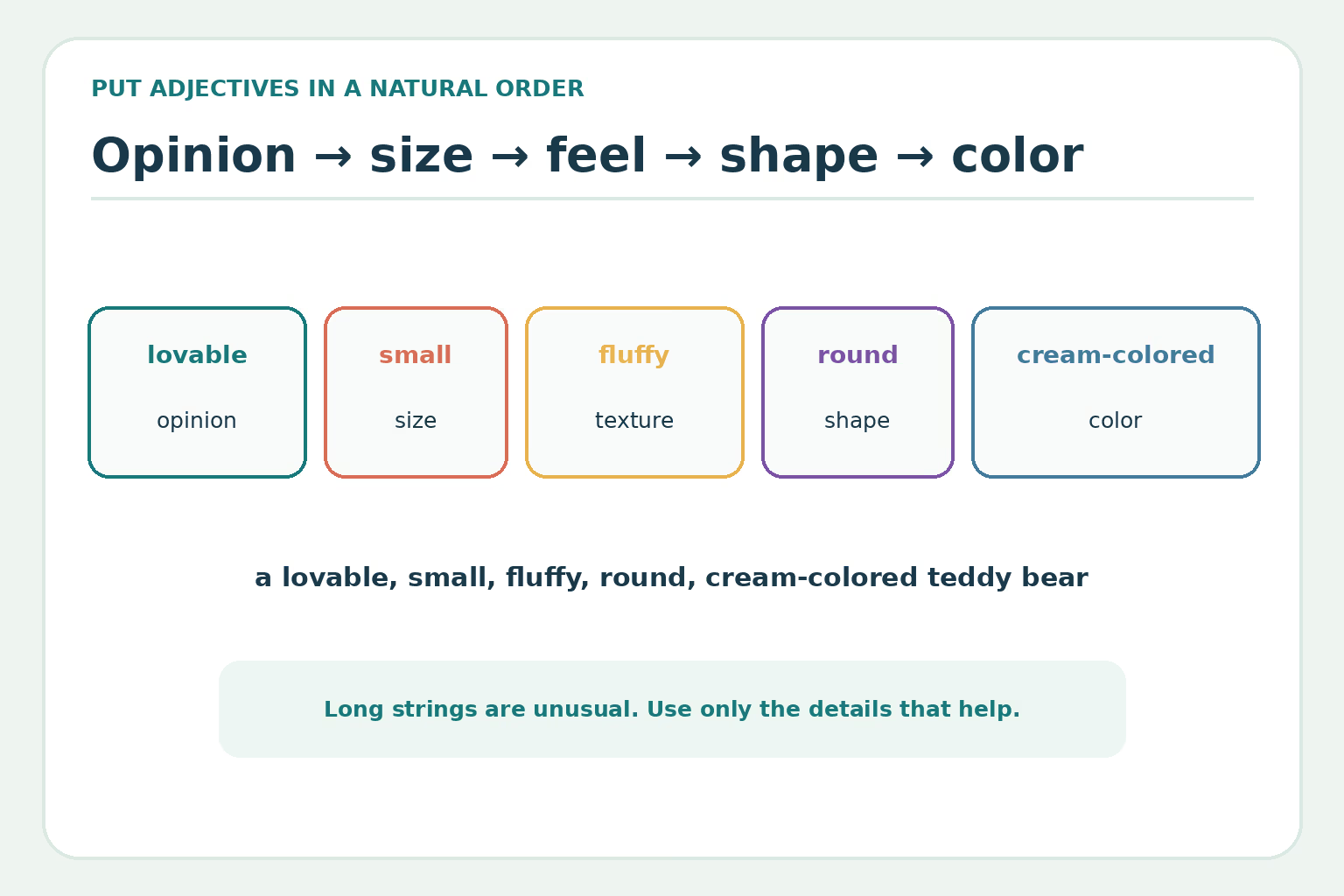
When several adjectives appear before one noun, English usually puts opinion words before more factual details. A useful general pattern is opinion, size, physical quality or texture, shape, age, color, origin, material, type, then purpose. You rarely need all these categories at once; the pattern simply helps longer descriptions sound natural. For example, “a lovable, small, fluffy, round, cream-colored teddy bear” moves from an evaluation to observable details. If the phrase feels crowded, remove adjectives that do not add a distinct feature.
Choose words for the situation
- For a story: Pair a personality adjective with an action that supports it: “The curious bear opened the little box.”
- For a gift note: Choose a warm impression and one personal detail: “Your cheerful bear has the same crooked smile as the one you picked at the fair.”
- For a product description: Favor verifiable details—color, dimensions, fabric, decoration, and stated care guidance. Words such as adorable express opinion; they do not tell a shopper what the toy is made of.
- For a memory: A single specific detail can be more vivid than a list: “The faded bear had one button eye and a ribbon tied around its neck.”
Quick editing checklist
- Underline the noun: make sure each adjective describes the teddy bear or a named part of it.
- Ask what kind of detail you mean: touch, appearance, size, condition, or story personality.
- Replace generic words such as nice or good when a more exact word would help.
- Check that a factual description is observable; reserve imagined feelings and personality for creative writing.
- Read the phrase aloud and remove repeated ideas, such as several words that all mean “soft.”
Frequently asked questions
What are good adjectives for a teddy bear?
For texture, try soft, plush, or fuzzy; for appearance, try round, striped, or cream-colored; for condition, try new, faded, or mended. Pick words that match the bear or the scene you are writing.
Is “teddy bear” one word or two?
Teddy bear is written as two words. An adjective normally comes before the full noun phrase: “a small teddy bear.”
Is “cuddly” the same as “soft”?
No. Soft describes how something feels. Cuddly suggests it is appealing or comfortable to hold close. A bear might be described with both, but each word adds a different idea.
Can a teddy bear be “brave” or “shy”?
Yes, in a story or playful description. Those adjectives assign a personality; they describe an imagined character rather than a measurable physical quality of the toy.
Sources and usage note
Cambridge Dictionary identifies adjectives as words that describe nouns or pronouns and explains the usual ordering of multiple adjectives before a noun. Its entries distinguish the tactile sense of plush from the affectionate or holdable sense of cuddly. The examples in this guide are original; the vocabulary categories are practical writing prompts rather than a fixed taxonomy.
When it comes to describing our beloved teddy bears, words can hardly do justice to their charm and comfort. These cuddly companions have a special place in our hearts, and finding the perfect adjectives to capture their unique qualities can be a delightful task. From soft and huggable to adorable and comforting, the adjectives we use to describe teddy bears can bring them to life in our imagination. In this article, I’ll be sharing a collection of descriptive words that will help you express the endearing qualities of your favorite teddy bear. So, whether you’re a collector, a gift-giver, or simply someone who cherishes these fluffy friends, get ready to dive into a world of adjectives that will make your teddy bear feel truly one-of-a-kind.
As you hold your treasured teddy bear close, you may find yourself searching for the perfect words to describe its unique personality and appeal. Look no further! In this article, I’ll be sharing a range of adjectives that will help you paint a vivid picture of your teddy bear’s charm. From its velvety fur and comforting presence to its lovable expression and playful spirit, these words will bring your teddy bear to life in the most delightful way. So, whether you’re writing a heartfelt note, creating a memorable gift, or simply want to celebrate the magic of teddy bears, this list of adjectives will be your go-to resource.
How to Describe teddy bear? – Different Scenarios
When it comes to describing a teddy bear, there are various scenarios in which you might want to capture its charm and appeal. Whether you’re writing a story, creating a product description, or simply trying to express your love for these cuddly companions, using the right adjectives can make all the difference. Let’s explore different scenarios and the adjectives you can use to bring your teddy bear to life:
1. Personality
Describing a teddy bear’s personality is a wonderful way to convey its unique traits and characteristics. Here are some adjectives to help you paint a vivid picture:
- Friendly
- Playful
- Caring
- Loyal
- Cheerful
2. Appearance
When describing how a teddy bear looks, it’s important to highlight its visual features. Here are some adjectives that can help you paint a detailed picture:
| Adjective | Example Sentence |
|---|---|
| Fluffy | The teddy bear has soft, fluffy fur. |
| Huggable | Its plush and huggable body invites warm embraces. |
| Cute | With its big, round button eyes, it looks adorable. |
| Brown | Its brown fur gives it a timeless and classic look. |
3. Fur
The texture and quality of a teddy bear’s fur can greatly contribute to its overall appeal. Here are some adjectives to describe its fur:
- Silky
- Velvety
- Fuzzy
- Luxurious
- Soft as a cloud
4. Presence
Describing a teddy bear’s presence involves capturing its impact and aura. Here are some adjectives to help you convey this:
- Comforting
- Inviting
- Endearing
- Enchanting
- Heartwarming
| Adjective | Example Sentence |
|---|---|
| Friendly | The teddy bear has a friendly and welcoming smile. |
| Joyful | With a twinkle in its eyes, it expresses pure joy. |
| Curious | Its inquisitive expression |
Describing Words for teddy bear in English
When it comes to describing a teddy bear, there are many adjectives that can help bring its charm and appeal to life. Whether you’re a preschool teacher looking to teach easy words to kids or just someone who wants to capture the magic of a teddy bear, using the right adjectives can make all the difference.
Here are some describing words that can be used to paint a vivid picture of a teddy bear:
- Cuddly: Teddy bears are known for their softness and cuddliness, making them perfect companions for snuggling.
- Playful: With their friendly smiles and joyful demeanor, teddy bears can bring a sense of playfulness and fun to any situation.
- Huggable: The size and shape of teddy bears make them incredibly huggable, providing comfort and warmth whenever you need it.
- Adorable: From their button eyes to their adorable little paws, teddy bears have a way of melting hearts with their cuteness.
- Fuzzy: Teddy bears often have fuzzy fur, which adds to their cozy and inviting nature.
- Loyal: Teddy bears are incredibly loyal friends, always there to provide comfort and support.
- Magical: There’s something magical about the way a teddy bear can make you feel safe and loved, as if it has a special power of its own.
- Classic: Teddy bears have been a beloved toy for generations, making them a timeless and classic choice.
- Gentle: Teddy bears have a gentle presence that can bring a sense of peace and tranquility.
- Innocent: With their wide-eyed innocence, teddy bears have a way of reminding us of the simple joys of childhood.
By incorporating these adjectives into your descriptions, you can capture the essence of a teddy bear and create a vivid image that will resonate with your readers or students. So next time you’re trying to convey the charm and appeal of a teddy bear, remember to choose your adjectives wisely.
Adjectives for teddy bear
Positive Adjectives for Teddy Bear with 12 Example Sentences
When it comes to describing a teddy bear, there are plenty of positive adjectives that can capture its charm and appeal. Here are twelve examples of positive adjectives that perfectly describe a teddy bear:
- Cuddly: The teddy bear is cuddly, making it perfect for snuggling and hugging.
- Playful: With its friendly expression, the teddy bear looks playful and ready for fun.
- Huggable: The teddy bear is incredibly soft and huggable, providing comfort and warmth.
- Adorable: With its cute and friendly appearance, the teddy bear is simply adorable.
- Fuzzy: The teddy bear’s fur is fuzzy, giving it a soft and comforting texture.
- Loyal: The teddy bear is always by your side, making it a loyal companion.
- Magical: The teddy bear has a way of making you feel safe and loved, almost as if it possesses some magical powers.
- Classic: The teddy bear is a classic toy that has been a favorite of children for generations.
- Gentle: With its soft and gentle demeanor, the teddy bear brings a sense of calmness and tranquility.
- Innocent: The teddy bear exudes an innocent charm that resonates with both young and old.
- Cheerful: With its smiling face, the teddy bear appears cheerful and welcoming.
- Comforting: The teddy bear provides a sense of comfort and security, making it the perfect companion during bedtime.
These positive adjectives not only paint a vivid picture of a teddy bear but also evoke positive emotions and create a strong connection with the readers or students.
Negative Adjectives for Teddy Bear with 5 Example Sentences
While the previous section highlighted positive adjectives, it’s important to note that not all adjectives used to describe a teddy bear are positive. Here are five examples of negative adjectives that can be used to describe a teddy bear:
- Tattered: A teddy bear that is old and worn out may be described as tattered.
- Dirty: If a teddy bear is covered in dirt or stains, it can be described as dirty.
- Deflated: A teddy bear that has lost its stuffing and appears saggy can be described as deflated.
- Stiff: A teddy bear that feels rigid and lacks the softness usually associated with it can be described as stiff.
- Aloof: While uncommon, some people may describe a teddy bear as aloof if it lacks a warm and friendly expression.
These negative adjectives may not be commonly used to describe teddy bears, but they provide a balanced perspective and help teach children about a variety of descriptive words.
Remember, choosing the right adjectives is essential in bringing a teddy bear to life and creating an engaging and immersive experience for readers or students.
Synonyms and Antonyms with Example Sentences
Synonyms for teddy bear
When it comes to describing a teddy bear, there are several synonyms that can be used to convey its characteristics and charm. Here are some synonyms to consider when describing a teddy bear:
- Cuddly: A teddy bear can be described as cuddly, meaning it is soft and huggable.
- Playful: This adjective emphasizes the teddy bear’s playful nature, suggesting it’s ready for fun and games.
- Huggable: Describing a teddy bear as huggable emphasizes its lovable and comforting qualities.
- Adorable: This term captures the cuteness and irresistible nature of a teddy bear.
- Fuzzy: Fuzzy describes the soft, textured fur that makes a teddy bear so touchable.
- Loyal: This adjective highlights the teddy bear’s symbolic loyalty, portraying it as a faithful companion.
- Magical: Used metaphorically, this adjective adds an element of enchantment and wonder to the teddy bear.
- Classic: Describing a teddy bear as classic implies its timeless appeal and enduring popularity.
- Gentle: This adjective highlights the tender and gentle nature of a teddy bear.
- Innocent: By using this term, you can convey the teddy bear’s purity and sweetness.
- Cheerful: Describing a teddy bear as cheerful suggests it brings joy and happiness.
- Comforting: This adjective emphasizes the teddy bear’s ability to provide comfort and solace.
Antonyms for teddy bear
On the other hand, there are also antonyms that can be used to describe a teddy bear, providing a balanced perspective and teaching children about a variety of descriptive words. Here are some antonyms to consider when describing a teddy bear:
- Tattered: Describing a teddy bear as tattered suggests it is worn-out or in poor condition.
- Dirty: This adjective indicates a teddy bear that is unclean or covered in dirt.
- Deflated: This term suggests a teddy bear that has lost its shape or is lacking in air.
- Stiff: Describing a teddy bear as stiff implies that it lacks softness and flexibility.
- Aloof: This adjective conveys a teddy bear that appears distant or uninterested.
By using both positive and negative adjectives to describe a teddy bear, children can learn a range of descriptive words and develop their vocabulary skills in an engaging and interactive way.
Conclusion
Describing a teddy bear using adjectives is a powerful way to bring it to life and create a captivating experience. In this article, I have highlighted the importance of using adjectives to paint a vivid picture of a teddy bear and evoke positive emotions. The list of positive adjectives, such as cuddly, playful, huggable, and adorable, showcases the endearing qualities of a teddy bear and makes it irresistible.
On the other hand, negative adjectives like tattered, dirty, and deflated provide a balanced perspective and help children learn about a range of descriptive words. By incorporating both positive and negative adjectives, we can teach children about the various aspects of a teddy bear’s appearance and condition.
I have also emphasized the significance of choosing the right adjectives to create an engaging and immersive experience for readers or students. By expanding their vocabulary through synonyms and antonyms, children can enhance their descriptive abilities and learn about different ways to describe a teddy bear.
Using adjectives to describe a teddy bear not only adds depth and character to the toy but also enhances language skills and encourages creativity in children. So, let’s continue to explore the wonderful world of adjectives and discover new ways to bring our teddy bears to life.


