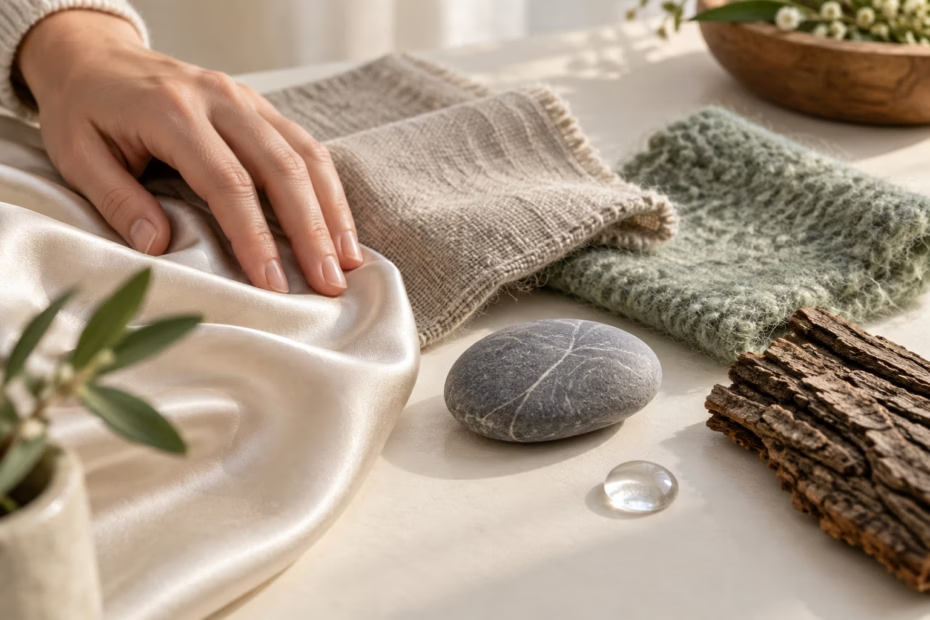
Adjectives for touch describe how a surface or contact feels: its texture, temperature, moisture, or resistance to pressure. A scarf may feel silky, a stone cool, a towel damp, and a cushion yielding. Choose the word that names the quality you mean; texture, wetness, temperature, and firmness are related sensations, but they are not interchangeable.
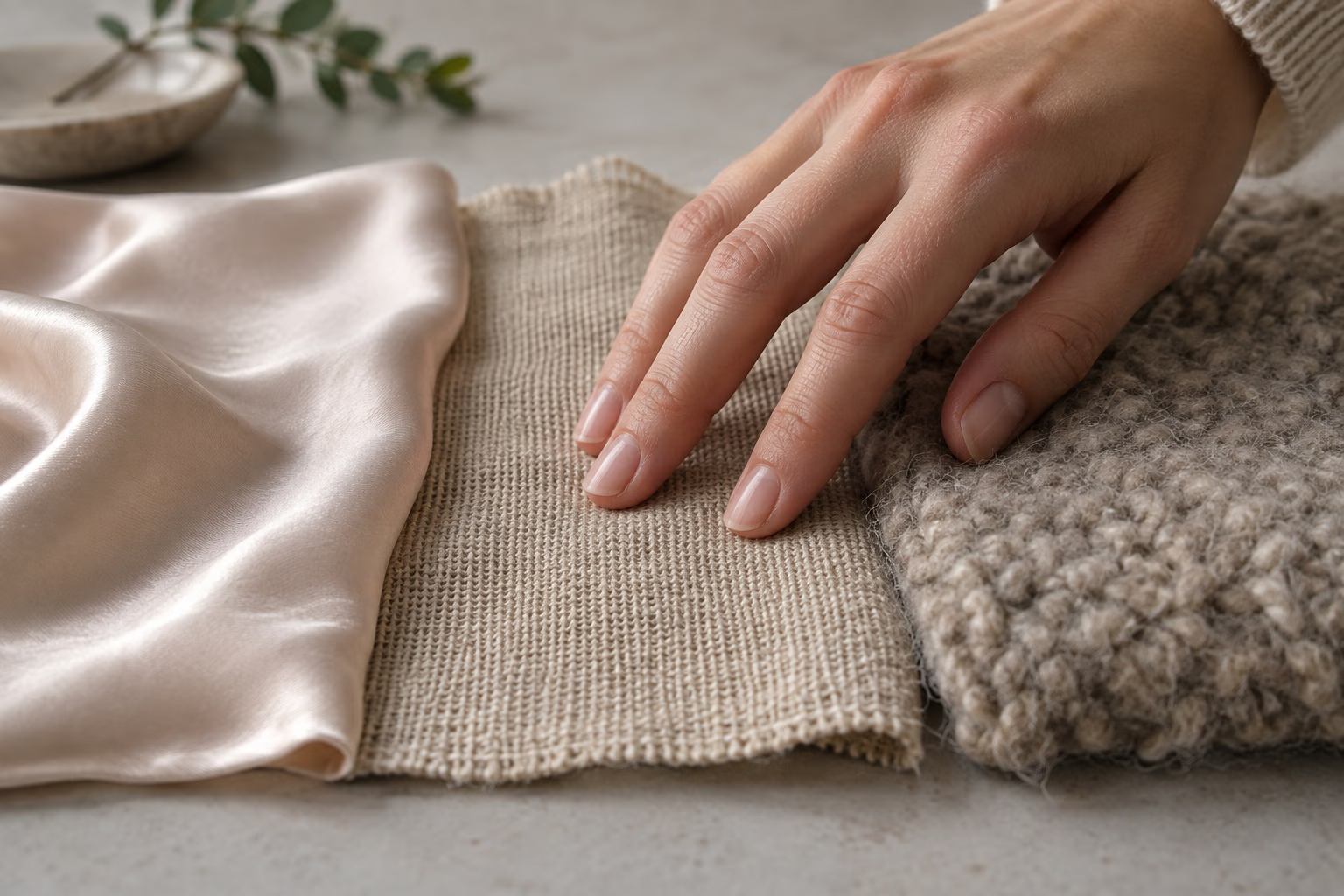
Quick list of adjectives for touch
| Quality | Useful adjectives | What they suggest |
|---|---|---|
| Even or smooth surface | smooth, sleek, polished, silky, satiny | Little friction or a fine, even finish |
| Uneven or abrasive surface | rough, coarse, gritty, grainy, scratchy, prickly | Raised, sharp, irregular, or irritating texture |
| Soft surface | soft, plush, fluffy, fuzzy, velvety, downy | Gentle pressure, fibers, or a yielding pile |
| Moisture | dry, damp, moist, clammy, soggy, slippery | Little moisture, slight wetness, soaking, or reduced grip |
| Temperature | cool, cold, chilly, icy, warm, hot, lukewarm | How something feels in relation to a familiar temperature |
| Pressure and firmness | firm, hard, rigid, yielding, springy, squishy | How much an object resists, gives way, or rebounds |
| Light or intense sensation | feathery, delicate, tender, sharp, stinging, tingling | A gentle contact or a distinct sensation on the skin |
These are practical groupings, not strict scientific categories. One object can have several qualities at once: a polished stone can be smooth, cool, and hard. Name the details that matter to your sentence instead of piling up near-synonyms.
Adjectives for texture
Smooth describes a surface that feels even, without noticeable bumps or roughness: “The ceramic handle felt smooth beneath her thumb.” Sleek often adds a polished, streamlined impression, while polished can point to a finished surface. Silky and satiny compare a surface to fine, soft fabric; they are useful for describing a feel, even when the material is not silk.
On the other end, rough is a broad word for an uneven or abrasive feel. Coarse suggests large, harsh, or less fine particles or fibers; gritty suggests small grains; and grainy draws attention to visible or felt granules. Scratchy describes something that rubs or irritates the skin, as an uncomfortable sweater might. Prickly suggests many tiny sharp points, like a burr or cactus spine. These distinctions help a reader imagine not only that something is rough, but how.
Fuzzy and fluffy suggest loose, soft fibers. Plush often implies a thick, soft pile; velvety suggests a dense, smooth softness; and downy evokes fine, light fibers. “The fuzzy lining softened the inside of the boot” is more specific than “The lining felt nice.”

Words for moisture and temperature
Damp means slightly wet, often with little visible water: “A damp sleeve brushed his wrist.” Moist is a neutral word for a small amount of moisture and is common in practical descriptions. Clammy usually conveys an unpleasant cool, damp feel, as in “The metal railing felt clammy after the fog.” Soggy suggests that something has absorbed a lot of liquid and become heavy or soft, such as a soggy sponge. Slippery is especially useful when contact reduces grip or makes a surface easy to slide across. Cambridge’s entry for slippery centers on this difficulty of holding or walking without sliding.
Dry describes a lack of moisture. It can be neutral (“The dry towel absorbed the spill”) or, with skin or a material, suggest a particular texture. Add a concrete detail if “dry” could be misunderstood: “The dry clay felt powdery at the edge and cracked in the middle.” Avoid using dry as a substitute for rough; a dry surface may still be smooth.
Cool and warm are moderate comparisons; cold and hot are stronger everyday terms. Chilly often suggests noticeable cold, while icy may mean very cold or literally covered with ice. Lukewarm means only slightly warm and can carry a figurative sense of limited enthusiasm. Temperature is relative to the person and setting, so “cool to the touch” is clearer than presenting a subjective feeling as an exact measurement.
Adjectives for pressure and sensation
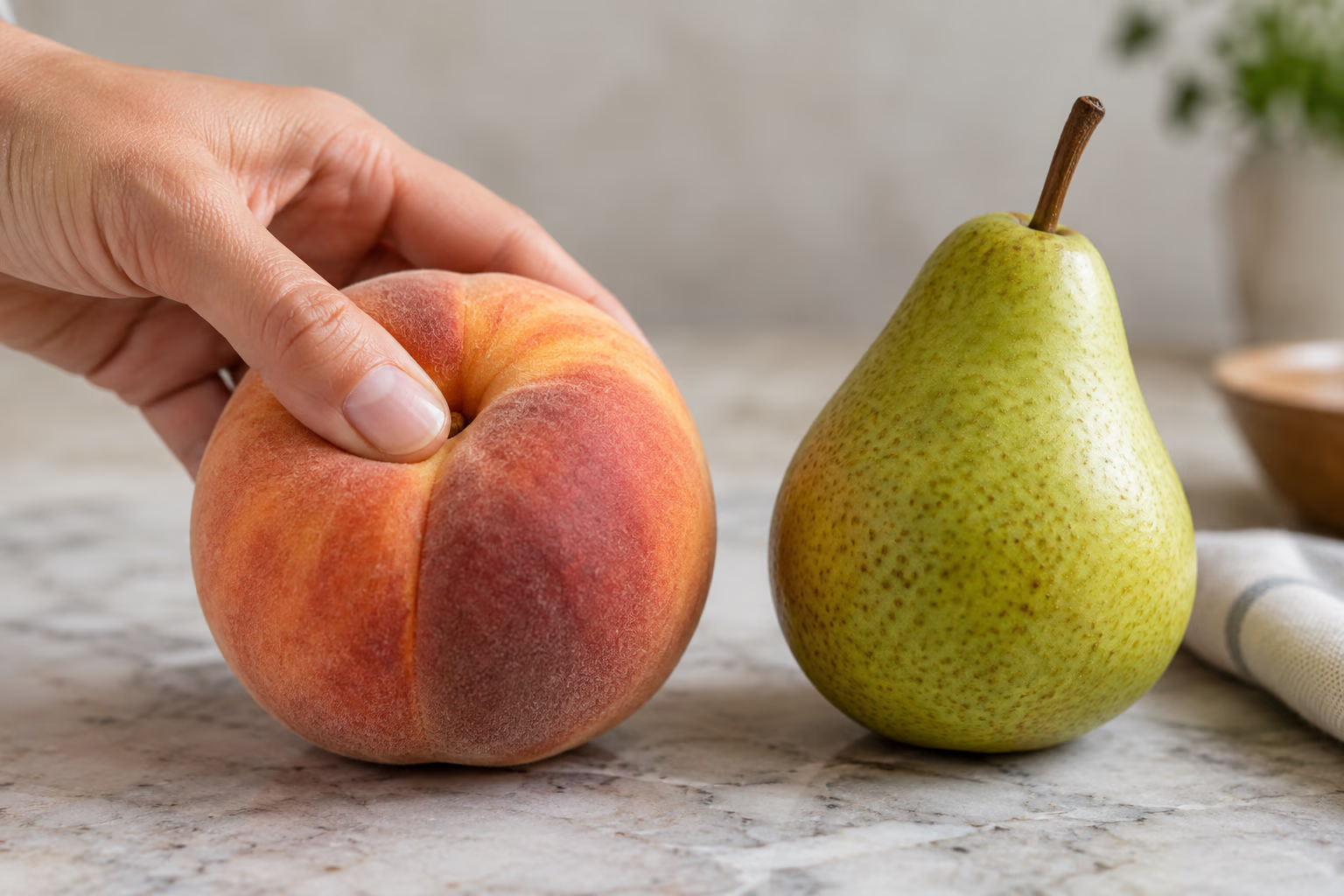
Soft is broad: an object may feel soft because its surface is gentle, its material compresses, or both. Plush points to a soft pile, while squishy suggests that something compresses easily and feels wet, pulpy, or yielding. Firm resists pressure but is not necessarily completely hard. Hard suggests little give; rigid emphasizes that a thing does not bend easily. Springy means it gives and returns toward its shape, while yielding focuses on giving way under pressure.
Words such as feathery, delicate, and tender can describe light or gentle contact. Sharp, stinging, itchy, and tingling name different sensations rather than surface textures: a sharp touch feels sudden and distinct; stinging suggests a smarting sensation; itchy describes an urge to scratch; tingling suggests a light prickling or buzzing feeling. Use these words as descriptions of a sensation, not as a diagnosis or a claim about its cause.
How to choose the right adjective
- Identify the quality. Is the sentence about texture, moisture, temperature, pressure, or a sensation?
- Choose a precise word. Replace “nice” or “bad” with an observable quality, such as “velvety,” “clammy,” or “rigid.”
- Include the object or contact. Explain what feels that way and, when useful, what touches it: “The wool cuff felt scratchy against her wrist.”
- Consider the reader. In a product description, use neutral terms a shopper can compare. In a story, select a detail that contributes to the scene or mood.
- Check intensity and connotation. “Cool” is milder than “icy”; “damp” is more neutral than “clammy.”
- Remove repetition. One or two well-chosen details usually say more than a string of similar adjectives.
Compare “The blanket felt soft and nice” with “The brushed cotton blanket felt light and fuzzy against her hands.” The second version identifies both the material and its texture. If a fact matters, be direct: “The handle is rigid plastic with a smooth finish” is more useful for a product specification than a poetic comparison.
Touch adjectives in sentences
- The silky scarf slid easily across the smooth lining of the coat.
- Fine sand left a gritty film on the wet glass.
- The knitted cuff felt scratchy against bare skin, so Jo rolled it above her wrist.
- A cool, polished stone rested in the palm of his hand.
- The damp bench had a clammy surface after the morning fog.
- The cushion was firm at the edges and more yielding in the center.
- Her fingertip brushed the prickly seed pod without pressing it.
- The springy mat compressed underfoot and returned to shape.
- The pastry had a crisp edge and a soft, almost spongy center.
- A feathery touch barely stirred the loose thread.
In these examples the adjectives appear before nouns (“a gritty film”) or after a linking verb (“the cuff felt scratchy”). They can also appear after verbs of perception: “The handle feels smooth” or “The wool scratched his neck.” The word should match the subject: the person may feel cold, while the surface feels cool.
Related term: tactile
Tactile is an adjective meaning related to the sense of touch, as in “tactile feedback” or “a tactile surface.” It does not mean “soft” or “rough” by itself; it tells readers that touch is involved. Cambridge Dictionary likewise defines tactile in relation to the sense of touch. Use tactile when discussing touch as a mode of experience, and a more specific adjective when naming the sensation: “The app gives tactile feedback through a brief vibration.”
For descriptive writing, sensory details work best when they serve the purpose. The University of Michigan’s Sweetland Center for Writing advises writers to consider how detail shapes a reader’s experience, and Purdue OWL discusses sensory language as one resource for descriptive essays. A story may benefit from the feel of rain-soaked sleeves; an instruction may need only the clear warning “Do not touch the hot surface.”
Frequently asked questions
What are adjectives for touch?
They are adjectives that describe a felt quality or sensation. Examples include smooth, rough, soft, prickly, damp, cool, and firm.
Is tactile an adjective for touch?
Yes. Tactile means related to the sense of touch. It is a broad term; use a word such as silky or scratchy to describe a particular texture.
What is the difference between smooth and slippery?
Smooth describes an even surface. Slippery describes a surface or object that is difficult to grip or easy to slide across. A surface can be smooth without being slippery.
What is the difference between damp, clammy, and soggy?
Damp means slightly wet; clammy commonly suggests an unpleasant cool, moist feel; and soggy describes something soaked and often softened or heavy.
How can I avoid overusing adjectives?
Choose the one or two words that give readers the most useful information. Replace vague praise with a concrete texture or temperature, and remove words that repeat the same idea.
Sources and further reading: Cambridge Dictionary: tactile; Cambridge Dictionary: smooth; Cambridge Dictionary: clammy; University of Michigan Sweetland Center for Writing; Purdue OWL.
When it comes to describing the sense of touch, words have the power to transport us to a world of sensations. From the gentle caress of a soft fabric to the rough texture of sandpaper, adjectives play a crucial role in painting a vivid picture in our minds. In this article, I’ll be exploring a variety of adjectives that can be used to describe touch, along with examples to help you better understand their usage. So, if you’re ready to dive into the realm of tactile descriptions, let’s get started!
How to Describe touch? – Different Scenarios
In this section, I’ll provide you with different scenarios and examples to help you understand how to describe touch using adjectives. Let’s dive in!
1. Soft Touch:
When we experience a soft touch, it can leave us feeling calm and comforted. Here are some adjectives you can use to describe a soft touch:
- Gentle: The touch of a mother’s hand on her child’s cheek is gentle, conveying love and tenderness.
- Silky: The touch of a smooth silk fabric against your skin feels silky, creating a luxurious and pleasant sensation.
- Feathery: A feather lightly brushing against your arm feels feathery, giving you a delicate, ticklish feeling.
2. Rough Touch:
A rough touch can elicit a different response, invoking sensations of roughness or discomfort. Here are some adjectives to describe a rough touch:
- Coarse: The touch of a rough sandpaper against your fingertips is coarse and abrasive.
- Prickly: Touching a cactus can feel prickly, with small thorns that poke and irritate your skin.
- Scratchy: Wearing a woolen sweater that’s not soft can feel scratchy, causing an itchiness or irritation.
3. Wet Touch:
A wet touch usually involves contact with water or another liquid, which can evoke feelings of moisture or coolness. Here are some adjectives to describe a wet touch:
| Adjective | Example |
|---|---|
| Damp | Touching a freshly watered plant might feel damp, leaving your fingers slightly moist. |
| Soggy | Stepping on a wet sponge can feel soggy, as it absorbs the water and becomes heavy. |
| Slippery | Holding a wet bar of soap can be slippery, making it difficult to grasp firmly. |
- Electrifying: When you touch a Van de Graaff generator, you may feel an electrifying sensation due to static electricity.
- Tingling: Using a foot massager can create a tingling sensation, relaxing your feet and improving circulation.
- **Pins and needles
Describing Words for touch in English
When it comes to describing touch, there are a variety of adjectives that can help us vividly express the feel of different objects and textures. Let’s explore some of these describing words for touch and see how they can bring our descriptions to life.
Soft Touch
A soft touch can be gentle, delicate, or even velvety. Imagine the sensation of stroking a furry kitten or running your fingers through a soft silk fabric. These actions evoke feelings of comfort and smoothness.
Below are some examples of adjectives that can be used to describe a soft touch:
Adjectives
- Gentle
- Silky
- Feathery
- Smooth
- Tender
Rough Touch
In contrast to a soft touch, a rough touch can be coarse, prickly, or even scratchy. Picture the sensation of touching a rough wooden surface or rubbing your hand against a prickly cactus. These textures elicit feelings of roughness and can sometimes even be slightly uncomfortable.
Here are some examples of adjectives that describe a rough touch:
Adjectives
- Coarse
- Prickly
- Scratchy
- Rough
- Gritty
Wet Touch
Have you ever touched something wet and felt the cool, moist sensation? Describing a wet touch requires words that convey dampness, moisture, and slipperiness. Think of the feeling when you dip your hands into a pool of water or touch a soggy sponge.
Check out these adjectives that can be used to describe a wet touch:
Adjectives
- Damp
- Soggy
- Slippery
- Moist
- Wet
Remember, these words can be great tools for expanding vocabulary and engaging young learners in learning about the different sensations that objects can evoke. Encourage children to use these adjectives in their own descriptions to develop their language skills and sensory awareness.
| Soft Touch | Rough Touch | Wet Touch |
|---|---|---|
| Gentle | Coarse | Damp |
| Silky | Prickly | Soggy |
| Feathery | Scratchy | Slippery |
| Smooth | Rough | Moist |
| Tender | Grit |
Adjectives for touch
As an expert blogger with years of experience, I have come across various adjectives that can be used to describe different types of touch. In this section, I will provide you with positive and negative adjectives for touch, along with example sentences to help you understand their usage. These descriptive words can be valuable tools for preschool and kindergarten teachers when teaching children about the sense of touch.
Positive Adjectives for Touch with Example Sentences
When we think about positive touch, words like soft, gentle, and comforting come to mind. Here are some adjectives that can be used to describe a positive touch, along with example sentences:
| Adjective | Example Sentence |
|---|---|
| Soft | The kitten’s fur is soft and fluffy. |
| Gentle | She gave me a gentle massage to help me relax. |
| Comforting | Holding a loved one’s hand can be comforting. |
These positive adjectives not only enhance vocabulary but also create a pleasant and soothing atmosphere.
Negative Adjectives for Touch with Example Sentences
On the other hand, there are occasions when we experience touch that is less pleasant. Negative adjectives can be used to describe such touch. Here are some examples along with sentences illustrating their usage:
| Adjective | Example Sentence |
|---|---|
| Rough | The sandpaper feels rough against my skin. |
| Prickly | The thorns on the cactus were prickly to touch. |
| Scratchy | The sweater had an irritating, scratchy texture. |
These negative adjectives help children recognize and describe touch that may not be as enjoyable.
By incorporating these adjectives into their lessons, preschool and kindergarten teachers can help their students develop a better understanding of the different sensations associated with touch. This not only enriches their vocabulary but also enhances their sensory awareness.
Remember, children grasp concepts in various ways, and the sense of touch is an important aspect of their learning journey. By describing touch using adjectives, educators can make the learning process more engaging and enjoyable for young learners.
Synonyms and Antonyms with Example Sentences
Synonyms for touch
When it comes to describing the sense of touch, there are several synonyms that can help us paint a vivid picture. Here are some alternative words that can be used interchangeably to describe different touch sensations:
| Synonym | Definition | Example Sentence |
|---|---|---|
| Tactile | Relating to the sense of touch | The tactile fabric was incredibly soft. |
| Haptic | Relating to the sense of touch | She enjoyed the haptic experience of the silky sand. |
| Palpable | Capable of being touched or felt | The tension in the room was palpable. |
| Tangible | Perceptible to the touch; touchable | The excitement in the air was tangible. |
| Contact | A touch or meeting of surfaces | I could feel the contact of the cold metal against my skin. |
Using these synonyms in your teaching materials can help enrich children’s vocabulary and broaden their understanding of the sense of touch.
Antonyms for touch
In order to provide a comprehensive understanding of touch, it’s important to also introduce antonyms – words that have opposite meanings. Here are some antonyms that can be used to describe different touch sensations:
| Antonym | Definition | Example Sentence |
|---|---|---|
| Numb | Lacking sensation or feeling | His hand felt numb after being in the cold for too long. |
| Insensitive | Not able to feel or perceive | The rock was insensitive to the touch. |
| Imperceptible | Not able to be perceived by touch | The texture of the water was imperceptible. |
| Intangible | Not perceptible to touch or physical senses | The ghostly figure seemed intangible. |
| Untouched | Not touched or affected by something | The book sat on the shelf, untouched for years. |
Including antonyms in your lessons will provide a balanced perspective and help children understand the range of sensations related to touch.
By incorporating these synonyms and antonyms into your teaching materials, you can engage young learners, enhance their vocabulary skills, and foster a deeper understanding of the sense of touch.
Conclusion
Expanding children’s vocabulary and understanding of touch is crucial for their cognitive development. By incorporating synonyms and antonyms for the sense of touch into teaching materials, we can engage young learners and enhance their vocabulary skills. Words like tactile, haptic, palpable, tangible, and contact provide a rich and varied description of touch, while antonyms such as numb, insensitive, imperceptible, intangible, and untouched offer contrasting perspectives.
By introducing these descriptive words, we can encourage children to explore the different sensations and textures associated with touch. This not only helps them develop a deeper understanding of the world around them but also improves their ability to express themselves effectively.
Incorporating these adjectives into lessons and activities allows children to expand their vocabulary in a meaningful way. It enables them to communicate their experiences and feelings more precisely, fostering their language development and overall communication skills.
By utilizing synonyms and antonyms for touch, we can enrich children’s vocabulary, broaden their understanding, and empower them to articulate their tactile experiences with confidence and precision.


