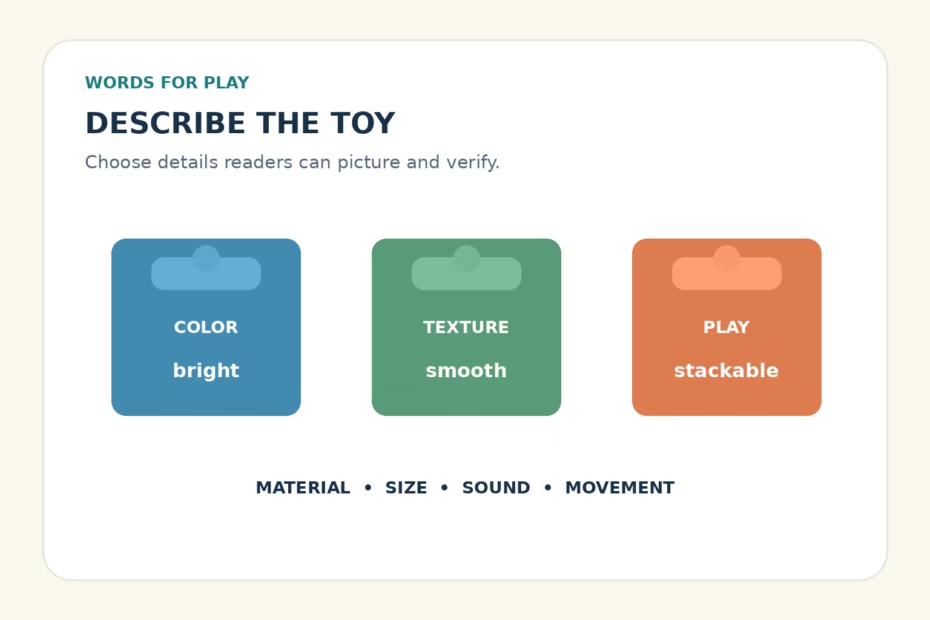
Use toy adjectives to help a reader picture a toy and understand how it is used. Words such as soft, wooden, stackable, and pretend give different kinds of information. The most useful description combines observable details—material, size, color, sound, and moving parts—with a fair account of the play the toy supports.
Quick list: adjectives for toys
These words work well in a classroom activity, a story, a product description, or a conversation with a child. Pick the ones that fit the actual toy rather than stacking several near-synonyms.
- Appearance: colorful, bright, patterned, shiny, glittery, transparent, striped, spotted, detailed, miniature
- Touch and material: soft, plush, fuzzy, smooth, textured, wooden, plastic, knitted, squishy, lightweight
- Shape and size: tiny, oversized, round, flat, chunky, slender, stackable, portable, poseable, flexible
- Play and use: interactive, imaginative, open-ended, cooperative, musical, buildable, collectible, hands-on, mechanical, pretend
- Sound and movement: rattling, quiet, musical, rolling, spinning, bouncing, motorized, articulated, foldable, wind-up
- Condition or quality: sturdy, durable, delicate, worn, well-made, washable, repairable, flimsy, noisy, incomplete
Describing toy appearance, material, and feel
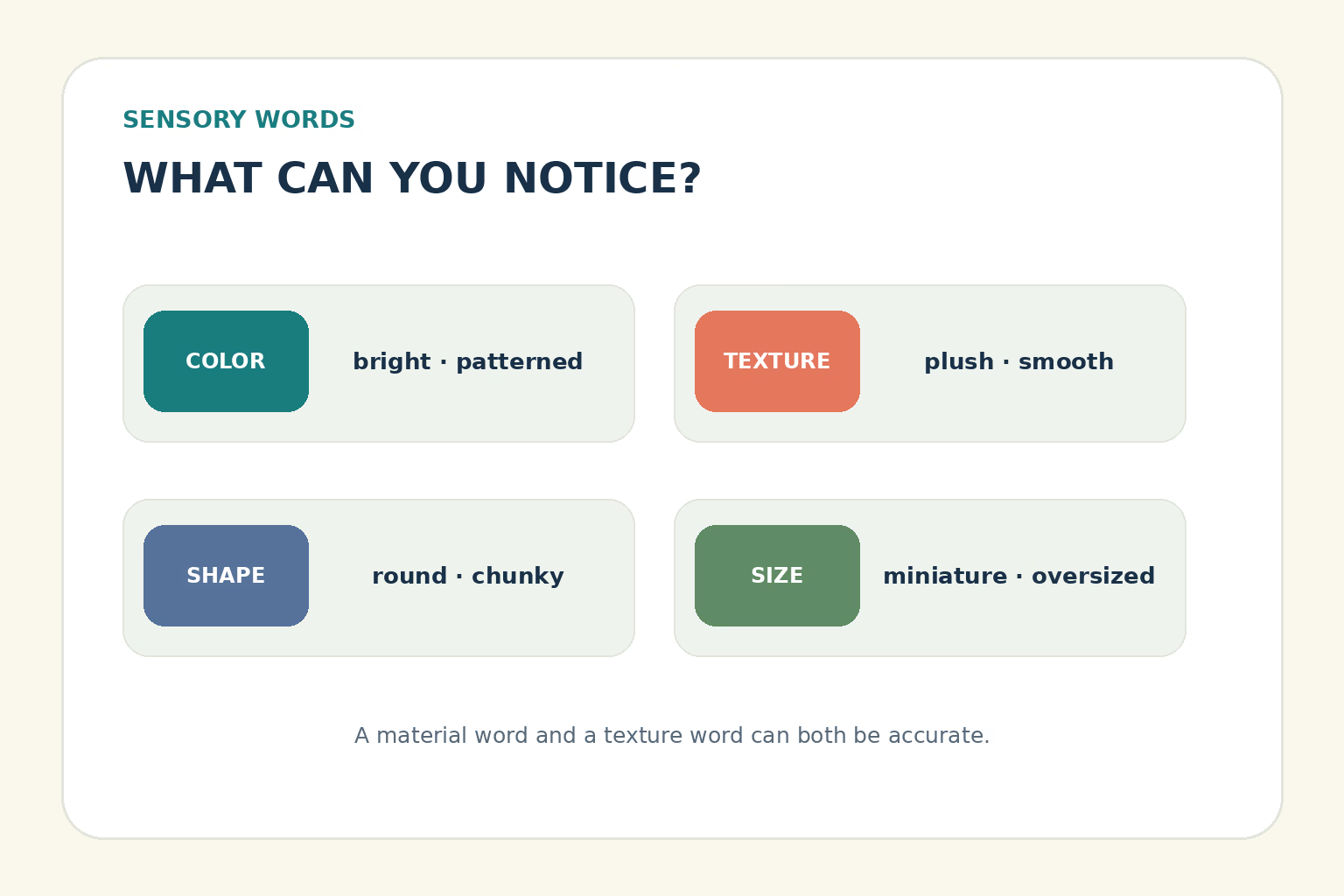
Appearance adjectives tell what someone can see; texture and material words describe what a toy is made from or feels like. Keep these categories distinct: wooden names a material, while smooth describes a surface. A toy can be both wooden and smooth, or plastic and textured.
| Word | Meaning | Example |
|---|---|---|
| Patterned | Marked with a repeated design | The patterned blocks have blue checks and yellow stripes. |
| Translucent | Letting some light through without showing a clear image | The translucent tiles glow when held near the window. |
| Plush | Covered in a soft, thick fabric | The plush rabbit has long ears and a cotton tail. |
| Textured | Having a surface that can be felt or seen | The textured ball has raised bumps around its edge. |
| Chunky | Thick or broad in shape | Chunky pieces are easy for small hands to grip. |
| Miniature | Made as a very small version of something | The miniature train fits on the tabletop track. |
Adjectives that explain how a toy is played with
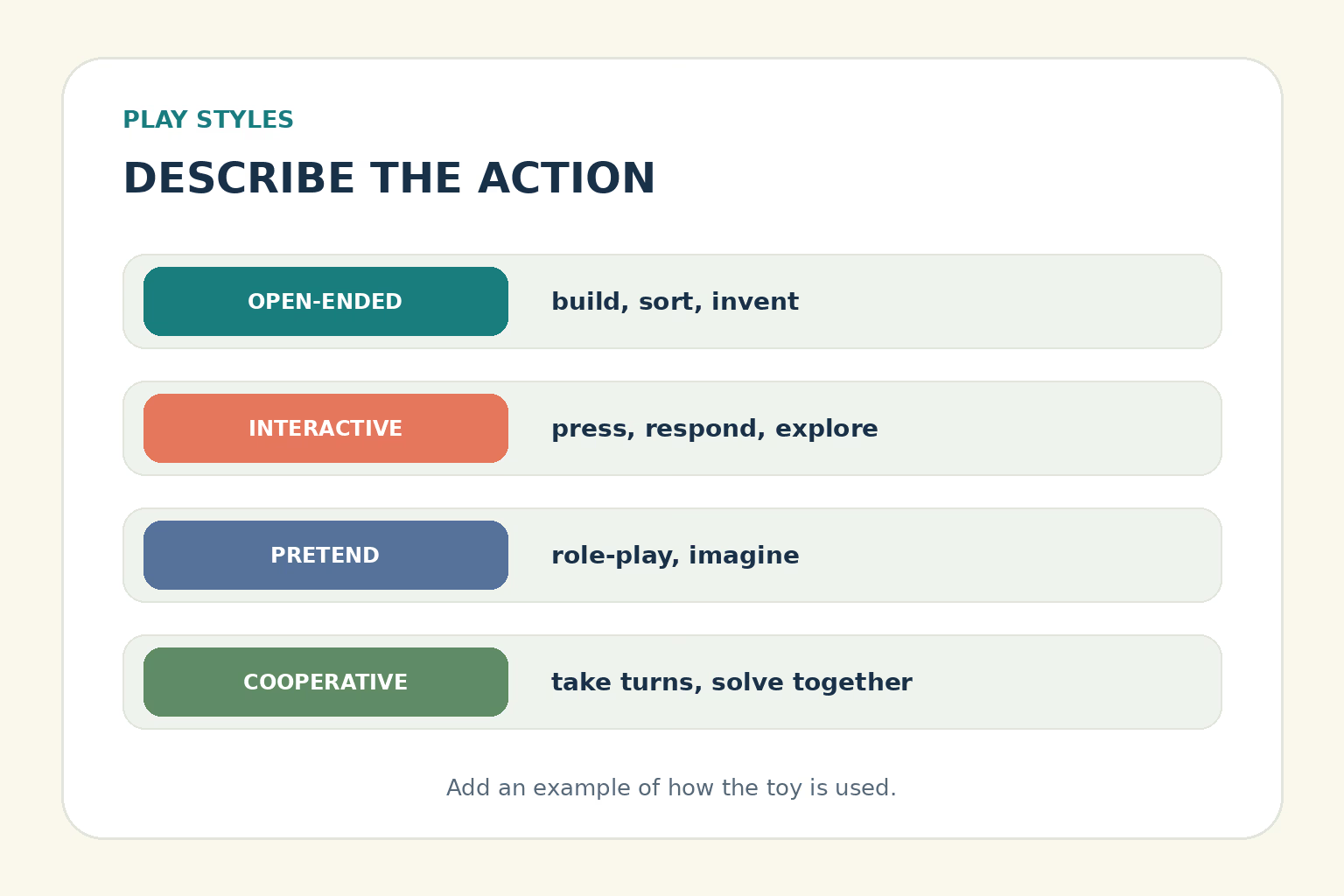
Play adjectives are strongest when followed by a concrete example. Instead of saying only that a toy is fun or educational, explain what a player can do with it: sort shapes, build a bridge, invent a story, or take turns. Open-ended materials can support different kinds of play; describe the possibilities without promising a particular learning outcome for every child.
| Adjective | What it suggests | Example sentence |
|---|---|---|
| Open-ended | Can be used in many ways, without one required result | The open-ended wooden pieces become a tower, a bridge, or anything the child imagines. |
| Interactive | Responds to a player’s action or encourages participation | The interactive puzzle lights up when a piece is placed correctly. |
| Cooperative | Invites players to work toward a shared goal | The cooperative game asks the whole group to solve one mystery together. |
| Pretend | Used in make-believe or role-play | The pretend kitchen comes with a kettle, cups, and fabric food. |
| Buildable | Can be assembled into structures or designs | The buildable set includes arches and connectors for taller models. |
| Musical | Produces or is designed around music or sound | The musical toy plays a short melody when its keys are pressed. |
Positive, neutral, and critical toy adjectives
A useful description does not have to praise every toy. Choose a word that matches what you can verify. Sturdy or durable should reflect construction and use; flimsy can describe a piece that bends or comes loose easily. If a toy is noisy, explain whether its sound is loud, repetitive, or adjustable rather than assuming every reader will find it annoying.
- Positive: engaging, sturdy, imaginative, versatile, tactile, well-made, portable, inviting.
- Neutral and precise: battery-powered, wind-up, stackable, washable, electronic, articulated, compact, age-labeled.
- Critical: flimsy, repetitive, bulky, difficult-to-assemble, incomplete, fragile, loud, hard-to-clean.
Examples: “The sturdy wooden truck rolls smoothly across the rug.” “The repetitive sound can be switched off.” “This compact puzzle has 24 large pieces and stores in a zippered pouch.” Specific details make the description more balanced than a string of general praise or criticism.
Example toy descriptions for different settings
- For a picture book: “A lopsided, red tin robot clanked across the kitchen, one bright button blinking on its chest.”
- For a classroom shelf: “These smooth, oversized counting beads can be threaded, sorted by color, or arranged into repeating patterns.”
- For a product listing: “The lightweight, foldable play mat has a washable surface, printed road pattern, and storage strap.” Mention dimensions, included parts, power needs, or care instructions when known.
- For a child: “This soft, spotted puppy has floppy ears. You can hug it, give it a name, or make up a story about where it is going.”
How to choose accurate toy adjectives
- Start with something you can observe. Note the material, color, texture, size, parts, sounds, and movement.
- Name the play action. Say whether a child can stack, roll, sort, build, pretend, or play with someone else.
- Use specific details instead of vague praise. Replace “great toy” with a feature and an example of how it works.
- Separate opinion from fact. “I found the tune repetitive” is clearly a personal response; “plays the same 10-second tune” is a checkable feature.
- Make safety wording precise. Do not call a toy “safe for all ages” based on appearance. Follow age guidance and warnings on its packaging. The U.S. Consumer Product Safety Commission explains that small-parts rules and choking-hazard labels apply to particular products and age groups; these details belong in factual product copy when relevant. See the CPSC toy-safety guidance and its small-parts guidance.
For child-led play, words like adaptable, open-ended, and hands-on can describe the activity more clearly than declaring that a toy will teach a specific skill. The CDC recommends following a child’s lead during special playtime and advises avoiding small detachable parts for very young children; use the toy’s own age and safety information as well. See the CDC guidance on child-led play. The National Association for the Education of Young Children also describes open-ended materials as supporting sensory, creative, and dramatic play in its family resource.
Quick adjective combinations
Pair one or two words from different categories to make a compact description: soft, washable plush bear; bright, stackable cups; compact, battery-powered robot; textured rubber ball; wooden, open-ended building set; or delicate miniature dollhouse chair. When two adjectives say nearly the same thing, keep the clearer one and use the space for a concrete feature.

When it comes to toys, there’s a whole world of adjectives that can be used to describe them. From soft and cuddly to shiny and colorful, adjectives play a crucial role in capturing the essence of a toy and igniting a child’s imagination. In this article, I’ll take you on a journey through the world of adjectives for toys, providing you with a range of descriptive words and examples that will help you bring your toy descriptions to life.
Toys come in all shapes, sizes, and materials, and each one has its own unique characteristics. Whether you’re describing a plush teddy bear, a vibrant puzzle, or a sleek remote-controlled car, the right adjectives can make all the difference in painting a vivid picture in the reader’s mind. So, whether you’re a parent looking for the perfect words to describe a toy to your child or a writer wanting to add depth to your toy descriptions, this article will equip you with a variety of adjectives and examples that will make your toy descriptions truly shine.
How to Describe toys? – Different Scenarios
When it comes to describing toys, there are various scenarios and contexts in which you may need to use adjectives to bring them to life. Whether you’re a parent looking to accurately describe a toy to your child or a writer wanting to create vivid descriptions for a story, here are some different scenarios and examples to help you describe toys effectively:
- Describing toys to children: Children have a vivid imagination, and using adjectives can help them visualize and engage with toys on a deeper level. Here are some examples:
- Writing toy descriptions for e-commerce: When selling toys online, it’s essential to provide accurate and appealing descriptions. Here are some adjectives that can make your toy descriptions more enticing:
- Creating toy characters for stories: If you’re a writer creating toy characters for a story, using adjectives can help bring them to life in the reader’s imagination. Here are some examples:
- Describing the materials and features of toys: Toys come in various shapes, sizes, and materials, each with unique characteristics. Here are some examples of how to describe toy materials and features:
Describing Words for toys in English
When it comes to describing toys, it’s important to use adjectives that can bring them to life and make them more engaging. As a preschool teacher, I understand the importance of teaching young children easy words to describe their toys. In this section, I’ll provide you with a list of descriptive words that you can use to enhance your toy descriptions and make them more vivid.
To help you better understand how these words can be used, I’ve prepared a table with examples of adjectives and their meanings:
| Adjective | Meaning |
|---|---|
| Colorful | Full of bright and vivid colors |
| Soft | Smooth and gentle to touch |
| Sturdy | Strong and durable |
| Playful | Lively and fun |
| Interactive | Engaging and responsive |
| Educational | Designed to teach and promote learning |
| Quirky | Unique and unusual |
| Cuddly | Huggable and comforting |
| Versatile | Capable of being used in different ways |
| Exciting | Thrilling and full of anticipation |
By incorporating these descriptive words into your toy descriptions, you can create a more engaging and informative experience for both children and their parents. Whether you’re describing a colorful playset, a soft plush toy, or an interactive learning game, these adjectives will help you paint a vivid picture in the minds of your audience.
Remember, the key to effective toy descriptions is to use adjectives that capture the essence of the toy and convey its unique features. So, have fun with your word choices and let your creativity shine through as you describe toys to spark the imagination of young children.
As we continue with the article, I’ll provide you with more examples and tips on how to write toy descriptions for e-commerce, create toy characters for stories, and describe the materials and features of toys. Stay tuned for more informative content that will make your toy descriptions stand out from the rest.
Adjectives for toys
When it comes to describing toys, the right adjectives can make all the difference. They bring the toys to life, capturing their essence and unique features. In this section, I’ll provide you with a list of positive and negative adjectives for toys, along with example sentences to help you understand how to use them effectively.
Positive Adjectives for Toys
Using positive adjectives can create a sense of excitement and appeal for toys. Here are some examples of positive adjectives that can enhance toy descriptions:
| Adjective | Example Sentence |
|---|---|
| Colorful | The toy is vibrant and visually appealing. |
| Interactive | This toy encourages active engagement and play. |
| Educational | It promotes learning and development in a fun way. |
| Durable | This toy is built to withstand rough play and last long. |
| Imaginative | It sparks creativity and encourages imaginative play. |
Negative Adjectives for Toys
While positive adjectives can highlight the strengths of toys, negative adjectives can help set realistic expectations and provide a balanced perspective. Here are some examples of negative adjectives that can be used to describe toys:
| Adjective | Example Sentence |
|---|---|
| Flimsy | This toy feels weak and easily breakable. |
| Noisy | The toy produces loud and annoying sounds. |
| Boring | It lacks excitement and fails to captivate attention. |
| Uninspiring | This toy lacks creativity and fails to stimulate imagination. |
| Unsafe | It has potential hazards and may not be suitable for young children. |
Remember, using a mix of positive and negative adjectives can help provide a comprehensive description of toys. It’s essential to be honest and accurate in your descriptions, ensuring that potential buyers have a clear understanding of what to expect.
By incorporating these adjectives into your toy descriptions, you can create engaging and informative content that will appeal to both parents and children, helping them make informed decisions about their toy purchases. Remember to choose adjectives that accurately represent the toy’s features and qualities, as this will help create a compelling description that stands out from the crowd.
Stay tuned for more examples and tips on how to write toy descriptions for e-commerce, create toy characters for stories, and describe the materials and features of toys.
Synonyms and Antonyms with Example Sentences
Synonyms for toys
When describing toys, it’s important to use a variety of adjectives to make your descriptions more engaging. Here are some synonyms for the word “toys” that you can use to add a touch of excitement to your descriptions:
Synonyms
- Playthings
- Amusements
- Games
- Playstuff
- Playthings
- Playthings
For example:
- “These amusements are designed to spark creativity and imagination.”
- “Children will have endless fun with these playthings.”
Using synonyms can help bring diversity to your toy descriptions and keep them interesting for potential buyers.
Antonyms for toys
In addition to using positive adjectives, it’s also important to provide a balanced perspective by incorporating some negative adjectives into your toy descriptions. Here are some antonyms for the word “toys” that you can use:
Antonyms
- Boredom
- Inactivity
- Tediousness
- Monotony
- Dullness
- Dreariness
For example:
- “Say goodbye to boredom with these engaging toys.”
- “These toys are designed to combat inactivity and promote active play.”
By including antonyms in your toy descriptions, you can provide a more comprehensive view of the product and give potential buyers a clearer understanding of its benefits.
Remember, using a mix of positive and negative adjectives will help you create more engaging and informative content for potential buyers.
Conclusion
Using adjectives to describe toys is an essential aspect of creating engaging and informative content. By incorporating synonyms and antonyms for the word “toys,” we can enhance toy descriptions and create excitement and appeal for potential buyers.
The article emphasizes the importance of using a mix of positive and negative adjectives to provide a comprehensive description of toys. This balanced perspective allows readers to make informed decisions about the toys they are interested in.
In addition to the adjectives discussed in this article, there are many more examples and tips on writing toy descriptions for e-commerce, creating toy characters for stories, and describing the materials and features of toys. Exploring these topics further can help you create even more compelling descriptions that capture the attention of your target audience.
So, next time you’re writing about toys, remember to utilize adjectives effectively. By doing so, you can create descriptions that not only inform but also inspire potential buyers to make a purchase.


