
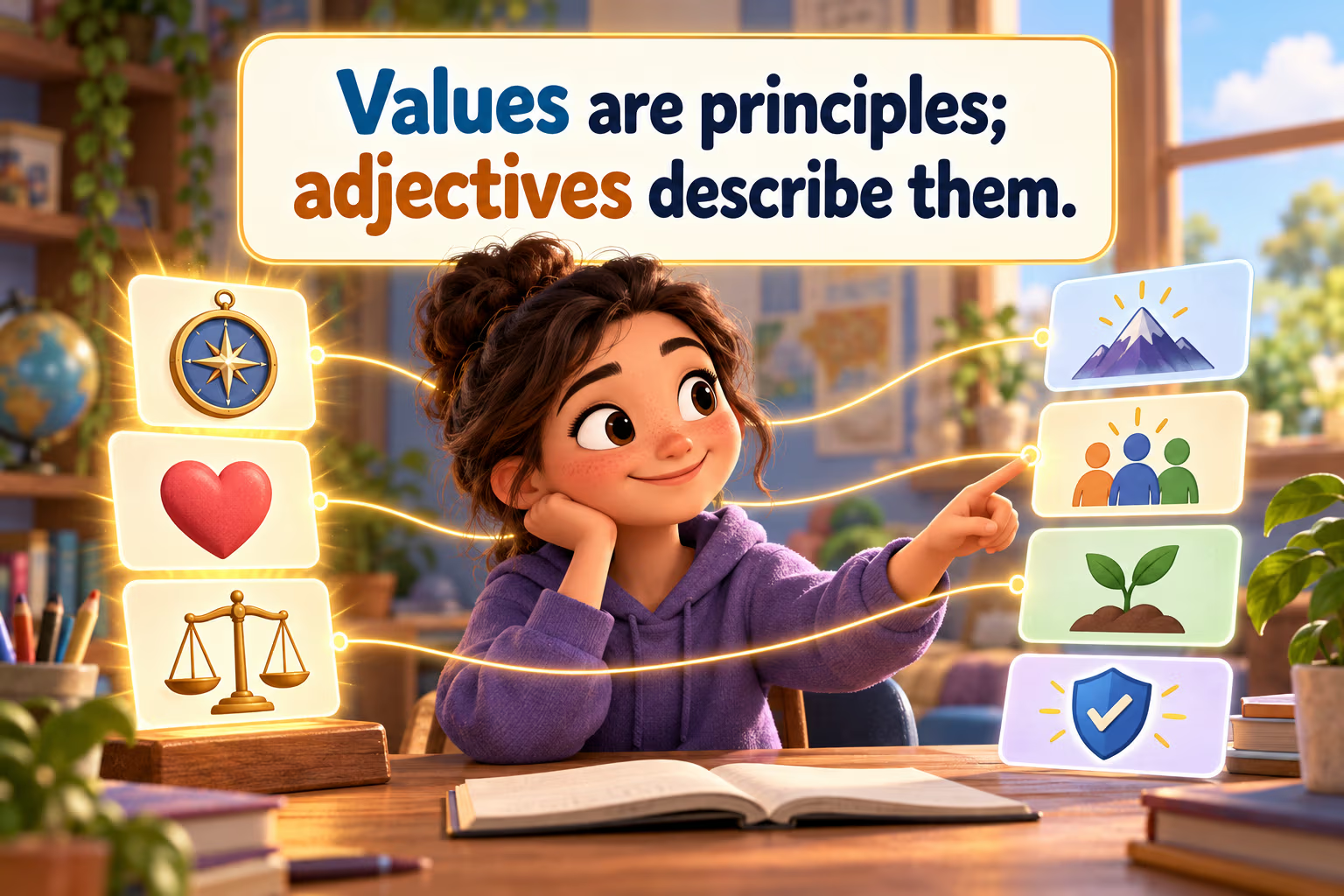
Adjectives for values describe the principles a person, group, or choice expresses. Words such as honest, compassionate, fair, and responsible can name related qualities, but a value is a guiding belief and an adjective describes a person, action, or decision. Choose a word that fits the evidence and explain it with a concrete example.
At a glance
- Values are beliefs or priorities about what matters; adjectives describe people, choices, actions, or principles.
- Honesty is a noun and honest is an adjective; compassion is a noun and compassionate is an adjective.
- Related qualities such as loyalty, kindness, courage, and reliability are not interchangeable synonyms.
- A single action can illustrate a value, but it does not establish a permanent character label.
- “Positive” and “negative” depend on context; use specific behavior when an evaluation could be disputed.
What Do Adjectives for Values Describe?
Values are beliefs about what is important or right, while adjectives add a description to a person, action, decision, or principle. For example, fair describes a decision that applies a standard impartially; fairness names the value. Cambridge Dictionary defines plural values as beliefs about right and wrong and what matters in life that influence behavior.
| Word form | Example | What it names |
|---|---|---|
| Noun: value | “Fairness is one of the team’s stated values.” | A principle or priority |
| Adjective | “The team used a fair process.” | A quality of the process |
| Action | “The team gave each applicant the same interview time.” | Observable evidence that may express fairness |
These categories help avoid a common mix-up in adjective lists: many words that describe values are nouns, including honesty, courage, respect, kindness, and integrity. Their related adjectives are honest, courageous, respectful, kind, and principled. The right form depends on the sentence, not on whether the idea is positive.
Which Adjectives Fit Common Values?
Choose a descriptor by identifying the specific principle or conduct you mean. The table pairs common values with adjective forms and an example that shows the behavior behind the word.
| Value or principle | Useful adjectives | Example tied to conduct |
|---|---|---|
| Honesty and truth | honest, truthful, candid | “She corrected the report after finding an error in her own figures.” |
| Fairness | fair, impartial, equitable | “The reviewer used the same criteria for every application.” |
| Care for others | compassionate, empathetic, considerate | “He asked what support his colleague wanted before stepping in.” |
| Responsibility | responsible, accountable, dependable | “They acknowledged the missed deadline and shared a revised plan.” |
| Courage or conviction | courageous, principled, steadfast | “She raised the safety concern despite pressure to move on.” |
| Curiosity and learning | curious, open-minded, reflective | “He asked how the evidence might change his first conclusion.” |
| Inclusion and respect | inclusive, respectful, welcoming | “The facilitator invited written as well as spoken input.” |
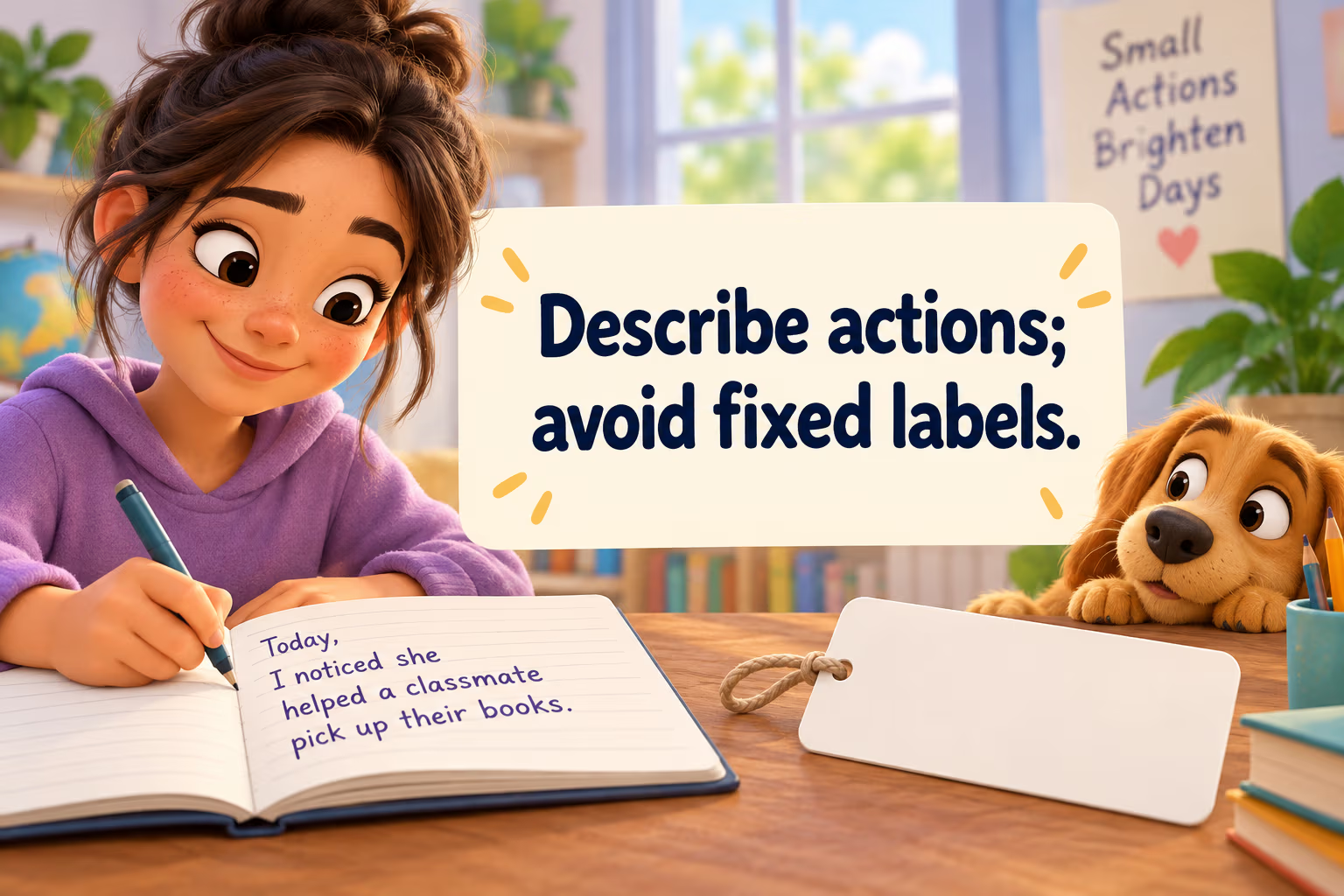
These are useful descriptors, not a test of someone’s character. A thoughtful example names the setting and action: “The volunteer was generous with her time, staying after the event to pack supplies.” It is more informative than calling someone “the most generous person.”
How Can You Describe a Value Accurately?
Start with the behavior and then choose the narrowest adjective that describes it. This keeps a description concrete in a personal essay, recommendation, classroom reflection, or workplace note.
- Name the action. Record what the person said, chose, or did rather than guessing at an unspoken motive.
- Identify the principle involved. Ask whether the example concerns truth, fairness, care, responsibility, freedom, or another priority.
- Choose a fitting word form. Use an adjective for the quality (honest response) and a noun for the principle (honesty matters).
- Keep the claim in scope. One example can support a description of that action; repeated examples across contexts provide a stronger basis for describing a pattern.
| Broad claim | More specific wording | Why it is clearer |
|---|---|---|
| “Ava is perfect.” | “Ava admitted that she had sent the outdated file and replaced it.” | Describes a verifiable action instead of an absolute judgment. |
| “Noah is loyal, so he is always ethical.” | “Noah is loyal to his team and disclosed the error in its report.” | Separates allegiance from a particular act of honesty. |
| “The student is lazy.” | “The student left two assigned questions blank on this draft.” | Reports the work observed without assuming motivation. |
Are Related Qualities Exact Synonyms for Values?
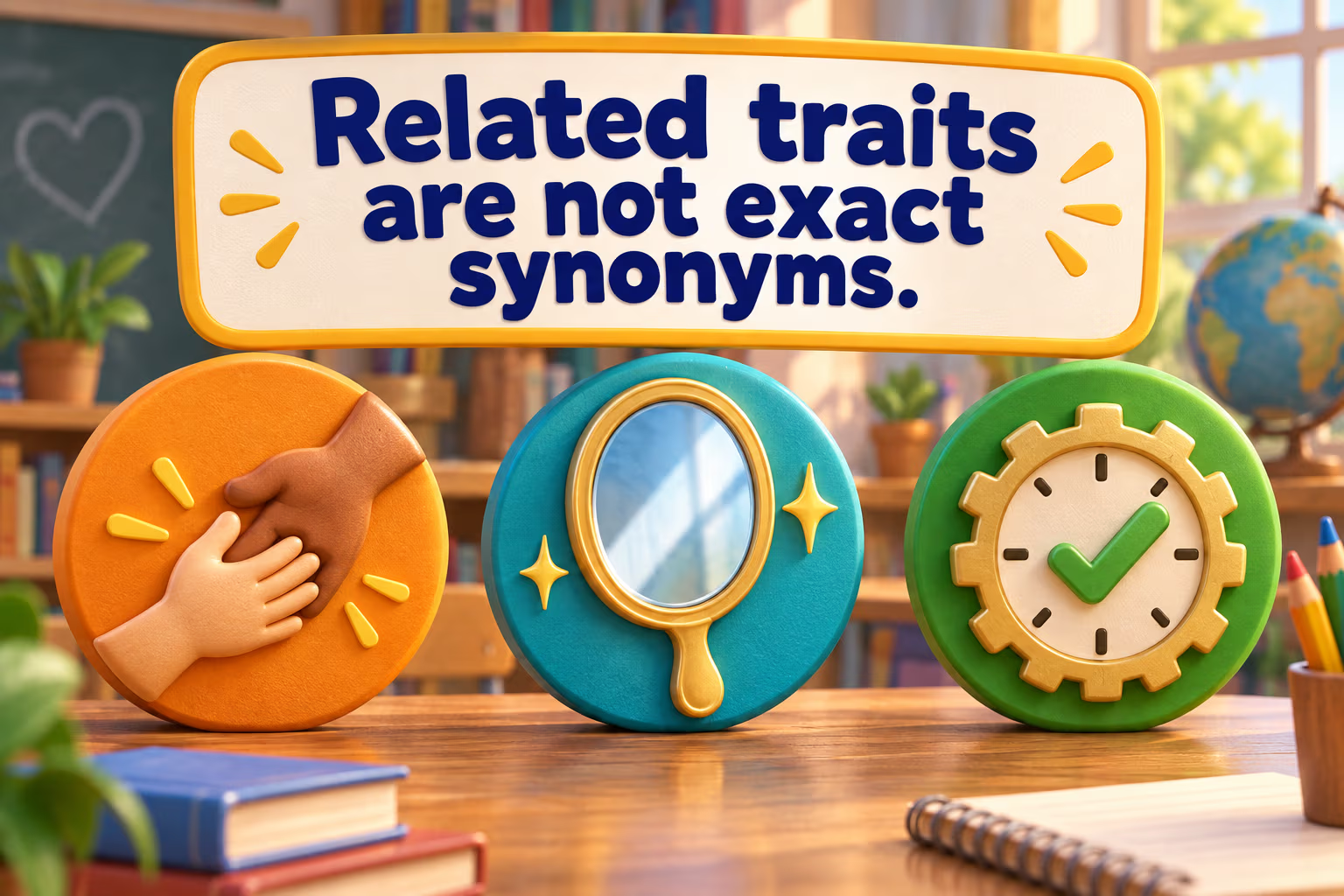
No. Words can relate to a value without meaning the same thing. Kind describes considerate behavior, while honest describes truthfulness; either may matter to someone, but neither is a synonym for the general noun values. Schwartz’s research treats values as motivational goals that people rank differently, and distinguishes values from personality traits, which describe what people tend to be like.
| Descriptor | What it can mean | What it does not prove by itself |
|---|---|---|
| Loyal | Committed to a person, group, or cause | That the cause is fair or every choice is truthful |
| Reliable | Dependable or consistent in a role | That the person shares every stated principle |
| Kind | Considerate or caring in manner | That a particular decision is impartial |
| Courageous | Facing difficulty or risk bravely | That the cause being defended is just |
| Principled | Guided by a stated principle or moral standard | That others agree with the principle or its application |
Schwartz’s framework is one way to study values, not a universal checklist for judging people. His 1994 model distinguishes ten broad value types by their motivational goals; the later refined theory describes 19 narrower values. Across the models, priorities can differ and some aims can conflict in a decision. A person may value both security and independence, for example, while facing a choice that advances one more than the other. These research categories help discuss motivations; they do not assign someone a fixed identity.
How Should You Use Negative Value Adjectives?
Use a negative adjective only when its meaning matches the evidence and the context. Dishonest can describe an untruthful action; selfish judges someone as putting their own interests first. They are not interchangeable opposites of every positive value, and a list of negative descriptors is not a reliable way to diagnose a person’s character.
For a disputed or serious claim, state what happened and whose standard is being applied. “The manager changed the figures without documenting the reason” is more checkable than “the manager is corrupt.” If a character in fiction is meant to be deceitful, give the reader evidence in the character’s choices instead of relying on a string of labels.
Original Examples and Adjective Lists
The complete original article is retained below, including all headings, lists, example sentences, and source wording. Its “synonyms” sections sometimes list values as nouns rather than adjectives, and some items are related ideas rather than exact synonyms or antonyms; the explanations above clarify these distinctions without removing any source material.

When it comes to expressing our values, words can be incredibly powerful. They have the ability to convey the essence of what we hold dear and what drives us. That’s why having a diverse range of adjectives to describe our values is essential. In this article, I’ll be sharing a comprehensive list of adjectives that can be used to describe values, along with examples to help you better understand how to use them effectively.
Adjectives play a crucial role in painting a vivid picture of our values. They add depth and nuance to our expressions, allowing us to communicate our beliefs and principles with precision. Whether you’re writing a personal statement, crafting a mission statement for your organization, or simply looking to articulate your values more effectively, this article will provide you with a valuable resource of descriptive words.
From adjectives like “authentic” and “compassionate” to “resilient” and “inclusive,” this article will explore a wide range of adjectives that can be used to describe values. By incorporating these words into your vocabulary, you’ll be able to express your values in a more impactful and engaging way. So, let’s dive in and discover the power of adjectives when it comes to describing our values.
How to Describe values? – Different Scenarios
Describing our values effectively is crucial in conveying the essence of what we hold dear and what drives us. Whether it’s in a personal conversation, an interview, or even in our writing, choosing the right adjectives can paint a vivid picture of our values and communicate our beliefs and principles with precision. Here are some tips on how to describe values in different scenarios:
- In Personal Conversations: When discussing values with someone, it’s important to use adjectives that reflect your true beliefs and create a meaningful connection. For example:
- In Professional Settings: When it comes to describing values in a professional environment, it’s important to choose adjectives that highlight your strengths and align with the organization’s values. For example:
- In Written Communication: When writing about your values, it’s important to be clear and concise. Here are some adjectives you can use to describe values in different contexts:
Remember to provide examples and anecdotes to support your use of these adjectives. By incorporating these descriptive words into your vocabulary, you can express your values in a more impactful and engaging way.
Adjectives for Values
- Authentic
- Compassionate
- Resilient
- Inclusive
- Honest
- Trustworthy
- Ambitious
- Determined
- Curious
- Sustainable
- Inspirational
- Visionary
- Empathetic
- Innovative
- Imaginative
- Open-minded
Describing Words for values in English
When it comes to describing values, choosing the right adjectives can make a significant impact in how we express ourselves. Here are some descriptive words that can help us effectively convey our values and create a meaningful connection with others.
Personal Growth
- Resilient: I have been through challenges, but I always bounce back stronger.
- Curious: I am eager to learn new things and explore different perspectives.
- Persistent: I never give up when faced with obstacles and keep working towards my goals.
Social Responsibility
- Compassionate: I genuinely care about the well-being of others and strive to make a positive difference.
- Empathetic: I understand and share the feelings of those around me, and I am always ready to lend a helping hand.
- Dedicated: I am committed to supporting causes that make the world a better place.
Leadership
- Influential: I have the ability to inspire and motivate others towards a common goal.
- Visionary: I have a clear and compelling vision for the future that guides my actions and decisions.
- Collaborative: I believe in embracing the strengths and ideas of others to achieve success together.
- Inventive: I have a knack for coming up with original and innovative ideas.
- Imaginative: I enjoy thinking outside the box and exploring new possibilities.
- Expressive: I have a unique way of expressing myself through various forms of art and communication.
Remember, the key to effectively describing values is to provide examples and anecdotes that illustrate these qualities in action. By incorporating these descriptive words into your vocabulary, you can express your values in a more impactful and engaging way.
So, whether you’re having a personal conversation, participating in a professional setting, or writing a meaningful message, choosing the right adjectives can help you accurately convey your values and create a lasting impression.
Adjectives for values
When it comes to describing values effectively, using the right adjectives can make all the difference. Adjectives have the power to bring values to life, allowing us to express and communicate our beliefs and principles in a more impactful and engaging way. In this section, I’ll share some positive and negative adjectives that can help you accurately describe values, along with example sentences to demonstrate their usage.
Positive Adjectives for Values with Example Sentences
- Honest: I believe in being honest, even when it’s hard.
- Kind: I strive to be kind to others, spreading positivity wherever I go.
- Responsible: Taking responsibility for our actions is essential to living with integrity.
- Empathetic: Showing empathy towards others allows us to build meaningful connections.
- Courageous: Having the courage to stand up for what is right is a core value of mine.
- Generous: Being generous with our time and resources can make a real difference in the lives of others.
- Determined: With determination, we can overcome any obstacles and achieve our goals.
- Respectful: Treating others with respect is fundamental to fostering healthy relationships.
- Grateful: Practicing gratitude helps us appreciate the blessings in our lives.
- Compassionate: Showing compassion to others is a reflection of our true values.
- Optimistic: Staying optimistic enables us to face challenges with a positive mindset.
- Inclusive: Embracing inclusivity promotes equality and belonging for everyone.
- Dishonest: I strongly oppose any form of dishonesty, as it goes against my values.
- Selfish: Being selfish undermines our ability to consider the needs of others.
- Irresponsible: Neglecting responsibilities can have negative consequences on ourselves and those around us.
- Unempathetic: Lack of empathy can lead to misunderstanding and strained relationships.
- Cowardly: Avoiding difficult situations out of fear goes against the value of courage.
By incorporating these adjectives into your vocabulary, you can express your values in a clear and compelling manner. It’s important to remember that values are personal and may vary from person to person. Therefore, choose the adjectives that best represent your own beliefs and principles.
Now that we’ve explored a range of positive and negative adjectives for values, let’s move on to the next section, where we’ll discuss the importance of providing examples and anecdotes to support the use of these adjectives in different contexts.
Synonyms and Antonyms with Example Sentences
Synonyms for Values
When it comes to describing values, it’s important to have a variety of adjectives at your disposal. Here are some synonyms that can help you effectively convey different values:
- Integrity: honesty, trustworthiness
- Compassion: empathy, kindness
- Resilience: determination, perseverance
- Courage: bravery, fearlessness
- Responsibility: accountability, reliability
Antonyms for Values
In addition to knowing synonyms, it is also helpful to understand the antonyms or opposite words for different values. Here are some antonyms that can provide contrast or highlight different perspectives:
- Dishonesty: deceit, fraudulence
- Cruelty: meanness, heartlessness
- Inaction: laziness, passivity
- Fear: apprehension, timidity
- Irresponsibility: negligence, unreliability
Remember, values are personal, and everyone has their own set of beliefs and principles. These synonyms and antonyms are just tools to help you express your values more clearly and effectively.
Conclusion
In this article, I have discussed the significance of using adjectives to effectively describe values in various situations. By providing a comprehensive list of synonyms and antonyms for different values, along with example sentences, I have demonstrated how these adjectives can be utilized to convey values clearly and powerfully.
It is crucial to have a diverse range of adjectives at our disposal when expressing our beliefs and principles. Values are personal and can differ from person to person, so it is essential to choose the adjectives that best reflect our own convictions.
By incorporating these descriptive words into our communication, whether in writing or speaking, we can articulate our values with precision and impact. Adjectives serve as the building blocks of effective expression, allowing us to communicate our beliefs and principles in a way that resonates with others.
Remember, the words we choose have the power to shape our interactions and influence the world around us. So, let’s embrace the power of adjectives and use them to describe our values with clarity and authenticity.
Frequently Asked Questions About Adjectives for Values
What are positive adjectives for values?
Common choices include honest, fair, compassionate, responsible, courageous, and inclusive. The best adjective depends on the action or principle you want to describe. Pair the word with an example—such as correcting an error or applying the same standard to everyone—so readers can see what the description means.
What is the difference between a value and an adjective?
A value is a belief or priority about what matters, such as honesty or fairness. An adjective describes a related person, action, decision, or principle: an honest answer, a fair process. Nouns and adjectives may express related ideas, but their grammatical roles differ.
Are kindness and honesty synonyms?
No. Kindness means considerate or caring behavior; honesty concerns truthfulness and fairness. Both may be important values, but one does not mean the other. Use a separate example for each quality when you want to describe both.
Can one action prove someone’s values?
One action can illustrate a possible value, but it may not show a person’s priorities across situations. Context, competing aims, and constraints matter. Describe the observed action first; use a broader label only when repeated evidence supports that wider claim.
What are negative adjectives for values?
Dishonest, unfair, selfish, and irresponsible can criticize specific conduct or a pattern, but each has a distinct meaning. The words are not strict antonyms of the noun values. When accuracy matters, state the action and the standard it failed to meet.
For research context, see Shalom Schwartz’s overview of the theory of basic values and the original paper on value types and motivational goals. The refined 19-value model is summarized in this cross-cultural measurement study. Cambridge Dictionary defines values in everyday English as beliefs about importance and right or wrong.


